


Gifting a Ring to Someone Actively Losing Weight
If someone is still losing weight, I would not treat today’s ring size as permanent. A drop of 40 to 60 lbs. can mean about 1 to 2 U.S. ring sizes, and even normal day-to-day changes can shift fit by ¼ to ½ size.
So if I were buying a ring now, I’d keep it simple:
- Pick flexibility first: adjustable rings, open-band styles, or a plain resizable band
- Avoid hard-to-resize designs: eternity bands, tension settings, tungsten, and titanium
- Use short-term fixes for loose sentimental rings: spirals, silicone guards, sizing pads, beads, or spring inserts
- Wait for stable weight before permanent resizing, often 3 to 6 months
- Budget for resizing if needed: many gold ring resizes cost about $40 to $150 in the U.S.
Here’s the short version: a ring can matter for years, but the fit may change fast. I’d buy for safe wear now and plan for one later resize, instead of paying for repeat work or risking a ring that spins, slips, or falls off.
| Situation | What I’d choose | Why |
|---|---|---|
| Surprise gift | Adjustable or open-band ring | Easier fit while size keeps changing |
| Engagement | Plain 14K gold ring with simple shank | Easier to resize later |
| Sentimental ring already owned | Temporary adjuster or jeweler add-on | Keeps it wearable without a permanent change |
That’s the core idea: flexibility now, permanent sizing later.
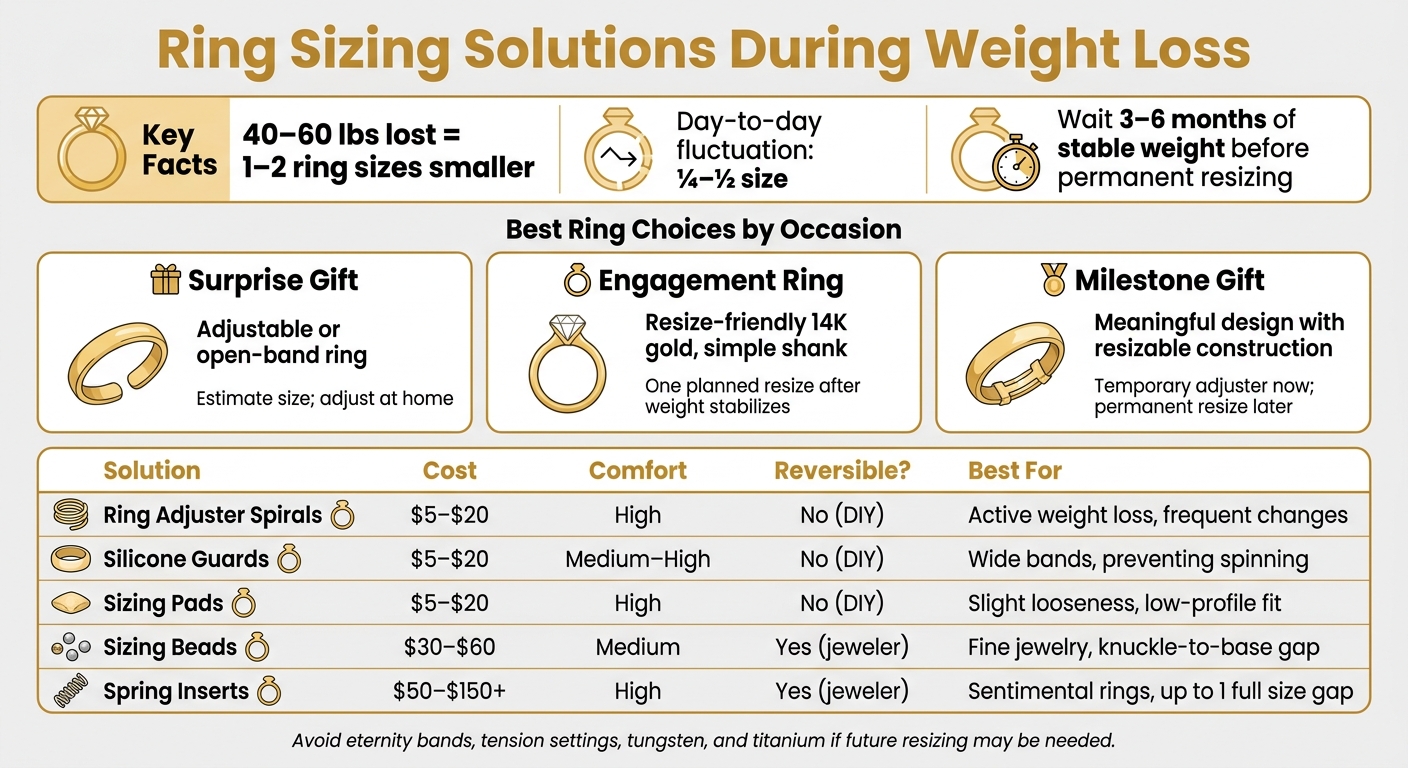
Ring Sizing Solutions During Weight Loss: At-a-Glance Guide
Why fixed-size rings often fail before weight stabilizes
That’s why fixed-size rings can become a problem before weight settles.
Fit, safety, and comfort issues with standard bands
The first issue is often rotation. Once a band gets even a little too loose, top-heavy rings like solitaires or halos start to turn. The center stone shifts toward the side of the finger or slips under the palm. It sounds minor, but it gets irritating fast - and it usually gets worse as weight loss continues.
A loose band can also catch on clothing or gym equipment. If someone works out often, that can turn into a daily headache. Then there’s the risk of losing the ring altogether. A loose ring can slip off during handwashing or in cold weather without the wearer noticing. For a gift that may cost hundreds or thousands of dollars, that’s a big deal, especially if it’s custom-made or carries personal meaning. In plain terms, the ring can stop fitting well long before the gift stops mattering.
Safety can go the other way too. If the wearer’s finger size changes for a short time because of heat or exercise, a ring that was just resized smaller may suddenly feel too tight. In severe cases, removal may need a medical professional or the fire department.
Why repeated permanent resizing is not always a good option
The easy answer seems to be: just resize the ring whenever needed. But if someone is still losing weight, “whenever needed” can mean several jeweler visits over a stretch of months.
There’s also wear on the ring itself. Each resize puts physical stress on the metal. Cutting and soldering the band again and again can weaken it over time, leading to small stress cracks, shape changes, and thin areas.
Some ring styles make this much tougher. Full-eternity and pavé bands are well known for being hard to resize without throwing off the stone pattern or loosening small settings. Engravings may disappear during the process. Tension-set rings rely on exact metal alignment, and resizing can affect that. So with these designs, repeat changes don’t just create hassle - they can alter how the ring looks and how it works.
That’s why temporary or adjustable options tend to make more sense while finger size is still changing. Adjustable and resizable rings are often the safer pick until size levels off.
sbb-itb-9da40c1
The best ring options when finger size is still changing
Once finger size is still in flux, the main job is simple: pick a ring that can keep up. In most cases, the best choices during active weight loss fall into three groups: adjustable, open-band, and custom resizable.
| Ring type | Fit flexibility | Best use |
|---|---|---|
| Adjustable | High | Everyday wear while size is shifting |
| Open-band | Medium–High | Minimalist or stacking styles |
| Custom resizable | Medium in the short term | Engagement, anniversary, and heirloom gifts |
Adjustable and open-band rings for immediate fit flexibility
Adjustable rings are often the easiest pick when fit keeps changing because they can shift without a trip to the jeweler. Some have a hidden sliding mechanism at the back of the band, so the ring still looks like a standard style while letting the wearer tighten or loosen it at home. Others use an open-back design that adjusts within a small range.
Open-band rings work in a similar way, but they tend to suit simpler looks a bit better, especially minimalist designs or stacked rings. That small gap gives you some room for size changes, which makes them a good day-to-day option when fit may keep moving.
If the ring is supposed to last for years, it makes sense to start with flexible styles now and then switch to a build that can be resized later.
Custom resizable designs for long-term meaningful gifts
For engagement rings and heirloom gifts, it’s smart to choose a style that a jeweler can resize later without harming the design. That usually means resize-friendly metals like 14K or 18K gold, platinum, or sterling silver, plus a simple plain shank with even metal thickness. Most plain bands can safely change by about 1–2 sizes. Go past that, and the band can start to thin out or lose its shape.
When you talk with a jeweler, say it plainly: the recipient is still losing weight. That matters. A good jeweler will usually steer you away from full-eternity bands, tension settings, and very thin shanks, since those are hard - or risky - to alter later. A classic solitaire or three-stone setting with a plain lower shank in 14K gold is one of the easiest options to resize.
How to match the right ring type to the occasion
The right ring also depends on the moment. A surprise engagement calls for something simple and flexible, like an adjustable proposal ring or a plain gold band. Milestone gifts often work well as adjustable or open-band styles. Heirloom pieces are better bought after size has settled, using a custom design built for later resizing.
Plain-band resizing is usually modest in cost, so it helps to plan for one or two future adjustments.
Temporary sizing solutions for existing or sentimental rings
When a ring already means something - maybe it was inherited, gifted, or bought before your size changed - the goal is a little different. You’re not chasing a forever fit right now. You just want safe, short-term wear while your weight and ring size settle, without locking yourself into a permanent resize.
Low-cost at-home adjusters for short-term wear
Ring adjuster spirals, silicone guards, and sizing pads are the easiest short-term fixes. You can find all three online or at jewelry counters for about $5–$20 per multipack, and they’re all DIY.
- Spirals: Clear coils that make the inner circumference smaller and come off whenever you want.
- Silicone guards: Soft inserts that help the ring grip better, though they can feel bulky on narrow bands.
- Sizing pads: Thin adhesive strips that give you a lower-profile fit for slight looseness, but they need frequent checks and replacement.
A quick word of caution: take the ring off before swimming, heavy lifting, or using harsh cleaning products. These tools are meant for short-term wear, not a lasting fix. If the ring is expensive or the size gap is more than slight, it makes sense to move past DIY and ask a jeweler for added support.
Jeweler-installed options for better stability
For heirlooms or rings with strong emotional value, a jeweler can help make the ring wearable without changing the look of the piece. These options tend to last longer and stay put better than at-home add-ons.
Sizing beads are two small metal beads soldered inside the band to cut down on spinning and help the ring sit more securely. One bead usually changes the fit by about ¼ size, and two beads by about ½ size. They’re especially helpful when the ring needs to slide over a larger knuckle but still sit snugly at the base of the finger.
Spring inserts work a bit differently. These are flexible metal strips that compress over the knuckle and then hold the ring snug at the base. They can make up for as much as one full ring size, which makes them a better choice when the gap between knuckle and finger base is bigger.
Both can be reversed by a jeweler. Beads can be removed, and the band can usually be polished smooth again. Spring inserts can also be adjusted, replaced, or taken out later if you decide on a permanent resize.
| Solution | Cost | Comfort | Visibility | Long-term use? | Best use case |
|---|---|---|---|---|---|
| Ring adjuster spirals | $5–$20 | High | Low–Medium | No (DIY) | Active weight loss; frequent size changes |
| Silicone guards | $5–$20 | Medium–High | Medium | No (DIY) | Wide bands; preventing spinning |
| Sizing pads | $5–$20 | High | Low | No (DIY) | Slight looseness; low-profile fit |
| Sizing beads | $30–$60 | Medium | Low | Reversible by a jeweler | Fine jewelry; knuckle-to-base difference |
| Spring inserts | $50–$150+ | High | Low | Reversible by a jeweler | Sentimental rings; up to 1 full size gap |
Many jewelers suggest waiting 3–6 months of stable weight and consistent ring fit before going ahead with a permanent resize. Until then, these short-term fixes can keep a meaningful ring secure without making a lasting change.
How to choose the right gift now and plan for later
A clear buying path for surprise gifts, engagements, and milestone rings
Once you’ve narrowed things down to flexible styles, the occasion helps you make the final call. At that point, the choice usually comes down to three things: How much more weight loss is likely? Does the ring need to fit right away? And will this design still make sense years from now?
If weight loss is still in progress, fixed sizing can backfire. Finger size may keep changing, so the ring needs to stay wearable through that shift. An adjustable or open-band ring, or a resize-friendly gold band, is usually the safer place to start.
For surprise gifts, try to estimate the current size as closely as possible. You can borrow a ring worn on the same finger and have it measured, or ask someone close to the recipient for help. Then pick a style with some built-in give. For engagement rings, a resize-friendly metal and a simple shank are often the best move. It’s usually smart to wait until weight has leveled off before doing a permanent resize. For milestone rings with sentimental meaning, focus on a design that can be altered later, and use a temporary adjuster for now.
One plain rule can save a lot of hassle: skip eternity bands, tension settings, and non-resizable metals like tungsten or titanium if future resizing may be needed.
Here’s the quick match that turns that choice into a buy:
| Occasion | Best ring choice | Sizing approach |
|---|---|---|
| Surprise gift | Adjustable or open-band ring | Estimate size; adjust at home |
| Engagement ring | Resize-friendly 14k gold with simple shank | One planned resize after weight stabilizes |
| Milestone gift | Meaningful design with resizable construction | Temporary adjuster now; permanent resize later |
Conclusion: Buy for now without giving up future wear
The biggest mistake here is acting like today’s size will stay the same. A fixed-size ring bought during active weight loss can end up too loose later. That often means spinning, slipping, or trip after trip to the jeweler. And repeated resizing can thin the band and make it weaker over time.
A better plan is flexibility first, permanence later. Use adjustable styles or temporary sizing aids while finger size is still changing. Then move to a permanent resize only after the recipient’s weight and finger size have stayed steady for several months. That keeps the ring secure and comfortable now, without boxing you into the wrong fit later.
FAQs
How can I estimate their ring size without asking?
Yes - you can estimate ring size without making it obvious.
The best move is to borrow a ring they already wear on the same finger and bring it to a jeweler. That usually gives you the closest match.
If you can’t take the ring, try one of these:
- Trace the inside circle on a piece of paper
- Press the ring into soap to get an impression
- Ask a trusted friend or family member if they already know the size
It’s simple, low-key, and often works better than guessing.
When should a ring be permanently resized?
Professional resizing works best when your finger size is likely to stay the same over time. That’s because it permanently changes the ring by cutting the band and then adding or removing metal.
It’s a solid pick if you want a classic, fixed fit. But it usually makes sense only when you’re confident your size won’t keep shifting. If a ring gets resized again and again, the metal can weaken, and small seams may start to show.
Which ring metals and styles are easiest to resize later?
Gold and silver are usually the easiest metals to resize because they’re softer and easier for a jeweler to work with. Harder metals, like titanium and tungsten, are often tough to resize and, in many cases, can’t be resized at all.
Simple bands and basic solitaire settings are usually the safest bets. Designs like eternity bands, detailed vintage rings, and tension settings are much harder to change without risking damage to the setting or the stones.


