


Ozempic Finger: The Jewelry Problem Nobody Warned You About
If your ring spins, slides over your knuckle with little effort, or feels close to falling off, it may not be safe to wear as-is. During fast weight loss, finger size can drop by 1 to 2 ring sizes, and jewelers report about a 150% year-over-year jump in requests to size rings down.
Here’s the short version:
- Fast weight loss can shrink your fingers from less fat, less fluid, and less swelling.
- A loose ring is a loss risk, especially when your hands are cold, wet, or soapy.
- Short-term fixes like silicone adjusters, metal guards, sizing beads, and sizing bars can help while your size is still changing.
- Wait until your weight has been stable for about 3 months before a permanent resize.
- Some rings are hard or impossible to resize, including full eternity bands, tungsten, and titanium rings.
- Engagement rings, wedding bands, and heirlooms need extra care, because spinning can stress prongs and settings.
If I were dealing with this, I’d do one thing first: check whether the ring still stays put during normal wear. If not, I’d use a short-term fix or stop wearing it on that finger until a jeweler checks it.
| Issue | What it means | What I’d do |
|---|---|---|
| Ring spins but stays on | Mild looseness | Try a silicone adjuster |
| Ring slides over knuckle easily | Loss risk | Use a guard or jeweler insert |
| Ring slips when hands are wet/cold | High loss risk | Stop wearing it loose |
| Weight still changing | Size may keep dropping | Wait before permanent resize |
| Weight stable for 3 months | Fit is more settled | Ask about resizing |
| Ring is tungsten, titanium, or full eternity | Resize may not work | Get a jeweler’s review first |
This piece breaks down when a loose ring is just annoying, when it becomes risky, and which fix fits each stage of weight loss.
How ring fit changes and why it becomes a real risk
From slightly loose to unsafe: the fit progression
Ring fit usually shifts little by little. At first, the ring may spin. Then it starts slipping over the knuckle with less effort. After that, there may be almost no resistance at all when it passes the knuckle.
That’s the point where things get risky. Once a ring moves too freely, it’s much easier to lose.
The biggest danger tends to show up when your hands are cold, wet, or covered in soap. A simple way to check is the shake test: hold your hand out and give it a gentle shake. If the ring slides or rotates freely, it’s no longer secure.
Why engagement rings, wedding bands, and heirlooms need extra attention
Loose rings matter even more when stones or sentimental meaning are involved. With a plain band, the main issue is losing the ring.
But with engagement rings and rings with stones, constant spinning creates another problem. It can push the center stone out of position. Over time, that repeated movement makes it more likely that the setting will hit hard surfaces and put stress on the prongs holding the stone in place.
That’s a small detail with a big downside. A ring doesn’t have to fall off to get damaged.
When finger size changes may still be temporary
If you’re still losing weight, your finger size may not have settled yet. Fingers can change from day to day based on hydration, sodium intake, and temperature. So a ring that feels loose today may fit a bit differently next week.
Here’s the general pattern:
- Around 10–15 lbs lost: often little to no change in ring fit
- Around 20–40 lbs lost: you may drop about a quarter to half a ring size
- Around 50 lbs or more lost: a full size change, and sometimes more, is common
Because of that, it’s smart to wait until your weight has been stable for at least three months before choosing a permanent resize.
sbb-itb-9da40c1
Short-term ways to keep a loose ring secure
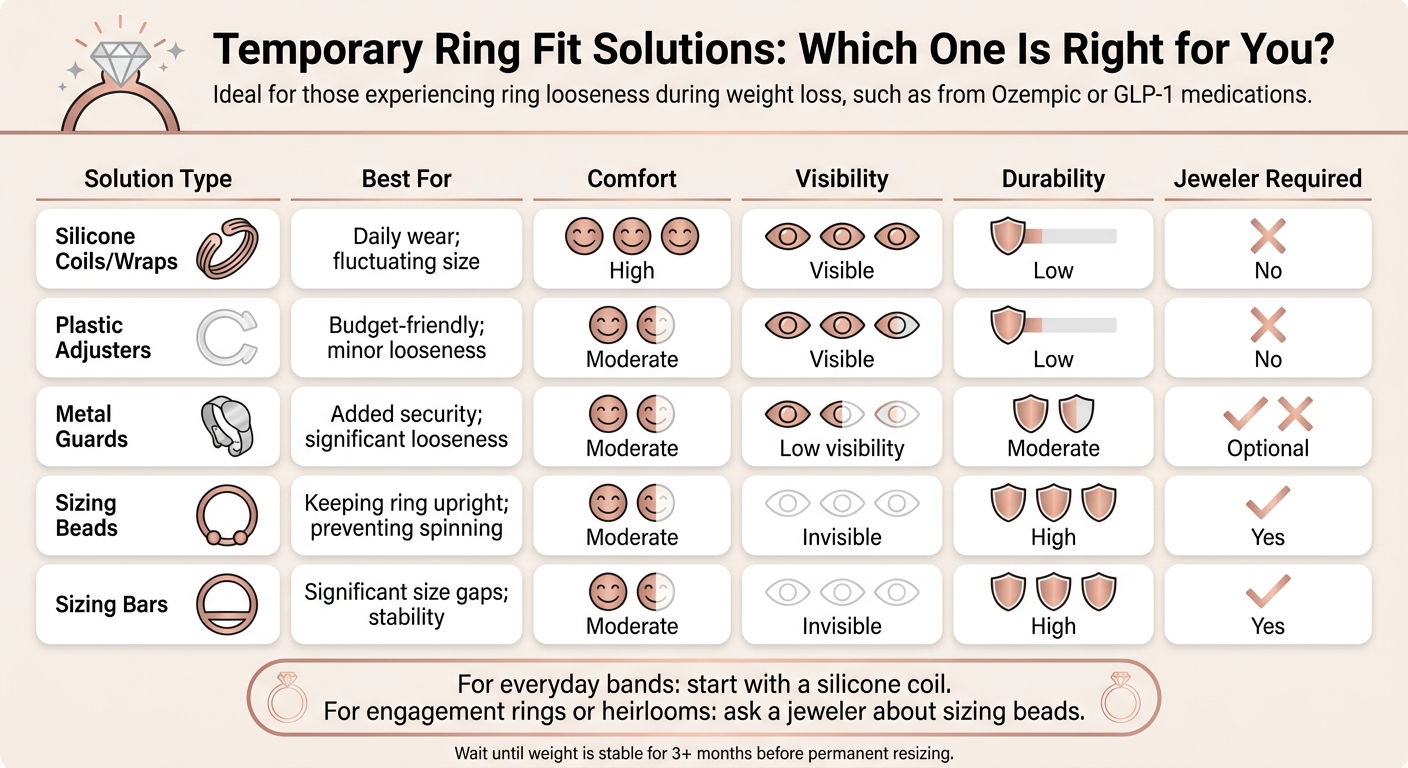
Temporary Ring Fit Solutions Compared: Which One Is Right for You?
When your ring size is still changing, a temporary fix can buy you time. It helps keep the ring in place until resizing makes sense.
If the fit keeps shifting from week to week, start with something reversible. That way, you can keep wearing the ring without making a permanent change too soon.
Ring adjusters, silicone coils, and temporary guards
Silicone coils and plastic adjusters sit inside the band and take up extra space. They’re low-cost, easy to remove, and simple to swap as your finger size changes.
Metal guards give the ring a firmer grip. They tend to work better for daily wear and still come off later if needed.
If the ring is too loose to trust, move it to another finger or wear it on a chain until you’re ready to resize it.
Sizing beads and sizing bars from a jeweler
If the ring is expensive or means a lot to you, a jeweler can add inner supports without doing a full resize.
Sizing beads are two small metal beads soldered to the inside of the band. They help stop the ring from spinning and add a bit of friction, which lowers the chance of slipping. A sizing bar does much the same thing and can help when the ring is loose enough to spin or slide.
Both can be removed later if your size settles down.
Comparison of temporary fit solutions
| Solution Type | Best For | Comfort | Visibility | Durability | Jeweler Required |
|---|---|---|---|---|---|
| Silicone Coils/Wraps | Daily wear; fluctuating size | High | Visible | Low | No |
| Plastic Adjusters | Budget-friendly; minor looseness | Moderate | Visible | Low | No |
| Metal Guards | Added security; significant looseness | Moderate | Low | Moderate | Optional |
| Sizing Beads | Keeping ring upright; preventing spinning | Moderate | Invisible | High | Yes |
| Sizing Bars | Significant size gaps; stability | Moderate | Invisible | High | Yes |
For an everyday band that’s only a little loose, a silicone coil is often enough. For an engagement ring or heirloom, sizing beads from a jeweler usually give the ring more protection and can still be removed later if your size stabilizes.
When to resize a ring and when adjustable designs make more sense
If temporary fixes are only buying time, the next step is simple: either resize the ring or move to a design that can shift with your finger size.
Signs it is time for permanent resizing
Go with permanent resizing when the ring stays loose during normal daily wear and your size has stopped changing. If you resize too soon, you may end up paying for another adjustment later.
Comfort and security matter just as much. If a temporary fix no longer feels safe, it’s time to make the change.
A ring you can lose costs more to replace than to resize.
Rings that are harder to resize safely
Some ring styles are much tougher to resize, and in some cases, it can’t be done at all.
Full eternity bands, with stones set all the way around, are usually not resizable because there’s no plain metal section to cut. Half-eternity rings may be possible, depending on the shank width, but they still need a jeweler’s review.
Titanium and tungsten rings can’t be cut and joined again, so they are not resizable. Vintage rings and tension-set designs also need extra care, since the process can weaken the metalwork. If you’re unsure, have a jeweler inspect the ring before you commit to anything permanent.
How adjustable rings handle ongoing size changes
Adjustable rings deal with changing finger size in a different way. Instead of needing repeat resizing, they move with those shifts. That makes them a good fit when weight loss is still happening or when finger size changes from day to day.
Here’s how the main options compare:
| Option | Size Flexibility | Best For | Design Impact | Repeat Work Needed | Daily Comfort |
|---|---|---|---|---|---|
| Traditional Resizing | None (fixed) | Stable weight; plain bands | Minimal if done well | Yes, if weight changes again | High |
| Jeweler Inserts (Beads/Bars) | Low (~½ size) | Minor fluctuations; top-heavy rings | Invisible from outside | Low; easily removed | Moderate (beads can be felt) |
| Adjustable Rings | High | Ongoing weight loss; fluctuating size | Integrated into design | None | High |
If your size is still changing, focus on the option that keeps the ring secure right now. If you’re not ready for a permanent resize, the next move is keeping the ring safe while your fit keeps shifting.
How to protect meaningful jewelry while your size is still changing
When your ring size is still shifting, the main goal is simple: keep the ring safe until the fit settles.
When to see a jeweler right away
If a ring has already slipped off, spins with ease, or slides around during normal movement, have it checked right away.
It’s also smart to have a jeweler look at any ring with loose stones, worn prongs, or nonstop movement on your finger. A ring that keeps moving may not seem like a big deal at first, but that extra motion can wear things down over time.
A loose ring is cheaper to resize than replace.
While you wait, cut back on situations where a loose ring could slip off without you noticing.
Simple habits that lower the risk of losing a ring
Take off a very loose ring before:
- Swimming
- Showering
- Gardening
- Going out in cold weather
Keep it in one fixed, secure spot when you’re not wearing it. If you want to keep it close, wear it on a sturdy chain.
Conclusion: Match the solution to where you are in the process
Temporary adjusters or sizing beads make sense while your size is still changing. Once your weight has stayed stable for at least three months, permanent resizing is usually the safer long-term move.
Some rings need extra care before any resize, especially full eternity, titanium, and tungsten styles. Engagement rings, wedding bands, and heirlooms are best handled by a jeweler.
FAQs
Can loose rings damage prongs or stones?
Not usually during normal wear. But a loose ring can still cause trouble.
If it snags on clothing or a surface, the ring can get caught. That may bend or weaken the prongs and, in some cases, loosen or even lose a stone.
A ring that spins or slides a lot is also easier to slip off. And if it falls, it can get damaged on impact.
If your weight is still changing, use temporary adjusters for now. They can help keep the ring in place until your size settles.
How do I know if my ring is too loose to wear?
A ring is too loose if it passes the shake test, spins with almost no effort, or shifts when you stretch out your hand. You might also notice it turning all day or sliding over your knuckle with very little resistance.
Finger size can change more than most people expect. Cold weather, hydration, and even the time of day can make a ring feel looser, especially in the morning. If the fit feels a little shaky, use a temporary ring adjuster and skip wearing it while swimming or working out.
What if my ring can’t be resized?
If your ring can’t be resized, you still have a few solid ways to keep wearing it without worrying that it’ll slip off.
Some ring styles just don’t allow for resizing. That often includes full eternity bands, pavé or channel settings that run around the entire shank, and rings made from tungsten carbide or titanium.
If that’s your situation, a few temporary fixes can help:
- Silicone or metal ring adjusters
- Sizing beads
- Ring guards
For rings with a lot of sentimental meaning, there’s also a simple backup plan: wear the ring on a chain until your weight stabilizes.


