


Adjustable Rings for Weight Loss Journeys: Fit That Follows You Down
If your ring feels loose during weight loss, waiting on permanent resizing is often the safer move. A drop of 20–50 pounds can mean about 1–2 ring sizes, so a fixed resize done too soon may need to be redone later.
Here’s the short version:
- Loose rings can slip off during hand washing, workouts, or cold weather
- Permanent resizing has limits and can put stress on the band over time
- Adjustable rings let you fine-tune fit at home as your finger size changes
- Open-band rings are simple for daily use
- Wrap styles usually allow more size range
- Hidden-adjustment rings work well when you want a classic outside look
- 925 sterling silver, gold, and steel/titanium tend to handle repeat changes better than weaker bands
- A good target is a ring with your current size near the middle of the fit range, not at the edge
If I were buying one, I’d focus on fit range, comfort, and metal first. The main goal is simple: keep the ring snug enough to stay on, without rushing into a permanent change while your size is still moving.
Quick Comparison
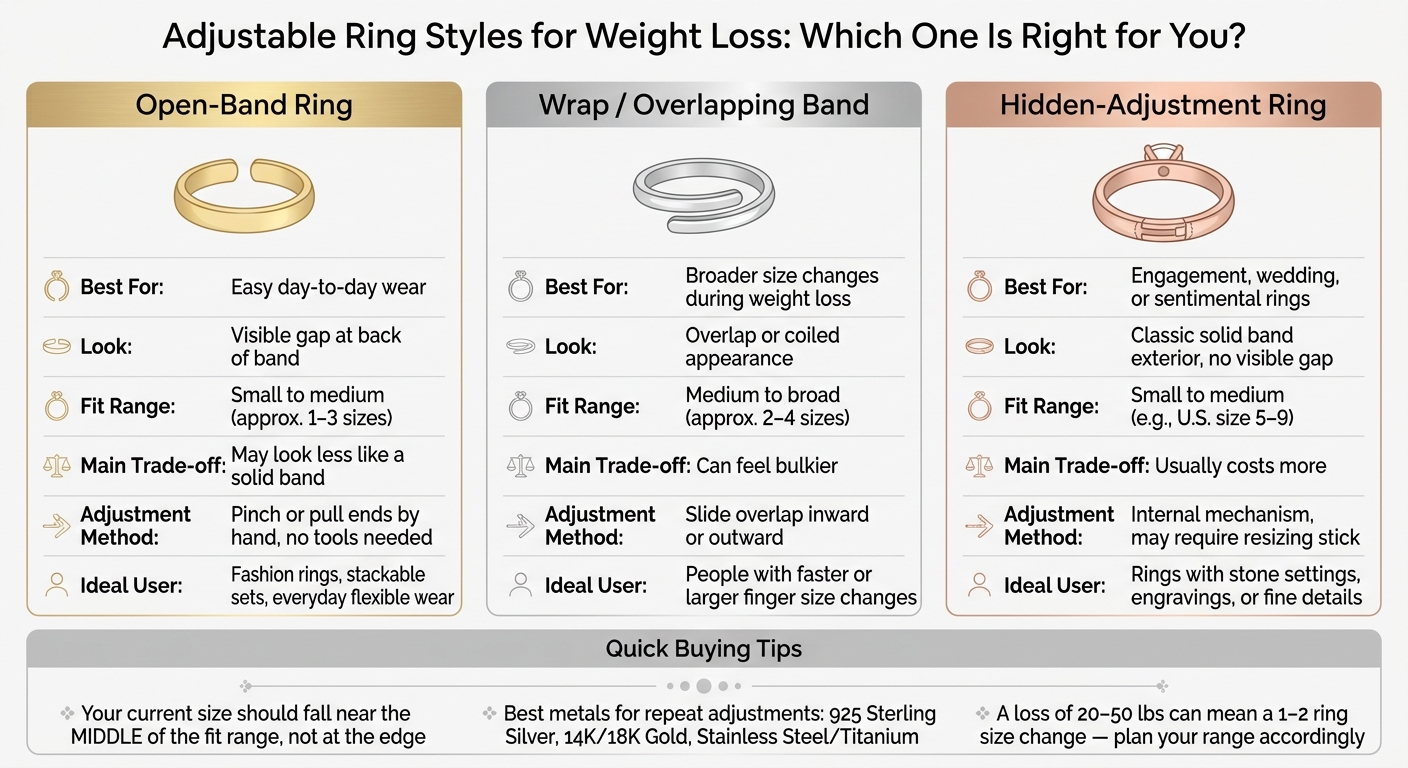
Adjustable Ring Styles for Weight Loss: Which One Is Right for You?
| Style | Best for | Look | Fit range | Main trade-off |
|---|---|---|---|---|
| Open-band | Easy day-to-day wear | Visible gap | Small to medium | May look less like a solid band |
| Wrap | More room for size change | Overlap/coiled look | Medium to broad | Can feel bulkier |
| Hidden-adjustment | Sentimental, wedding, or engagement rings | Classic outside shape | Small to medium | Usually costs more |
That’s the core idea: when your finger size is still changing, an adjustable ring can help you keep wearing jewelry you care about with less risk of loss and less wear from repeat resizing.
sbb-itb-9da40c1
How adjustable rings solve the problem
An adjustable ring has some give built right into the band. Instead of locking you into one fixed size, it can be tightened or loosened across a range of sizes - often several full sizes - without cutting, soldering, or sending it to a jeweler. That range comes from a few common ring styles, and each one adjusts in its own way.
Open-band, wrap, and hidden-adjustment designs explained
The three most common adjustable designs each handle sizing a bit differently.
- Open-band rings have a small gap at the back of the band. Bring the ends closer together to make the ring smaller, or pull them apart slightly to loosen the fit.
- Wrap and overlapping bands use a coiled or crossing shape. Moving the overlap inward tightens the ring and can help it sit more securely.
- Hidden-adjustment rings place the sizing feature inside the band, so the outside keeps a smooth, classic look while still allowing size changes.
How these designs handle gradual size changes
These designs make it easier to deal with small shifts in finger size over time. You can fine-tune the fit so the ring stays snug, centered, and less likely to slip off. And because each tweak is small, it puts much less strain on the metal than having the ring resized by a jeweler again and again.
Satinski adjustable rings for changing finger sizes
Some rings use this idea in a more subtle way. Satinski's adjustable rings use a hidden mechanism that keeps a classic exterior while allowing size changes within a U.S. 5 to 9 range. Each ring comes with a resizing stick for simple at-home adjustment. If you need a size outside that standard range, custom orders are available. The next step is looking at which style makes the most sense for daily wear, sentimental pieces, and engagement rings.
Which adjustable ring styles work best during weight loss
Pick a ring style based on how fast your finger size is changing and how often you plan to wear it. The best option comes down to what matters most: flexibility, a subtle look, or a more secure long-term fit.
Open-band and wrap styles for everyday flexible wear
Open-band and wrap-style rings are usually the easiest pick when your size is still shifting, especially for fashion rings or stackable sets. The big upside is simple: you can adjust them by hand at home, with no tools.
That makes them a smart temporary everyday option until your size settles.
Wrap-style rings often give you more room to adjust than open-band styles because the overlapping coil allows a broader fit range. They also spread pressure more evenly around the finger, which can make them easier to wear for longer stretches. Open-band rings, on the other hand, are easier to find in simple, minimal, and stackable designs that work well with other rings.
What matters most is fit. You want a ring that still feels secure as your finger gets smaller. Go with sturdy metals that can handle repeat adjustments without bending out of shape.
Hidden adjustable settings for engagement and sentimental rings
For engagement rings, wedding bands, or rings that mean a lot to you, a hidden-adjustment design is often the better long-term option. From the outside, the band looks like a standard solid ring - no visible gap and no coil. The sizing happens through an internal mechanism instead.
That setup makes sense when you want to keep both the fit and the ring’s original look. It’s especially useful for rings with fine details, stone settings, or engravings that could be harmed by repeat resizing.
Here’s the simple match-up:
- Open-band rings: best for easy day-to-day flexibility
- Wrap styles: best when you need a broader adjustment range
- Hidden-adjustment rings: best for a classic look with subtle sizing changes
Once you know which style fits your daily wear, check the fit range, comfort, and material before you buy.
What to look for before you buy
Once you know the style you want, focus on three things before you buy: size range, comfort, and material.
Fit range, comfort, and secure wear
Start with the size range. Look for a ring that shows a clear U.S. size span. Your current ring size should land near the middle of that range, not right at the limit. That extra room helps if your finger size shifts over time.
Comfort matters just as much. Rings labeled "comfort fit" have a rounded inner edge, which can ease pressure during long wear. You’ll notice that more than you might think when you’re typing, driving, or working out. A smooth surface with no rough edges also helps. It keeps the band from snagging on clothes or rubbing your skin the wrong way.
Secure wear comes down to how the ring sits on your finger. A rounded or contoured interior, or just a snug inner fit, can help cut down on spinning, especially when your finger size changes. Low-profile bands also tend to stay put better than top-heavy rings with large settings.
Materials that hold up through repeated adjustments
Some materials handle adjustment better than others:
- 925 sterling silver - strong and workable; a solid pick for daily wear and regular adjustments
- 14K/18K solid gold - the toughest option here; keeps long-term value and can handle professional resizing if needed
- Stainless steel/titanium - very durable and hypoallergenic; a good match for active lifestyles
Any ring can weaken if you bend it again and again, especially around thin spots or near settings. So think of it as adjustable, not endlessly bendable. Make small changes when needed, but don’t keep reshaping it over and over.
Those details matter most when your finger size is still in flux.
Who benefits most from adjustable rings
Adjustable rings make the most sense when finger size is still changing during weight loss. A loss of 20–50 pounds can often mean a 1–2 ring size change. So if a ring covers a 3–4 size span, you’ll have enough room for longer use.
They also help people dealing with arthritis, long-term swelling, or age-related finger changes, since finger size can shift from day to day or slowly over time.
And if you’re trying to protect a sentimental ring while your weight is still changing, an adjustable companion band or ring guard can help you keep wearing the original without making permanent changes.
Conclusion: A ring that changes fit as you do
When you lose weight, your fingers can change too. A ring that once fit just right may start to spin, feel loose, or even slip off. And it doesn’t take a huge change for that to happen. Even a modest drop in weight can make a favorite ring feel less secure.
That’s where adjustable rings come in.
Instead of forcing you to resize the ring again and again, adjustable designs move with your finger. The big win is simple: a steadier, more comfortable fit with less need for repeat resizing.
Before you buy, check the fit and the material. Look at the ring’s size range, how it adjusts, and what it’s made from, then compare that with how you plan to wear it day to day. If your rings already feel loose, get your finger sized and match that number to the ring’s adjustable range. A ring that shifts with you can help keep meaningful jewelry secure during weight loss.
FAQs
When should I resize my ring permanently?
Permanent resizing is often the best choice for rings with complex engravings, continuous patterns, or unusual settings when you want to protect the original craftsmanship and keep the ring’s structure intact.
If your finger size is stable over the long run and you want a fixed fit, a professional jeweler can resize the ring. That said, resizing it again and again isn’t ideal. Over time, repeated work can weaken the band, throw off the ring’s symmetry, or put delicate stone settings at risk.
How do I know if an adjustable ring will stay secure?
Look for long-lasting materials like 18K gold or sterling silver, along with a strong, low-profile adjustable design such as a tension setting or open band. Those details help the ring hold its shape and sit snugly, without sliding or spinning.
A dedicated resizing stick can also help you keep the ring’s round shape at home for a more secure, custom fit.
Can adjustable rings damage the metal over time?
No. Satinski rings are made to keep their shape and strength without the damage that can come with standard resizing.
With standard resizing, a jeweler may cut, solder, or stretch the metal. Satinski adjustable rings work differently. They’re built with built-in flexibility, so you can change the fit without putting the ring through that process.
In durable materials like sterling silver and 18K gold, these rings are made to handle repeated adjustments while keeping their strength, design, and sentimental value intact.


