


Custom Resizable Rings vs. Standard Rings
If your ring size may change, a custom resizable ring is usually the better pick. If your size is steady and you want a closed band, a standard ring often makes more sense.
Here’s the short version:
- Custom resizable rings let you change the fit without cutting the band
- Standard rings stay at one size unless a jeweler resizes them
- Adjustable styles often cover about 1 to 3 U.S. sizes
- Standard ring resizing in the U.S. can cost about $30 to $300+, based on metal and setting
- Many rings can only be resized about 2 to 3 times before wear becomes a concern
- Resizable rings are often easier for surprise proposals, pregnancy, arthritis, swelling, and hot weather
- Standard rings are often better for full-eternity bands, full engraving, and a closed-band look
I’d sum it up like this: buy for how the ring will fit six months from now, not just how it fits today. That matters because ring size can shift with heat, travel, workouts, pregnancy, and age. And according to the article, nearly 1 in 3 rings are resized within six months.
Quick Comparison
| Criteria | Custom Resizable Ring | Standard Ring |
|---|---|---|
| Fit | Adjustable by the wearer | Fixed size |
| Size changes | Handles daily swelling and small shifts | Needs jeweler work |
| Proposal/gift risk | Lower if exact size is unknown | Higher if size guess is wrong |
| Cost over time | Fewer resize fees | May need $50–$150+ resize visits |
| Comfort for arthritis or knuckles | Often easier to put on | Can be hard to pass over knuckles |
| Band look | May have an opening or adjuster | Closed, continuous band |
| Some design limits | Yes | Better for eternity styles and full engraving |
So if I were choosing, I’d keep it simple: pick resizable for fit flexibility, and pick standard for a fixed, closed-band style.
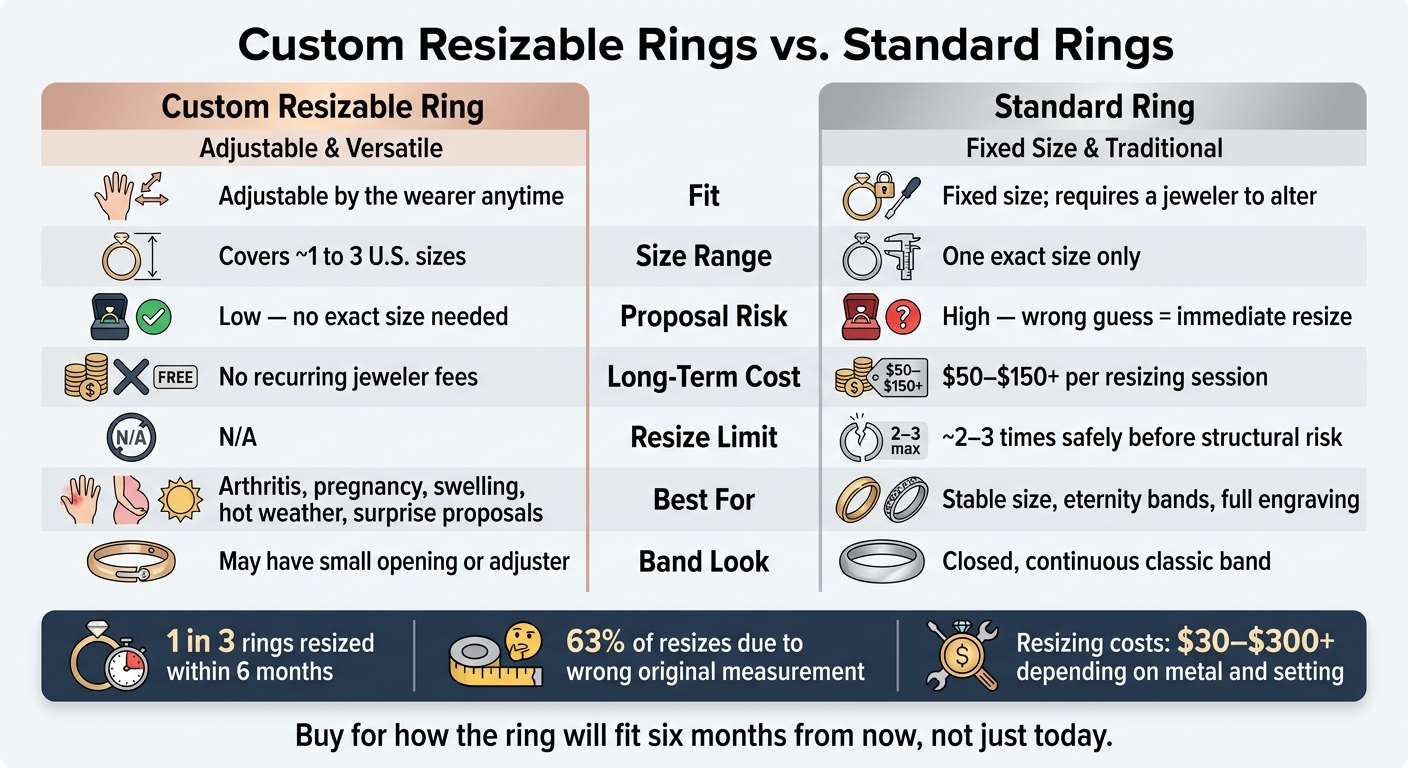
Custom Resizable Rings vs. Standard Rings: Key Differences at a Glance
Custom Resizable Rings: Fit, Comfort, and Design
How Adjustable Fit Helps in Daily Wear
Finger size changes more than most people think. Heat, workouts, travel, hydration, and cold can all make rings feel too tight or too loose from one part of the day to the next. A fixed band can't do much about that. An adjustable ring can.
With a resizable ring, you can loosen the band when your fingers swell and tighten it when they shrink. That helps cut down on both pinching and slipping, without needing a trip to the jeweler.
For people with arthritis or prominent knuckles, adjustable and hinged designs can make day-to-day wear much easier. The ring can open wide enough to pass over the knuckle, then fasten more snugly at the base of the finger. The same goes for pregnancy and postpartum recovery, when finger size can shift a lot over just a few weeks. In that kind of moment, a little flex in the fit goes a long way.
That same flexibility affects the design options too.
Design Choices in Resizable Styles
Adjustable doesn't mean boring. Today's resizable rings come in many looks, including classic solitaires, moissanite-set engagement rings, leaf motifs, infinity bands, and minimalist stacking rings. In many cases, the adjuster stays hidden, so the ring still looks like a standard band while giving you room to change the fit.
Satinski sells resizable engagement rings, wedding bands, stacking rings, and custom engraved designs in sterling silver and 18K gold, with styles that include leaf, infinity, and moissanite designs. Sterling silver works well for everyday pieces. For engagement or wedding rings, 18K gold is often the better pick because it wears better and resists tarnish more effectively.
Resizable Rings: Pros and Cons
Resizable rings solve a lot of fit problems, but there are a few tradeoffs.
| Criteria | Pros | Cons |
|---|---|---|
| Fit Flexibility | Adapts to daily swelling and long-term size changes | Cannot adjust infinitely; works within a defined size range |
| Comfort with Swelling | Can be loosened during heat, exercise, or pregnancy without taking the ring off | Severe or persistent swelling may still require taking the ring off |
| Ease of Gifting | No exact size needed for surprise proposals or gifts | The ring still needs to fall within the recipient's approximate size range |
| Resizing Needs | No jeweler required for minor adjustments; saves time and cost | Mechanisms need regular cleaning to remove lotion, soap, and residue |
| Design Freedom | Wide range of styles, metals, and stones available | Some open-back designs have a small open section or feel slightly bulkier than closed bands |
If your ring size hardly ever changes, a fixed band may be simpler to wear day after day.
sbb-itb-9da40c1
Standard Rings: Fixed Fit, Sizing, and Resizing
When a Fixed-Size Ring Works Well
Standard rings make sense when the size is already known. If the wearer knows their exact U.S. ring size, a fixed-size ring can give that close, tailored feel many people want.
It also has the clean, continuous band most people picture when they think of fine jewelry. No gaps, no adjustment points - just a classic look. And if the wearer's finger size stays steady through the year, that fit can stay comfortable for years without any extra work.
Fit Problems and Professional Resizing
The trouble starts when finger size changes. A ring that once fit well can start to feel tight or slip too much. That can happen because of seasonal swelling, exercise, pregnancy, aging, or arthritis.
When that happens, the usual fix is professional resizing. A bench jeweler cuts the band, adds or removes metal, then solders and polishes it so the ring keeps its shape. Plain gold or silver bands usually cost about $30–$100 to resize. Platinum often runs $100–$250. Stone-heavy settings can cost $150–$300+.
Timing matters too. Simple resizing at a local jeweler with an in-house bench can take as little as 1–3 business days. More involved work - like platinum bands, intricate settings, or big size changes - often takes 1–3 weeks. If it's a ring worn every day, that time off your hand can feel like a long stretch.
And cost isn't the only issue. Some ring styles don't give jewelers much room to work with.
Full-eternity bands, with stones all the way around, have little to no safe adjustment range. Tungsten carbide and some titanium rings can also be hard - or at times impossible - to resize with standard methods. In those cases, a fit change may mean replacement instead of repair.
Standard Rings: Pros and Cons
| Criteria | Pros | Cons |
|---|---|---|
| Fit Precision | Can be made to the wearer's exact U.S. ring size for a tailored feel | Requires knowing the correct size upfront; a wrong size means immediate resizing |
| Comfort Over Time | Excellent when finger size stays stable | Can become too tight or too loose with seasonal changes, weight shifts, pregnancy, or aging |
| Resizing Needs | One professional resize can restore a perfect fit | Each resize adds cost and takes the ring off your finger for days or weeks |
| Design Stability | Fits full-eternity bands, continuous engravings, and complex stone patterns | Some designs, including eternity bands and tension settings, are difficult or impossible to resize |
| Gifting Risk | Simple once the correct size is known | Guessing wrong on a surprise proposal means an immediate trip to the jeweler |
| Maintenance | No moving parts; easy to clean | Repeated resizing can thin the band over time and may leave faint solder marks |
Side by side, the tradeoff is pretty clear: standard rings can feel perfect when the fit is right, but if that fit changes later, cost, downtime, and design limits can become part of the deal.
Adjustable | Resizable Rings Guide Pros & Cons | Types Of Expandable One Size Fits All Rings
Side-by-Side Comparison: Which Ring Type Fits Your Needs
The choice usually comes down to three things: fit, design, and what you'll spend over time.
Fit, Personalization, and Cost Over Time
Sizing issues are more common than most buyers expect. Nearly 1 in 3 rings are resized within six months, and 63% of those cases happen because the original measurement was off.
| Feature | Custom Resizable Ring | Standard Ring |
|---|---|---|
| Adjustable Fit | Wearer adjusts it anytime | Fixed; requires a jeweler to alter |
| Response to Size Change | Adapts instantly to daily swelling or seasonal shifts | Requires a jeweler to cut, stretch, or add metal |
| Design Personalization | Styles include leaf, infinity, and moissanite designs; engraving may be limited by the adjustment gap | Full 360-degree engraving and continuous stone settings possible |
| Likely Resizing Needs | Low to none | Many wearers need at least one professional resize over time |
| Long-Term Cost | No recurring jeweler fees | $50–$150+ per resizing session in the U.S. |
| Safe Resizing Limit | N/A | Roughly 2–3 times safely before structural integrity is at risk |
A custom resizable ring makes sense if day-to-day comfort is the big issue. Fingers change more than people think. Heat, cold, travel, salt, pregnancy, and even time of day can affect fit. A ring that adjusts on the spot can save a lot of hassle.
A standard ring has its own edge. If you want a clean, unbroken band, it's often the better pick. That's especially true for designs like full-eternity settings or continuous inside engraving, where the band needs to stay complete all the way around.
The long-term cost gap can add up too. A standard ring may need one or more trips to the jeweler, and each resize in the U.S. can run $50–$150+. There’s also a limit to how many times that can be done safely. Most rings can only handle about 2–3 resizes before the structure may weaken.
Specs help, but daily wear tells the story better.
Best Choice by Scenario: Proposals, Pregnancy, Arthritis, and Hot Weather
These differences show up fast in everyday life.
| Scenario | Custom Resizable Ring Experience | Standard Ring Experience |
|---|---|---|
| Surprise Proposal | Fits immediately - no size guessing required | High risk of wrong size; often needs resizing before it can be worn comfortably |
| Pregnancy | Expands as fingers swell, then adjusts back postpartum | Often becomes too tight to wear safely and may need to be set aside entirely |
| Arthritis | Opens to pass over a swollen knuckle, then closes for a secure fit at the base | Difficult to put on; if sized for the knuckle, it spins loosely at the finger base |
| Hot Weather / Summer | Easy to loosen during U.S. summer heat when fingers naturally expand | Can dig into the skin or restrict circulation during heat-induced swelling |
| Stable Size, Traditional Look | Works, but the adjustment gap changes the look | Ideal - clean, continuous band with a precise, tailored fit |
A surprise proposal is a good example. With a resizable ring, you don’t have to play detective and hope the size is right. With a standard ring, a bad guess can mean the ring sits in the box until it’s resized.
Pregnancy and arthritis make the difference even clearer. Swollen fingers and enlarged knuckles can turn a fixed ring into a daily struggle. An adjustable style gives the wearer room when they need it, then tightens back down for a better fit.
Hot summer weather in the U.S. can cause the same problem on a smaller scale. A ring that felt fine in the morning can feel tight later in the day. If someone’s ring size stays steady year-round and they want that classic, uninterrupted band, a standard ring often looks best.
So the decision usually gets narrower pretty fast: Do you want flexibility and easier fit, or do you want a fixed band with a more classic look?
Conclusion: Picking the Right Ring for Comfort, Style, and Long-Term Wear
No ring type is better across the board. Once you look at fit, style, and long-term cost, the choice gets pretty simple.
Custom resizable rings make more sense for long-term wear when finger size may change. That also makes them a smart pick for surprise proposals, since the exact size may not be known ahead of time.
Standard rings are a better match when the wearer's size is stable and already known.
Budget plays a part too. A standard ring may cost less upfront, but future resizing can add to the total. A resizable ring may cost more at the time of purchase, but it can cut down on or remove resizing costs later.
Satinski offers adjustable rings in sterling silver and 18K gold, including leaf, infinity, and moissanite styles.
Choose custom resizable rings when size changes are likely, and choose standard rings when the fit is stable and known.
FAQs
How much can a resizable ring adjust?
Satinski resizable rings usually fit U.S. sizes 5–9. Thanks to the flexible or mechanical design, you can adjust them fast while you're out and about. That helps with day-to-day finger swelling, temperature shifts, and other normal changes.
If you want a closer fit, the band can often expand or contract by about half a size. In plain terms, it’s made to stay secure and comfortable without needing professional resizing.
Can all standard rings be resized?
Not always. Many standard rings can be resized by a jeweler, especially simple bands, solitaire settings, and basic channel-set designs.
That said, some rings are much harder to adjust. Styles with full gemstone coverage, fine detailing, or materials like titanium and tungsten may be difficult - or impossible - to resize. And some materials, such as quartz or wood, can't be resized at all.
Which ring type is better for daily swelling?
Adjustable rings are usually the better pick for daily swelling. Unlike fixed-size rings, you can loosen or tighten them as your fingers change from heat, exercise, or health-related shifts.
That makes them more comfortable and easier to wear throughout the day, without needing professional resizing.


