

Men's Ring Styles That Work With Larger Knuckles
If your ring must clear a larger knuckle but stay snug at the base, the style matters more than the size number. From the article, I’d boil it down like this: a small gap often works with a comfort-fit band, a mid-range gap may need an open, hidden-adjustable, or insert-based fit, and a **large gap - about 2+ U.S. sizes - ** usually points to a hinged, expandable, or custom ring.
Here’s the short version in plain English:
- Measure both the knuckle and the base of your finger
- If the gap is about 0–0.5 sizes, start with comfort-fit
- If the gap is about 0.5–1.5 sizes, look at open bands, hidden-adjustable bands, or sizing inserts
- If the gap is about 2+ sizes, go to hinged, expandable, or custom-fit options
- Band width changes the feel: 5–8 mm is often the safest range for men
- Gold and platinum give jewelers more room for later fit work than tungsten or titanium
- If your finger size shifts through the day from swelling or joint pain, skip a plain fixed band and look at a ring that opens or uses an inside insert
The main takeaway: I wouldn’t pick a ring for larger knuckles by style alone. I’d match the ring to the gap size, band width, metal, and whether your finger swells.
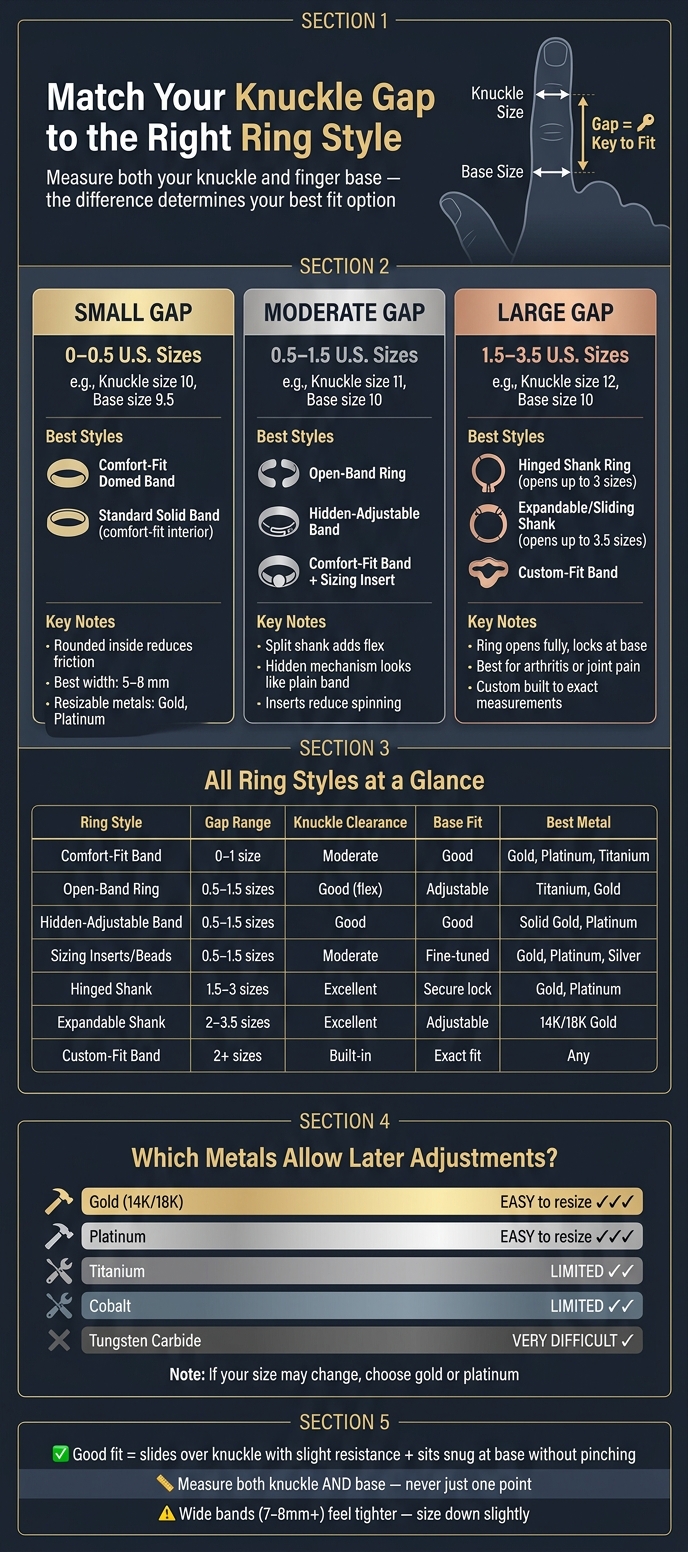
Men's Ring Styles for Larger Knuckles: Match Your Gap to the Right Fit
Ring Solutions For Larger Knuckles | Goldsmith's Workshop Secrets
sbb-itb-9da40c1
Quick Comparison
| Ring style | Best for | Typical gap | Main point |
|---|---|---|---|
| Comfort-fit band | Mild fit issue | 0–0.5 to about 1 size | Rounded inside helps it slide over the knuckle |
| Open-band ring | Mid-level fit issue | About 0.5–1.5 sizes | Split band gives some flex |
| Hidden-adjustable band | Mid-level fit issue | About 0.5–1.5 sizes | Looks like a plain band outside, adjusts inside |
| Hinged shank | Large gap or sore joints | About 1.5–3 sizes | Opens fully, then locks at the base |
| Expandable ring | Large gap | About 2–3.5 sizes | Hidden sliding shank clears the knuckle |
| Band with inserts | Ring clears knuckle but spins | Often 0.5–1.5 sizes | Beads, springs, or liners tighten base fit |
| Custom ring | Hard-to-fit fingers | 2+ sizes or out-of-range sizing | Built around your exact measurements |
If I were shopping today, Sep. 13, 2026, I’d start with the fit problem first, then pick the ring style that solves it with the least hassle.
Key Fit Principles for Larger Knuckles
Larger knuckles create a common fit problem: the ring has to pass over the knuckle, but it also needs to sit snugly at the base of the finger. That gap between the knuckle and the base is what shapes the best design choice.
For a small-to-moderate gap, a comfort-fit band is usually the easiest fix. This style has a rounded inner surface, so the ring slides over the knuckle with less friction and then sits more snugly at the base. It tends to work best in 4–8 mm widths, with 6–8 mm often being the sweet spot.
When the gap is larger, comfort-fit alone often isn't enough. In that case, open bands, hidden-adjustable bands, and expandable bands tend to do a better job. For the biggest fit differences, or for people dealing with arthritis or joint pain, hinged shanks are often the strongest option.
If the gap is still too large, it helps to switch from designs that only change the inside of the ring to designs that change how the band behaves overall. Sizing beads, bars, or silicone liners can cut down on spinning while still letting the ring clear the knuckle.
Material matters too. Gold and platinum are the easiest metals to resize or modify without weakening the band. Titanium and cobalt tend to work best when the ring already includes built-in adjustability. Tungsten carbide is the hardest to modify, so it usually works best with a flexible or lined design.
| Fit Feature | Best For | Best Materials |
|---|---|---|
| Comfort-fit interior | Mild size gap (about 1–2 sizes) | 14K/18K gold, platinum, titanium |
| Open-band design | Moderate gap, everyday wear | Titanium, stainless steel, gold |
| Hidden-adjustable bands | Fluctuating size, moderate gap | 14K/18K gold, platinum |
| Hinged shank | Severe gap, arthritis, or joint pain | Gold, platinum |
| Sizing beads/inserts | Moderate gap, ring already sized to knuckle | Gold, platinum, silver alloys |
| Removable liners | Non-resizable metals, quick fix | Silicone (over tungsten or cobalt) |
Use this summary to match your knuckle gap with the ring type that makes the most sense. With these fit rules in place, the first option to look at is an adjustable ring.
1. Satinski Adjustable Men's Rings
For men whose knuckles are wider than the base of the finger, an adjustable band is the most direct fit fix. Satinski adjustable rings use a sliding band that opens for knuckle clearance, then tightens at the base. One end slides inside the other, and the overlap stays hidden on the palm side.
The collection covers U.S. sizes 7.5–11.5. That makes the ring a good pick for daily wear, but the main upside is how easily it can change size while it's on your finger. The included Satinski Resizing Stick helps widen the band safely and keep its shape after tightening.
To adjust the fit, use the resizing stick to widen the band for knuckle clearance. Then press it inward in small increments until the base feels snug.
If you plan to adjust the ring often, solid 14K or 18K gold is the better choice over vermeil. The reason is simple: the sliding joint sees more wear with repeated adjustment.
If you want a similar fit option without a sliding band, the next choice is a hidden-adjustable wedding band.
2. Hidden-Adjustable Wedding Bands
A hidden-adjustable wedding band looks like a standard band on the outside. But inside, it has a concealed mechanism that lets the ring open over the knuckle and then tighten once it sits at the base of the finger.
This style makes sense when a fixed-size band fits the base of your finger but won’t pass over your knuckle. That’s usually the sweet spot: the base is close to a standard size, but the knuckle needs a bit more room. Many hidden-adjustable rings cover U.S. sizes 5–9, so they can work well for a moderate gap between the knuckle and the finger base. If that size difference is much larger, a hinged or expanding shank is often the better pick.
Material matters here. You want a metal that can handle repeated opening and closing without wearing down too fast. Solid gold is a good choice for daily wear because the hidden contact point can wear through plating over time.
Design also plays a big role in how well this style disappears into the ring. Mid-width bands with a smooth interior tend to hide the mechanism best. And if you want a clean, masculine look, brushed, matte, or flat profiles usually do the job well.
If you want a simpler profile without a hidden mechanism, the next option is an open-band ring.
3. Open-Band Men's Rings
When the knuckle is wider than the base of the finger - but not so wide that you need a hinge - an open-band ring can be a smart fix. It uses a split shank, which lets the ring flex over the knuckle and then sit closer at the base. Put simply: it’s a ring with a flexible split shank.
The fit matters here. Set the tension so the ring holds the base of the finger without pinching.
Width matters. For most men, a moderate width of about 5–8 mm hits the sweet spot between stability, comfort, and enough flex to get over the knuckle.
A comfort-fit rounded interior helps the ring slide over the knuckle with less pressure and then sit more securely at the base. A low or medium dome gives the ring structure without making it feel bulky. Rounded, polished open ends also help, since they’re less likely to snag or irritate the skin.
For a ring that will flex often, 14K solid gold is usually the better pick. Plated finishes tend to wear down at the flex point. Sterling silver costs less, but it can lose shape faster. The metal has to stand up to repeated bending without wearing out at the split.
If flex alone doesn’t do the job, the next option uses a comfort-fit interior instead of an open shank.
4. Comfort-Fit Domed Bands
If an open-band ring doesn’t flex enough, a comfort-fit domed band is usually the next simple fix.
This style has a rounded inside and a curved outside, so the ring moves with less friction as it goes over a larger knuckle. It tends to work best when the gap between the knuckle and the base of the finger is moderate, not severe.
One thing to know: comfort-fit bands often feel a bit larger than flat-fit bands. A good starting point is about 1/4 to 1/2 size smaller than your standard size. From there, test how it fits over both the knuckle and the base of the finger at room temperature.
For most men, 5-7 mm is the sweet spot. That width usually gives the ring enough stability without adding extra friction or too much bulk.
You’ll find comfort-fit domed bands in:
- Gold
- Platinum
- Tungsten
- Titanium
All four metals can be made in this profile, but only gold and platinum can be resized later.
If a comfort-fit dome still doesn’t get over the knuckle cleanly, the next step is a ring with a hinged shank.
5. Hinged Shank Rings
If a comfort-fit band still snags at the knuckle, a hinged shank fixes the issue with a simple mechanical design. The ring opens to pass over the knuckle, then locks in place at the base of the finger.
The ring should be sized to the base of your finger. The hinge takes care of knuckle clearance. Many styles open enough to cover up to 3 US sizes, which means a US 7 ring can clear a size 10 knuckle. For men whose knuckle is more than about 1.5 sizes larger than the base of the finger, this is often one of the most exact and secure fit options.
For look and comfort, many men's hinged shank rings come in widths around 5–8 mm with flat or softly domed profiles. A comfort-fit interior can help ease pressure points. The hinge usually sits on the underside of the finger, where it stays less visible and better shielded from impact. Even with that hardware, the ring still looks like a standard band when closed.
That said, a hinged ring has more moving parts than a solid band. Over time, the hinge pin and locking clasp can wear down, especially with heavy daily use. It helps to have a jeweler check the hinge and clasp from time to time. If you do a lot of heavy hand work, taking the ring off during those tasks can reduce strain on the mechanism.
Resizing is also more involved than it is with a standard band. If the hinge alignment shifts, a big size change may mean the jeweler has to replace the hinged shank part instead of resizing the ring in the usual way. Before you order, talk through the expected size range with your jeweler so you know how much adjustment the ring can handle over time.
6. Expandable Men's Rings
If a hinged shank feels a bit too mechanical, expandable rings give you a more discreet option. They use a hidden sliding shank that opens to pass over the knuckle, then closes again at the base of the finger. They’re not elastic or spring-loaded, and the mechanism sits underneath the band, so from the outside the ring still looks like a solid band.
Many well-made expandable shanks can open up to 3.5 U.S. sizes past their resting size. That makes them a good fit when the knuckle is around 2–3 sizes larger than the base of the finger. For example, a size 7 ring can pass over a size 10 knuckle and then return to a closer fit at the base.
A 6–8 mm width usually works best. It gives the mechanism enough structure without making the ring feel bulky.
For metal, solid 14K or 18K gold tends to hold up better with repeated sliding. Plated metals can wear through where the band overlaps.
A little upkeep goes a long way:
- Clean the overlap with mild soap.
- Check the ring for wear.
- Use a resizing stick or tapered mandrel to help keep the band round, so it keeps both its knuckle clearance and base fit over time.
If the base still feels loose after expansion, sizing inserts can help fine-tune the fit.
7. Custom-Fit Bands With Sizing Inserts
If an expandable shank gets over the knuckle but the ring still feels loose at the base, inserts can dial in the fit. The idea is simple: a jeweler sizes the ring so it clears the knuckle, then adds an insert inside the lower part of the band to keep it from spinning.
The outside of the ring stays the same, which makes this a good pick for wedding bands and signet rings. You get a tighter fit where it matters, without changing the solid-band look.
Common choices include sizing beads, spring inserts, and inner liners:
- Sizing beads create small contact points inside the ring and slightly reduce the fit.
- Spring inserts flex over the knuckle and then tighten at the base.
- Inner liners make the lower inside of the ring narrower while still leaving room to pass the knuckle.
Each option has a different job. If your finger size changes now and then, spring inserts tend to make more sense. If your fit is steady, beads or liners are often the better match.
There are a couple of tradeoffs. First, this kind of work adds cost. Second, later changes can be harder, depending on the insert type. That said, when the problem is “fits over the knuckle, but won’t stay put,” inserts are often the clean fix.
Metal matters too. Gold and platinum are the easiest metals for this kind of adjustment. Tungsten and titanium give jewelers fewer options because they’re harder to solder or resize.
If the gap between your knuckle and ring base is bigger, inserts may not be enough on their own. In those cases, hinges or expanding shanks usually do the heavy lifting. Use the comparison table below to line up each insert type with your knuckle gap and metal.
Comparison Tables: Fit Options at a Glance
These tables help you match your knuckle gap to the fit style that makes sense for your finger.
The goal stays the same the whole time: the ring needs to get over the knuckle and still sit snugly at the base.
Table 1: Flexible Styles vs. Solid Bands
Start here if you're deciding between rings that open or flex and rings with a fixed shape.
| Ring Type | Knuckle Clearance | Base Fit | Best For |
|---|---|---|---|
| Flexible styles | High - opens to pass the joint | Good when properly adjusted; may need inserts for large gaps | Large knuckle-to-base differences, arthritis, swelling |
| Solid band (comfort-fit interior) | Moderate - domed profile reduces friction | Moderate - may need a sizing insert or guard to reduce spin | Mild to moderate knuckle differences, daily wear |
| Solid band (standard interior) | Low - flat inner wall creates more friction | Strongest when sized to the base, but only works for minimal differences | Fingers where knuckle and base are nearly the same size |
Table 2: Comfort-Fit Band vs. Standard Interiors
This is the rounded-inside vs. flat-inside comparison. That small design change can make a big difference when a ring has to pass a prominent knuckle.
| Feature | Comfort-Fit Band | Standard Interior |
|---|---|---|
| Inner shape | Domed / rounded | Flat |
| Knuckle clearance | Easier - less friction sliding over the joint | More friction - can snag on a prominent knuckle |
| Skin contact | Minimal - reduces pressure points | Full contact - can feel tight if the finger swells |
| Sizing note | May feel slightly roomier; some jewelers suggest going about a quarter to half size smaller than your standard measurement | Size to the base if the knuckle difference is small |
| Best for | Bands 5 mm and wider; moderate knuckle differences | Narrow bands; fingers with little knuckle-to-base difference |
Table 3: Match Your Knuckle Gap to the Right Style
If you already know your numbers, this table is the shortcut. Measure both the knuckle and the base of your finger, then compare the gap. In U.S. sizing, about 0–0.5 sizes is a small difference, 0.5–1 size is moderate, and 1–2+ sizes is large.
| Knuckle-to-Base Difference | Gap Range | Best Ring Style | Best Fit Reason |
|---|---|---|---|
| Small | 0–0.5 US sizes (e.g., knuckle 10, base 9.5) | Comfort-fit solid band | Clears the knuckle easily while still looking like a traditional band |
| Moderate | 0.5–1 US size (e.g., knuckle 11, base 10) | Comfort-fit band + sizing insert or guard | Clears the knuckle, and the insert helps reduce spinning at the base |
| Large | 1–2+ US sizes (e.g., knuckle 12, base 10) | Adjustable, hinged, expandable, or custom-fit band | Minimizes the force needed to get the ring on and keeps it secure once in place |
For large gaps, standard solid bands in non-resizable metals often miss the mark. They usually do one of two things: spin too much or won't get past the knuckle at all.
Next, measure both points with care before you order.
How to Measure Your Finger When You Have Larger Knuckles
If your knuckles are larger, don’t measure just the base of your finger. Measure both the knuckle and the base. If you skip the knuckle, you can end up with a ring that fits the bottom of your finger but won’t go over the knuckle at all.
Use a narrow paper strip or a soft measuring tape at each point. Wrap it around, mark where it overlaps, then flatten it and measure the length in millimeters. Do this three times for each spot and use the largest number that repeats. Those two measurements will show you how much space there is between the knuckle and the base, which matters when picking a ring style.
Then compare the two numbers. That knuckle-to-base gap helps you figure out whether a standard band is likely to fit, or if an adjustable, hinged, or custom-fit design makes more sense.
Band width matters too. Wide bands, especially those that are 7–8 mm or more, usually feel tighter than slimmer bands in the same size. So when you share your measurements with a jeweler, include the width you plan to wear.
A good fit should slide over the knuckle with gentle resistance, feel snug at the base, and come off without soap or lubricant.
When to Order a Custom Ring Instead of a Standard Size
If your knuckle and base measurements show a big gap, it’s time to look past standard sizing and go custom. When the knuckle-to-base gap is under 0.5 size, a comfort-fit band will often do the job. If the gap is around 1 to 1.5 sizes, sizing beads or a spring insert can help keep the ring steady. Once you get to 2+ sizes, custom sizing tends to be the better long-term fix.
Custom sizing also makes sense if your ring size shifts during the day because of heat, work, arthritis, or fluid retention. A fixed-size band can start to feel like a bad compromise in that case - fine one hour, annoying the next.
Custom orders are available for any size, so the fit can be built around your exact knuckle and base measurements.
Here’s a simple way to match the fit issue to the right fix:
| Fit Situation | Recommended Custom Solution |
|---|---|
| About 1 U.S. size difference, or a ring that spins at the base after clearing the knuckle | Sizing beads |
| Around 1 to 1.5 sizes difference, especially with swelling or sensitive skin | Spring insert |
| 2+ U.S. sizes difference, painful knuckles, or a difficult knuckle-to-base gap | Hinged shank or custom shank |
| Outside the standard adjustable size range | Custom order |
For a daily-wear wedding band or engagement ring, a custom solution is often a safer bet than modifying a standard ring again and again. Repeated resizing weakens the band over time. And if the ring has to slide over a large knuckle every day, solid 14K gold tends to hold up better than gold vermeil at high-friction contact points.
When you talk to the jeweler, share your knuckle and base measurements, your preferred band width, and how swelling tends to change through the day. That gives them what they need to build a ring that stays secure without feeling tight.
Conclusion
Use the gap between your knuckle and the base of your finger as the guide. The best ring for larger knuckles should pass over the knuckle with slight resistance and then sit at the base in a secure way, without pinching.
That gap tells you which style makes sense. A comfort-fit domed band usually works when the difference is small. If the mismatch is larger, look at an adjustable, hinged, expandable, or custom-fit design.
Style matters too. Hidden-adjustable, open-band, comfort-fit, and expandable rings can still look clean and masculine.
If your size shifts during the day because of arthritis, swelling, or weight changes, think about adjustability now instead of later. Repeated resizing can weaken a band over time.
Measure both points, match the gap to the right style, and talk to a jeweler if the difference is large. Measure both points, choose the matching style, and order custom only when the gap is too large for a standard fit.
FAQs
How do I measure my knuckle and finger base correctly?
If you’re not sure about your size, measure your finger or use a size guide as a reference. If your knuckles are larger, measure both the knuckle and the base of your finger.
That’s where adjustable rings can make life a lot easier.
A fixed-size ring often needs to be big enough to slide over the knuckle. The catch? It can end up feeling loose or spinning once it sits at the base of your finger. An adjustable ring works a bit differently. You can slip it over the knuckle, then tighten the band for a more secure fit.
What ring style is best if my finger size changes during the day?
An open-band ring with a hidden gap is often the best pick. It can tighten or loosen as your finger size shifts with temperature, exercise, or hydration, so it stays comfortable and secure at the base of your finger.
If you plan to wear it every day and adjust it often, go with 14K solid gold or a gold-filled finish. Those options hold up better at the contact points where the ring moves than standard gold plating.
Which metals are easiest to resize later?
Softer metals like gold and silver are usually the easiest to resize. Jewelers can cut and shape them with less trouble, which makes the whole process more straightforward.
Harder materials like platinum, stainless steel, and tungsten are tougher to work with. Tungsten carbide is the trickiest of the bunch because it can't be cut. If it needs to come off, a professional has to shatter it for removal.


