

Rings That Fit Over Large Knuckles Without Spinning
If your ring must go over a large knuckle but then feels loose at the base, the fix depends on the size gap. In most cases, a gap under 1 size can work with beads or an adjuster, a 1–2 size gap often works with a spring insert, and a 3+ size gap may call for a hinged or expandable shank.
I’d keep it simple:
- Small gap: sizing beads or a removable adjuster
- 1–2 sizes: spring insert
- Top-heavy ring that flips: Euro shank
- Large knuckle, slim finger base, daily wear: hidden-adjustment or hinged design
- Finger size changes during the day: adjustable band or expandable shank
The main thing I’d watch is not just whether the ring goes on, but whether it stays centered after it’s on. A lower setting, more even weight, and a band with more contact against the finger can help cut down on spinning.
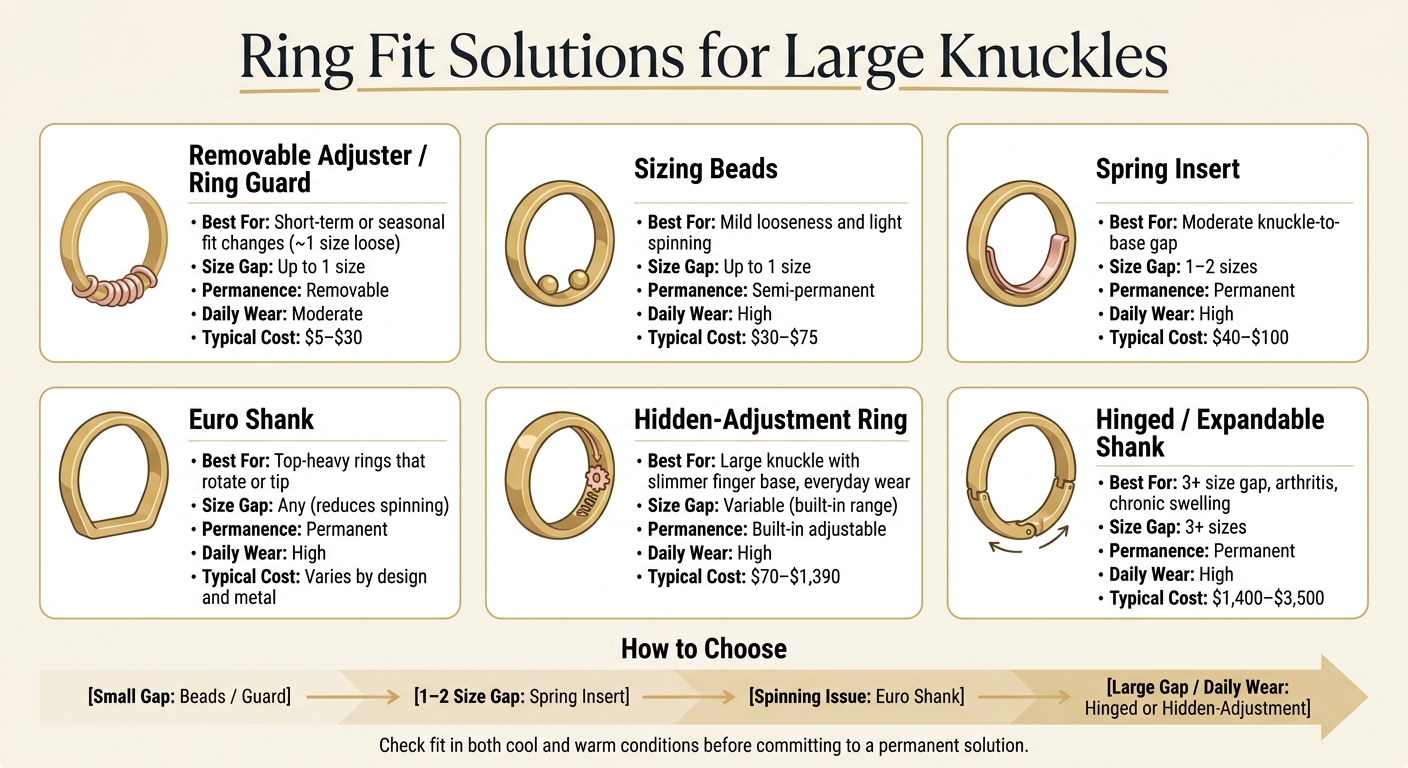
Ring Fit Solutions for Large Knuckles: Cost & Use Case Guide
Ring Solutions For Larger Knuckles | Goldsmith's Workshop Secrets
sbb-itb-9da40c1
Quick Comparison
| Option | Best for | Typical Cost |
|---|---|---|
| Removable adjuster | Short-term fit change, about 1 size loose | $5–$30 |
| Sizing beads | Mild looseness, light spinning | $30–$75 |
| Spring insert | 1–2 size gap | $40–$100 |
| Euro shank | Rings that rotate or tip | Varies |
| Hidden-adjustment ring | Large knuckle with slimmer finger base | About $70–$1,390 |
| Hinged / expandable shank | 3+ size gap, arthritis, swelling | $1,400–$3,500 |
Bottom line: I’d match the fix to the gap between your knuckle and your finger base, then check comfort in both cool and warm conditions. That’s the simplest way to find a ring that goes on without a fight and doesn’t spin all day.
Adjustable ring designs that tighten after clearing the knuckle
Open, split, and hidden-adjustment bands that reduce spinning
If you want a fit that feels more built-in, adjustable ring designs usually do a better job than removable reducers. They tackle the knuckle-to-base size gap in a few different ways.
Open bands flex enough to get over the knuckle. That sounds simple, and it is. But there’s a trade-off: repeated bending can weaken softer metals, and the open gap can snag delicate clothing.
Split shanks use overlapping sections that open as the ring passes over the knuckle, then sit more snugly at the base of the finger.
Hidden-adjustment bands keep the resizing feature tucked inside the shank, so the ring still looks like a closed band. That’s a smart option if you want a closer fit without a visible gap.
Satinski adjustable rings for everyday wear and changing finger size
For everyday wear, hidden-adjustment styles are often the closest match for people who need a ring to clear a larger knuckle but stay put on a slimmer finger base. Satinski’s adjustable ring line uses a hidden resizing mechanism built directly into the shank. The ring expands to slide over a large knuckle, then tightens at the finger base without a visible gap or external adjuster. That range helps one ring fit both a wider knuckle and a narrower finger base for many wearers. It addresses the common knuckle-versus-base size mismatch without adding an outside adjuster.
Satinski offers these rings in sterling silver, starting at about $70, and in solid 18K gold, with premium styles priced up to about $1,390. The brand’s adjustable rings also hold a 4.8 out of 5-star rating based on 465 customer reviews.
Design details that help adjustable rings stay centered
A better fit helps, but fit alone doesn’t stop a ring from turning. The shape and balance of the ring matter too. Once sizing is close, a few design details can make a big difference.
Band width affects how much of the ring touches the skin. A wider band creates more friction, which makes the ring harder to rotate on its own. Narrow bands touch less surface area, so they tend to turn more easily.
Setting height plays a part too. A lower-profile setting keeps the center of gravity closer to the finger, which cuts down on the sideways pull that happens during normal hand movement. Tall prong settings or high-domed stones push weight upward and make top-heavy tilting more likely.
Even weight distribution across the full band also helps keep the ring centered. If a ring carries most of its weight on one side, like a large stone set off-balance, it’s more likely to spin.
In plain terms, wider bands, lower settings, and balanced weight give a well-fitted ring a better shot at staying centered. Small fit tweaks can help the ring stay in place during normal movement.
Permanent ring modifications for bigger knuckles and slimmer finger bases
If sizing beads or guards don't do enough, permanent changes usually give the cleanest fit. They're often the best long-term answer when the gap between your knuckle and finger base is large - often 3 or more US sizes. In that case, you need a ring that can get over the knuckle and still sit snugly at the base.
Hinged and expandable shanks that open over the knuckle
A hinged shank replaces the bottom part of the band with a small hinge and locking clasp. Expandable shanks work in a similar way, with a built-in opening section that gives the ring more room to pass over a larger knuckle or deal with swelling. You open the shank, place the ring at the base of the finger, then lock it shut. That means the ring is sized to your finger base - not your knuckle. Some built-in hinge systems are made for this exact job, and some styles open a full 180° for more severe knuckle-to-base size differences.
These options are often a big help for people with arthritis, chronic swelling, or knuckle enlargement from an injury. Many sit smoothly under the finger, so they feel fairly discreet in daily wear. The downside is price. In the U.S., professional installation of a hinged shank usually costs about $1,400 to $1,800, and more involved work can go up to $3,500, depending on the ring design and metal type. A jeweler also has to remove the original bottom part of the band, which changes the ring's profile a bit.
If the size gap is smaller, you may not need this much work. A spring insert or shaped shank can often fix the issue with less change to the ring itself.
Spring inserts and Euro shanks that limit rotation
For a 1 to 2 US size gap, a spring insert can work well. A jeweler solders a thin, horseshoe-shaped strip of metal inside the back of the shank. As the ring moves over the knuckle, the spring compresses. Once the ring reaches the base of the finger, it springs back inward and helps hold the ring in place. This is one of the lower-cost permanent fixes, with installation usually running $40 to $100.
A Euro shank has a flatter base that helps cut down on rotation, especially in top-heavy rings. That flatter shape creates more contact with the finger and helps keep rings from tipping or spinning during the day. It doesn't change how the ring goes on, but it can help the ring stay centered once it's on. Jewelers often combine a Euro shank with slight upsizing or a spring insert when the ring both spins and has a size-gap issue.
Use the table below to match the fix to your finger shape and size gap.
| Modification | Best for | Typical US cost |
|---|---|---|
| Hinged / expandable shank | 3+ size gap, arthritis, chronic swelling | $1,400–$3,500 |
| Spring insert | 1–2 size gap, moderate rotation | $40–$100 |
| Euro shank | Top-heavy rings that spin | Varies by design and metal |
Sizing beads, ring guards, and fit aids
When a ring gets over the knuckle but still feels loose at the base of the finger, internal fit aids can tighten things up without changing the outside look. If permanent changes feel like too much, or the size gap is small, these lower-cost options help by taking up extra space inside the band after the ring is already on your finger.
Sizing beads for small fit gaps and better grip
Sizing beads are two small metal beads soldered to the inside of the band, usually around the 4 o'clock and 8 o'clock positions. A jeweler places the smooth beads inside the ring so they create extra contact points. That added contact helps the ring grip better and cuts down on spinning and tipping. They’re especially helpful for top-heavy rings that tend to droop toward the palm.
There’s one big limit: the size gap. Sizing beads tend to work best when the base of the finger is only about one full US size smaller than the knuckle. If the gap is bigger than that, beads may press uncomfortably without fully holding the ring in place. Installation usually costs $30–$75 and often takes anywhere from a few days to a week.
Comfort can go either way. Some people stop noticing the beads after a short adjustment period. Others find them annoying over time, especially if they have sensitive skin or arthritis. If that happens, a jeweler can often change the bead size or move the placement to make the fit easier to wear.
Ring guards and removable adjusters for quick, low-cost changes
If you want a temporary fix, removable adjusters are usually the first thing to try. Ring guards and removable adjusters include metal guards, plastic coil adjusters, silicone sleeves, and clip-on pieces that wrap around or attach to the inside of the band to make the ring fit tighter for now. A lot of them go on in minutes, which makes them handy when you need a fast fix.
They usually work best when the ring is only about one size too large. Past that point, they’re more of a patch than a solid answer. Plastic coil adjusters and silicone sleeves often cost $5–$20 per pack, and they’re easy to replace as finger size changes with temperature, medication, or seasonal swelling. Metal clip-on guards usually cost about $5–$30 and tend to last longer, but they can scratch soft metals and trap lotion underneath. Because of that, they’re often better for occasional wear than daily use.
One of the best things about removable adjusters is that they let you test the fit before spending money on a permanent change. You can use them to figure out how much size reduction you need.
Comparison table: which fit solution works best for your finger shape
Use beads when you want a modest permanent tightening. Use guards when you want something quick and reversible.
| Fit Solution | Best Use Case | Permanence | Comfort | Visibility | Typical Cost (USD) | Daily-Wear Suitability |
|---|---|---|---|---|---|---|
| Sizing beads | Modest gap and mild spinning | Semi-permanent | Moderate | Very low | $30–$75 | High |
| Ring guards / adjusters | Temporary or seasonal fit changes | Removable | Low–Moderate | Moderate–High | $5–$30 | Moderate |
Conclusion: Choosing the right no-spin ring solution for daily wear
When you compare adjustable rings, permanent shanks, and internal fit aids, one thing matters most: the size difference between your knuckle and the base of your finger.
Start there. If the gap is less than half a size, standard ring sizing may be enough. A gap of 1–2 sizes often points to sizing beads, a spring insert, or a removable guard. If the gap is larger, hinged, expandable, or hidden-adjustment rings usually make more sense.
If your finger size shifts during the day, go with a design that can tighten or loosen after the ring passes over the knuckle. That detail can make the difference between a ring that feels fine for an hour and one you can wear all day.
Then match the fit method to how often you plan to wear the ring. A fashion ring you wear now and then can work with a removable adjuster. But for a ring you wear every day, a permanent fit option is often the better call.
Before you commit, do one last fit check:
- Passes the knuckle without pain
- Sits snugly at the base
- Stays centered during daily tasks
- Still feels right in both cool and warm conditions
If any answer is “no,” go back and check the fit again. Many jewelers in the U.S. offer free or low-cost sizing evaluations, so it’s easier to compare your options before making a final choice.
The right fix should do three simple things: clear the knuckle, stay centered, and feel comfortable every day.
FAQs
How do I measure my knuckle-to-base size gap?
Measure your knuckle and the base of your finger separately with a non-stretchy string or a thin strip of paper. Mark the spot where the ends overlap, then measure that length to get each circumference.
Pick a ring size that falls between those two measurements. That way, the ring can slide over the larger knuckle but still sit snugly at the base of your finger.
For the best fit, take your measurements in the late afternoon or early evening.
Can a ring be made more secure without changing its look?
Yes. Hidden sizing mechanisms can make a ring more secure without changing how it looks.
Designs like those in the Satinski Allring collection use flexible bands or internal systems built into the ring itself. The ring opens up enough to pass over larger knuckles, then tightens at the base of the finger for a snug fit. That helps cut down on spinning, without visible add-ons like sizing beads or outside adjusters.
Which option is best for daily swelling or arthritis?
For daily swelling from arthritis, the best choice is an adjustable open-back resizable ring with a flexible expanding band. It can slide over swollen joints and then tighten for a secure fit, with no tools needed.
Satinski’s Allring Edge (US sizes 5–9) is made for swollen knuckles and finger sizes that change through the day. It also comes with a resizing stick for at-home adjustments.


