


Why Your Wedding Ring Feels Tight Some Days and Loose Others
If your ring feels snug one day and loose the next, that is usually normal. Finger size can shift by about 1/2 ring size in a single day and by up to 1 full size between winter and summer.
Here’s the short answer:
- Heat and humidity can make your fingers swell, so your ring feels tighter.
- Cold air and A/C can shrink finger size a bit, so your ring feels looser.
- Morning fluid buildup, salty food, exercise, hormones, pregnancy, and weight change can all affect fit.
- A fit change is often normal if it follows a clear trigger and goes away within a few hours.
- It may be a sizing problem if your ring hurts, leaves a deep mark, feels numb, or slips off too easily.
A few numbers help put this in perspective:
- Warm conditions can change fit by about 1/4 to 1/2 size
- Cold weather can make a ring feel up to 1 size looser
- Hand blood flow can increase a lot in heat and drop by about 20% in cold conditions
What I’d watch for: if your ring is only tight after a hot shower, a workout, travel, or a salty meal, that usually points to normal swelling. If it feels off on most days, under normal conditions, the ring may need a better fit.
| Situation | What usually happens | What it can mean |
|---|---|---|
| Hot day, shower, workout | Ring feels tighter | Short-term swelling |
| Cold weather, strong A/C | Ring feels looser or spins | Short-term finger shrinkage |
| Morning | Ring may be harder to remove | Overnight fluid shift |
| Deep groove, tingling, color change | Ring feels too tight | Act on it soon |
| Slides off during hand washing | Ring feels too loose | Fit may be off |
In short: most ring fit changes come from normal body changes, not a bad ring size. The main job is to spot the pattern, know when it is normal, and know when to fix it with an adjuster, a resize, or a different ring style.
Why does my ring fit differently all the time?
sbb-itb-9da40c1
Why Wedding Ring Fit Changes Throughout the Day
Finger size changes during the day because of temperature, fluid shifts, and activity. That’s why a ring can feel snug at one point and loose a little later.
How Heat and Humidity Make Your Ring Feel Tighter
Warmth is the most common reason a ring suddenly feels tighter. When your body gets warm, blood vessels widen, a process called vasodilation. More blood moves into your hands, and your fingers swell a bit. Heat can triple hand skin blood flow compared with cooler conditions.
That small change is often enough to change how your ring feels. A ring that fits fine in a cool room may start to feel snug after a hot shower or during humid summer weather. On its own, weather-related swelling can change ring fit by about 1/4 to 1/2 size.
How Cold Air and Air Conditioning Make Your Ring Feel Looser
Cold does the reverse. When temperatures drop, blood vessels narrow, which is called vasoconstriction. That lowers finger volume and can make a ring feel less secure. Cold can reduce hand blood flow by about 20%.
So a ring that stays put indoors might start spinning after an hour in strong air conditioning or outside in cold weather. In winter conditions, rings can feel up to one full size looser.
How Time of Day and Fluid Retention Affect Ring Fit
Time of day plays a part too. Overnight, fluid can shift into the hands, which is why fingers often look or feel puffier in the morning. For most people, that mild swelling eases within a couple of hours once they’re upright and moving around.
Food and hormones can change things as well. A salty dinner may make your body hold more water overnight, and some of that extra fluid can settle in your hands. Hormonal changes during the menstrual cycle or pregnancy can also affect ring fit.
| Time / Condition | Finger Response | Ring Feel |
|---|---|---|
| Morning after sleep | Overnight fluid redistribution toward the hands | Tighter, harder to remove |
| Hot summer day or post-shower | Vasodilation; more fluid in tissues | Snug, may leave a faint mark |
| Cold weather or strong A/C | Vasoconstriction; reduced finger volume | Loose, may spin |
Most day-to-day fit changes come back to these familiar patterns.
Specific Reasons Your Ring Feels Tight or Loose on Certain Days
Beyond normal day-to-day shifts in temperature and fluid levels, a few common situations can push ring fit one way or the other. What matters most is the pattern: if the change lines up with a clear trigger and then goes away, that usually points to a short-term shift rather than a sizing issue.
What Usually Makes a Ring Feel Tight
A ring often feels tighter when your fingers swell, even a little.
- Exercise can lead to short-term finger swelling, which makes a ring feel snug.
- Salty meals may cause short-term water retention, and your fingers are one of the first places you might notice it.
- Pregnancy can tighten ring fit as finger size changes over time.
What Usually Makes a Ring Feel Loose
When a ring feels loose, the pattern is often the reverse: cooler conditions, less swelling, or less friction between the ring and your skin.
- Dry skin can make a ring slide more easily.
- Weight changes can shift ring fit slowly, usually over weeks or months.
If this keeps happening and you can't tie it to a clear cause, the issue is more likely the ring size itself, not just normal daily fluctuation.
How to Tell Normal Fit Changes From a Sizing Problem
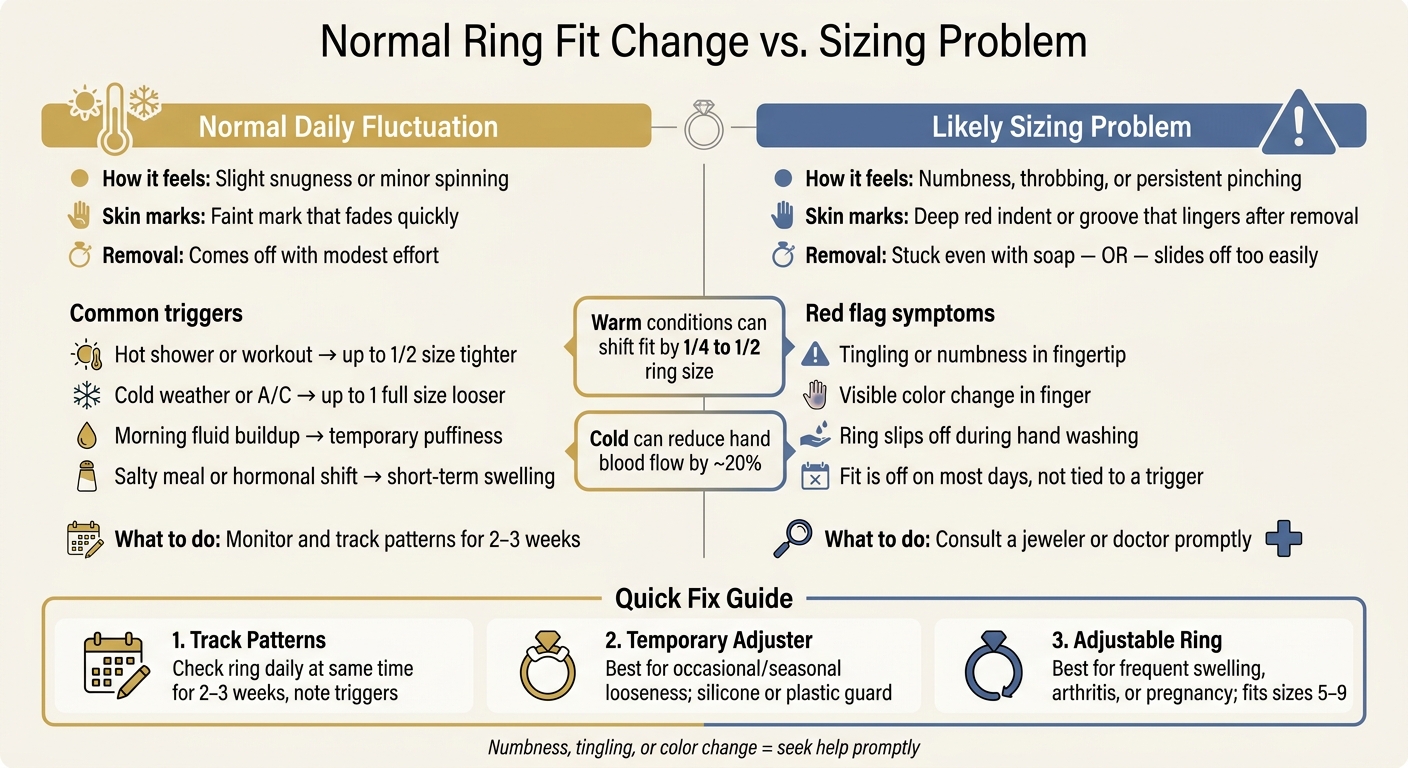
Why Your Ring Feels Tight or Loose: Normal vs. Sizing Problem
Fit changes usually come from temperature swings or shifts in body fluids. So the main job is simple: look for a pattern. Most changes in ring fit are temporary and harmless. What matters is whether the change follows a clear trigger and goes away on its own, or keeps showing up no matter what’s going on.
Signs the Fit Change Is Probably Normal
A fit change is probably normal when there’s an obvious cause and the ring feels normal again within a few hours.
The clearest sign? The ring comes off without much trouble, doesn’t leave a lasting mark, and feels fine again before long. If there’s no pain, no numbness, and no visible indentation after you take it off, the fit is likely still in the normal range - even if it feels a bit tighter or looser at certain times of day.
Signs the Ring Size Likely Needs Resizing
A sizing problem is more likely when the fit is off on most days, sticks around for hours, or starts causing symptoms. A ring that leaves a deep red groove long after removal or causes tingling is too tight. A ring that slips off while washing your hands or slides over the knuckle with almost no resistance is too loose. When a ring keeps falling outside the normal fit range - on most days, under ordinary conditions, and not just after an obvious trigger - it’s probably time to stop just watching it.
| Normal Daily Fluctuation | Likely Sizing Problem | |
|---|---|---|
| How it feels | Slight snugness or minor spinning | Numbness, throbbing, or persistent pinching |
| Skin marks | Faint mark that fades quickly | Deep red indent or groove that lingers |
| Removal | Comes off with modest effort | Stuck even with soap, or slides off too easily |
| What to do | Monitor and track patterns | Consult a jeweler or doctor |
Any sign of numbness, tingling, or visible color change in the fingertip takes this out of the “fit issue” category. Those symptoms can point to restricted circulation, so they’re worth dealing with promptly instead of waiting to see what happens.
Once you spot the pattern, the next step gets a lot easier.
Simple Ways to Make Your Ring More Comfortable and Secure
Use the fix that matches how often your ring fit changes.
Track Fit Patterns With a Consistent At-Home Check
Check your ring at the same time each day, ideally in the middle of the morning, in a room that isn't too hot or too cold. A ring that fits well should go over your knuckle with a little resistance, then come off without a struggle.
Do this several times a week for 2–3 weeks. As you check, jot down what may have affected the fit: exercise, a salty meal, travel, or hot or cold weather. Add that trigger to each note.
After a couple of weeks, patterns usually start to show. Maybe your ring gets tight after flights. Maybe it feels loose when the temperature drops. Once you can spot the pattern, it's much easier to pick a short-term fix.
Use Temporary Ring Adjusters for Short-Term Looseness
If your ring fits well most of the year but starts to spin or slide in cold weather or after small weight changes, a temporary ring adjuster can help without changing the ring for good. Common choices include silicone sleeves, plastic guards, and foam inserts.
For mild looseness, a thin silicone or plastic guard is often enough. It's low-cost, easy to switch out, and hard to notice once it's on. If you have sensitive skin, go with hypoallergenic silicone. It also helps to clean both the ring and the adjuster on a regular basis so moisture doesn't get trapped against your skin.
These adjusters work best for occasional looseness. If you're using one every day just to stop the ring from spinning, that's a sign the ring itself may need a better fix.
Consider a Resizable or Adjustable Wedding Ring for Lasting Comfort
If your finger size changes often, an adjustable wedding ring can make life a lot easier. Instead of relying on a fixed band sized for one point in time, you can fine-tune the fit as your finger changes, without going back to a jeweler again and again.
Satinski's adjustable rings and wedding bands start at $70 and use a hidden adjustment mechanism, so the ring still looks like a standard band from the outside. It fits US sizes 5–9, which can help if you have larger knuckles and need the ring to move over the joint but still sit snugly at the base. That can mean less taking it off and putting it back on when swelling changes the fit.
| Solution | Best For | Limitation |
|---|---|---|
| Temporary adjuster | Occasional looseness, seasonal changes | Not ideal for constant size mismatch |
| Adjustable ring | Frequent swelling, arthritis, pregnancy | One-time cost |
FAQs
How should a wedding ring fit?
A properly fitting wedding ring should feel comfortable, not tight. It should slide over your knuckle with a bit of friction, then sit at the base of your finger without feeling restrictive.
A good fit means the ring can turn on your finger without much effort, but it shouldn’t leave deep marks or slip off with ease. Finger size can change during the day, and things like temperature or activity can affect the fit too. That’s why it helps to measure your finger at different times instead of relying on a single check.
When should I get my ring resized?
Resize your ring only if the fit change looks permanent, not temporary. Finger size can shift more than most people think. Heat, exercise, hydration, and even salty food can make a ring feel tighter or looser from one day to the next. That’s why it’s smart to watch the fit for a few weeks before making a permanent change.
If the problem sticks around because of weight changes, pregnancy, or aging, a professional jeweler can check whether the ring can be resized safely. If your fit tends to change on and off, a temporary adjuster may be the better move.
Get medical care if sudden tightness causes pain, numbness, or poor circulation.
Can I wear my ring during exercise?
Yes, but pay close attention to how your body responds during exercise. Hard workouts, weight training, and cardio can boost blood flow and lead to short-term fluid buildup, which can make your fingers swell and your ring feel tighter than usual.
If your fingers start swelling, take your ring off early so it doesn’t become painful or cut into circulation. If your ring fit tends to change a lot during workouts or other activity, an adjustable ring can make things a lot more comfortable while still helping it stay in place.


