


Wedding Band Too Tight? Why It Happens and What to Do
If your wedding band feels tight, the first question is simple: Is it swelling, or is the ring too small? In many cases, finger size changes during the day. Heat, exercise, salt, alcohol, pregnancy, weight change, and arthritis can all affect fit. In hot weather above 80°F, finger size can increase by 1–2 mm, and by evening your finger may be up to half a ring size larger.
Here’s the short version:
- Tight only at certain times usually points to swelling
- Tight all day often means the ring size is off
- Cool, elevate, and lubricate before trying to remove it
- Stop at once if you see blue, white, or purple skin, numbness, or severe pain
- Spacers help loose rings, not tight ones
- Permanent fit problems usually need resizing or a replacement
- Tungsten, titanium, and full eternity bands may not be resizable
- Finger size that changes often may call for an adjustable band instead
Removing a stuck ring with dental floss - NO CUTTING!
sbb-itb-9da40c1
Quick Comparison
| Situation | What it usually means | What I’d do next |
|---|---|---|
| Tight in the evening, fine in the morning | Temporary swelling | Cool the hand, elevate it, and wait |
| Tight after heat, workouts, salt, or alcohol | Temporary swelling | Remove it gently before swelling gets worse |
| Tight all day, every day | Wrong size or long-term fit change | See a jeweler |
| Hard to pass over a larger knuckle | Arthritis or shape change | Ask about resizing or a different band style |
| Blue, white, or purple skin, numbness, severe pain | Blood flow problem | Get help right away |
| Ring is tungsten or titanium | May not be resizable | Replacement is often the next step |
I’d match the fix to the cause: wait out mild swelling, get help with removal if warning signs show up, and look at resizing or an adjustable band if the problem keeps coming back.
Why your wedding band feels too tight
A wedding band can start feeling tight for a bunch of reasons. Heat, exercise, salty food, pregnancy, weight changes, arthritis, and even the time of day can all play a part. The easiest way to figure it out is to notice when the fit changes.
Temporary swelling from heat, exercise, salt, and time of day
Finger size shifts during the day more than most people expect. Heat, exercise, salty meals, alcohol, and later hours can all make a ring feel snug. When temperatures go above 80°F, blood vessels expand, and finger circumference can increase by 1–2 mm. By evening, fingers can be up to half a ring size larger than they were earlier in the day.
If your band feels fine in the morning but tighter later on, temporary swelling is the most likely cause.
Life and health changes: pregnancy, weight shifts, and arthritis
If the fit stays the same all day, the cause is more likely long-term. Pregnancy can lead to temporary swelling that changes ring fit for a while. Weight gain can slowly increase finger size and make a ring that once fit well feel too tight. Arthritis can also change how a ring fits over time. Rheumatoid arthritis causes inflammatory swelling that comes and goes with flares, while osteoarthritis can lead to bony nodules that make it harder for the ring to get over the knuckle.
| Condition | Swelling Type | Effect on Ring Fit |
|---|---|---|
| Rheumatoid arthritis | Soft, inflammatory | Tightness can fluctuate with flares |
| Osteoarthritis | Hard, bony nodules | Knuckles can become larger and the ring may not pass over them |
| Pregnancy | Temporary swelling | Ring fit may change for a period of time |
Signs the ring was the wrong size from the start
If none of those swelling triggers line up with what you’re noticing, the ring size itself is probably the issue. When a band has always felt too tight, the original size was likely off. A ring that fits well should sit at the base of the finger and slide over the knuckle with slight resistance.
How to safely remove a tight ring
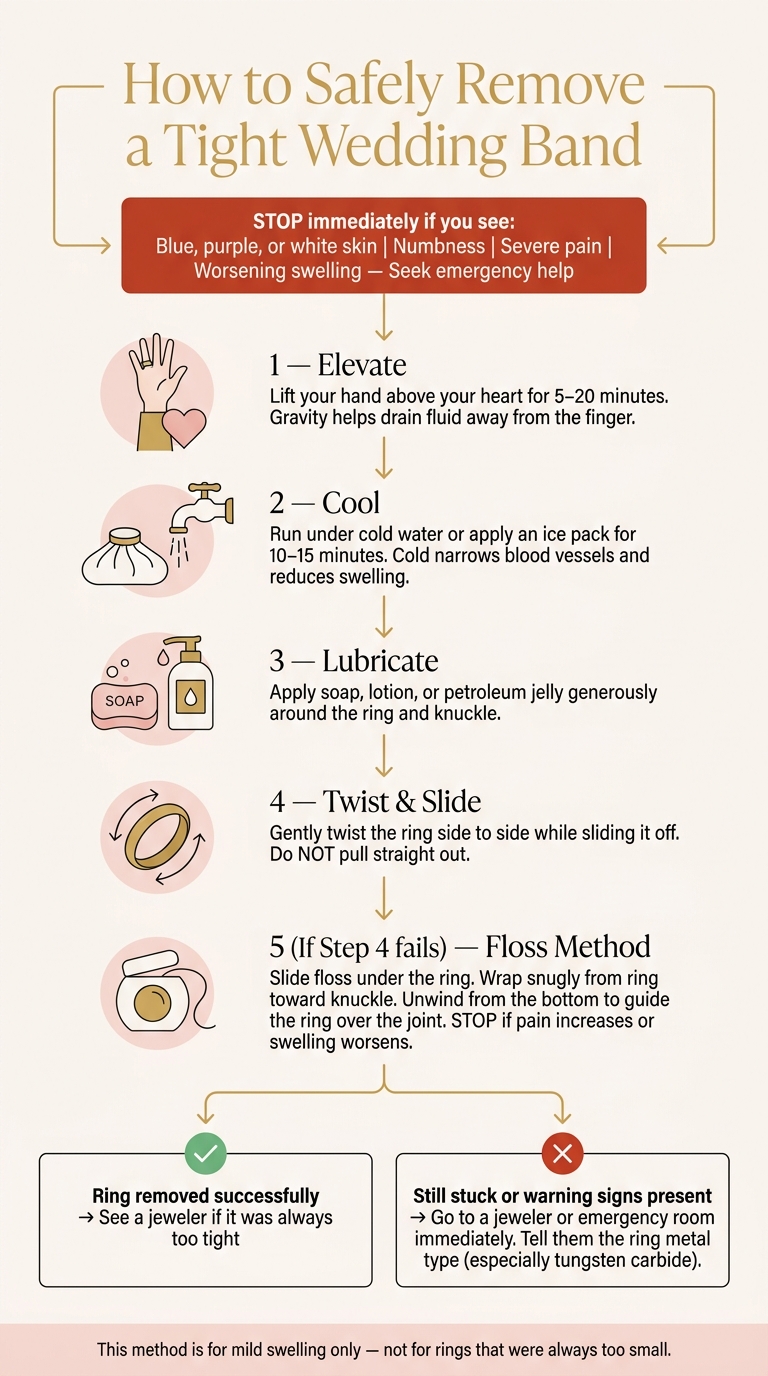
How to Safely Remove a Tight Wedding Band: Step-by-Step Guide
Stop right away if the finger is blue, purple, white, numb, or in severe pain. Home removal is ONLY for mild swelling. If the ring was always too small, this is a jeweler job. This section deals with mild tightness only.
Start with cooling, elevation, and lubrication
Go in this order.
First, lift your hand above your heart for 5 to 20 minutes. Gravity can help move extra fluid away from the finger, and that can shrink the swelling enough to matter.
Next, run the finger under cold water or hold an ice pack against it for 10 to 15 minutes. That helps narrow the blood vessels for a short time and can make the finger a bit smaller.
When the finger feels less swollen, put plenty of lubricant around the ring and the knuckle. Soap, lotion, or petroleum jelly can all work. Then gently twist the ring side to side as you slide it off. Don’t pull straight out. That can scrape the skin and make the ring even harder to remove.
Using floss or string: when it works and when to skip it
If lubrication doesn’t do the trick, dental floss or a thin, strong string may help. Slide the floss under the ring, wrap it snugly from the ring toward the knuckle, then unwind from the bottom so the ring moves over the joint.
This method is best only when the finger is not badly swollen, discolored, or painful. Stop at once if you feel sharp pain or if the swelling gets worse.
If the ring only needs a short-term fit change, switch to temporary fixes instead of trying to force it off again.
Warning signs that mean stop and get help
Some cases are past the point of a home fix. Don’t keep trying to remove the ring yourself if you notice:
- Blue, purple, or white skin on the finger or fingertip
- Numbness or loss of sensation
- Severe throbbing pain during or after removal attempts
- Swelling that gets worse during removal attempts
At that point, get immediate help from a jeweler or an emergency room. Tell them what metal the ring is made from, especially if it is tungsten carbide.
If the ring comes off but still feels tight, the next step is a temporary fix.
Temporary fixes to make the band wearable
If the fit changes from day to day, the fix should match the cause. Use spacers only when the ring feels loose while your finger is at its normal size. If the band is actually tight, you’re looking at removal, a different style, or resizing.
When ring spacers help and when they do not
Ring spacers and sizing coils take up extra room inside a ring that’s a little too big. They can help stop spinning and sliding.
What they don’t do is solve a ring that’s too tight. If your ring fits fine most of the time but gets tight during swelling triggers, take it off before the swelling starts.
Removal methods, temporary adjustments, and permanent fixes compared
Once you know if the ring is loose, tight, or only hard to wear at certain times, the right fix is pretty straightforward.
| Method | Purpose | Use Case | Duration |
|---|---|---|---|
| Spacers/Coils | Stabilizing a loose ring | Ring is too large or finger has shrunk | Short-term |
| Professional resizing | Permanent size change | Stable, long-term finger size change | Permanent |
| Resizable bands | Adaptive fit | Arthritis, pregnancy, or recurring swelling | Lifetime |
For recurring swelling, a resizable wedding band can make day-to-day wear much easier. It opens over the knuckle, then closes more snugly at the base, which helps when the main problem is a finger that changes size over time.
When to see a jeweler and which long-term fix is right for you
Signs your band needs professional resizing
If your ring still feels tight after swelling has gone down, the issue likely isn't temporary anymore. When the tightness happens all the time, not just on certain days, it's time to talk to a jeweler.
A jeweler can help you figure out whether resizing or replacement makes more sense for the band you have. That matters because resizing isn't always simple. It can distort engravings and put stress on delicate gemstone settings. Tungsten and titanium bands usually can't be resized, so they often need to be replaced with a larger size. Full eternity bands can also be hard, or impossible, to resize.
Choosing a resizable wedding band for a finger size that changes
If your finger size changes often due to arthritis, pregnancy, or seasonal swelling, an adjustable band is usually the better long-term fit.
Satinski's adjustable wedding bands use a patented hidden adjustable band, the Allring system, that lets you adjust the fit from US size 5 to 9 without tools. The ring stays round, with no visible adjustment. Options include sterling silver styles starting at $70 and solid 18K gold bands ranging from about $990 to $1,390.
Use the fix that matches the cause: a permanent size change, recurring swelling, or a band that can't be resized.
| Situation | Recommended Fix |
|---|---|
| Stable size change | Professional resizing |
| Arthritis or recurring swelling | Adjustable/resizable band |
| Pregnancy (third trimester) | Adjustable band or temporary spacer |
| Tungsten or titanium band | Replacement band in a larger size |
| Full eternity band | Replacement band |
Conclusion: Match the cause to the right next step
Match the fix to the cause: resize a band that's always too small, or choose an adjustable band if your finger size changes. Get urgent help for numbness, blue or white skin, or severe pain.
FAQs
How tight should a wedding band feel?
A wedding band should fit snugly enough to stay put without sliding off, but not so tight that getting it over your knuckle feels like a struggle.
Your fingers change size throughout the day. Heat, exercise, and even fluid retention can make them swell a bit. That’s why a good fit needs some give. The ring should feel secure, yet still come off without pain or force.
If your ring leaves deep marks, hurts, or seems to cut off circulation, it’s too tight.
Can a tight ring cut off circulation?
Yes. A ring that’s too tight can limit blood flow and press on the skin and tissue around it. That can lead to numbness, tingling, lasting marks on the finger, or even a tourniquet effect if swelling causes the ring to get stuck.
If the pain gets worse, the finger turns red, starts throbbing deeply, looks blue or gray, or the numbness and tingling don’t go away, get urgent medical help instead of trying to force the ring off.
Should I remove my ring before exercise or hot weather?
Yes. Exercise and hot weather can make your fingers swell, which can make your ring feel tight or even get stuck.
If you notice swelling, take your ring off right away. It’s much easier to remove early than after your finger swells more.


