


Ring Guards, Adjusters and Snuggies: Why They All Fail Eventually
Most ring sizers fail because daily wear breaks them down. If your ring guard, snuggie, spring insert, or stick-on pad gets wet, bends, traps soap, or shifts inside the band, it stops fixing the fit and can start causing skin rash, pinching, or even ring loss.
Here’s the short answer: temporary ring sizers are for short-term use, not daily wear for months or years. Many only fix about up to 1/2 size, while finger size can change by 0.5 to 1 full size from temperature and swelling, and 1 to 2 sizes during pregnancy. That mismatch is why these add-ons often stop working.
If I had to sum up the whole article in a few points, it would be this:
- Metal guards and spring inserts can lose tension, shift, scratch softer metals, and create sore pressure spots.
- Silicone and plastic snuggies can trap moisture, soap, lotion, and dirt, which may lead to ring rash and odor.
- Adhesive pads can peel off with handwashing or sanitizer and often leave sticky residue behind.
- If a ring still spins, pinches, or irritates your skin after replacing the sizer more than once, the add-on is now part of the problem.
- A professional resize often costs about $40 to $150 in the U.S. and is usually the cleaner fix for a steady size.
- If your fingers change size often, a built-in adjustable ring may make more sense than adding another insert.
Quick comparison
| Option | Works well at first for | Main problem over time | Best use |
|---|---|---|---|
| Metal guard / spring insert | Loose rings that need extra hold | Bends, shifts, pinches, may scratch ring | Short-term wear |
| Silicone / plastic snuggie | Mild looseness and at-home fixes | Traps buildup, stretches, turns cloudy | Short-term wear |
| Adhesive pad | Very small fit change | Peels, slides, leaves residue | Very short-term use |
| Professional resizing | Steady finger size | Not ideal for every ring style | Long-term fix |
| Built-in adjustable ring | Finger size changes during the day or season | Higher upfront cost | Long-term wear |
Bottom line: if your ring fit problem keeps coming back, another guard or snuggie usually won’t solve it for long. At that point, I’d look at a proper resize or a ring made to adjust from the start.
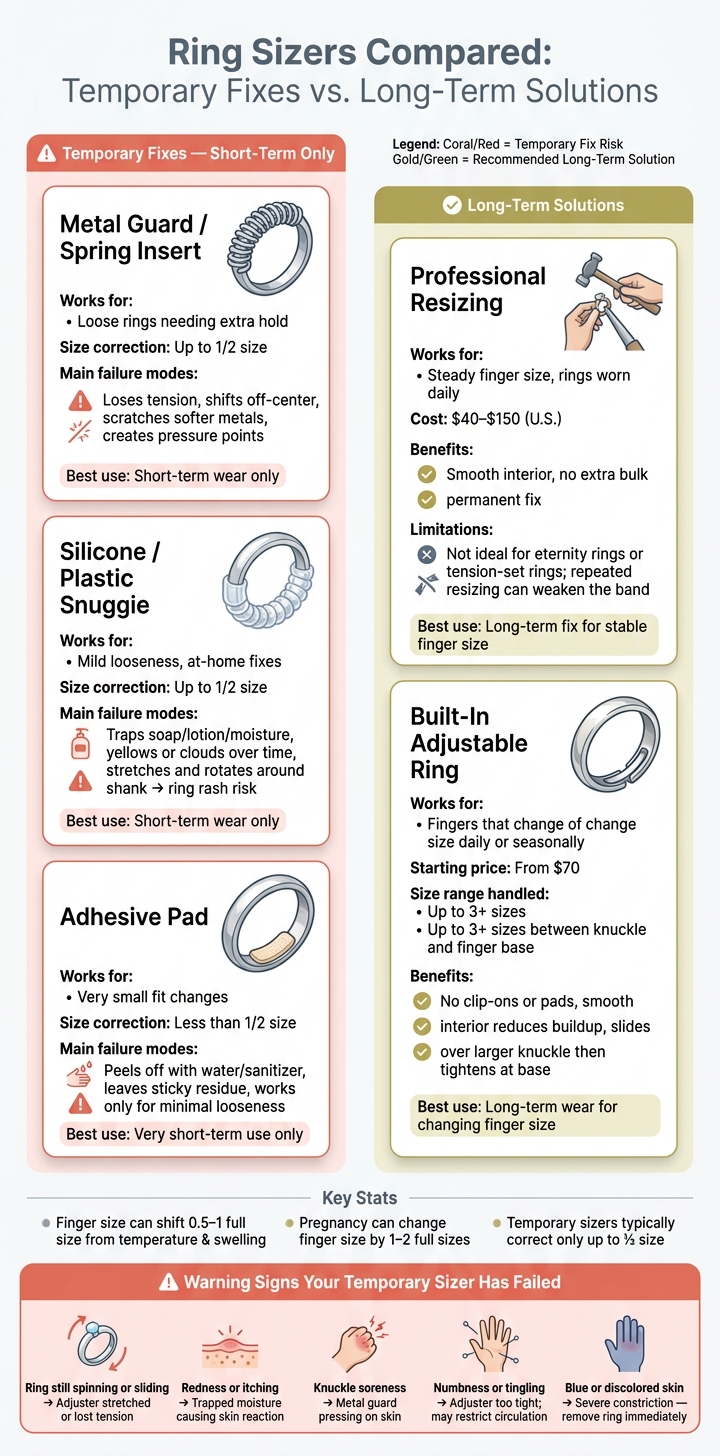
Ring Sizer Comparison: Temporary Fixes vs. Long-Term Solutions
How to Make Your Ring Fit Smaller: At Home DIYs & Professional Options
sbb-itb-9da40c1
How Ring Guards, Snuggies, and Adjusters Fail During Daily Wear
Temporary ring sizers each fail in their own way, and the weak spot usually comes down to the material. In day-to-day wear, those problems tend to show up in three forms: metal fatigue, trapped buildup, and adhesive breakdown.
Here’s the short version:
| Type | How It Works | Initial Benefit | Failure Mode |
|---|---|---|---|
| Metal ring guard / spring insert | Clips onto or sits inside the bottom of the band to narrow the inner diameter | Feels secure; reduces spinning on top-heavy rings | Loses tension from repeated flexing; shifts out of place; scratches softer metals; creates pressure points when fingers swell |
| Plastic or silicone snuggie | Wraps around the inside of the band to add padding | Comfortable, nearly invisible, easy to add at home | Traps soap, lotion, and moisture; yellows or clouds over time; stretches out and rotates around the shank |
| Adhesive bump / DIY pad | Stick-on pad adds a small amount of bulk to the inner shank | Stops spinning immediately; easy to apply at home | Peels off with water and sanitizer; leaves sticky residue; works only for very small size changes |
Metal Ring Guards and Spring Inserts: Loosening, Scratching, and Pressure Points
Metal guards and spring inserts press against your finger from inside the band. At first, that can make the ring feel snug and steady. But with repeated flexing, the metal starts to lose tension. Once that happens, the guard no longer holds the ring the way it should.
Then the trouble starts. The guard can shift off-center and create pressure points, especially when fingers swell in summer heat or after exercise. Many wearers describe this as a pressure point on the underside of the finger. Instead of helping the ring sit right, the insert can make it spin, pinch, or both.
There’s also the metal-on-metal issue. Many guards are made from metals that are harder than fine jewelry alloys, so they can scratch or wear down softer metals like 18K gold where the guard rubs during movement. It’s a bit like putting a stiff clip inside something meant to move gently with your hand.
Plastic and Silicone Snuggies: Trapped Moisture, Dirt, and Material Breakdown
Plastic and silicone snuggies often feel more comfortable at first. They sit right against the skin and add a bit of cushion, which is why so many people try them at home.
The downside is what they trap. Soap film, lotion, hand sanitizer, sweat, and skin oils can collect between the ring and your finger. Over time, that buildup creates a grimy layer that can lead to irritant contact dermatitis, the same "ring rash" dermatologists link to trapped moisture and residue under bands.
The material itself also wears down. Clear coils that start out almost invisible can turn cloudy or yellow with UV light, body oils, and cosmetic chemicals. And with repeated bending at the knuckle, tubing-style snuggies can stretch, harden, or form small cracks. When that happens, the snuggie can rotate around the shank, and the ring starts slipping again.
Even when the ring looks fine from the top, the part underneath can get messy fast.
Adhesive Bumps and DIY Adjusters: Peeling, Residue, and Weak Size Correction
Adhesive pads seem like the easiest fix. Stick one inside the band, and the ring may stop spinning right away. That instant change is why they’re so tempting.
But water and sanitizer are hard on glue. Repeated handwashing, showering, and alcohol-based sanitizers can soften the adhesive, which causes the pad to lift at the edges, slide around, or fall out altogether. After that, you’re often left with sticky residue inside the band that needs rubbing alcohol to remove. In textured bands or detailed settings, that residue can be a pain to clean out.
There’s also a sizing limit. Even when the pad stays put, it usually corrects less than 1/2 size. So if the ring is more than slightly loose, the fix doesn’t go far enough. The wearer ends up replacing or reapplying the pad again and again, without getting a fit that lasts.
When a Temporary Fix Becomes the Problem
At some point, a worn sizer stops solving the fit issue and starts causing new ones. What began as a simple fix can turn into a problem with comfort, wear, and even safety.
Warning Signs: Spinning, Sliding, Pinching, and Skin Irritation
The clearest sign is simple: the old issue comes back. If the ring starts spinning or sliding again, the fix has likely run out of road.
| Warning Sign | Likely Cause | What It Signals |
|---|---|---|
| Ring still spinning or sliding | Adjuster has stretched out or lost tension | The material has reached its limit |
| Redness or itching | Trapped moisture under plastic/silicone | A hygiene hazard or skin reaction |
| Knuckle soreness | Metal guard pressing against the skin | A pressure point that will worsen |
| Numbness or tingling | Adjuster too tight during heat or exercise | Circulation may be restricted |
| Blue or discolored skin | Severe constriction of blood vessels | A safety risk - remove the ring immediately |
Numbness, tingling, or discoloration are not minor annoyances. They mean the ring is too tight. If you notice any of them, take the ring off right away.
Why Finger Size Changes Expose the Limits of Add-Ons
Finger size doesn't stay the same all the time. It can shift with temperature, salt intake, activity, pregnancy, weight changes, arthritis, and age. So a fixed add-on may feel fine one day, then too tight or too loose the next.
That’s the core issue with static inserts: they don’t move with your body. And when your finger changes, even a little, that mismatch shows up fast.
How a Worn-Out Adjuster Can Lead to Ring Loss or Costlier Repairs
A low-cost adjuster can still lead to a much bigger bill. Spring guards can wear down the shank and turn a small fit issue into a costlier repair. And if a loose plastic adjuster stops holding the ring in place, there’s a real chance the ring could fall off.
Professional resizing in the United States usually costs between $50 and $150. So when a temporary sizer wears out, it should be treated for what it is: a short-term fix, not something to rely on for the long haul.
Better Long-Term Solutions for a Reliable Fit
Once a temporary sizer wears out, stretches, or starts irritating your skin, it stops fixing the fit and starts adding hassle. At that point, two long-term paths make sense: professional resizing or a ring made to adjust from the start.
Professional Resizing for Rings That Need a Stable Size
If a ring needs a permanent size change, the fix should come from the band itself, not another add-on.
Professional resizing makes sense when a ring is consistently more than half a size off, gets worn every day, or has already gone through repeated guards or snuggies. A jeweler can size a plain band up or down by adding or removing metal. That leaves you with a smooth interior and no extra bulk.
Simple bands and classic solitaires are usually the easiest to resize. Rings with stones all the way around the band, like eternity rings, and tension-set rings are much harder to alter without shifting stone placement. And there’s a limit here: repeated resizing can weaken the band, especially after more than a couple of size changes. In the U.S., a plain resize usually costs $40 to $100. More involved work can cost more.
Purpose-Built Adjustable Rings for Fingers That Change Size
If your fit changes during the day, the ring needs built-in adjustment, not a removable insert.
For fingers that swell or shrink from heat, salt intake, pregnancy, weight changes, or arthritis, a fixed size can feel fine in the morning and wrong by afternoon. A purpose-built adjustable ring solves that by building the adjustment into the band itself. That means no clip-ons, no stick-on pads, and fewer of the usual annoyances.
The smooth interior helps cut down on buildup, snagging, and pressure points. It can also slide over a larger knuckle, then tighten at the base of the finger. Some specialized adjustable shanks can handle a gap of 3 or more sizes between the knuckle and the finger base. Temporary guards usually can’t do that without getting bulky and unstable.
How Satinski Adjustable Rings Address Everyday Fit Problems
This is where a built-in adjustable design starts to look like the better long-term answer.
Satinski's adjustable rings use a hidden mechanism that lets the band open and close without outside clips or visible hardware. Because the adjustment is part of the ring, there’s no separate piece to stretch out, peel away, or collect debris. The ergonomic interior spreads pressure more evenly, which helps reduce the tight spots common with standard fixed bands.
Pricing starts at $70, with adjustable engagement rings starting at $90. Custom orders vary based on design and material. All rings fit U.S. sizes 5 to 9 and come in sterling silver and 18K gold options that are hypoallergenic, lead-free, and nickel-free.
If your finger size stays steady and the ring can be resized safely, one professional resize may do the job. If your size shifts often or the ring shape makes resizing tough, a built-in adjustable ring cuts out the repeat upkeep.
The right pick comes down to one thing: is the fit issue permanent, or does it change?
Conclusion: Temporary Sizers Wear Out, but Better Fit Solutions Last Longer
Ring guards, snuggies, silicone tubes, spring inserts, and adhesive pads all have the same weak spot: they're made for short-term fixes, not years of daily wear. Over time, they loosen, wear down, or stop giving you a steady fit. They don't change the ring itself. They just fill a gap, and most can only fix about half a ring size with any consistency.
That matters more than it seems. Once the fit starts changing from day to day, or even hour to hour, you're no longer solving the problem. You're just managing it.
If the ring still spins, slides, or irritates your skin after you've replaced the insert more than once, the temporary fix isn't doing its job.
From there, the decision is pretty simple. If your finger size stays steady, one professional resizing is often the cleaner, lower-maintenance choice. No extra pieces. No added bulk. Just a smooth band that fits the way it should.
If your finger size changes often because of heat, arthritis, or a larger knuckle than the base of your finger, a purpose-built adjustable ring like Satinski's makes more sense. The adjustment is built into the ring itself, not added on later. So there's nothing extra to stretch out, peel off, or swap again a few months down the line.
For a ring you wear every day, a permanent resize or a built-in adjustable design will usually outlast any add-on.
FAQs
How long can I safely wear a ring adjuster?
Ring adjusters, like silicone inserts or ring snuggies, are best used as short-term fixes for small, temporary fit changes.
They’re not a good long-term answer. Over time, they can wear down, slip out of place, trap moisture, and collect dirt. If you find yourself adjusting your ring all the time, that’s usually a sign to talk to a professional jeweler or look into a ring with a permanent adjustable design.
Can a ring snuggie cause skin irritation?
Yes. A ring snuggie can irritate your skin, especially if it pinches or rubs. The main issue is simple: it sits on the underside of the band instead of giving you a smooth, close fit.
If your ring starts to feel too tight out of nowhere, or you notice steady discomfort or redness, stop wearing it and get the fit checked. If you have sensitive skin, look for a smooth, hypoallergenic interior contact.
Should I resize my ring or buy an adjustable one?
It comes down to why the ring doesn’t fit.
If your finger size has changed for good, professional resizing is usually the best fix, as long as the ring’s design and metal can handle the change without weakening the ring.
But if your finger size shifts often because of temperature, activity, pregnancy, or arthritis, an adjustable ring is often the better long-term option. It gives you more flexibility day to day and can help you avoid repeat trips for resizing, plus the extra wear that can come from changing a fixed-band ring again and again.


