


Lymphedema After Mastectomy: Choosing Rings That Never Leave a Mark
If a ring leaves a mark, feels tight, or gets harder to remove later in the day, I treat that as a warning sign. After mastectomy, hand and finger swelling can change from hour to hour, so the safest ring is one that stays light, smooth, easy to remove, and does not leave a lasting groove.
Here’s the short version:
- About 1 in 5 breast cancer survivors may develop lymphedema.
- Hand swelling can be part of it, and ring fit may change by afternoon.
- I look for rings with:
- Smooth interiors
- Rounded edges
- Low-profile settings
- Easy removal
- Ring types that often work best:
- Adjustable rings
- Open-band rings
- Silicone rings
- Custom resizable rings
- I remove the ring right away if I notice:
- Numbness
- Tingling
- Color change
- Cool skin
- A deep groove
- Trouble getting it off
Quick Comparison
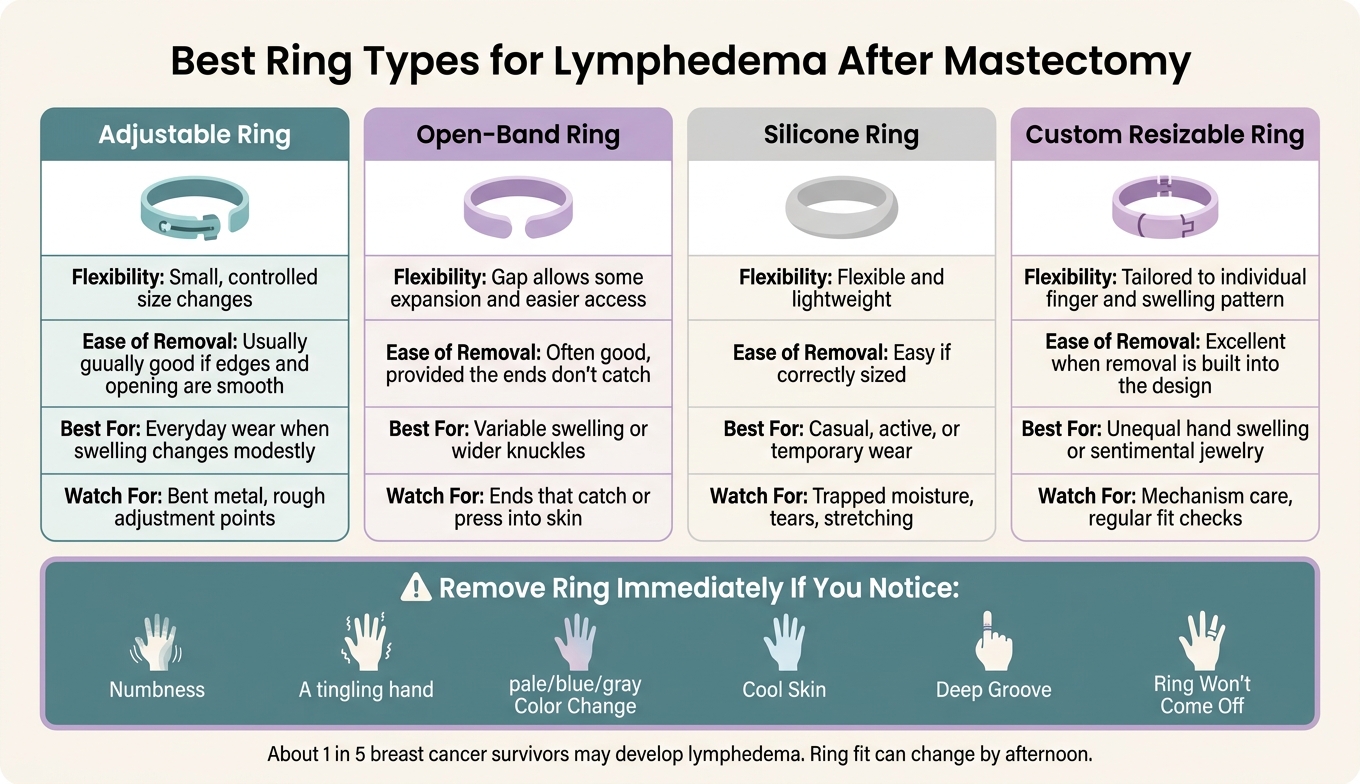
Best Ring Types for Lymphedema After Mastectomy
| Ring type | Best for | Watch for |
|---|---|---|
| Adjustable | Small day-to-day size changes | Bent metal, rough adjustment points |
| Open-band | Swelling that comes and goes | Ends that catch or press into skin |
| Silicone | Casual wear, exercise, work | Trapped moisture, tears, stretching |
| Custom resizable | Sentimental rings or uneven swelling | Mechanism care, fit checks |
My bottom line: I would pick the ring that comes off with little effort, stays dry underneath, and leaves no lasting mark. If a finger turns pale, blue, gray, cold, or painful, I would get urgent medical help.
sbb-itb-9da40c1
What to look for in a ring when finger size changes daily
With lymphedema, the goal isn't a perfect fit. It's a ring that feels light, smooth, and easy to remove as swelling shifts during the day. The features that matter most are pretty simple: a smooth interior, rounded band edges, no exposed prongs, no rough solder joints, and enough room so the ring doesn't press into a bent finger.
That's why adjustable, open-band, silicone, and custom resizable rings are usually the best place to start.
Adjustable and open-band rings for day-to-day flexibility
Adjustable rings use an adjustable or open-ended band so you can make small, controlled size changes as swelling moves up and down. Open-band styles leave a set gap between the ends of the band. That extra space can give the finger a bit more room and often makes removal easier than with a fully closed ring.
That said, resizing should stay limited. Repeated bending can weaken metal and leave behind sharp spots. If you need to resize a precious-metal adjustable ring, it's safer to have a jeweler handle it instead of doing it at home.
Before you wear either style for the day, take a close look at the band ends. They should be smooth and lined up properly. Then move your finger through normal tasks like making a fist, gripping a cup, or fastening a button. You're checking for three things: comfort, easy removal, and no pressure points.
Silicone and custom resizable rings for lower-pressure wear
Silicone rings can work well for casual wear, active days, or work settings. They're lightweight, flexible, and less likely to snag than a metal band. You'll still want to remove and dry both the ring and your finger on a regular basis. If the ring starts to show tears, stickiness, or discoloration, it's time to replace it.
A custom resizable design makes more sense in a few specific cases. For example, one hand may swell more than the other. Or the knuckle and finger base may be very different in size. Sometimes the issue is emotional as much as practical: a meaningful ring needs to fit in a way that feels secure without becoming hard to remove.
In those cases, a jeweler can build in details like a wider opening, a hinged mechanism, or a smooth interior sized to your largest comfortable size. That helps the ring stay wearable on lower-swelling days without turning into a hazard on higher-swelling ones.
Ring type comparison for fingers that swell and shrink
| Ring type | Flexibility | Ease of removal | Skin-contact considerations | Durability | Best use case |
|---|---|---|---|---|---|
| Adjustable ring | Small, controlled size changes | Usually good if edges and opening are smooth | Inspect adjustment points and seams for pinching; avoid overtightening | Depends on metal; frequent forceful bending weakens it | Everyday wear when swelling changes modestly |
| Open-band ring | Gap allows some expansion and easier access | Often good, provided the ends don't catch | Rounded, polished ends are essential; a wide gap can snag clothing | Metal may fatigue if repeatedly bent | Variable swelling or wider knuckles |
| Silicone ring | Flexible and lightweight | Easy if correctly sized | Keep clean and dry; inspect for trapped moisture or rolling edges | Can stretch, tear, or degrade with heat and chemicals | Casual, active, or temporary wear |
| Custom resizable design | Tailored to the individual finger and swelling pattern | Excellent when removal is built into the design | Custom polishing and low-profile settings reduce pressure points | Often durable when professionally made; mechanisms need occasional maintenance | Unequal hand swelling or sentimental jewelry needing a personalized fit |
Once you've picked a style, the daily fit check is what tells you whether it's still safe to wear.
How to check ring fit before it becomes a problem
With lymphedema, ring size can shift by afternoon. That’s why you need to check fit more than once a day. Even a flexible ring can become unsafe as swelling changes, so check it twice a day. A ring should stay removable, feel light, and leave no mark. These checks help you tell if that’s still true.
Daily fit checks to run before keeping a ring on
Before you put the ring on, look at the finger first. If it already feels full, heavy, tender, numb, or painful, or it looks different than usual, skip the ring that day.
If the finger seems steady, try the ring on. It should slide over the knuckle with only light resistance. No forcing. No twisting it against the skin.
Once it’s on, see how it acts during normal movement. Slowly bend and straighten the finger. Then open and close your hand. The ring should allow normal bending and gentle rotation without pinching or needing force.
After that, take the ring off and check the skin. Then do the same check again later in the day, after normal hand use. If the ring is harder to remove than it was in the morning, take it off right away and leave it off until the swelling settles.
Skin changes that mean the ring is no longer safe to wear
After removing the ring, inspect the skin under and around the band. A deep groove, redness that sticks around, or tenderness are clear signs to stop wearing it. That pressure may be too much for tissue that’s already having trouble draining fluid.
Take the ring off at once if you notice:
- Numbness
- Tingling
- A color change in the fingertip or nail, such as pale, bluish, or dusky skin
- Unusual coolness
- Pressure that keeps building instead of easing
Pain, numbness, tingling, or any finger color change means the ring needs to come off now.
If the ring gets stuck, don’t force it. Get urgent medical help if the finger is painful, discolored, or cold. And if you notice spreading redness, warmth, drainage, or a fever of 100.4°F (38°C) or higher, contact a clinician promptly. Those are infection warning signs, not just a fit issue.
Materials and construction details that affect daily comfort
A ring’s shape, weight, and material all play a part in day-to-day comfort, especially when finger swelling shifts over the course of the day. That matters more than it may seem. A ring can feel fine in the morning and still leave a mark later when swelling goes up.
Design details that reduce pressure on swollen fingers
Look for a smooth, polished interior and rounded edges. Those details help cut down on rubbing and pressure as your finger size changes. A comfort-fit interior usually puts less pressure on the finger than a flat band.
A light, narrow band with stones set close to the band is often easier to wear. It tends to press less, rotate less, and snag less. Before you buy, run a clean fingertip along the inside of the band. It should feel completely smooth - no ridges, no rough solder points, and no sudden transitions.
Skip sharp prongs, rough textures, tight pierced-out decorative patterns, and heavy stones. These can create small high-pressure spots or catch skin folds, which is the last thing a finger needs when it’s already having trouble draining fluid.
Even when a ring is well made, it should still feel light, smooth, and easy to remove.
Sterling silver, 18K gold, and silicone: care and skin considerations
Sterling silver is light, but it’s an alloy rather than pure silver. Ask for the exact metal mix and confirm that it’s nickel-free, especially if you have sensitive skin or a history of metal reactions. Silver can tarnish, and it may react with sweat, lotion, or cleaning products. Follow the jeweler’s care instructions, dry it fully after cleaning, and check it now and then for worn or rough spots.
18K gold: Choose nickel-free 18K yellow gold if you want a higher-gold alloy with a lower chance of nickel exposure.
Silicone rings are flexible and light, which can make them a good pick for lower-pressure wear. But flexibility isn’t the whole story. Silicone can hold heat, sweat, soap, and moisture against the skin. Take it off on a regular basis, wash both the ring and your finger with mild soap and water, rinse well, and dry everything fully before putting it back on. The Royal Marsden specifically recommends drying carefully between fingers and under rings, because retained moisture can contribute to skin breakdown.
No material is automatically safe. And a hypoallergenic label is not a promise. If you notice redness, itching, burning, scaling, or a rash, stop wearing the ring and contact a clinician if it doesn’t clear up. Never wear a ring over broken, blistered, draining, or infected skin.
Construction matters, but the day-to-day fit is what tells you whether a ring can stay on.
When to take the ring off and contact a clinician
Daily fit checks aren't only about comfort. They can warn you that a ring needs to come off before a small issue turns into a bigger one.
Signs that mean the ring must come off immediately
Treat day-to-day fit changes as your stop sign. If a ring starts to pinch, leave a groove, or feel tighter than usual, take it off.
Remove the ring right away if any of these happen while you're wearing it:
- Swelling is getting worse and the band feels tighter than when you first put it on
- A deep or lasting groove or indentation shows up
- The finger becomes painful, numb, tingly, or unusually cold
- The fingertip looks pale, white, blue, purple, or gray
- The ring no longer slides off with gentle movement
Never force a ring over a swollen knuckle. Pulling, twisting, or pushing too hard can damage skin that's already at risk. If gentle soap and water don't work, stop trying to remove it at home and get professional help. A clinician or emergency department can remove it safely. A pale, blue, gray, cold, numb, or severely painful fingertip needs urgent care.
After removal, check the skin closely. A mark that fades is a sign that the fit changed. But if you see a lasting indentation, blister, crack, or open skin, keep the ring off and contact a clinician.
Contact your lymphedema specialist promptly if swelling continues after removal or shows up with redness, warmth, tenderness, fever, chills, or flu-like symptoms.
Use this as a quick removal guide.
| Situation | What to do |
|---|---|
| Light mark, fades quickly, finger looks and feels normal | Remove the ring, monitor, and think about a looser or adjustable style |
| Increasing swelling, deep indentation, pain, tingling, or numbness | Remove immediately; contact your care team if symptoms continue |
| Pale, blue, gray, cold, severely painful, or immobile finger | Seek urgent medical care; do not force removal |
| Red, hot, tender skin with fever, chills, or flu-like symptoms | Seek same-day medical advice - possible infection |
| Ring won't move with gentle handling | Stop home attempts; get professional removal |
Conclusion: the best ring stays removable, light, and mark-free
Post-mastectomy lymphedema doesn't mean you have to give up meaningful jewelry. It does mean choosing rings that stay light, easy to remove, and free of lasting marks.
A daily check of color, warmth, sensation, movement, and skin marks can catch trouble early. The right ring stays comfortable, comes off without a struggle, and doesn't leave a lasting mark.
FAQs
Can I still wear my wedding ring with lymphedema?
Yes - if you choose a ring that can handle day-to-day swelling. Fixed-size rings can get uncomfortable, and in some cases unsafe, when fingers swell because they may restrict circulation.
Better options include adjustable rings with open-band or hidden resizing features, silicone bands for more give, or wearing your original ring on a necklace so it stays close without risking irritation or circulation issues.
How loose should a ring fit if my fingers swell during the day?
It should fit snugly enough to stay in place at the base of your finger without spinning, but still slide over your knuckle without a struggle.
That’s where adjustable rings can help. If your fingers swell during the day, a fixed-size ring may start to feel too tight or a bit loose. An adjustable ring makes it easier to fine-tune the fit, so it stays comfortable and secure.
What should I do if a ring suddenly feels tight or gets stuck?
Don’t panic or yank on the ring. Pulling hard can make the swelling worse.
Instead, hold your hand above heart level for 5 to 10 minutes. Then try ice or cold water to bring the swelling down. You can also add a little soap, oil, or hair conditioner and gently twist the ring off.
If that doesn’t work, try the dental floss method. If the ring still won’t budge, or your finger turns white or blue or starts to feel numb, get medical help right away. A jeweler may also be able to remove it safely.


