


Guide to Choosing Rings for Swollen Joints
If your knuckle is larger than the base of your finger, the best ring is usually one that opens, flexes, or adjusts. That is the core issue: many people with swollen joints need a ring that can pass over the knuckle without getting stuck, then sit more securely once it is on.
I’d boil the article down to this:
- Size for the knuckle first, not the base of the finger
- Hinged, open-band, split-shank, stretch, and silicone rings tend to work better than fixed bands
- Sizing beads, inserts, sleeves, and wraps can help if the ring feels loose at the base
- Titanium, sterling silver, 18K gold, stainless steel, and silicone each feel different in weight, skin feel, and upkeep
- Smooth interiors, rounded edges, and low-profile settings can feel better on sore fingers
- Do not force a tight ring off if swelling is sudden, painful, or cuts off circulation
One fact stands out: swollen knuckles can be 2 to 4 ring sizes larger than the base of the finger. That explains why a ring may fit in one spot but fail in another. The piece also notes that arthritis affects tens of millions of U.S. adults, which helps explain why this fit problem is so common.
Here’s the short version: if I were buying a ring for swollen joints, I’d look first at hinged adjustable styles, then soft or flexible options for mild swelling, then fit aids for rings I already own. I’d also measure my finger in the morning and evening, use the larger number, and make sure the ring can still come off on a bad swelling day.
3 X Ring Solutions For Larger / Irregular Knuckles #jewelrytips
sbb-itb-9da40c1
Quick comparison
| Option | Best for | Main upside | Main downside |
|---|---|---|---|
| Hinged adjustable ring | Large knuckle, smaller finger base | Opens wide, then closes more snugly | More moving parts to clean and check |
| Open-band ring | Mild to moderate swelling | Some give over the knuckle | May feel less secure for some people |
| Split-shank ring | Classic look with more room | Spreads pressure across the finger | Not as adjustable as hinged styles |
| Stretch or silicone ring | Day-to-day swelling changes | Soft, light, easy to put on | Wears out faster than metal |
| Fixed ring with beads/inserts | Existing ring that spins | Helps steady the fit at the base | Works only if ring removal is still safe |
If you want the shortest takeaway: buy for safe knuckle clearance first, then fine-tune the fit at the base.
Ring Designs That Work Best for Swollen Knuckles
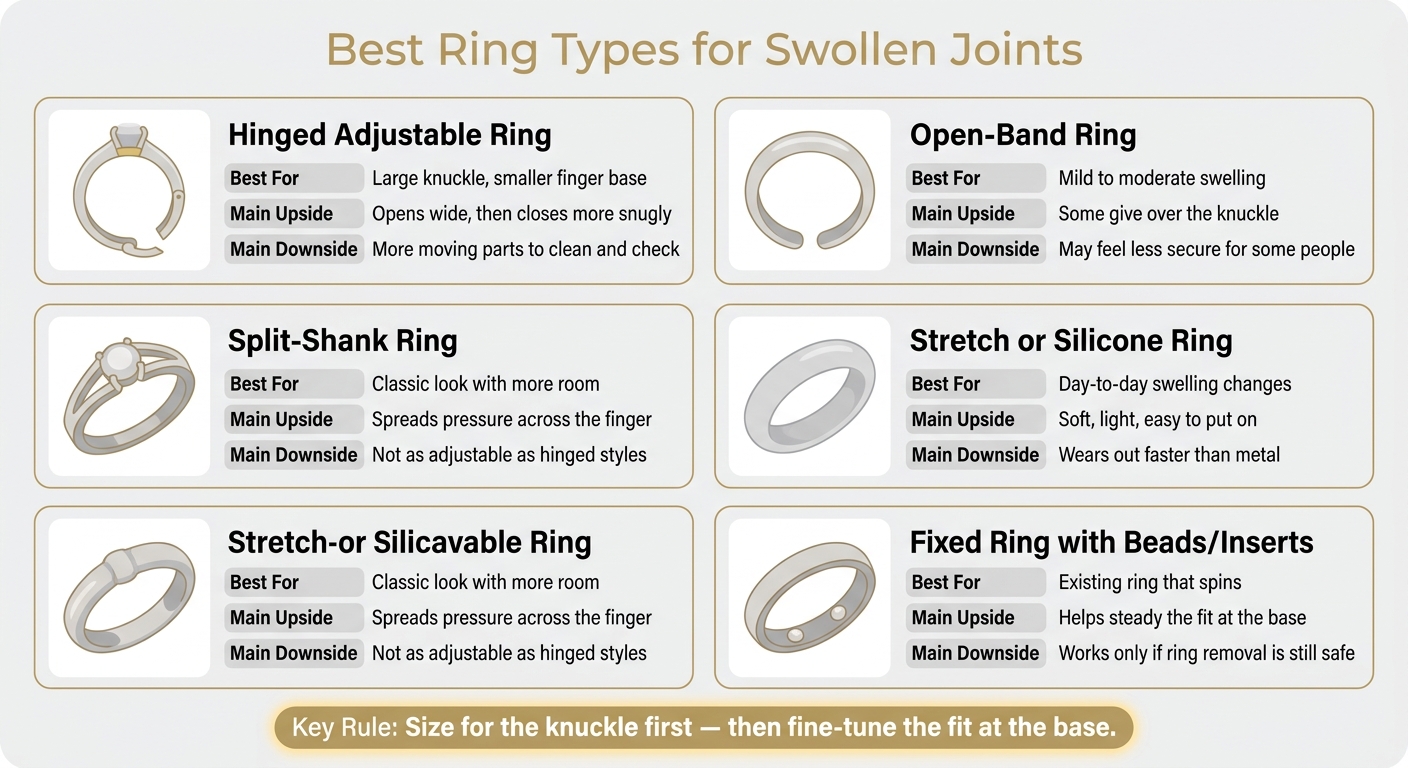
Best Ring Types for Swollen Joints: Options at a Glance
The best ring styles for swollen knuckles have one thing in common: they give the knuckle more room. That usually means the ring can flex, open, or shift a bit instead of forcing a fixed circle over a larger joint.
Open-Band, Split-Shank, and Hinged Rings
Open-band rings have a small gap in the band. That gap lets the ring flex slightly as it moves over the knuckle, instead of pushing a rigid band over a wider joint. Smooth, rounded ends matter here. They help avoid pressure points when swelling kicks in.
Split-shank rings separate the band into two arms that spread across the finger before meeting at the top setting. That spread helps distribute pressure more evenly and adds a little extra room at the knuckle. If you want a more classic look but still need a bit more space, this style makes a lot of sense.
Hinged adjustable rings open wide with a hinge, then close for a snug fit at the base of the finger. Some expanding rings open several sizes without tools, which makes them much easier to get over larger knuckles. For daily wear, engagement rings, and wedding bands, this style often hits the sweet spot between comfort, appearance, and security.
If you'd rather skip hinges and metal parts, the next options go in a softer direction.
Flexible Rings and Fit Solutions for Existing Rings
Stretch rings and silicone rings are a good match for mild to moderate swelling. They're easy to put on, more forgiving when finger size changes during the day, and often feel better on sensitive skin. Silicone is especially handy for active wear or for days when swelling comes and goes. The trade-off is simple: they wear out faster than metal, and they don't look as polished.
If you already have a ring you don't want to replace, a few fit tools can help:
- Sizing beads: Small metal balls added inside the band. They help cut down on spinning and keep the ring steadier at the base of the finger.
- Spring inserts or inner sleeves: These help bridge the gap between a larger knuckle and a smaller finger base without changing the ring for good.
- Ring wraps: These add an extra layer around part of the band to tighten the fit.
These options work best when swelling is mild to moderate and the ring can still come off safely.
For most people, hinged adjustable rings offer the best mix of comfort, fit, and security.
Satinski Adjustable Rings for Daily and Occasion Wear
Satinski makes hidden-adjustment rings in sterling silver and 18K gold, with styles that include engagement rings, wedding bands, and stacking rings. That hidden fit adjustment helps when your hands swell during the day, but you still want a ring that looks right for both everyday wear and special occasions.
Materials and Comfort Features to Look For
Once a ring gets past the knuckle, the next thing that matters is how it feels on a swollen finger. And that comes down to the material more than the look. On swollen joints, the material affects pressure, skin irritation, and day-to-day comfort.
Best Metals for Sensitive or Painful Fingers
Titanium is a strong pick for sensitive fingers because it’s light, biocompatible, and usually hypoallergenic. That low weight can make a swollen finger feel less burdened. The catch: titanium is harder to resize than softer metals.
18K gold (75% pure gold) works well if you want a more classic fine-jewelry option. Yellow 18K gold has a lower nickel risk than many white gold alloys, and the higher gold content is often gentler on sensitive skin than 10K or 14K choices. The trade-off is simple: it’s much heavier than titanium, and that extra weight can be more noticeable on a swollen finger.
Medical-grade stainless steel is durable and budget-friendly, but if you’re sensitive to nickel, check the alloy before you buy. Sterling silver is softer and easier to resize, which can help if your swelling changes over time. But it does need regular polishing to prevent tarnish, and it scratches more easily than steel or titanium.
| Material | Hypoallergenic | Weight | Durability | Care Needs | Typical Price (USD) |
|---|---|---|---|---|---|
| Titanium | Excellent; biocompatible | Very light (~4.5 g/cm³) | Very high | Low; mild soap and water | $30–$500 |
| 18K Gold | Good; confirm nickel-free for white gold | Heavy (~15.5 g/cm³) | Good; softer than steel | Gentle cleaning; protect from dents | $200–$1,000+ |
| Medical-grade Stainless Steel | Good when surgical-grade/nickel-free | Light-medium (~7.9 g/cm³) | High | Low; corrosion-resistant | $20–$100 |
| Sterling Silver | Often suitable; alloy matters | Medium (~10.4 g/cm³) | Moderate; scratches and tarnishes | Regular polishing; avoid harsh chemicals | $20–$150 |
| Medical-grade Silicone | Excellent; non-metal | Very light | Moderate; may tear over time | Wash with mild soap; replace when worn | $10–$50 |
Soft Materials, Smooth Finishes, and Lightweight Profiles
Medical-grade silicone has one big advantage: it stretches a bit as fingers swell. Instead of pushing force into the joint, it absorbs impact. It’s also temperature-neutral, which helps it stay comfortable through hot and cold weather. The downside is wear. Silicone won’t last like metal, so you should expect to replace it over time.
Material is only part of the story. Small design details can make a big difference in daily wear. Rounded or beveled interior edges help a ring move over a swollen knuckle and reduce pressure points. A polished inner surface lowers friction against inflamed tissue. And low-profile settings - like bezels or flush-set stones - are usually a safer bet than high prongs because they’re less likely to snag on clothing or catch on a stiff, swollen finger.
If you’re choosing between two rings made from similar materials, go with the one that has the smoother interior and the lower-profile setting.
Even the best material can feel awful if the size is wrong, so the next step is measuring the knuckle the right way.
How to Measure and Size Rings for Swollen Joints
Getting the size right gets tricky when your fingers change over the course of the day. A finger can be slimmer in the morning and more swollen by evening, so one quick measurement can leave you with a ring that feels fine at noon and awful later.
Measure at Different Times and Size for the Knuckle First
Measure at least twice: once in the morning and once in the evening, when swelling is often at its worst. Use the larger measurement as your baseline. If a ring fits only on your good days, it can become painful or hard to remove during a flare-up.
To measure at home, wrap a nonstretch string or a strip of paper around the knuckle, mark where it overlaps, and then measure that length in inches. If you already have a ring sizer, use that instead. Start with the larger knuckle measurement, then fine-tune for the base of the finger. After that, compare the number to the table below to find a starting size.
| U.S. Ring Size | Approx. Finger Circumference |
|---|---|
| 5 | 1.94 in |
| 6 | 2.04 in |
| 7 | 2.14 in |
| 8 | 2.24 in |
| 9 | 2.35 in |
| 10 | 2.44 in |
| 11 | 2.54 in |
| 12 | 2.65 in |
Circumference values are approximate and can vary slightly by manufacturer.
Each full U.S. size step is about 0.10 inches in circumference, so even a half-size difference can change comfort in a noticeable way when a joint is inflamed. If you're between sizes, go with the larger one.
When to Use Inserts, Sizing Beads, or Adjustable Settings
The knuckle tells you the smallest size the ring can be. But once the ring gets past the knuckle, that same size may feel loose or spin at the base. That's why it makes sense to size for the knuckle first, then use inserts or beads only to cut down on spinning at the base.
Here’s a simple example: if the base of your finger measures about a size 7, but your knuckle needs a size 8 for the ring to pass over it without a fight, a size 8 with a sizing insert or sizing bead is the safer choice. Buying the size 7 might seem tempting, but it can turn into a problem when it's time to take the ring off. Sizing beads are small metal balls soldered inside the band by a jeweler. They take up space at the base without changing how the ring moves over the knuckle. Ring guards and silicone inserts do much the same thing, and they can be removed on days when swelling gets worse.
If your swelling swings a lot from day to day, adjustable rings can make life easier. Some adjustable open bands open more over the knuckle and then tighten at the base. That helps close the fit gap without forcing you into a smaller fixed size.
Once the size is set, the next issue is day-to-day wear. After sizing, comfort comes down to how the ring handles flare-ups and normal daily use.
Daily Wear, Safety, and a Final Buying Checklist
How to Wear and Care for Rings During Flare-Ups or Daily Swelling
Once a ring gets over the knuckle, day-to-day wear is mostly about keeping an eye on swelling. The best move is simple: take the ring off before swelling hits its high point.
A ring is too tight if it leaves a lasting indentation, hurts, or changes finger color or temperature.
A short weekly check can help keep the ring smooth, clean, and safe to wear. Rinse it in lukewarm water with mild soap, gently brush around hinges or open ends with a soft toothbrush, and dry it all the way with a lint-free cloth. Then check that any moving parts open and close easily, with no grinding or sharp edges. Avoid pulling open bands too hard, and take adjustable rings off before swimming in chlorinated pools or using strong cleaning products. Satinski designs its resizable rings for frequent small adjustments, but this habit still helps with comfort and wear over time. If your ring has moving parts, regular cleaning matters just as much as getting the fit right.
If swelling jumps all of a sudden, pause before doing anything else. Lift your hand above heart level for a few minutes, use a cool compress, and then apply mild soap, lotion, or oil to gently twist and rock the ring off. Don’t pull straight, and don’t force it. If it still won’t come off, or the pain gets worse fast, get help from a jeweler or an urgent care provider who can cut it off safely.
What to Check Before You Buy
Before buying, give the ring one last practical check. It should go over the knuckle, feel comfortable during wear, and still come off without a struggle if your finger swells.
| What to Check | What You're Looking For |
|---|---|
| Knuckle clearance | Slides over the largest knuckle with only mild resistance; no pain or force needed |
| Base fit | Fits snugly without pinching or spinning |
| Material | Nickel-free or low-iritation metal |
| Weight and profile | Lightweight and low-profile; a comfort-fit interior is preferred |
| Adjustability | Open, split-shank, hinged, or resizable designs that you can adjust yourself without tools |
| Purpose match | Style suits how you'll actually wear it - daily, occasional, stacked, or as a wedding band |
| Return/resize policy | Option to exchange or resize if real-world fit differs from the store |
If your finger size changes often, Satinski's resizable rings give you built-in adjustability. That way, you don’t have to choose between a ring you love and one that feels safe to wear.
FAQs
How do I know if my ring is too tight?
A ring is too tight if it pinches, cuts off blood flow, or leaves clear marks on your skin. It should feel snug, not uncomfortable, and you should still be able to turn it on your finger without a struggle.
That part matters more than people think. Fingers can swell during the day because of heat, exercise, or certain health issues. So a ring that feels fine in the morning can start to hurt by the afternoon. Satinski’s adjustable rings help make room for those normal shifts in finger size.
What ring style is best for large knuckles?
Adjustable rings are often the best pick for large knuckles. The band can open enough to get over the knuckle, then tighten so it sits more securely at the base of the finger.
Comfort-fit designs can help too. Their rounded interior tends to cut down on friction and pressure, which makes the ring easier to slide on and more comfortable to wear.
If the knuckle is much larger than the base of the finger, hinged rings are another good option.
Can I make an existing ring fit swollen joints?
Usually, no. Fixed-size rings are rigid, so they don’t handle day-to-day swelling very well. A jeweler may be able to resize a standard ring, but that can cost more, take time, and sometimes affect the ring’s structure or delicate settings over time.
For a more practical long-term option, Satinski offers adjustable rings with flexible designs that let you change the fit at home as your finger size changes.


