


The Hidden Cost of Resizing Your Ring Twice During Weight Loss
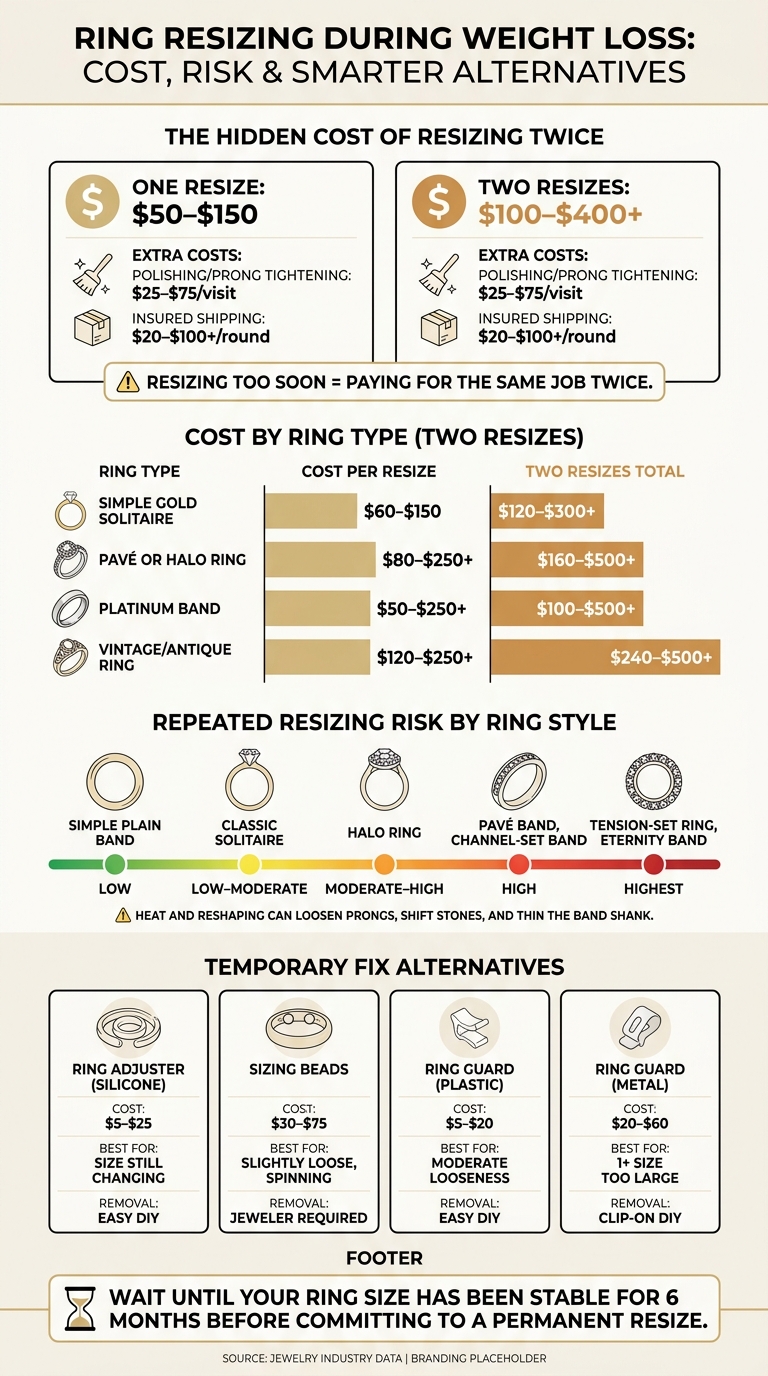
If you resize your ring before your weight levels off, you may pay for the same job twice. In many cases, that means $100 to $400+, days or weeks without your ring, and more stress on the band and stone settings.
Here’s the short version:
- One resize often costs about $50 to $150
- Two resizes can push the total to $100 to $400+
- White gold may need extra rhodium work
- Pavé, halo, channel, tension, and eternity rings carry more risk with repeat resizing
- Temporary fixes like ring adjusters, sizing beads, and ring guards can buy you time
- It often makes sense to wait until your size has stayed the same for about 6 months
I’d look at it this way: if your finger size is still changing, a permanent resize can be too much, too soon. A small temporary fix now can save money, cut hassle, and lower the chance of wearing down the ring from repeated cutting and soldering.
Quick comparison
| Option | Upfront Cost | Best for | Main tradeoff |
|---|---|---|---|
| Permanent resize | $50–$250+ | Stable ring size | May need to be done again |
| Ring adjuster | $5–$25 | Fast DIY fix | Can show underneath and trap moisture |
| Sizing beads | $30–$75 | Slight looseness, spinning | Jeweler has to add/remove them |
| Ring guard | $5–$60 | Ring is over 1 size too big | Can feel bulky or pinch |
| Adjustable ring | Varies | Weight loss still in progress | Better as a stopgap or new-ring choice |
So the main takeaway is simple: don’t rush into a second resize if your body is still changing. In many cases, waiting a bit longer is the lower-cost move for both your wallet and your ring.
Ring Resizing vs. Temporary Fixes: Cost & Risk Comparison During Weight Loss
3 WAYS TO SIZE DOWN a RING | WITHOUT CUTTING in HALF
sbb-itb-9da40c1
The real cost of resizing the same ring more than once
When weight loss keeps going after the first resize, the cost can snowball. If your finger size is still shrinking, a second appointment may come much sooner than you planned. And that means paying for the same work all over again.
How two resizing appointments add up to a larger total bill
Each resize involves the same shop work. The jeweler cuts the ring, adjusts it, solders it, and finishes the surface. If the shank has stones, those settings may need to be checked too. If the ring is white gold, it may also need rhodium plating again.
So when you resize the same ring twice, you’re often paying for:
- two labor charges
- two setting checks
- two rounds of shipping and insurance, if the ring is sent out
Say you size a gold engagement ring down once early in your weight loss and then again a few months later. That same ring can end up with two full labor bills. The first resize may cost $60–$150. The second may add another $60–$150. If the ring needs polishing or prong tightening both times, add $25–$75 per visit. That brings the total to $150–$400+ before shipping or insurance even enters the picture.
The spread gets bigger with more detailed rings.
| Ring Type | Estimated Cost Per Resize | Two Resizes (Estimated Total) |
|---|---|---|
| Simple gold solitaire engagement ring | $60–$150 | $120–$300+ |
| Pavé or halo engagement ring | $80–$250+ | $160–$500+ |
| Platinum band | $50–$250+ | $100–$500+ |
| Vintage or antique ring | $120–$250+ | $240–$500+ |
A pavé or halo engagement ring, for example, can cost $80–$250+ per resize once stone-checking labor is added. In some cases, the jeweler may need to inspect 15 to 30+ accent stones before and after the work. Do that twice, and the total climbs in a hurry.
If the ring isn’t handled in-store, there’s another charge to watch: insured shipping. Round-trip shipping and insurance can add $20 to $100+ each way per round.
The non-financial cost: time, hassle, and days without your ring
The money is only part of it. There’s also the plain inconvenience of doing this twice.
A standard resize at a local jeweler usually takes 3–7 business days. Chain stores or mail-in services can take 2 to 4 weeks, and sometimes longer. Repeat the process, and you may be without your ring twice.
There’s also the frustration of making a permanent change before your size settles. If your weight is still moving, a ring that fits today may feel loose again a few months from now. Then you’re back at the counter, paying again and waiting again. And it’s not just annoying. Repeated resizing can also weaken the ring itself.
How repeated resizing can weaken the band and loosen stone settings
Beyond the cost and hassle, repeated resizing can wear down the ring itself. If your weight is still changing after the first resize, the ring may keep changing with your finger too.
What happens to the band when it is cut or soldered more than once
Each resize changes the metal. A jeweler cuts the shank, adjusts the size, solders it back together, and refinishes the surface. On a well-made ring, that usually goes fine once. But when the same spot is altered again and again, stress builds over time.
With each change, the resize seam can become less even. The shank may get thinner, slightly misshapen, or weaker than it was before. That can leave the ring more likely to bend, crack, or wear through from day-to-day use. And if the second resize happens soon after the first, the band has had less time to settle.
The risk goes up when the ring includes stones, channels, or tension-based designs.
Ring styles and settings that need extra caution
Stone settings can loosen too. Heat and reshaping may loosen prongs, move stones out of place, or lower the pressure that keeps them secure.
Some styles deal with repeated resizing better than others:
| Ring Style | Repeated Resizing Risk |
|---|---|
| Simple plain band | Lower - more metal to work with; fewer setting concerns |
| Classic solitaire | Lower to moderate - resilient, but settings should be inspected after each resize |
| Pavé band | Higher - small stones often need resetting along the shank |
| Halo ring | Moderate to higher - stone setting needs careful handling during band alteration |
| Channel-set band | Higher - harder to resize twice without warping channel walls and loosening stones |
| Tension-set ring | Highest - another resize is structurally risky when the stone depends on band pressure |
| Eternity band | Highest - stones around the full circumference make resizing twice especially disruptive |
Pavé, halo, channel-set, tension-set, and eternity rings need extra care. A second resize can be especially disruptive for these styles. Later work may make the first resize seam less stable and increase the odds that stones shift or need to be tightened again.
If your ring size is still changing, a temporary fit fix is often safer than doing another permanent resize.
Better options while your finger size is still changing
If your ring size is still in flux, a temporary fit fix is usually the safer move. It gives you some breathing room while your weight settles, and it helps you avoid paying for another permanent resize too soon.
Temporary ring adjusters, sizing beads, and ring guards
These three options each solve a different fit problem. So the best pick depends on how loose the ring feels and how much visibility, comfort, and security matter to you.
Plastic or silicone ring adjusters are usually the easiest place to start. These flexible inserts slip inside the band and can make a ring fit about 0.5 to 2 sizes smaller. They’re simple to use and easy to remove, but they do show from the palm side and can hold moisture.
Sizing beads are small metal domes a jeweler solders inside the band so you can avoid another full resize. They’re hard to notice when worn and can help if your ring spins or tips to one side. They usually cost about $30–$75, and a jeweler has to remove them, which makes them a semi-permanent option for rings that are only a little loose.
Ring guards clip onto or wrap around the band and give more hold when the ring is over one size too big. They make the most sense when the ring feels loose enough that it might slip off.
| Solution | Approx. Cost (USD) | Comfort | Visibility When Worn | Ease of Removal |
|---|---|---|---|---|
| Ring adjuster (silicone/plastic) | $5–$25 | Soft, flexible | Low–medium (palm side) | Easy DIY, seconds |
| Sizing beads | $30–$75 | Comfortable after short adjustment | Low (underside only) | Jeweler required |
| Ring guard (plastic) | $5–$20 | Moderate; can pinch if too tight | Medium | Easy DIY |
| Ring guard (metal) | $20–$60 | Secure, slightly firmer | Medium–high | Clip-on: DIY; permanent: jeweler |
When an adjustable ring is the smarter long-term choice
Temporary fixes are useful as a bridge. But if you expect your finger size to keep changing - or you’re buying a new ring during active weight loss - an adjustable ring can make more sense than doing permanent alterations over and over.
A standard band has to be cut and soldered each time the size changes. An adjustable ring works differently. It uses a built-in mechanism that lets you tighten or loosen the fit, while keeping the adjustment out of sight. From the top, it still looks like a regular solid band. Adjustable engagement rings, wedding bands, and stacking rings can cover U.S. sizes 5 to 9 without any permanent change to the metal.
That matters during weight loss. If your finger size keeps shifting, an adjustable ring can help you avoid repeat resizing, extra fees, and added wear on the ring. It’s an especially good option for rings that are difficult to resize.
Use a temporary fix for now, then reassess once your size levels off.
When to resize, when to wait, and what to do next
After a short-term fix, the next step is simple: figure out whether your ring size has actually settled.
The main thing to look at is stability. Wait until the fit has stayed the same for 6 months, across different times of day and different seasons, before you commit to a permanent resize. If you do it too soon, you may end up paying twice, waiting twice, and putting the band through the process twice.
If you're still losing weight, or if pregnancy, surgery, or another life or health change could shift your finger size again soon, that's a clear sign to pause.
A simple guide to choosing between permanent resizing and temporary fit solutions
Use this table to pick the least permanent option that still solves the problem.
| Solution | Best Used When |
|---|---|
| Permanent resizing | Size has been stable for 6+ months; ring style is simple; no further size changes expected |
| Temporary adjusters (silicone/plastic) | Size is still changing; you need an immediate, reversible fix |
| Sizing beads | Ring is only slightly loose; you want a low-profile semi-permanent option |
| Ring guard (metal) | Ring is more than one size too large; you need extra hold without altering the band |
| Adjustable ring | Size is actively shifting; you want to avoid repeated permanent alterations |
Plain gold solitaires are usually the easiest rings to resize for good. Simple bands tend to handle the process better. On the other hand, thin bands, pavé settings, eternity rings, and platinum styles come with more risk each time they’re altered. In those cases, lower-impact fit fixes often make more sense until your size stays put.
Key points to review before you alter your ring again
Before you book another resizing appointment, take a minute and check the basics. It’s a small step, but it can help you avoid extra cost and extra wear on the ring.
- Has the fit been stable for at least 6 months? If not, a temporary adjuster is usually the safer call.
- How many times has this ring already been resized? Repeat resizing can add wear, especially after several alterations.
- What’s the ring’s style and metal? Detailed settings and metals like platinum or rose gold need more caution with repeat work.
- Are more size changes likely? Weight loss, pregnancy, surgery, or other health changes are all good reasons to wait.
- What have you already spent? Two resizes at $50–$150 each can turn into $100–$300+ on a simple ring, and more for detailed settings.
If your size is still moving around, stick with a temporary fix until things settle.
FAQs
How do I know when my ring size is stable enough to resize?
Your ring size is steady enough for permanent resizing when your finger stays about the same size over time. For the best reading, measure in the late afternoon, when your hands are at a normal temperature and you're well hydrated.
If your finger size shifts a lot due to weight loss, pregnancy, or medical conditions, permanent resizing may not be the right move. Making the same ring larger or smaller again and again can weaken the band.
Can resizing a ring twice damage the band or loosen stones?
Yes. Resizing a ring more than once can weaken the band and increase the chance of damage to the setting.
Here’s why: every resize means a jeweler has to cut the band, add or remove metal, and solder it back together. That process changes the ring each time. Over time, those changes can create stress points in the band.
Repeated heat and metalwork can also make the ring more likely to bend or crack. And it’s not just the band you have to watch. The setting can take a hit too, with prongs loosening or stones shifting out of place.
Which temporary ring fix is best if my ring keeps getting looser?
If your ring keeps feeling too loose, temporary fixes like ring adjusters or sizing beads can help it stay put. They’re low-cost, simple to use, and handy when you need a fast fix. But they’re not meant to solve the problem for good.
For better long-term comfort, and to avoid paying for repeated resizing over time, an adjustable ring can make more sense. You can change the fit when needed without going back for more professional work each time.


