


Carpal Tunnel, Wrist Braces, and Everyday Jewelry
If jewelry adds pressure, take it off early. That’s the main rule I’d follow with carpal tunnel symptoms or a wrist brace.
Here’s the short version:
- Rings are often the first problem, because fingers can feel swollen or tight during a flare-up.
- Bracelets and watches can rub sore skin, catch on brace straps, and hold sweat against the wrist.
- Adjustable, smooth, lightweight pieces are usually easier to wear than stiff or heavy ones.
- Night bracing often means removing wrist jewelry before bed.
- If a ring, bracelet, or watch causes numbness, tingling, pain, skin marks, or color changes, I’d remove it right away.
- If fingers turn blue, gray, pale, or cold, or a ring gets stuck from swelling, I’d treat that as urgent and get medical help.
A few facts matter here. Carpal tunnel often affects the thumb, index, middle, and part of the ring finger. And night symptoms are common enough that nighttime wrist bracing is often suggested to help keep the wrist straight while sleeping.
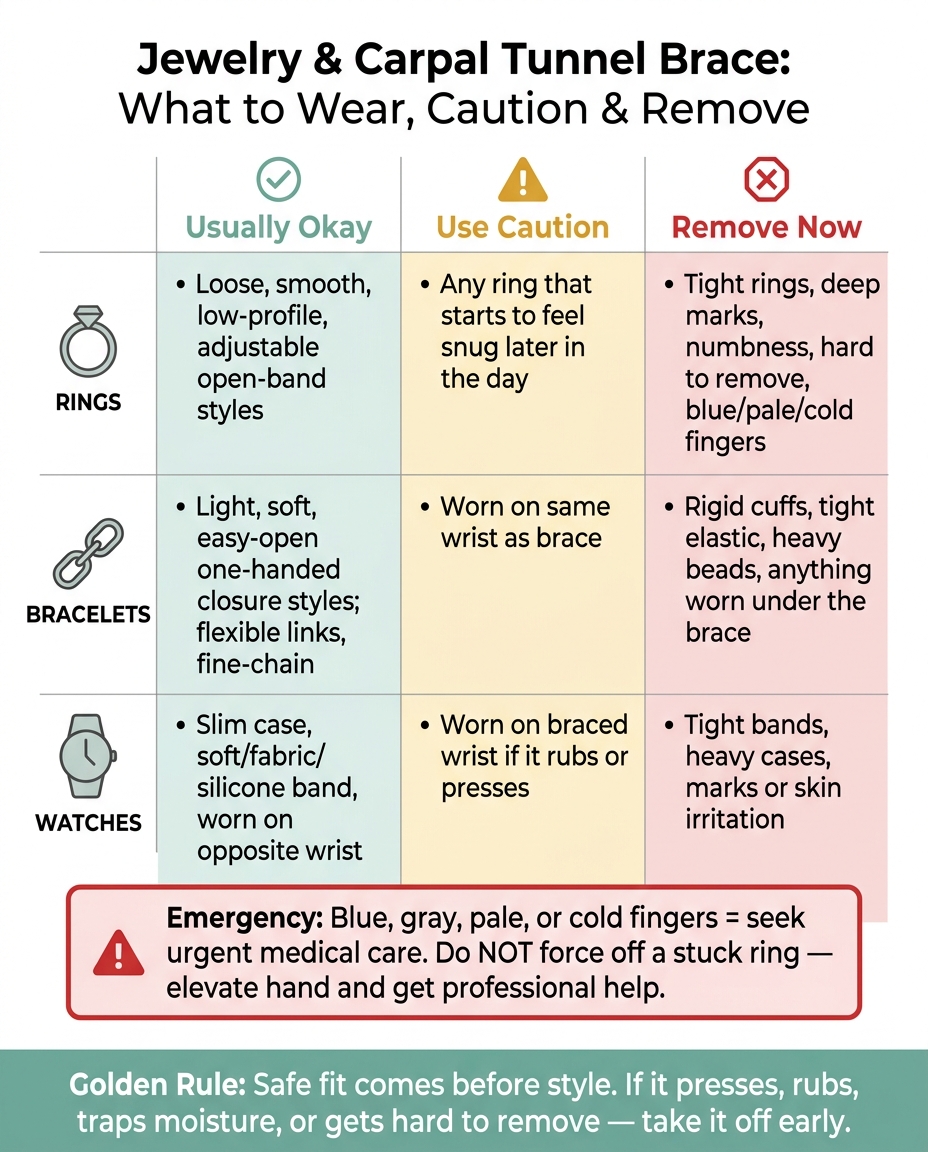
Jewelry & Carpal Tunnel Brace: What to Wear, Caution, and Remove
Carpal Tunnel Night Brace: How to Wear a Wrist Splint for Better Sleep
sbb-itb-9da40c1
Quick Comparison
| Jewelry type | Usually okay | Use care with | Take off |
|---|---|---|---|
| Rings | Loose, smooth, low-profile, adjustable styles | Any ring that starts to feel snug later in the day | Tight rings, deep marks, numbness, hard removal |
| Bracelets | Light, soft, easy-open styles | Same wrist as the brace | Rigid cuffs, tight elastic, heavy beads, anything under the brace |
| Watches | Slim case, soft band, other wrist | Braced wrist if it rubs or presses | Tight bands, heavy cases, marks, skin irritation |
So if I had to sum up the whole article in one line, it would be this: pick jewelry that does not press, rub, trap moisture, or get hard to remove when symptoms change.
Rings That Stay Comfortable When Fingers Swell
When finger size shifts throughout the day, rings are usually the easiest place to make things simpler. If carpal tunnel lowers sensation, you may not feel pressure right away. That means a ring can get too tight before you notice. And if you’re wearing a brace, hand movement can feel awkward, which makes tight rings harder to check and remove.
Pick Adjustable Rings With Smooth, Low-Profile Details
Go with an adjustable or open-band ring that can shift a bit with swelling. A rigid band stays the same size, so it won’t give you any extra room when your finger gets fuller. An open-band style has a little more flexibility.
It also helps to choose a ring with a smooth interior, rounded edges, and a low-profile setting. Those details can cut down on pressure points and make the ring less likely to snag on brace fabric. Adjust the ring gently. If you bend it again and again, the metal can weaken over time.
How to Check Ring Fit Before Discomfort Starts
A ring that fits well should slide over the knuckle with slight resistance, stay in place, and not leave a deep mark when you take it off. After wearing it for a bit, check your finger. If it looks pale, bluish, or red, or if it feels numb, tingly, cold, or unusually tight, that’s a sign the fit isn’t working.
Check the fit at different times of day, not just once. Fingers are often slimmer in the morning and fuller later on because of heat, activity, fluid retention, or symptoms. If a ring keeps getting tighter, take it off early.
Once you’ve handled rings, do the same check for wrist jewelry. It should fit without pressing on the brace.
Brace-Friendly Bracelets and Watches
Rings are usually the first thing people rethink, but wrist jewelry deserves the same comfort check. A wrist brace adds extra bulk, so bracelets and watches can get awkward fast. The easiest move is to wear them on the other wrist while you’re using the brace, or skip them on the braced wrist altogether.
Bracelets That Reduce Pressure and Come Off Easily
If you still want to wear a bracelet on the same wrist as the brace, focus on three things: light weight, smooth surfaces, and a closure you can open with one hand. Flexible links, rounded edges, and low-profile clasps tend to work best. On the flip side, bulky beads, sharp charms, stiff edges, and tight elastic can be a pain to deal with, especially if you have to stretch the bracelet over your hand to get it off.
Best choices: adjustable bracelets, flexible bangles, and fine-link chains. Avoid: rigid cuffs.
Rigid cuffs are often the hardest option to wear because they press against the brace and don’t come off easily. Swelling can also creep up over the course of the day. So a bracelet that feels okay in the morning might feel tight, irritating, or hard to remove by afternoon.
That same low-pressure approach applies to watches too.
Watches With Removable Bands and Softer Materials
Watch cases and bands can press right into brace padding or sore skin. A slim, lightweight case paired with a fabric, nylon, soft leather, or flexible silicone band is usually easier to deal with. Quick-release spring bars and hook-and-loop straps also help, since you can take the watch off fast if your symptoms change.
In many cases, wearing the watch on the opposite wrist is the simplest answer. It keeps the brace out of the way and gives tender skin a break. If a watch leaves marks, rubs, or feels hard to loosen in a hurry, take it off.
Once wrist jewelry feels comfortable enough, the next piece is figuring out when to wear it as brace use and symptoms change.
A Daily Jewelry Routine for Brace Wear and Symptom Changes
Once you’ve picked pieces that work with a brace, it helps to follow a simple routine. The main idea is pretty straightforward: don’t let jewelry add pressure when your brace is on.
What to Wear Before, During, and After Brace Use
Before putting on the brace, take off your watch, bracelets, and any ring that already feels snug. If swelling starts, remove rings right away. Wear the brace directly on your skin unless your clinician tells you to do something else.
If swelling, numbness, or pain gets worse, keep the braced wrist clear. If you want to wear wrist jewelry, move it to the other wrist.
After you take the brace off, do a quick skin check. Look for redness, pressure marks, moisture, or soreness. Light marks that fade are common. Marks that stick around are not.
What Works Best at Night and During Flare-Ups
Nighttime bracing is one of the most common recommendations for carpal tunnel because keeping the wrist straight during sleep can cut down on the tingling and numbness that wake people up. Before bed, take off watches, bracelets, and bangles. A smooth ring may still feel fine overnight, but only if it stays loose and slides off without a struggle.
During a flare-up, keep things simple. Take off all wrist jewelry and remove any ring that feels tight. At that point, brace fit and symptom changes matter more than jewelry.
When symptoms shift, less jewelry is usually the safer call. Here’s a quick look at what that can mean in day-to-day use:
| Situation | Use with Caution | Remove |
|---|---|---|
| Nighttime bracing | A smooth ring only if it stays loose and comfortable | Watches, bracelets, bangles, and anything that can catch on brace straps |
| Daytime bracing | Lightweight, smooth rings or flexible bracelets that don't contact the brace | Tight watches, rigid bangles, layered bracelets, or anything worn under the brace |
| Swollen fingers | Remove tight rings; wear only a clearly loose adjustable ring | Rings that feel tight, leave deep marks, or won't slide off |
| Symptom flare-ups | Lightweight pieces worn briefly if they cause no pressure | Anything that increases pain, numbness, tingling, swelling, redness, or skin rubbing |
If jewelry still causes pain, numbness, or skin irritation, take it off. If a piece leaves marks, traps moisture, or makes numbness worse, remove it right away.
When to Remove Jewelry and When to See a Doctor
Warning Signs That Mean Jewelry Should Come Off Right Away
Even if you've checked the fit carefully, things can change fast when swelling or numbness kicks in.
Take off any ring, bracelet, or watch right away if numbness, tingling, throbbing, pain, swelling, weakness, or limited movement starts getting worse, or if the piece suddenly feels tighter. That includes adjustable jewelry too. If swelling changes or blood flow drops, even a piece that seemed fine an hour ago can turn into a problem.
Blue, gray, pale, or cold fingers are a red flag for poor circulation and need urgent medical care. If a ring won’t slide off because of swelling, don’t pull or twist it. That usually makes things worse and can damage the skin. Instead, elevate your hand and get help from a medical professional. They have the right tools to remove it safely, including cutting the band if needed.
Skin issues matter too. Redness, rash, blisters, broken skin, pressure marks, drainage, warmth, or a sore that doesn’t get better after the jewelry or brace is removed should be taken seriously. Remove the piece, keep the skin clean and dry, and wait until the area heals before wearing it again.
Once the jewelry is off, the next step is figuring out whether the symptoms need medical care.
Key Takeaways for Comfort, Fit, and Style
The rule is simple: safe fit comes before style. If the braced wrist needs to stay clear, wear jewelry on the other wrist instead. And if swelling or irritation starts, remove the piece early, before it becomes hard to take off.
Lightweight pieces, adjustable designs, and soft materials can make jewelry easier to wear. But if numbness, weakness, or pain keeps getting worse, that’s a medical issue. Jewelry tweaks won’t fix it.
FAQs
Can tight jewelry make carpal tunnel symptoms worse?
Yes. Tight rings or bracelets can add pressure, irritate the area, and limit circulation. That can make discomfort, numbness, or swelling in the fingers and wrist feel worse.
If you’re dealing with inflammation or sensitive joints, adjustable, lightweight, or flexible jewelry is often a better fit. It can feel more comfortable and adjust more easily to day-to-day swelling.
Should I stop wearing my ring if my fingers swell at night?
Yes. If your fingers swell at night, it’s usually best to take your ring off early. That can help you avoid discomfort, tight pressure, and circulation issues.
If this happens often, an adjustable ring might be a good fit. And if the swelling keeps happening, gets worse, or comes with joint pain or stiffness, talk to a medical professional.
What jewelry materials are easiest to wear with a wrist brace?
With a wrist brace, the most comfortable jewelry materials tend to be lightweight, gentle on skin, and a little more forgiving.
Silicone is a smart pick for rings. It’s soft, light, and can stretch if your fingers swell during the day.
If you want something more polished, titanium, aluminum, sterling silver, 18k gold, and gold-filled jewelry are all solid choices. They’re light enough for daily wear, hold up well, and are usually easier on sensitive skin.


