


Why the Bottom Ring in a Stack Needs to Be Half a Size Bigger
If your ring stack feels fine at first but gets tight later, the bottom ring is usually the issue. In many cases, I’d start by making that ring about 0.5 US size larger, while keeping the upper rings at your usual size.
Here’s the short version:
- A stack acts like one thicker ring
- Once total stack width hits about 5–7 mm, fit often feels tighter
- Daily finger swelling can shift fit by about 0.5 size
- The bottom ring takes the most pressure and often leaves the first deep marks
- A graduated fit - larger on the bottom, same or slightly smaller on top - often feels better than sizing every ring the same
That means the goal is not to make the whole stack loose. It’s to give the base of your finger a bit more room while keeping the top rings steady so they don’t spin.
If I were checking stack fit, I’d look for three things: comfort by evening, easy removal with light resistance, and marks that fade fast instead of lasting.
| Stack issue | What it often means | Common fix |
|---|---|---|
| Deep grooves by night | Bottom ring too tight | Size bottom ring up about 0.5 |
| Upper rings spinning | Top rings too loose | Keep top rings at measured size |
| Tight fit after heat or activity | Normal swelling + stack pressure | Test fit later in the day |
In short: don’t size stacked rings like single rings. I’d treat the set as one unit and fit the bottom band first.
How Stacked Rings Change the Way Your Finger Fits
More Total Width Means Less Room on the Finger
A ring stack works a lot like one wider band. Even if each ring is slim, the stack can feel tighter than a single narrow ring because every edge adds a bit more pressure. The bottom ring usually feels it first since it carries the full weight and pressure of the stack.
Once the total width gets to about 5 to 7 mm, most people start to notice that the fit feels more snug than it would with one thin ring. Stacks around 5 to 6 mm often call for a quarter-size increase. Stacks over 7 mm often need about half a size more.
A wider stack also holds the finger more firmly, which means there’s less space for movement or swelling. That’s where things can get tricky. Small changes in finger shape or size that might not matter with one ring can suddenly make a stack feel much tighter.
Finger Shape and Daily Swelling Affect Fit From Morning to Night
Fingers aren’t shaped like straight tubes. They usually taper a little, and the knuckle is often wider than the base of the finger. With a stack, that fit issue becomes more obvious because the added width makes the rings harder to angle over the knuckle when you’re taking them off.
Finger size shifts during the day too. Heat, exercise, hydration, and sodium can all change the fit. For many people, that swing can be about half a ring size, which is enough to matter when a stack already feels snug.
So a stack that feels fine in the morning may leave pressure marks or get tougher to remove by late afternoon. It’s smart to test the fit later in the day, when your fingers are at their largest. That’s also why the lowest ring usually needs the extra room first.
sbb-itb-9da40c1
Why the Bottom Ring Often Needs to Be Half a Size Larger
The extra width matters most at the base of your finger, because that’s where the stack lands first. And for most people, the base of the finger is wider than the middle. So when you wear a stack, the bottom ring hits that widest point first and starts to feel snug before the upper bands do.
Once the rings settle into place, the lowest band carries the full load. It takes the most pressure in the stack. Every ring above it adds weight and pushes down, and because stacked bands move together, that pressure builds on the bottom ring. That’s when you start to notice those little signs: pressure marks, a pinched feeling after a few hours, or trouble sliding the stack off at night. A half US size adds about 0.75 mm of inner circumference, and that small change can make a noticeable difference.
That’s why it usually works better to size the stack as a set instead of sizing each ring on its own. Graduated sizing means using slightly different sizes across the stack instead of making every band match. For example, a US size 7.5 bottom ring may pair with US size 7 upper rings. The larger base ring gives the widest part of the finger a bit more room, while the smaller upper rings stay snug closer to the mid-finger and knuckle. That helps the stack stay in place instead of spinning or shifting around.
If you size every ring up by the same amount, the whole stack can start to feel loose, and a heavier center stone may rotate. Graduated sizing is a more precise fix. It eases pressure at the base without giving up stability higher on the finger. The best fit depends on your finger shape and the way your stack sits during wear.
Common Stack Fit Problems and How to Fix Them
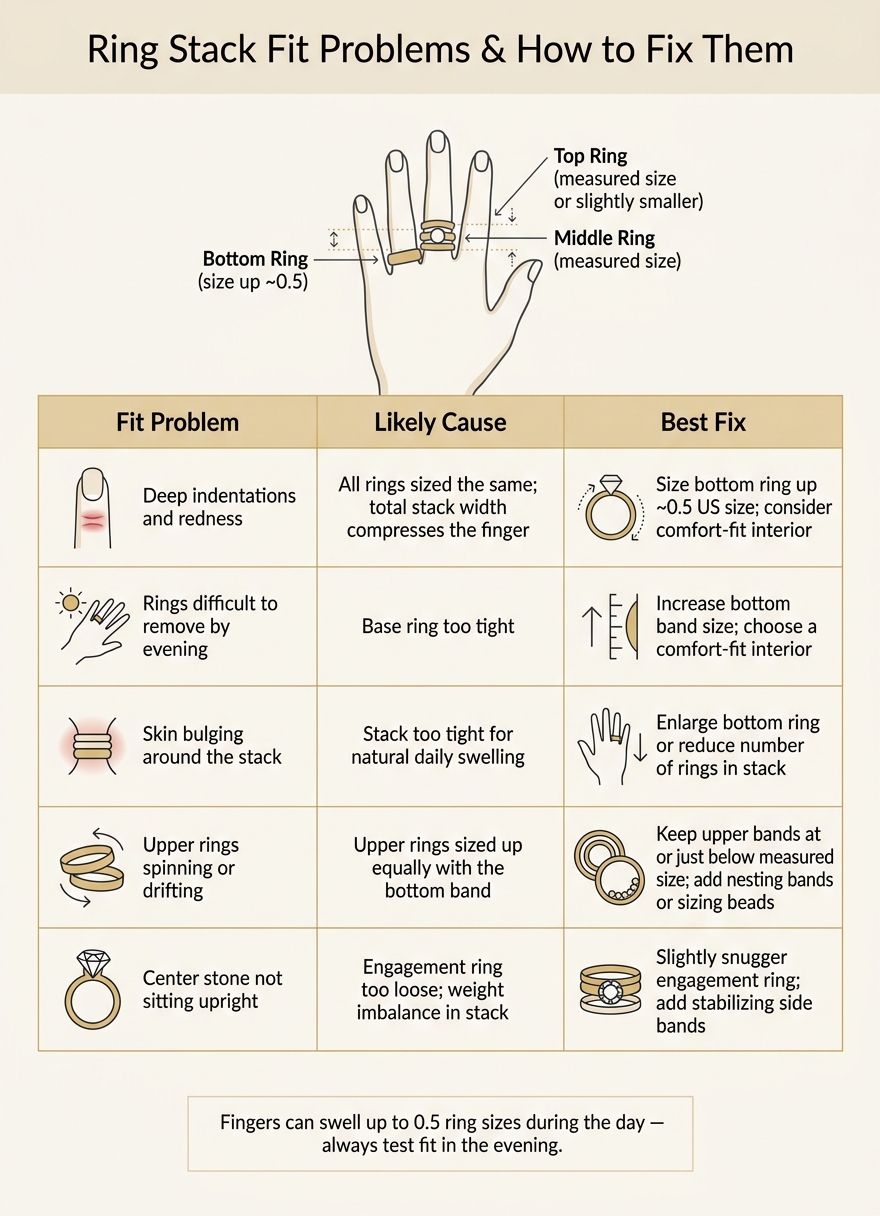
Ring Stack Fit Guide: Common Problems & Fixes
Once you’ve picked the stack size, daily wear is where things get real. A stack can look perfect in a box and still feel off by noon. In most cases, fit issues come down to one of two things: the bottom ring is too tight, or the rings above it are too loose and move around. The good news? Both are fixable, and both usually trace back to how each ring was sized in relation to the others.
Tightness, Pressure Marks, and Rings That Are Hard to Remove
A bottom ring that’s too snug usually gives itself away fast. You may notice deep indentations that stick around after you take the rings off, redness, skin bulging above or below the stack, or a ring that won’t come off without soap, lotion, or a tool. A stack that fits well should feel snug, not restrictive. It may leave light marks, but those should fade within 10–20 minutes, and the ring should come off with slight resistance.
A simple fix is to size the bottom ring up by about half a US size. That gives the base of the finger a bit more room and helps the stack stay comfortable as your hands swell during the day. A comfort-fit interior, which is slightly rounded on the inside, can also spread pressure more evenly and make the ring easier to remove.
Spinning and Shifting When Upper Rings Are Too Loose
Here’s where many stacks go wrong: people size every ring up the same way. But the finger is usually narrower above the base, so upper bands can end up too loose. When that happens, rings spin, decorative details drift out of line, and prong-set stones can rotate into less protected positions.
The fix is usually pretty simple. Keep the upper bands at your measured size or a touch below, while the bottom ring stays about half a US size larger. If the rings still spin, sizing beads inside the upper ring can add enough friction to help it stay put without making it feel tight. Contoured or nesting bands can also help because their shape keeps them oriented, instead of relying on tightness alone.
This size balance matters most for wedding bands, engagement rings, and full stacking sets.
Use the guide below to match the issue with the fix.
| Fit Problem | Likely Cause | Best Fix |
|---|---|---|
| Deep indentations and redness | All rings sized the same; total stack width compresses the finger | Size the bottom ring up by about 0.5; consider a comfort-fit interior |
| Rings difficult to remove by evening | Base ring too tight | Increase bottom band size; choose a comfort-fit interior |
| Skin bulging around the stack | Stack too tight for natural daily swelling | Enlarge bottom ring or reduce the number of rings in the stack |
| Upper rings spinning or drifting | Upper rings sized up equally with the bottom band | Keep upper bands at or just below measured size; add nesting bands or sizing beads |
| Center stone not sitting upright | Engagement ring too loose; weight imbalance in the stack | Slightly snugger engagement ring; add stabilizing side bands |
Sizing Strategies for Wedding Bands, Engagement Rings, and Stacking Sets
Once the bottom ring needs a bit more space, the next move is to size the entire stack as one fit system.
Size the Full Stack Together, Not Each Ring on Its Own
Don’t size each ring like it’ll be worn alone. Keep the engagement ring at its measured size, then bump the bottom band up by about 1/4 to 1/2 size. That small change can make a big difference, especially with wedding bands and engagement rings, where even a slight mismatch can change how the full set sits on your finger.
When Adjustable Rings Work Better Than Fixed Sizing
Fixed-size rings make sense if your finger size stays pretty steady. But that’s not how it goes for a lot of people. If you have larger knuckles, fingers that swell in warm weather, or arthritis-related joint sensitivity, the fit can get tricky fast.
A ring sized to get over the knuckle may spin too much at the base. A ring sized for the base may not get past the knuckle at all.
An adjustable base ring can help with small fit shifts caused by knuckles, swelling, or joint sensitivity, without making the rest of the stack loose.
After that, test the set during normal wear, not just on a sizing mandrel or during a quick in-store try-on.
Quick Comfort Checks Before You Commit to a Stack
Try the full stack during the warmest part of the day. Then take it off after 1–2 hours and look for deep grooves or discoloration that sticks around. It also helps to do a few everyday tasks while wearing it, such as:
- Typing on a keyboard
- Gripping a steering wheel
- Opening a jar
The stack should feel secure, but it shouldn’t pinch or spin around.
Light marks are normal. Deep grooves are not. If you notice deep grooves or lingering discoloration, the bottom ring likely needs to go up by about half a size. In some cases, wearing fewer bands each day may give you a better fit.
Conclusion: A Slightly Larger Bottom Ring Can Make Your Stack More Comfortable
A ring stack usually feels tighter than a single band. And by evening, it can feel even snugger.
The bottom ring tends to carry the most pressure, so it’s often the first place tightness shows up. It sits closest to your hand, right on the fleshiest part of the finger. If that ring is even a little too tight, that’s usually where you’ll notice deep marks, redness, or a frustrating struggle when it’s time to take the stack off.
In many cases, making the bottom ring about half a US size larger can ease that pressure without making the whole stack feel loose. That little bit of extra space gives the base of your finger more room to swell under the weight of the bands above it. Meanwhile, the upper rings, kept at your usual size, can help keep the stack centered and cut down on spinning.
Still, this is a place to start, not a hard rule. Finger shape, knuckle size, and day-to-day swelling all affect whether a half-size increase makes sense for you.
The best fit is simple: your stack should stay comfortable from morning to night, come off without a fight, and leave no lasting marks on your skin. If it doesn’t, the bottom ring is the first place to check.
FAQs
How do I know if my bottom ring is too tight?
Look for clear signs of restriction: red marks, deep indentations, numbness, tingling, or swelling, especially after exercise or in warm weather.
A good fit should feel secure and comfortable. It should turn freely without much effort and shouldn’t leave marks or cut off circulation. If it spins a lot or slides off easily, it’s too loose.
Should every ring in a stack be the same size?
No. Rings in a stack don't all need to be the same size.
In fact, wider bands often fit better at 1/4 to 1/2 size larger. They cover more of the finger, so they tend to feel tighter and create more resistance when you slide them on and off.
Finger size can also shift during the day. Heat, activity, and normal swelling can all make a ring feel snug one moment and fine the next. Because of that, adjustable bands can make a stack more comfortable and help cut down on tightness or pressure marks.
What if my stack fits in the morning but feels tight later?
That’s completely normal. Finger size can shift during the day due to temperature, activity, hydration, and salt intake.
If your Satinski ring is adjustable, gently widen it a bit for comfort, then tighten it again once your fingers go back to normal. That helps keep the fit secure and comfortable without needing professional resizing.


