

Best Wedding Bands for Men Who Work With Their Hands
If you work with tools, machinery, or live wires, the safest ring for the job is usually silicone. It’s non-conductive, flexes with swelling, and can break under force instead of trapping your finger. For off-duty wear or lower-risk work, metal bands like tungsten, titanium, cobalt chrome, and low-profile comfort-fit styles make more sense. If your fingers swell a lot or your knuckle is larger than the base of your finger, an adjustable band like Satinski solves a fit problem fixed rings can’t.
Here’s the short version:
- Silicone: best for job-site safety
- Satinski adjustable: best for swelling and large knuckles
- Tungsten carbide: best for scratch resistance
- Titanium: best if you want a lighter metal ring
- Cobalt chrome: best if you want a bright white metal with strong wear resistance
- Low-profile comfort-fit metal bands: best for glove use and lower snag risk
A few facts stand out:
- Silicone bands often break under about 20 to 40 lbs. of force
- Tungsten ranks about 8.5 to 9 on the Mohs scale
- Satinski’s adjustable ring covers U.S. sizes 5 to 9
- Satinski lists a 4.8/5 rating from 468 reviews
- Silicone rings often cost about $20 to $45
- Satinski solid gold runs about $990 to $1,390
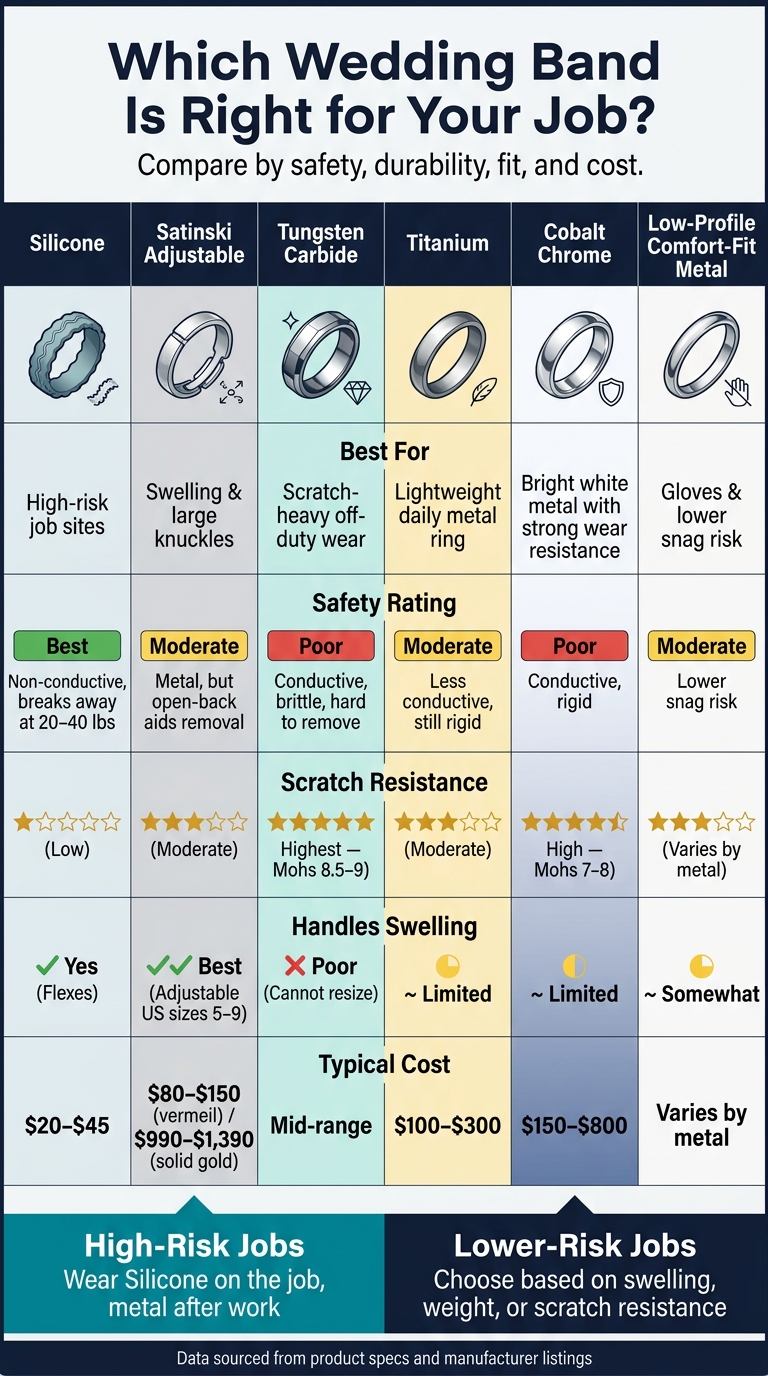
Best Wedding Bands for Men Who Work With Their Hands: Side-by-Side Comparison
Quick Comparison
| Band Type | Best Use | Main Risk | Fit for Swelling | Usual Cost |
|---|---|---|---|---|
| Satinski Adjustable | Large knuckles, changing finger size | Still metal, so not for live electrical work | Best | $80 to $150 for vermeil; $990 to $1,390 for solid gold |
| Silicone | High-risk job sites | Wears out faster | Very good | $20 to $45 |
| Tungsten Carbide | Scratch-heavy off-duty wear | Brittle under hard impact; conductive | Poor | Mid-range |
| Titanium | Light daily metal ring | Rigid metal; limited resizing | Limited | $100 to $300 common |
| Cobalt Chrome | Bright white metal with strong wear resistance | Rigid and conductive | Limited | $149.99 to $799.99 |
| Low-Profile Comfort-Fit Metal | Gloves, lower snag risk | Still a rigid metal ring | Somewhat | Depends on metal |
My take: if you work around electricity, rotating equipment, or pinch points, I’d wear silicone on the job and keep a metal band for after work. If safety risk is lower, I’d pick based on what bugs you most - scratches, weight, swelling, or glove comfort.
That’s the full decision in plain English before the article gets into the details.
sbb-itb-9da40c1
1. Satinski Adjustable Wedding Bands
Satinski uses a sliding design that opens over the knuckle, then tightens at the base of the finger. That matters if your hands swell during work. The inner slider lets the band open and close without needing a trip to the jeweler, and it covers US sizes 5–9. You can adjust it at home with your fingers or the included Satinski Resizing Stick, which cuts out repeat resizing costs.
That said, flexibility doesn't remove job-site risk. This is still a metal ring. The open-back design can make emergency removal easier than dealing with a rigid band, but you should still take it off before electrical work and other tasks where metal jewelry can be a problem.
Durability
If you're wearing a ring during daily hands-on work, 14K solid gold is the tougher pick. When it gets scratched, you won't expose a different base metal underneath.
Gold vermeil costs less, usually around $80–$150, which makes it easier on the wallet. But there's a tradeoff: repeated sliding and frequent adjustments can wear down the gold layer at the contact point over time. Solid gold costs more at $990–$1,390, but it handles long-term wear better.
Fit and Swelling
Finger size can shift a lot during the day. Morning fit and afternoon fit are often not the same, especially with physical work or heat. Satinski's sliding mechanism helps with that by letting you loosen or tighten the band as needed instead of being stuck with one fixed size.
The ring currently has a 4.8/5 rating across 468 reviews on the Satinski platform. Many users mention swelling from arthritis or post-surgery recovery, and that shows up again and again in the feedback.
Maintenance and Cost
Satinski says adjustments should be done with slow, even pressure, either with your fingers or the resizing stick. The goal is simple: keep the band round and avoid putting too much stress on one spot.
For care, stick with:
- A soft cloth
- Mild soap and water
- No harsh chemicals or solvents
If you wear a vermeil band every day, expect replating every one to three years. That usually runs $30–$100 per service.
If you want a simpler work-first option, the next band type is silicone.
2. Silicone Wedding Bands
If adjustability matters, silicone gives you more flex and more safety on the job.
Silicone bands are the safest option for work.
Safety at Work
Medical-grade silicone is made to break under 20–40 lbs of force before your finger takes the hit. Metal rings can withstand up to 495 newtons of force, which is far above the ~53 newtons at which finger tissue tears. That gap can help prevent a ring-avulsion injury.
For electricians and anyone working near live circuits, silicone is non-conductive, so it won't create a path for electrical current. That's a big deal in the field. On many jobsites, metal rings aren't allowed at all.
Safety is the main reason people choose silicone, but it also handles rough daily wear better than you might expect.
Durability
Silicone stands up well to oils and water, which makes it a solid fit for mechanics and construction workers. With daily hard use, you can expect it to last about 12–18 months before it needs to be replaced.
Fit and Swelling
Silicone stretches, and that matters when your hands swell from heat, heavy gripping, or a long shift. Instead of digging into your finger, the band gives a little as your hand changes through the day.
If swelling happens all the time, it's smarter to size up by half a size or pick a slightly wider band made to handle that change, instead of depending only on stretch.
Maintenance and Cost
Cleaning is easy: just use soap and warm water. Quality silicone bands usually cost $20–$45 per ring, so replacing one isn't a big headache. That's why a lot of workers keep a spare nearby.
A common setup is simple:
- Silicone for work
- A metal band for off-duty wear
That makes silicone the easiest choice for the workday.
For men who want a harder ring, the next option is tungsten carbide.
3. Tungsten Carbide Wedding Bands
If you want a ring that’s much harder and more scratch-resistant than silicone, tungsten is a strong next pick. It ranks 8.5–9 on the Mohs hardness scale, which puts it just below diamond. In plain English, that means everyday scuffs from tools, rough surfaces, and grime are less likely to show.
Safety at Work
The downside is brittleness. Tungsten doesn’t bend or deform under pressure. Instead, it can crack or shatter under impact from dropped tools or machinery. That can limit crushing force, but a broken ring can leave sharp pieces behind, and removal after a break may be harder. Tungsten also conducts electricity, so it should not be worn near live circuits.
Durability
Tungsten handles scratches well, even around tools and rough surfaces. Its weak spot is blunt force. If the band takes a hard hit against heavy machinery, it can chip or crack.
Fit and Swelling
Tungsten cannot be resized. So if your ring size changes for good, you’ll usually need a replacement. It also keeps its shape instead of flexing, which means it won’t adjust to swelling during a shift.
Maintenance and Cost
Care is simple: use mild soap, water, and a soft cloth. Tungsten stays fairly low-maintenance because it doesn’t tarnish and rarely needs polishing. Rings with inlays or coatings may need a little more attention. Price-wise, tungsten sits in the middle of the pack, giving you strong scratch resistance without the cost of gold or platinum. If you want something lighter and with a bit more give, titanium is the next material to compare.
4. Titanium Wedding Bands
Titanium sits in a nice middle spot for work wear. It’s lighter than tungsten, but more rigid than silicone, so you get a metal ring without that heavier feel on your hand. Many higher-end rings use Grade 5 Ti-6Al-4V titanium, which has a tensile strength of about 1,000–1,170 MPa. If you want a strong metal band that doesn’t feel bulky, titanium makes a lot of sense.
Safety at Work
Titanium is non-magnetic and less conductive, which helps in some job settings. But here’s the plain truth: it’s still a rigid metal ring. If your day involves heavy machinery, pinch points, or other higher-risk tasks, switching to a silicone band is often the safer move. Then you can keep the titanium ring for normal day-to-day wear.
Durability
Titanium handles corrosion and daily use well, which is a big plus if your ring sees a lot of wear. It does scratch more easily than tungsten, though. On the flip side, it’s tougher and less likely to crack or shatter from impact. That tradeoff matters. If you don’t want every little mark to show, a matte or brushed finish usually does a better job of hiding scratches than a mirror-polished ring.
Fit and Swelling
If your hands swell during the day, the fit can matter just as much as the material. A comfort-fit band with rounded inner edges tends to feel better and can cut down on pinching during a long shift. One thing to watch: most titanium rings can’t be resized, so sizing needs extra care. A ring that feels fine in the morning can feel very different by the end of the day.
Maintenance and Cost
Titanium is easy to care for. Warm soapy water and a soft cloth are usually all you need. On price, basic titanium bands often cost around $100–$300. Premium 6mm comfort-fit bands can run $325–$850. Over five years, ownership costs usually land around $180–$520.
5. Cobalt Chrome Wedding Bands
If you want more scratch resistance than titanium but don't want tungsten's tendency to chip, cobalt chrome is a smart step up. It has a bright, platinum-like finish for less money, and it handles daily bumps and wear well. So if you want a ring that feels tough and still looks polished after work, this metal checks a lot of boxes.
Safety at Work
Cobalt chrome is still a rigid metal band, so the same job-site rule applies: take it off before high-risk machine or electrical work. A hard ring can snag, and that's not something to mess with.
For those work settings, a silicone band usually makes more sense during the day. Then you can switch back to cobalt chrome when you're off the clock.
It also has more heft than lighter metals. Cobalt chrome is dense, at around 8.4–8.9 g/cm³, so that weight can become more noticeable over a full shift.
Durability
Cobalt chrome is usually rated around Mohs 7 to 8 and 550 to 650 HV, which means it does a good job resisting scratches and generally wears better than titanium.
It isn't as hard as tungsten carbide, but that's part of the tradeoff. You give up a bit of hardness, but you also get a ring that's less brittle.
Fit and Swelling
With cobalt chrome, fit matters more than people often expect. Since the metal is dense and rigid, a ring that feels a little off in the morning may feel pretty tight later in the day.
Some designs can be resized by ±1 to ±2 sizes, but many plain bands aren't built for repeated adjustment. That's why it's smart to try one on at the end of the day, when your fingers are closest to normal workday swelling.
A comfort-fit interior can help too. Those rounded inner edges tend to reduce pressure during long wear, which can make a big difference if the ring stays on for hours at a time.
Maintenance and Cost
Care is simple:
- Clean it with warm water, mild soap, and a soft cloth.
- Polished finishes can show fingerprints, so an occasional polish helps keep the ring looking sharp.
On price, plain comfort-fit bands usually cost $149.99–$299.99, mid-range styles tend to land around $299.99–$429.99, and decorative designs can run $519.99–$799.99.
If you want the lowest-profile option possible, the next choice is a low-profile comfort-fit metal band.
6. Low-Profile Comfort-Fit Metal Bands
With work rings, shape matters just as much as metal. Low-profile comfort-fit bands sit close to the finger, so they snag less on gloves, tools, and equipment. On job sites, that can matter as much as looks, since glove use and snag risk often shape the decision.
Safety at Work
The main safety plus is lower snag risk. These bands sit flatter against the finger, and the rounded edges inside and out leave less for pockets, gear, or machinery to catch. They also slide under work gloves more easily.
That said, they are still metal rings. They do not flex or snap away like silicone. If you work around rotating equipment, high voltage, or heavy machinery, it’s smarter to switch to silicone or take the ring off.
Durability
Profile changes how a ring feels. The metal changes how it wears.
Tungsten offers the best scratch resistance. Cobalt chrome gives you a good middle ground between hardness and how it reacts under stress. Titanium stays light and resists corrosion well.
For most people who work with their hands, a width of around 4–6 mm in a low-profile comfort-fit style tends to be the sweet spot. It’s tough enough for daily wear without feeling chunky or getting in the way.
Fit and Swelling
The big draw here is the comfort-fit interior. The domed inside surface spreads pressure more gently during long wear and can feel better when fingers swell over the course of the day.
There’s one catch: comfort-fit bands can feel a bit roomier than standard-fit rings in the same numeric size. Get sized at the end of the day, when your fingers are at their largest, and check both the knuckle and the base of the finger before you buy.
Maintenance and Cost
Care is simple. Use mild soap, warm water, and a soft cloth. Because the profile is lower and smoother, there are fewer spots for grime to build up. That’s a big plus for mechanics and construction workers dealing with grease and dirt every day.
As for price, the metal matters more than the comfort-fit design. Tungsten and titanium comfort-fit bands tend to be lower-cost, hard-wearing picks, while gold and platinum versions cost a lot more.
Those are the tradeoffs that matter most in a side-by-side comparison.
How Each Band Type Compares on What Matters Most
Here’s the fast comparison of the four things that matter most: safety, durability, fit, and maintenance.
Safety at Work
When safety is the top issue, silicone stands apart. It’s the only non-conductive option here, which makes it the safest pick for live electrical work. It also comes off the easiest in an emergency because it can tear or be cut.
Titanium conducts less than most metals, but it’s still a rigid metal ring. Tungsten and titanium both tend to be the hardest to remove. That can become a big deal if the ring gets stuck after swelling or injury.
The table below shows the main differences at a glance.
| Band Type | Conductivity | Breakaway | Snag Risk | Emergency Removal |
|---|---|---|---|---|
| Silicone | Non-conductive | Tears under force | Very low | Easy (tears/cuts) |
| Satinski Adjustable | Conductive | None | Low | Cuttable (gold/silver) |
| Tungsten Carbide | Conductive | None | Low | Difficult (fracture method) |
| Titanium | Less conductive than most metals | None | Low | Difficult (standard cutters fail) |
| Cobalt Chrome | Conductive | None | Low | Easier to remove than tungsten |
| Low-Profile Comfort-Fit | Depends on the metal type | None | Lower than standard | Depends on the metal type |
Durability
This is where the tradeoff gets clear.
Tungsten carbide has the best scratch resistance, but it can be brittle if it takes a hard hit. Cobalt chrome gives you strong scratch resistance with better toughness. Titanium is much lighter, though it tends to scratch more easily.
Silicone works by a different set of rules. It’s meant to tear under force, so you replace it instead of repairing it.
| Band Type | Scratch Resistance | Impact Toughness | Surface Notes |
|---|---|---|---|
| Silicone | Low | Tears by design | Replaced, not repaired |
| Satinski Adjustable | Moderate (14K gold ~140 HV) | Good | Solid gold outlasts vermeil |
| Tungsten Carbide | Highest | Brittle; can fracture | Best for scratch-heavy work |
| Titanium | Moderate | Strong; won't shatter | Matte finish hides scratches |
| Cobalt Chrome | High | Better than tungsten | Good all-around work ring |
| Low-Profile Comfort-Fit | Depends on the metal type | Depends on the metal type | Lower profile reduces snag wear |
Fit and Swelling
Fit can change fast during a long shift, especially if your hands swell. That’s where Satinski’s adjustable design has a clear edge. It opens over the knuckle and tightens at the base, which helps it deal with swelling better than fixed bands.
Silicone also helps here because it flexes with minor swelling. Fixed metal rings don’t have that give, so once your finger changes size, comfort can drop off in a hurry.
| Band Type | Handles Swelling | Comfort-Fit Interior | Low-Profile Option | Adjustable |
|---|---|---|---|---|
| Silicone | Yes (flexes) | N/A | Yes | No |
| Satinski Adjustable | Best | Yes | Yes | Yes (US 5–9) |
| Tungsten Carbide | Poor | Available | Available | No |
| Titanium | Limited | Available | Available | No |
| Cobalt Chrome | Limited | Available | Available | No |
| Low-Profile Comfort-Fit | Somewhat | Yes | Yes | No |
Maintenance and Cost
This part often gets missed, but it adds up.
Satinski’s solid gold band skips replating costs, which keeps upkeep simple. The vermeil version costs less at the start, but it needs replating every 1 to 3 years. Fixed bands can also bring resizing costs if your finger size changes.
So the choice isn’t just about the sticker price. It’s also about what you may keep paying over time.
| Band Type | Cleaning/Maintenance | Cost Notes |
|---|---|---|
| Silicone | Easiest to clean | Low-cost to keep in rotation |
| Satinski Adjustable (Gold) | Low maintenance; occasional polishing | $990–$1,390 upfront |
| Satinski Adjustable (Vermeil) | Needs replating every 1–3 years | $80–$150 upfront; $30–$100 per replating |
| Tungsten Carbide | Low maintenance | Price varies |
| Titanium | Low maintenance | Price varies |
| Cobalt Chrome | Low maintenance | Price varies |
| Low-Profile Comfort-Fit | Low maintenance; depends on the metal type | Price varies |
Next, weigh the tradeoffs in a simple pros-and-cons breakdown.
Pros and Cons of Each Band Type
Every band type has one thing it does well and one tradeoff you need to live with. The table below keeps it simple, so you can compare each option fast and focus on the choice that matters most.
| Band Type | Main Pros | Main Cons | Best for |
|---|---|---|---|
| Satinski Adjustable (Solid Gold) | Opens over large knuckles and closes snugly at the base; fits US sizes 5–9; solid 14K gold is consistent throughout | Higher upfront cost ($990–$1,390); gold is conductive, so it is not the safest choice for live electrical work | Swelling or large knuckles |
| Satinski Adjustable (Vermeil) | Affordable entry point ($80–$150); same adjustable fit as solid gold | The 2.5-micron gold layer can wear at the sliding contact point over time and may need replating every 1–3 years | Budget-conscious buyers |
| Silicone | Non-conductive and flexible, with break-away behavior under extreme force; easy to clean and usually costs about $20–$40 to replace | Not a traditional wedding-ring look; can stretch or tear over time; no resizing - just replace | Live electrical work |
| Tungsten Carbide | Extremely scratch resistant and holds its polish for years; among common ring metals, it offers the highest scratch resistance | Brittle under sharp impact; cannot be resized; emergency removal requires specific tools | Best scratch-resistant off-duty ring |
| Titanium | Very lightweight, strong, corrosion-resistant, and hypoallergenic | More scratch-prone than tungsten or cobalt chrome; resizing is possible only in limited cases and usually requires a specialist | Best lightweight daily metal |
| Cobalt Chrome | Hard, durable, and highly scratch resistant; bright white finish without rhodium plating; often ASTM F75-compliant and typically contains less than 0.05% nickel | Conducts electricity; resizing is limited to roughly 1–1.5 sizes | Best durable bright-white metal |
| Low-Profile Comfort-Fit Metal Bands | Rounded interior reduces pressure points; sits closer to the finger; improves glove compatibility and lowers snag risk | Still a rigid metal ring | Best for tool-heavy, non-electrical work |
Start with job risk, then move to fit and style.
If you work in a high-risk setting, silicone is the safer pick. It’s non-conductive, flexible, and cheap to replace if it gets damaged. For live electrical work, that matters more than polish or looks.
If your job has lower risk, the better choice usually comes down to what bothers you most in day-to-day wear. Need room for swelling or large knuckles? The Satinski Adjustable design solves a problem most rigid rings can’t. Want a ring that stays clean-looking with less visible wear? Tungsten Carbide and Cobalt Chrome stand out for scratch resistance. If weight drives you crazy, Titanium keeps things light on the hand. And if you use tools all day but don’t deal with live current, a low-profile comfort-fit metal band can feel less annoying under gloves and lower snag risk.
The short version is pretty clear: for high-risk jobs, silicone is the workday front-runner. For lower-risk work, pick the metal that gives you the best mix of fit, surface wear, and comfort.
Conclusion
Choosing the right wedding band starts with a simple question: how much risk comes with the job? That answer shapes everything else, from safety and fit to durability and day-to-day comfort. After that, the best pick comes down to what matters most to you: safety, fit, or long-term wear.
For high-risk work, safety comes first. If you're around live electricity or moving machinery, metal rings shouldn't be worn on the job. A medical-grade silicone band is the safest option for work because it doesn't conduct electricity and can break away under heavy force.
For lower-risk jobs, or when you're off the clock, tungsten, titanium, and cobalt chrome are solid metal choices built for daily wear. Just take them off before any task with a high hazard level.
Fit matters just as much as material for some people. If your fingers swell during the day or your knuckles are larger than the base of your finger, an adjustable band can fix that problem. It opens to get over the knuckle, then tightens at the base. That makes it a good choice for long shifts and changing finger size. And if you wear gloves every day, a low-profile comfort-fit metal band can cut down on bulk and feel easier under work gloves.
For many people, the easiest setup is two bands: a silicone band for work and a metal or adjustable band for off-duty wear. That gives you safety on the job and style when the shift is over.
FAQs
Should I wear two wedding bands?
It depends on your lifestyle and the kind of work you do. A lot of people who use their hands all day keep one formal ring for weddings, dinners, and other special events, then wear a second, tougher band for everyday work.
That setup helps shield your main ring from wear, scratches, and the kind of damage that often comes with physical labor. It also lets you hold on to the meaning behind your primary ring while making day-to-day wear more comfortable and safer.
How do I know if my job is too risky for metal rings?
Your job can be rough on metal rings if you use tools, work around heavy machinery, or hit your hands against hard surfaces a lot. That’s common in fields like construction, auto repair, and farming, where a ring can take a beating and sometimes create safety issues.
If you still want a metal ring, pay close attention to scratch resistance, toughness, and fit. Tungsten and titanium hold up well under daily wear, but they can’t be resized. If your fingers tend to swell during the day, an adjustable design may be a better pick.
What ring should I choose if my fingers swell a lot?
If your fingers swell often, an adjustable wedding band is usually the smartest pick. It can loosen or tighten for a better fit as your finger size shifts from swelling, hot weather, or exercise.
For everyday wear over time, 14K solid gold or gold-filled finishes tend to work better because they hold up to repeated adjustments better than standard plating.


