

Men's Adjustable Wedding Bands: A Complete Buyer's Guide
If your ring fit changes, an adjustable band can fix a problem a fixed ring often can’t. I’d look at one if your finger swells, your knuckle is much larger than the base of your finger, or you’re buying online and don’t know the exact size yet.
Here’s the short version:
- Silicone bands stretch on their own, but they wear out faster.
- Open-band metal rings can work for small fit changes, but too much bending can change the shape.
- Hinged rings are often the best pick for large knuckles.
- Sliding inner-track rings can cover about 4–5 US sizes, which is much more than a fixed ring can usually handle.
- For daily wear, 14K solid gold usually lasts longer than plated metal in adjustable designs because the moving parts create friction.
- A full ring size is only about 0.8 mm in diameter, so even a small finger change can affect comfort.
- Wider bands - especially over 6 mm - can feel tighter, and some men go up half a size for comfort.
If I were buying one, I’d focus on three things first:
- How much your finger size changes
- Whether the ring must get over a large knuckle
- How often you’ll wear and adjust it
Adjustable Ring for Arthritis / Converting an Existing Ring for Arthritis
sbb-itb-9da40c1
Quick comparison
| Type | Best for | Fit range | Main downside | Common price |
|---|---|---|---|---|
| Silicone | Workouts, manual work, short-term swelling | Stretch fit | Wears out faster | $20–$50 |
| Open-band metal | Small fit changes | Small range | Can warp with repeat bending | $70+ |
| Sliding adjustable metal | Swelling, weight changes, online sizing | ~4–5 US sizes | Moving area can wear more | $70–$1,390 |
| Hinged metal | Large knuckles | Fixed once closed | Hinge needs care | $200+ |
| 14K/18K solid gold adjustable | Daily wear, long-term use | ~4–5 US sizes | Higher upfront cost | $990–$1,390 |
Bottom line: if your size is steady, a fixed band is often simpler. If your fit changes often, an adjustable band can make daily wear much easier. And if you want one ring for daily use, I’d put more of the budget into solid metal and keep a silicone backup for the gym, travel, or hands-on work.
Below, I break down which adjustable style fits which problem, what materials hold up best, and what to check before you buy.
How Adjustable Ring Technology Works
Adjustable rings use a few different systems. Each one has its own tradeoff between fit range, security, and how long it lasts. The big difference comes down to two things: how the ring changes size and how well that method holds up over time.
Silicone Adjustables and Size-Reducing Inserts
Silicone bands stretch as your finger swells during the day, so they adjust without you doing anything. That makes them a good pick for short-term swelling.
The downside is simple: silicone wears down faster than metal. It’s useful, but it’s not the kind of ring most people should treat as a lifelong piece.
Open-Band and Flexible Metal Designs
Open-band rings have a gap or overlapping ends, which lets you adjust the size by hand. They’re easy to change and don’t need tools.
That said, repeated bending can slowly warp thin or soft metals. The metal matters a lot here. Harder options like 14K gold hold their shape better with repeat flexing than softer metals or plated pieces. In plain terms, open-band styles are better for small, occasional changes, not constant day-to-day resizing.
Hinged, Resizable, and Custom Adjustable Bands
Hinged bands are often the best answer for people with large knuckles. The ring opens at a hinge, slips over the knuckle, and then locks shut at the base of the finger. So you get a snug fit where it counts, without fighting to get the ring on in the first place.
Sliding or hidden-mechanism bands solve the problem in a different way. Designs like Satinski's Allring use a patented sliding overlap built into the inner wall of the band, so the outside still looks like a solid ring. Two metal ends slide over each other - one flat “tongue” moving along the inside of the other - which lets the ring adjust across a range of sizes without a visible gap. Satinski's adjustable rings usually span US sizes 5–9, which is about 4 to 5 US sizes. By comparison, most fixed bands can only be resized a small amount before the ring’s structure becomes a problem.
For daily wear, sliding designs tend to do better in 14K solid gold than in gold vermeil. The reason is pretty practical: the overlap track creates constant metal-on-metal friction. In that area, plated finishes can wear through in as little as 1 to 3 years, exposing the base metal underneath. Solid gold keeps the same color even as tiny surface wear happens.
Custom adjustable bands are made for a specific fit issue, like unusual band widths, large knuckles, or a certain adjustment range.
Here’s the side-by-side view:
| Mechanism | How It Adjusts | Fit Range |
|---|---|---|
| Silicone Stretch | Material elasticity | Dynamic, self-adjusting |
| Open-Band Metal | Manual bending by hand | Small range, minor changes |
| Sliding/Hidden Track | Overlapping tongue mechanism | ~4–5 US sizes (e.g., 5–9) |
| Hinged Mechanical | Locking clasp and hinge | Fixed base, bypasses knuckle |
Next, match the mechanism to the fit problem you need to solve.
Who Adjustable Wedding Bands Work Best For
Once you know how adjustable bands work, the next step is simple: is this the kind of fit issue you actually have? Adjustable bands help when a fixed-size ring can’t deal with changes in your finger over time or even over the course of a single day.
Best for Swelling, Weight Changes, and Large Knuckles
Swelling can change how a ring fits from morning to night. For men with arthritis, that shift can be less predictable, especially during flare-ups that make a ring hurt or turn into a hassle to remove. Weight changes can also affect fit, and sometimes the shift is small but still easy to notice.
Each full ring size is only about 0.8 mm in diameter, so even minor changes in finger size can make a fixed ring feel very different.
Shape matters too. Sometimes the issue isn’t swelling at all. It’s the finger itself. A ring that’s sized to get over a large knuckle may end up loose at the base. Adjustable and hinged bands deal with that problem well because they can pass over the knuckle and then sit more snugly where the ring should rest. If your fit is steady and straightforward, a fixed ring is still usually the better pick.
Useful for Online Buyers and Gift Purchases
Buying a ring online is often less exact than people expect. Printable sizers, string methods, and rough estimates can all be off. That’s where adjustable bands help. They lower the odds of getting the first fit wrong, which makes them a smart option for surprise gifts or for wedding planning when time is tight.
Still, there’s a limit. A band made for small fit corrections won’t help much if your actual size falls well outside its range. Check the adjustment range before you order.
After that, the focus shifts to the band’s material and how much adjustment it can handle for daily wear.
How to Choose the Right Adjustable Band
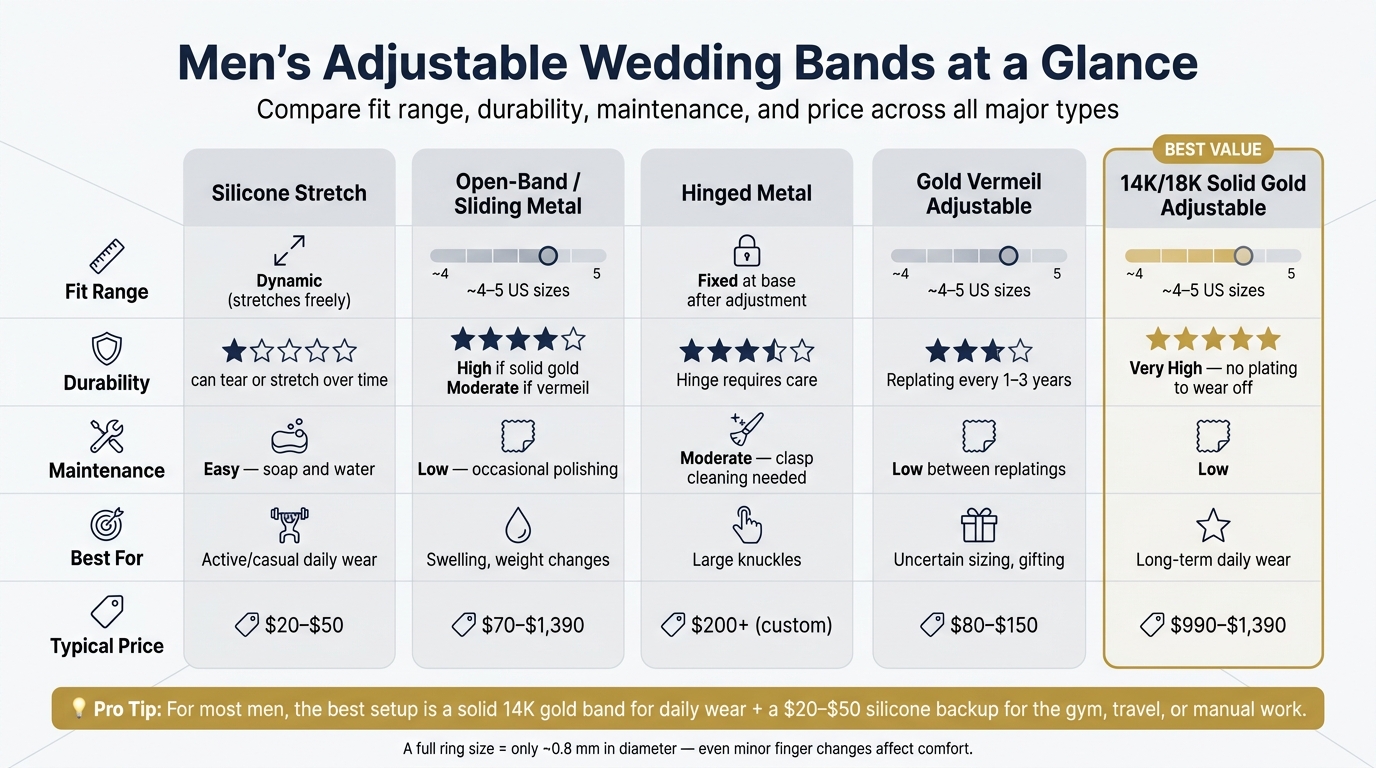
Men's Adjustable Wedding Bands: Types, Fit Range & Price Compared
Metal, Comfort Fit, Width, and Durability
When you're picking an adjustable band, look past the size range and focus on material, comfort, and how the ring will hold up day after day.
Metal matters even more with adjustable bands because the overlap area tends to wear faster than the rest of the ring. For daily wear, solid 14K gold is the safer pick. Plated metals can wear through at the overlap, while vermeil, silver, and silicone are better for lighter use.
Sterling silver is softer - about 75 HV on the Vickers scale, compared with 140 HV for 14K gold. In plain English, that means silver scratches more easily and can tarnish with daily wear. Silicone feels comfortable, especially for active use, but it’s a material you may need to replace over time.
Width plays a part too. Bands over 6 mm often feel tighter, so going up by half a size can help keep the fit comfortable.
Adjustment Range, Security, and Daily Wear Performance
Most adjustable metal rings cover about 4 to 5 US sizes . That range works for many common fit changes, but it’s still smart to check the exact range before you buy.
A well-made sliding band usually has a concealed inner overlap, which helps cut down on spinning or slipping. The fit should be pretty straightforward:
- It should pass over the knuckle with firm resistance
- It should sit snugly at the base of the finger
- It should not spin freely
Use the included resizing tool when making changes. Hand-bending may warp the band over time.
Use those limits to compare the main band types below.
Adjustable Band Types Side by Side
| Band Type | Fit Range | Durability | Maintenance | Best For | Typical Price (USD) |
|---|---|---|---|---|---|
| Silicone Stretch | Dynamic (stretches freely) | Low - can tear or stretch over time | Easy (soap and water) | Active/casual daily wear | $20–$50 |
| Open-Band / Sliding Metal | ~4–5 US sizes | High if solid gold; moderate if vermeil | Low (occasional polishing) | Swelling, weight changes | $70–$1,390 |
| Hinged Metal | Fixed at base after adjustment | High, but the hinge requires care | Moderate (clasp cleaning) | Large knuckles | $200+ (custom) |
| Gold Vermeil Adjustable | ~4–5 US sizes | Moderate - replating every 1–3 years | Low between replatings | Uncertain sizing, gifting | $80–$150 |
| 14K/18K Solid Gold Adjustable | ~4–5 US sizes | Very high - no plating to wear off | Low | Long-term daily wear | $990–$1,390 |
Conclusion: Key Tradeoffs and How to Make the Right Call
Once you compare the main options, the choice is mostly about fit changes, comfort, and how you’ll wear the ring day to day. Adjustable wedding bands help with size changes, but they won’t suit everyone. It comes down to three simple things: how much your finger size shifts, how much flexibility you want, and whether the ring feels comfortable and stays secure.
If your size changes a lot, a silicone band or hinged metal band is usually the better pick. If the changes are small, a comfort-fit fixed band may do the job just fine. If you do manual work, silicone is the safer route. If you want a more classic look, 14K or 18K solid gold is a strong long-term choice. And if your size stays pretty steady, a fixed band is simpler and often holds up better over time.
Material matters too. You’ll want one that fits how often you expect to resize the ring. Some hard metals last a long time, but most can’t be resized later. Gold and platinum are easier to resize and repair, which makes them a better long-term fit for adjustable designs.
There’s also the wear issue. If you resize often, the mechanism takes more stress. In that case, solid metal tends to last better than plated finishes.
For most people, the simplest setup is a main metal band plus a backup silicone ring. Think of it like this: wear the metal band for daily life, and keep the silicone ring for workouts, travel, or manual work. Put most of your budget into the ring you’ll wear every day, and keep the backup simple.
FAQs
How do I know if I need an adjustable wedding band?
You may need an adjustable wedding band if your finger size changes often or if fixed-size rings are hard to get on and off.
It can be a good fit if you deal with swelling from arthritis or pregnancy, weight changes tied to medication, larger knuckles than the base of your finger, or day-to-day swelling and shrinking caused by activity, weather, or your routine.
Which adjustable ring style is best for large knuckles?
For large knuckles and a smaller finger base, an adjustable sliding band is usually the best pick. It opens up enough to get over the knuckle, then tightens at the base of the finger for a snug, comfortable fit. That helps cut down on spinning, which is often the main issue with this finger shape.
Hinged rings can also help with swelling. But adjustable bands are often the better option for day-to-day wear because they’re lighter, easier to use, and more forgiving when finger size shifts during the day.
Are adjustable wedding bands durable enough for everyday wear?
Yes, adjustable wedding bands can hold up well for everyday wear if you pick the right metal and build. 14K solid gold or gold-filled styles tend to handle daily rubbing and repeated resizing better, without weakening the ring.
Since adjustable rings have a sliding contact point, the metal matters a lot. Higher-quality precious metals help cut down on visible wear over time. If you want the best long-term durability and appearance, solid gold is the top choice.


