

Bariatric Surgery and Jewelry: A Two-Year Sizing Timeline
Your ring size can change for up to 24 months after bariatric surgery. In the first 0–6 months, swelling and fast weight loss can turn a snug ring into a loose one. From 6–18 months, fit may keep shifting, so short-term fixes often work better than resizing. By 18–24 months, many people are closer to a stable size, which is when a jeweler resize may make more sense.
Here’s the short version:
- Right after surgery: take rings off and store them safely
- Months 0–6: focus on not losing the ring
- Months 6–18: use temporary fit help if your size still keeps changing
- After 18 months: think about permanent resizing only if your fit stays the same for 2–3 months
- Daily fit can still change: heat, salt, exercise, and hydration can shift finger size by up to 0.5 ring size
That means the best plan is simple: protect first, resize later. If your ring is loose enough to slip off during hand washing, workouts, or while pulling off gloves, stop wearing it every day. If it is only a little loose, a temporary ring guard or sizing beads may help for now.
| Phase | Timeframe | Best move |
|---|---|---|
| Early change | 0–6 months | Remove, store, or use a short-term adjuster |
| Middle stretch | 6–18 months | Keep checking fit; avoid final resize if size still shifts |
| Later stage | 18–24+ months | Ask a jeweler about resizing if fit is steady |
I’d treat this as a safety issue as much as a style one: a tight ring can be hard to remove, and a loose ring can disappear fast.
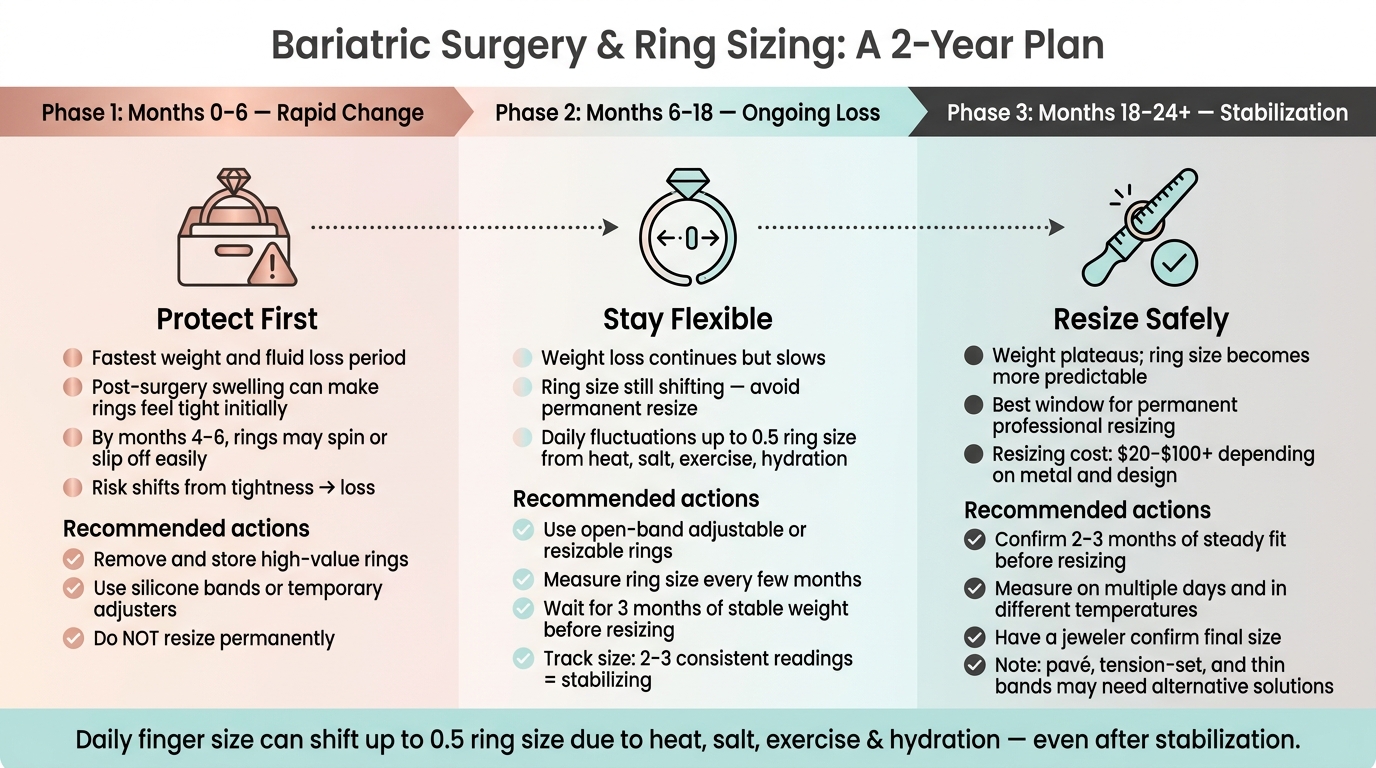
Bariatric Surgery Ring Sizing Timeline: 0–24 Months
Why Finger Size Changes After Bariatric Surgery
Finger size often gets smaller after bariatric surgery because body fat drops and hand swelling goes down too. As you lose fat across the body, the soft tissue around the fingers gets thinner. The bones don't change. That's why a ring might need to come off early, even if it seems to fit again later.
The Typical Weight-Loss Timeline from 0 to 24 Months
Weight loss after bariatric surgery tends to follow a pattern. Ring fit usually changes right along with it.
| Phase | Timeframe | What's Happening | Ring Fit Impact |
|---|---|---|---|
| Rapid loss | Months 0–6 | Fastest weight and fluid loss | Rings may go from snug to spinning within weeks |
| Continued loss | Months 6–18 | Slower but steady loss; approaching lowest weight | Gradual loosening; may need multiple interim adjustments |
| Stabilization | Months 18–24+ | Weight plateaus; body composition settles | Ring size becomes more predictable |
That early stretch can be a moving target. In the first six months, the main goal is to protect the ring and your finger, not rush into a permanent resize.
Why Rings May Spin, Slide, or Fit Differently Day to Day
A ring can feel tight in the morning, then loose later on. Heat, salt, exercise, and hydration can change finger size by up to half a ring size. After surgery, medication use and fluid shifts can make those ups and downs stand out even more.
Here's the key difference: a day-to-day swing comes and goes. A true size change sticks around. If your ring stays loose at different times of day for several weeks, that's usually a sign the change is no longer temporary. At that point, short-term fixes may stop being worth it.
sbb-itb-9da40c1
Months 0-6: Fast Changes Mean Protecting Jewelry Comes First
This is the stretch when ring fit can change the most, and it can change fast. During the first six months, things are still shifting too much for permanent resizing. So the goal is simple: protect the ring, not perfect the fit.
What Commonly Happens to Rings Right After Surgery
Rings and other jewelry should come off before surgery to help avoid burns and circulation issues.
Right after surgery, swelling can throw ring fit all over the place before weight loss even starts to show. In the first 1–3 weeks, IV fluids, inflammation, and less movement can cause short-term swelling in the hands and fingers. That means a ring that fit fine before surgery might suddenly feel tight or may not go on at all. Then, because weight loss is often fastest in the first 3–6 months, ring size can start changing in the other direction just as fast.
As the swelling goes down, the main risk often flips from tightness to loss. By months 4–6, a ring that used to need a bit of effort to get over the knuckle may spin around easily or slip off with a light shake of the hand. That’s when losing it by accident becomes a serious concern, especially while washing your hands, drying them with a towel, pulling on gloves, or working out.
Short-Term Options: Remove, Store, or Use Temporary Adjusters
If the ring is very loose, store it. If it’s only a little loose, a temporary adjuster may do the job. A simple test helps: if a firm hand shake over a soft surface makes the ring fly off, it’s time to stop wearing it every day.
For rings that are only slightly loose, temporary fixes can buy you time. If the ring spins a little but still needs a firm pull to get over the knuckle, silicone guards, removable sizing wraps, or other short-term adjusters can help keep it in place. A jeweler may also add jeweler-added sizing beads inside the band for a small interior fit change.
For high-value or deeply sentimental rings, like engagement rings or heirloom bands, storing them is often the safest move during this phase. Keep the ring in a sturdy jewelry box, a small safe, or another secure spot at home. Pick one storage place and stick with it every time. That small habit can save a lot of stress later.
Some people switch to a simple silicone band or plain metal band for daily wear during this period. It lets them keep the meaning and look of wearing a ring without risking something they can’t replace. It’s also smart to check whether high-value rings are covered by a homeowners, renters, or jewelry insurance policy.
Once the looseness stays about the same for several weeks, move on to regular sizing checks.
Months 6-18: Ongoing Weight Loss Calls for Flexible Jewelry
If the first six months are about protection, months 6–18 are about flexibility. Weight loss often keeps going through months 12–18, which puts rings in an awkward middle ground. They may be too loose for safe daily wear, but your finger size may still be changing too much for a final resize. In this stretch, temporary wear solutions matter more than permanent resizing.
When a Ring Is Consistently Too Large but Your Size Is Still Changing
At this point, the goal isn't a final resize. It's a secure fit that works for now. The clearest sign you're in this phase is a ring that keeps getting looser over several weeks, not just at different times of day.
Wait until your weight has been stable for 3 months before resizing. If you resize too soon, you may end up paying for the same work twice. On top of that, repeated alterations can weaken a band or damage a setting over time.
Adjustable and Resizable Rings as an Interim Solution
This is where the ring's design can make day-to-day wear a lot easier. Open-band adjustable rings can expand or contract within a set range, which makes them a smart option when your size is still shifting. Resizable settings are made so a jeweler can change the fit later without altering the ring's look.
Satinski's resizable engagement rings and wedding bands are built for exactly this kind of in-between stage: wear them now, then adjust them later once your size settles. For many people, that's a lot more practical than putting a meaningful ring in a box and waiting.
How to Check Your Ring Size While Your Size Is Still Changing
During this phase, it's worth tracking your ring size on a steady schedule. Measure at the end of the day, and skip checks right after exercise, salty meals, or when your hands are cold. Those things can throw off the result.
It also helps to get measured by a jeweler every few months during the first 18 months. That gives you a more accurate read and makes it easier to tell whether your size is still changing or starting to level off. If two or three checks in a row show the same size, that's a good sign things are settling. Once the numbers stop moving, timing a permanent resize becomes much simpler.
Months 18–24 and Beyond: When Permanent Resizing Makes More Sense
After months of stopgap fit fixes, the focus changes. At this stage, it’s less about protecting the ring day to day and more about deciding whether a permanent resize is the better move.
By 18–24 months, weight loss often slows down, and ring size tends to settle into a more steady pattern. That makes this the point when permanent resizing often starts to make sense. Even then, leave room for small day-to-day shifts from heat, exercise, and swelling.
Signs You May Be Ready for Professional Resizing
Once the fit stops changing from week to week, check whether your size has actually leveled out. The clearest sign is 2 to 3 months of steady fit. If your ring stays loose on different days and in different conditions, and your weight has stayed the same, that’s a strong clue.
Some fit problems go beyond annoyance. If the ring spins, slips off while you wash your hands, or gets hung up at the knuckle, it’s not just awkward anymore. It can turn into a safety risk.
Before you move ahead with resizing, measure your finger on more than one day. Then have a jeweler confirm the size instead of trusting one at-home check. If you get the same result in both warm and cool conditions, the choice is less of a gamble.
Simple bands in gold, silver, or platinum are often the easiest to resize. Rings with more complex designs can be tougher. That includes:
- pavé settings
- tension-set stones
- very thin bands
Those styles may call for a different fix instead of a standard resize.
Long-Term Options for Sentimental and Everyday Rings
For rings you wear all the time, the best move is usually the smallest change that keeps the ring secure. That goes double for engagement rings, wedding bands, and heirlooms. You want the fit to feel right without changing the ring more than needed.
Professional resizing often costs $20 to $100+, based on the metal and the design work involved. If the ring is only a little too big, or your finger size still shifts a bit with heat or swelling, sizing beads or small inside-the-band changes can help tighten the fit without altering the ring in a major way.
Wear the original ring only after its size has stayed steady for several months.
Conclusion: A Simple Two-Year Plan for Safer Jewelry Decisions
Over the first two years, ring fit tends to follow a pretty clear pattern: the biggest changes happen early, things slow down in the middle, and fit usually becomes more stable near the end.
That matters because the decision changes along with your finger size. Early on, the main job is protection, not a perfect fit. Temporary fixes make sense while your size is still shifting. Then, once the fit has stayed the same for several months, resizing starts to make more sense.
There’s a practical reason to wait. If you resize too soon, you may end up paying twice. And if a ring gets resized again and again, the band can weaken over time.
When your size finally seems settled, take one extra step before making the change official. Have a jeweler confirm the final size after your fit has stayed steady for months, especially for engagement rings, wedding bands, and heirlooms.
Your ring isn’t going anywhere. The point is to keep it safe until your size settles.
FAQs
How do I know if my ring is too loose to wear safely?
If your ring slips or spins during normal hand movement, it may be too loose to wear safely and could fall off.
Check the fit when your fingers are at a normal temperature, not when they’re cold, right after exercise, or after a salty meal. If it still slides off with little effort, think about an adjustable ring or having a jeweler resize it.
Get medical care if you notice swelling, pain, or signs of poor circulation.
Should I resize my ring or wait until my weight stabilizes?
It’s usually smart to wait until your weight has stayed about the same for a few months before getting a permanent professional resizing.
Here’s why: if you’re still losing weight, your finger size may keep changing too. And if you resize the ring too soon, it might not fit well later.
For now, temporary fixes can help. Adjustable rings or ring sizers make it easier to keep an eye on the fit as your body changes.
If your ring starts feeling dangerously tight or gets so loose that it could slip off, talk to a jeweler. They can tell you whether a safe change or a short-term fix makes more sense.
What should I do with my wedding ring right after surgery?
Right after bariatric surgery, pay close attention to how your ring fits as your weight changes. A ring that once felt fine can start slipping sooner than you expect.
If it gets loose, stick with temporary, non-permanent fixes for now, such as:
- Transparent plastic or silicone ring adjusters
- Metal sizing beads
- Ring guards
If the ring becomes very loose, you can wear a tighter, low-cost ring above it to help hold it in place. If swelling makes your ring feel too tight or painful, take it off and wear it on a necklace chain for a while.
Hold off on permanent resizing until your weight has stayed stable for a few months.


