

Should You Resize Your Ring During Weight Loss or Wait?
If you're still losing weight, I’d usually wait to do a permanent resize. A ring can change by about 1 full size after roughly 20 lb of weight loss, and fingers can still shift by about 1/4 to 1/2 size during the day from heat, hydration, and activity. That means resizing too soon can lead to another resize later.
Here’s the short answer:
- Wait if your weight is still changing
- Resize after your weight has been stable for 3 to 6 months
- Use a temporary fix if the ring feels loose right now
- Act sooner if the ring is slipping off, causing pain, or leaving deep marks
I’d think about it this way: a resize is a metal repair, not just a small fit change. Many rings can be resized, but doing it more than once can put more stress on the band and, in some cases, affect stones, engraving, or the ring’s shape.
A fast check:
| Situation | What I’d do |
|---|---|
| Still losing weight | Wait and use a ring guard, sizing beads, or stacking |
| Weight stable for 3–6 months | Get sized by a jeweler |
| Ring spins and has slipped off | Fix the fit soon |
| Ring leaves deep grooves, causes numbness, or is hard to remove | Resize now |
| Heirloom, eternity, thin, or stone-heavy ring | Get a jeweler to inspect it first |
My takeaway: if the fit problem changes from day to day, I’d use a reversible fix. If the fit is off all the time and your size has leveled out, that’s when a permanent resize makes sense.
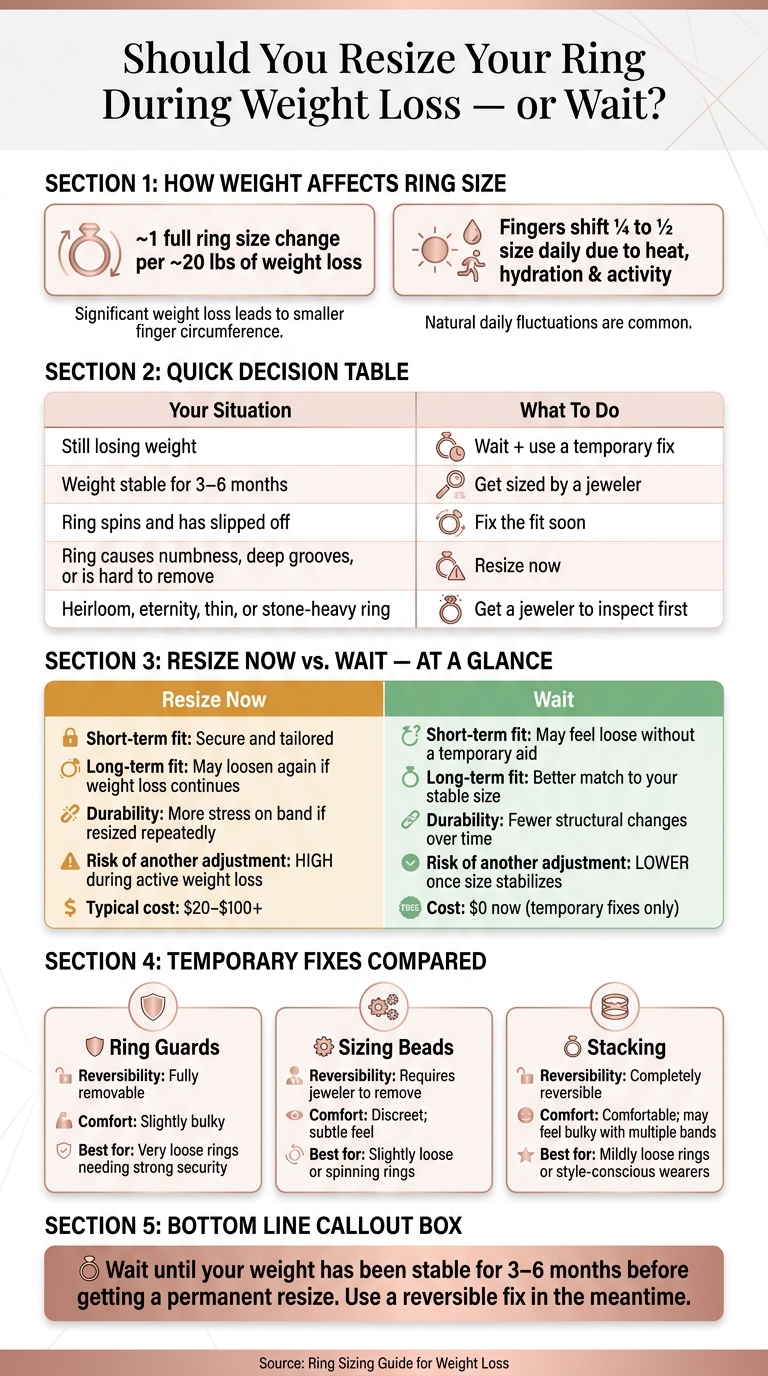
Should You Resize Your Ring Now or Wait? Quick Decision Guide
How weight loss affects ring fit and when a loose ring becomes a real problem
What matters most is whether the change is steady or just part of normal day-to-day swings. When you lose weight, the soft tissue at the base of your finger can get smaller, which can make a ring feel looser. At the same time, finger size can still shift during the day. That’s why it helps to judge the fit over several days, not in one quick check.
A good fit should slide over the knuckle with mild resistance, rest at the base of the finger, and turn a little without spinning.
Signs your ring is only temporarily loose or tight
Look for patterns instead of reacting to a single day. Check the fit at different times of day for 1 to 2 weeks. If the fit changes only with heat, cold, or hydration, it’s probably temporary.
Signs the fit has become unsafe or uncomfortable
These are red flags, not normal weight-loss changes.
Too loose:
- The ring makes full 360° turns without you touching it
- The stone or setting shifts toward the side or palm
- The ring slides toward your fingertip when your hand is relaxed
- The ring slips off during normal activities, like washing your hands, pulling on gloves, or reaching into a bag
Here’s a simple at-home check: hold your hand palm-down at shoulder height and gently shake it side to side. If the ring slides forward or looks like it could come off, it’s too loose.
Too tight:
- Deep grooves in your skin that stay for more than about 30 minutes after you remove the ring
- Swelling or bulging around the band
- Numbness or tingling
- Regular trouble getting the ring off, even with soap and water
If a ring feels tight only during a workout or on a hot afternoon, that’s usually not a big deal. But when tightness, marks, or discomfort keep showing up no matter the conditions, the fit has shifted from snug to unsafe.
sbb-itb-9da40c1
Why resizing too early can cause bigger problems down the line
Resizing isn't a small tweak. It's a structural change. Every time a ring is resized, a seam is created, and repeated work can weaken the band over time.
That matters a lot during active weight loss. If your ring size is still changing, resizing now can set you up for another resize not long after. And each extra adjustment puts more stress on the ring. The better move is to wait until your size has clearly settled before making a permanent change. If your finger size is still shifting, a permanent resize is still too soon.
Ring types that need extra caution before resizing
Some rings are much less forgiving than others.
Small stone-set bands need extra care because those tiny stones can loosen when the band is reshaped. Channel-set rings can end up with gaps or alignment problems if the metal walls move. Thin bands also have less metal to work with, so repeated cutting and soldering can make them more likely to bend or crack.
Engraved or patterned rings bring a different issue: the design can lose detail where the jeweler cuts the band. Eternity rings are often hard - or not possible - to resize in the usual way because there isn't a plain section of metal to alter. Custom, heirloom, or mixed-metal rings also call for extra care, since their original build can be tough to fix cleanly after cutting.
Cost, durability, and appearance tradeoffs to consider first
In the U.S., a standard resize usually costs about $20 to $100+, depending on the metal and how much work is involved. Bigger size changes often cost more because they take more labor and, when sizing up, extra metal.
Price is only part of the story. Repeated resizing can leave visible seams, slightly change the thickness of the band, or soften engraved details. If the ring has sentimental value, those changes may matter just as much as getting the fit right today.
| Factor | Resize Now | Wait |
|---|---|---|
| Fit (short term) | Secure and tailored to your current size | May feel a bit loose without a temporary aid |
| Fit (long term) | More likely to become loose again if weight loss continues | Better chance of matching your stable size |
| Long-term durability | More stress on the band and settings if resized repeatedly | Fewer structural changes over time |
| Likelihood of another adjustment | High during active weight loss | Lower once your size stabilizes |
That leaves you with a simple call: figure out whether the fit problem needs attention right now, or whether it's still just temporary.
When to wait and when to resize: a clear decision guide
The main question is simple: is the fit issue temporary, or has your size settled enough for a permanent change? If you're in active weight loss, your ring size can shift along with it. That makes timing the whole game.
Resize only after your weight has been stable for at least 3–6 months. That stretch gives your finger time to show your actual new size, not a short-term fluctuation from one lighter week.
When waiting is the safer choice
Hold off if your ring size still changes day to day or your weight is still going down. This matters even more at the start of a new weight-loss plan, medication, or workout routine, when weight loss often keeps going and may speed up.
For engagement rings, wedding bands, and heirlooms, it's smart to wait if your size is still shifting. In the meantime, a ring guard can help keep the ring secure until things level out.
When resizing now makes sense
A permanent resize makes sense when the problem is consistent, not just occasional. If your weight has been stable for 3–6 months, your ring spins freely every day, and it has already slipped off once or twice, that's not a small annoyance. It's a safety issue.
If you're dealing with ongoing pain, numbness, or deep marks, resize now. A stopgap fix won't solve those problems the way a permanent resize can, and waiting just drags out the discomfort and the risk.
Before you resize a ring that has already been altered or has delicate settings, ask a jeweler to inspect it first. They can look for hairline cracks, worn prongs, or old sizing marks that may affect how safely the ring can be changed again. It also helps to mention any future weight or lifestyle changes, so the jeweler can suggest the best approach for long-term wear.
If the fit is still changing, stick with a temporary fix until your size settles.
Temporary fixes that work better during active weight loss
If your ring size is still moving around, stick with fixes you can undo later. That way, you can keep the ring on safely without changing the metal before your size settles.
Ring guards, sizing beads, and stacking methods
Ring guards are small plastic, silicone, or metal pieces that clip onto or wrap around the inside of the band. They make the inner space smaller right away, and you don’t need a jeweler to use them. They’re a solid pick when a ring feels clearly loose and you want a fast fix that stays put. The trade-off is that some styles can feel a bit bulky under the band. It also helps to clean them often so grime doesn’t build up.
Sizing beads are two small metal balls soldered inside the shank by a jeweler. From the outside, they’re almost impossible to see. That makes them a smart choice for solitaire engagement rings and other top-heavy settings that like to spin. They can also help when your knuckle is larger than the base of your finger, since the ring can still pass over the knuckle and then sit more snugly once it’s in place. Since a jeweler has to add or remove them, repeated changes can put stress on the metal over time.
Stacking means wearing a looser ring next to a tighter band. The snugger band helps limit movement without making any permanent change. This works best when the looseness is minor. If the ring can slide off with a light shake, go with a guard or sizing beads instead for better security.
Choose based on how much your size is still changing:
| Option | Reversibility | Comfort | Adjustability Range | Effect on the Ring | Best Use Case |
|---|---|---|---|---|---|
| Ring guards | Fully removable; no permanent change | Can feel slightly bulky; usually comfortable once adjusted | Moderate to large size reduction | No direct change to metal; may trap grime if not cleaned | Very loose rings needing strong security during weight loss or exercise |
| Sizing beads | Requires a jeweler to remove and refinish | Discreet; may feel noticeable for sensitive skin | Small adjustments and anti-spin support | Adds solder points and interior beads; repeated changes can stress metal | Slightly loose or spinning rings where appearance matters |
| Stacking | Completely reversible; no alteration to any ring | Comfortable for most; can feel bulky with multiple bands | Flexible; depends on how snug the companion bands are | Normal friction wear where bands touch; no structural modifications | Mildly loose rings, style-conscious wearers, or those already using multiple bands |
When an adjustable ring is the better option
If your size may keep shifting for months, a built-in adjustable ring can make more sense over the long run. The size range is part of the ring’s design, so you’re not depending on add-ons while the fit keeps changing.
One practical note: if you adjust one at home, use a ring-sizing tool so the band stays perfectly round. Pushing it past its intended range can warp the band.
Conclusion: Pick the safest fit now and the right fix later
It comes down to one thing: is your ring size still changing, or has it leveled off? Weight loss can affect ring size, but it doesn’t happen in a clean, easy-to-predict way. That’s why rushing into a permanent resize can backfire.
Repeated resizing weakens the band and limits future adjustments. If you use up those changes while your finger size is still shifting, you may have less room for a proper final resize later.
For now, stick with a reversible fix. If your size is still moving, a temporary option is usually the safer call.
With engagement and wedding rings, waiting is often the smart move. Once your weight has stayed stable for 3–6 months and the fit is still consistently off, then it makes sense to get a permanent resize.
The goal is simple: keep the ring safe now, and fix it right later.
FAQs
How do I know if my ring is loose enough to be dangerous?
A ring is dangerously loose when it slides or spins so much that it feels insecure and might slip off. A proper fit should still rotate without feeling tight, but if it keeps moving, the ring is usually too big.
If it often shifts or slides toward the knuckle, it may not stay in place well enough for daily wear. Short-term fixes like ring guards, sizing beads, or adjustable rings can help lower the risk of losing it.
Can resizing damage an engagement or heirloom ring?
Yes. Resizing can damage an engagement or heirloom ring because the jeweler has to cut the band to add or remove metal. That process can affect the ring’s strength, especially if the piece is older or has already been resized before.
The risk also goes up with repeated resizing. Over time, the metal can weaken, which may lead to cracking, warping, or changes in the band’s shape.
Some rings are more risky to resize than others, such as:
- Rings with complex settings
- Tension-set stones
- Eternity-style rings with stones set all the way around the band
What temporary ring fix works best while I’m still losing weight?
While your finger size can change during weight loss, the best short-term fix is usually one that gives you some flex without making a permanent change. Adjustable rings from Satinski are a simple option because you can resize the band at home whenever you need to.
Other short-term options include ring guards or coils, sizing beads added by a jeweler, and ring snuggies. These can help keep your ring secure and comfortable until your finger size settles.


