


How Much Ring Size Do You Lose Per 10 Pounds? A Realistic Guide
Most people do not lose a full ring size for every 10 pounds. In many cases, 10 lb changes how a ring feels more than how it measures.
Here’s the short version:
- There is no fixed rule for ring size change per 10 lb
- Some people see no measurable change
- Finger swelling can shift fit by up to about 0.5 to 1 size
- Knuckle shape, band width, temperature, and salt intake can affect fit as much as body weight
- If your ring slides off with little resistance, it’s time to look at a fix
- If your weight is stable for 3 to 6 months, resizing may make sense
What I’d keep in mind is simple: a loose ring is not always a smaller finger. Sometimes it’s just cold weather, morning hands, or less swelling that day.
If you want a fast way to judge it, use this:
- Spins a little: usually watch and wait
- Slides during handwashing: try a temporary fix
- Comes off over the knuckle too easily: get it checked
- Has fallen off: stop wearing it until it’s fixed
| Situation | What it usually means | Next step |
|---|---|---|
| Ring feels a bit looser after 10 lb loss | Minor fit shift | Monitor for a few days |
| Ring spins all day | More than a one-time swelling change | Try a guard or jeweler check |
| Ring slips off with little effort | Fit problem | Resize or add beads |
| Fit changes morning to night | Swelling, temperature, sodium, or exercise | Measure at different times |
So if you’re asking, “How much ring size do you lose per 10 pounds?” the plain answer is: often none on paper, but sometimes enough to notice in daily wear.
Why 10 Pounds Affects Ring Fit Differently for Each Person
A 10 lb loss doesn't change ring fit the same way for everyone. Finger shape, swelling, and ring position all play a part. In many cases, a ring starts to feel different before your ring size changes on paper.
Finger shape, knuckles, and where the ring sits on your finger
Finger shape has a big effect on how soon a ring feels loose. Not all fingers are built the same. Some people have a knuckle that's much wider than the base of the finger. Others have fingers that look more straight or gently tapered.
When you lose weight, the soft tissue at the base of the finger often gets smaller before the knuckle changes at all. That means a ring can feel looser around the base but still stay on because it has to pass over a larger knuckle.
People with tapered fingers - wider at the base and narrower toward the tip - usually notice fit changes sooner. Even a small drop in soft tissue can make the ring spin, slide a bit lower, or feel less snug, even if the actual change is under half a ring size. With straighter fingers, that same amount of loss may not feel like much.
Ring placement matters too. A ring that sits low, close to the base, rests on a softer part of the finger. So small changes in circumference tend to show up there first. A ring that sits higher, closer to the knuckle, often feels steadier through modest weight loss.
Swelling, temperature, body composition, and time of day
Day-to-day swelling can change ring fit more than a small drop in weight. Warm weather, salty foods, exercise, and hormones can make fingers swell. Cold weather often does the opposite and makes rings feel looser.
So if your ring feels tight one day and loose the next, that doesn't always mean your size has changed. Sometimes it's just your body doing normal body things.
| Factor | Effect on Ring Fit | Duration |
|---|---|---|
| Hot weather | Fingers swell, rings feel tighter | Temporary |
| Cold weather | Fingers shrink, rings feel looser | Temporary |
| High sodium | Fluid retention, temporary puffiness | Temporary |
| Exercise | Increased blood flow, transient swelling | Temporary |
| Weight loss | Gradual reduction in soft tissue at finger base | Permanent |
| Arthritis/aging | Enlarged knuckles, reduced skin elasticity | Permanent or cyclical |
Fingers can shift by as much as a full ring size during the day and across seasons. They tend to be smallest in the early morning and largest later in the day.
Body composition matters too. Two people can weigh the same and lose the same 10 lb, yet get very different results with ring fit. One person may lose more soft tissue in the fingers. Another may not. That's why one ring suddenly starts spinning while another barely feels any different.
sbb-itb-9da40c1
How to Check Whether Your Ring Fit Has Actually Changed
Check the ring across several days. One loose moment doesn't always mean the fit changed for good. Fingers swell and shrink during the day, so if the ring feels looser, make sure that pattern stays the same instead of showing up once in a while.
Using a ring sizer, mandrel, and at-home fit checks
Start with a simple shake test. Hold your hand palm down, with your fingers pointed toward the floor, and give it a gentle shake. If the ring slides toward your fingertip or feels close to falling off, the fit has changed by more than a small amount.
If the ring passes that test, measure your finger next. Use a plastic or metal ring sizer on the exact hand and finger where you'll wear the ring. Check it at different times of day so you can tell the difference between normal swelling and an actual size change. Then match the result to a standard US ring size like 6, 6.5, or 7. Also, keep this in mind: wider bands often feel tighter than thin bands, so they may need a slightly larger size to feel right.
Then check the ring itself. Set the ring on a mandrel, or ring stick, and let it slide down until it stops on its own. Read the size at the inner edge of the ring. If the ring measures about one full size larger than your finger - for example, your finger measures 6 and the ring reads 7 on the mandrel - that points to a real size difference.
If a ring spins freely all day, that's another strong sign the looseness isn't just temporary.
When to get a jeweler's assessment
If it's an engagement ring, wedding band, or another high-value piece, have a jeweler check it before you resize anything. A jeweler can measure the ring on a calibrated mandrel and size your finger with a proper sizing set. They can also watch how the ring moves over your knuckle while you flex and straighten your finger.
That step matters even more for rings with pavé, halo, or tension settings. Those styles aren't always simple to resize, and changing the size can affect the structure around the stones.
Bring a few notes about when the ring feels loose. For example, does it slip in the morning, spin all day, or only feel loose when your hands are cold? That kind of detail helps a jeweler figure out whether you need a resize, sizing beads, or no change at all.
If the looseness stays the same across several days, the next move is to decide between a temporary fix and a permanent resize.
What to Do When Your Ring Becomes Loose
If your ring feels loose day after day, the best fix depends on how much it moves.
Temporary fixes for a slightly loose ring
If the ring spins but still stays on, a temporary fix usually makes sense.
Sizing beads are small metal beads a jeweler solders inside the bottom of the band. They slightly shrink the inner circumference and help the ring sit upright without changing the full ring size. This works especially well when a ring has to pass over a large knuckle but then feels loose at the base. In the U.S., jewelers often charge a modest fee for this - usually in the tens of dollars.
Ring guards make the opening smaller and tighten the fit. Because they’re removable, they’re a smart pick if you’re still losing weight or expect your finger size to keep shifting. Both fixes can help when your fingers change a bit throughout the day.
There’s one thing to watch out for: cheap metal guards with rough edges can scratch the inside of the band or bother your skin. And if your ring has a detailed setting, loose stones, or signs of damage, check with a jeweler before trying a fix at home. That small step can save you a much bigger headache later.
If the ring still spins a lot or feels like it could slide off, a temporary fix probably isn’t enough.
Permanent resizing and when it is the right call
If your ring can slip off during normal daily use, it’s usually time to think about permanent resizing. This makes the most sense when the ring stays loose in both warm and cold weather and your weight has stayed about the same for at least three to six months.
In the U.S., resizing a simple gold band down by one size often costs around $40 to $80. A more detailed ring - like an engagement ring with a pavé or halo setting - can cost $100 to $250 or more because the stones and the structure make the job harder.
Before you move ahead, ask the jeweler about your ring’s metal and design. Tungsten and titanium rings usually can’t be resized and may need replacement instead. Full eternity bands and rings with detailed engravings also cost more and carry more risk, since changing the band size can affect stone spacing and surface details.
If your finger size keeps changing, though, even a good resize may not solve the problem for long.
Adjustable and resizable rings for fingers that change size
If your finger size shifts often - because of weight changes, arthritis, aging, or swelling - an adjustable ring can take a lot of the hassle out of the process.
These rings use a built-in mechanism that lets the band expand or compress within a set range, so the fit stays comfortable whether your fingers are a bit swollen or at their smallest. They’re especially helpful for fingers that change size from weight loss, swelling, or arthritis. And because the mechanism is hidden instead of added on from the outside, the ring keeps a clean look while still adjusting to your fit needs.
The big upside is simple: the ring adjusts without repeated trips for resizing. That matters because resizing a ring again and again can put stress on the metal and weaken the band, especially near stone settings. An adjustable design avoids that wear.
Small Fit Change or Time to Act? How to Decide
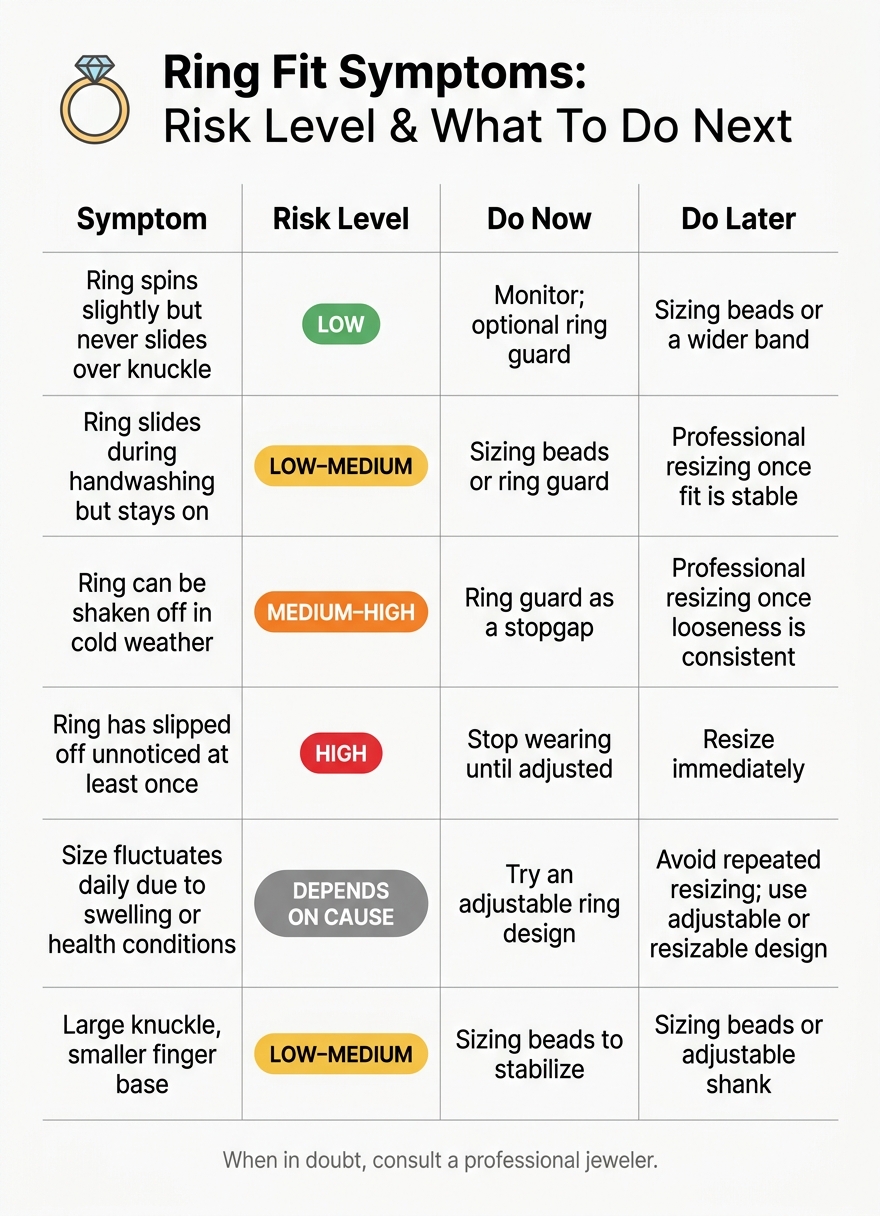
Ring Fit Symptoms: Risk Level & What To Do Next
The main issue is safety: can the ring still stay on your finger without slipping off?
A simple way to check is with the shake test and knuckle test. At room temperature, if the ring slides toward your fingertip or passes over your knuckle with little resistance, it’s too loose.
If the looseness only happens when your hands get cold or during short-term swelling, a temporary fix is often enough. But if the ring has slipped off even once without you noticing, or you’re pushing it back into place several times a day, it’s time to talk to a jeweler.
Use the chart below to match what you’re seeing with the best next step.
| Symptom | Risk Level | Now | Later |
|---|---|---|---|
| Ring spins slightly but never slides over knuckle | Low | Monitor; optional ring guard | Sizing beads or a wider band |
| Ring slides during handwashing but stays on | Low–Medium | Sizing beads or ring guard | Professional resizing once the fit is stable |
| Ring can be shaken off in cold weather | Medium–High | Ring guard as a stopgap | Professional resizing once the looseness is consistent |
| Ring has slipped off unnoticed at least once | High | Stop wearing until adjusted | Resize |
| Size fluctuates daily due to swelling or health conditions | Depends on cause | Adjustable ring design | Adjustable ring or resizable design; avoid repeated resizing |
| Large knuckle, smaller base | Low–Medium | Sizing beads to stabilize | Sizing beads or adjustable shank |
FAQs
Can 10 pounds really change ring size?
Yes, losing 10 pounds can change your ring size.
But there isn't a one-size-fits-all rule. Some people notice a clear difference. For others, the change is small or barely there.
It comes down to a few things:
- Genetics
- Body composition
- Where your body tends to store fat
Finger size can also shift from day to day. Temperature, activity, hormones, health, and age can all affect how a ring fits. So while a 10-pound weight loss may make a ring feel looser for one person, it might have little effect for someone else.
How do I know if my ring is too loose?
A ring is usually too loose if it slips on and off with little effort, spins around often, or feels like it could fall off during normal daily activity.
Finger size can change with temperature, exercise, and even hydration, so don’t judge the fit based on one moment. Watch how it fits over a few weeks instead. If it still feels loose or slides off during routine movement, ask a jeweler whether the issue is temporary or if sizing beads or a ring guard could help.
Should I resize now or use a temporary fix?
It depends on why the ring feels off and how often it happens.
If your ring size has changed for good due to weight loss or medical reasons, a professional jeweler is usually the best option for a durable, custom fit.
If your finger size shifts day to day or by season because of activity, temperature, or swelling, short-term fixes like ring adjusters, sizing beads, or stacking rings give you more flexibility.
Before you make any permanent change, track the fit for a few weeks.


