


Military Couples and Wedding Rings: Deployment-Proof Choices
If you’re in the military, one ring is often not enough. The safest setup for most couples is two rings: a silicone band for high-risk duty and a plain metal ring for home, leave, or low-risk days.
Here’s the short version:
- Silicone bands are best for PT, field work, and deployment because they’re non-conductive and break away under force.
- Metal rings can snag, conduct heat, and conduct electricity, which can be a problem around gear, machinery, or electrical systems.
- Finger size can shift during deployment due to heat, humidity, travel, stress, and exercise.
- Fixed metal rings usually only allow about 1–2 sizes of resizing before the band may weaken.
- 14K gold is 58.3% pure gold, which gives a good mix of wear life and price for daily use.
- Silicone bands often cost under $50, so keeping 2–4 spares is a smart move.
- If your size changes often, an adjustable ring can help you avoid repeat resizing.
What “deployment-proof” means is simple: not one ring for every job, but the right ring for each setting.
Quick Comparison
| Ring Type | Best For | Main Upside | Main Risk |
|---|---|---|---|
| Silicone band | PT, field work, deployment | Breakaway, non-conductive, low cost | Can stretch, wear out, or get lost |
| Low-profile metal band | Off-duty, home, low-risk days | Clean look, long wear | Snagging, heat, electrical conduction |
| Adjustable metal ring | Travel, swelling, size changes | Better fit when finger size shifts | Metal safety risks still apply |
My takeaway: if you want fewer sizing issues, less loss, and less wear on your main ring, use a two-ring plan, get sized over 3–5 days, and store your fine ring in a hard case or home safe with photos, receipts, and details for insurance.
That’s the core idea of the article below.
sbb-itb-9da40c1
Know your service conditions before picking a ring
Before you pick a ring, start with the job itself. Think about what your day actually looks like. Will you be wearing gloves? Handling weapons or machinery? Working near electricity? Moving from one climate to another? Those details shape what kind of ring makes sense.
For active duty, the safest pick is usually simple, low-profile, and easy to remove. If a ring can snag on gear or bunch up inside a glove, it can become a problem fast. And the tougher the work setting, the more that simple design matters.
Safety risks: snagging, ring avulsion, heat, and conductivity
A caught ring can do more than annoy you. It can cause ring avulsion, a severe finger injury that happens when the ring snags on gear or equipment.
Metal rings can also conduct heat and electricity, which makes them a poor fit around electrical systems or hot equipment.
How deployment, training, and climate shifts change finger size
Fit matters just as much as material. In service, hand size can change fast. Travel, heat, humidity, stress, and exercise can all affect finger size. A ring that feels perfect at home might feel tight after time in a hot, humid place. In other settings, that same ring might suddenly feel loose.
One common issue is the large-knuckle/small-base fit. Many people have knuckles that are larger than the base of the finger, so a ring sized to get over the knuckle may spin once it settles lower on the finger. In the field, that loose fit can make snagging more likely or cause the ring to slip off.
That’s why three ring styles tend to stand out here: silicone, low-profile metal, and adjustable designs.
Match your ring type to your duty setting
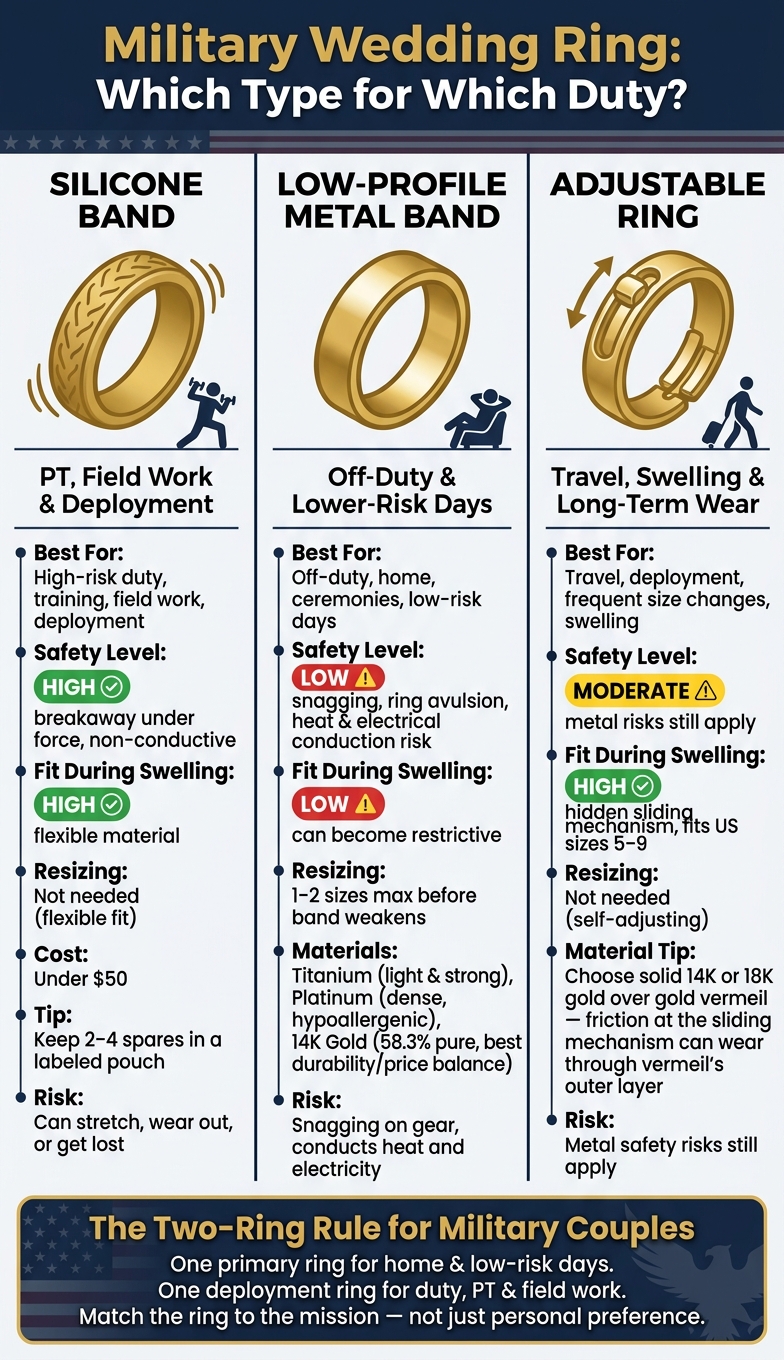
Military Wedding Ring Guide: Silicone vs. Metal vs. Adjustable
Safety comes first, but comfort matters too. And if your fingers tend to swell, the ring that felt fine in the morning can feel tight by the end of the day. That’s why it makes sense to match your ring to the job in front of you: field work, PT, office duty, or travel.
Silicone bands for training, field work, and deployment
Silicone is the go-to pick for high-risk settings. It’s flexible, non-conductive, and made to break away under force. In this case, that breakaway design isn’t a flaw. It’s the whole point.
Silicone bands also tend to cost under $50, which makes keeping a spare easy. If one gets lost, stretched, or worn down, replacing it is simple.
When metal is okay, a plain low-profile band is the next step up.
Low-profile metal bands for off-duty and lower-risk days
For off-duty time or lower-risk days, a smooth, low-profile metal band is usually the better fit. Flat, smooth edges help cut down on snags, which is exactly what you want.
The metal itself matters too:
- Titanium is light and strong.
- Platinum is dense, durable, and hypoallergenic.
- 14K gold is 58.3% pure gold and gives you a good balance of durability and price for daily wear.
There’s one catch with fixed metal bands: resizing has limits. Standard resizing usually handles only 1–2 sizes before it weakens the band.
If finger swelling is the main problem, an adjustable ring deals with that head-on.
Adjustable and resizable rings for swelling and long-term wear
Adjustable rings are built for size changes, so you don’t have to keep sending the ring out for resizing. Satinski's adjustable wedding bands use a hidden sliding mechanism at the back of the band. That lets the ring expand or contract across US sizes 5 through 9. The mechanism stays out of sight, so the ring still looks like a standard band.
For deployment wear, material choice matters more than it might seem. Solid 14K or 18K gold is the better pick than gold vermeil. Why? The sliding contact point inside the band creates friction over time. Solid gold keeps its color even as tiny amounts of wear build up. With vermeil, that same friction can wear through the outer layer and expose the silver base underneath.
Here’s a quick side-by-side look:
| Feature | Silicone Bands | Fixed Metal Bands | Adjustable Rings |
|---|---|---|---|
| Best Use | PT, high-risk field work | Off-duty, low-risk days | Travel, deployment, swelling |
| Safety | High (breakaway, non-conductive) | Low (snagging/avulsion risk) | Moderate (metal risks apply) |
| Fit During Swelling | High (flexible) | Low (can become restrictive) | High (expands via mechanism) |
Build a ring plan that cuts loss, sizing problems, and wear
After you pick the ring type, the next move is simple: set up a wear plan and a backup plan.
Use a primary ring at home and a deployment ring on duty
Give each ring a clear job. Keep your primary ring at home for leave, ceremonies, formal events, and lower-risk days. Use your duty ring for PT, field training, maintenance, and shipboard or aircraft work. A silicone band or a rugged, low-profile metal band usually makes the most sense there.
It also helps if the two rings still feel connected. Matching the engraving, finish, or color can tie them together without making daily wear a hassle.
Keep backup rings and store fine jewelry securely
Have a few extras ready. Keeping 2–4 spare silicone bands in your usual sizes can save you from a lot of annoyance. Store them in a labeled pouch so you’re not digging through a drawer when one goes missing.
Your primary ring needs better protection. Store it in a hard case or a safe at home. Before you leave, make a record of it with clear photos from several angles, plus the metal type, ring size, any engravings, and the original purchase price in U.S. dollars. Keep receipts or appraisals with that file in case you ever need to file an insurance claim or buy a replacement.
Get an accurate fit before you leave
Once your storage plan is set, dial in the size before you go. Measure at the end of the day when your hands are warm, then repeat that measurement over 3–5 days to see your normal range. If the numbers shift by about half a size, go up instead of down. That can help keep the ring from feeling too tight when your hands swell.
If your ring size changes often - maybe because of climate changes between duty stations, weight shifts, or heavy training - an adjustable option can make life easier. Satinski's adjustable wedding bands use a hidden sliding mechanism that fits US sizes 5 through 9. That can help with seasonal swelling and changes tied to activity levels.
For many couples, the simplest setup works best: one primary ring and one deployment ring. It covers most training and deployment needs without turning ring wear into a whole system.
Conclusion: The simplest deployment-proof ring setup for most couples
Once you strip away the extra options, the setup that works for most couples is pretty simple: use two rings. Keep one primary ring for home and lower-risk days, and one deployment ring for active duty, training, or field work.
For higher-risk duty, go with silicone. For lower-risk days, a plain, low-profile metal band usually makes more sense. If you're choosing a primary ring, 14K solid gold tends to hold up better with frequent wear, handles resizing better, and keeps its color better at common wear points.
If your ring size shifts a lot, an adjustable band can help cut down on repeat resizing.
The main rule is simple: match the ring to the duty setting, not personal preference. The right ring is the one you can wear safely on the job and comfortably at home.
FAQs
Can I wear a metal wedding ring on base?
It depends on your installation’s safety rules. Metal rings are often restricted during physical training, field exercises, or machinery work to help prevent injury.
For active-duty life, durable options like 14K solid gold or platinum can hold up well. And when your finger size shifts - as it often can with heat, cold, travel, or training - adjustable, low-profile designs may feel more comfortable day to day.
How do I know if I need an adjustable ring?
An adjustable ring can make sense if your finger size tends to change or feels hard to pin down. That happens more often than people think. Arthritis, pregnancy, medication-related weight changes, and swelling from heat, exercise, or a high-sodium diet can all affect fit.
It can also be a smart pick if your knuckle is larger than the base of your finger. In that case, getting a ring over the knuckle is one issue, and keeping it snug afterward is another. An adjustable style helps with both.
This type of ring is also handy when you don’t know your exact size, especially when buying online or giving a ring as a gift. It takes some of the guesswork out of the process.
How many backup silicone rings should I keep?
Keep two backup silicone rings on hand. Put one in your deployment or travel bag, and keep the other as a spare you can wear.
If your main ring gets lost, tears, or needs to be swapped out during training or because your hand size changes, you’ll still have a safe ring that’s easy to remove.


