


Is Moissanite Still Worth It? An Honest 2026 Buyer's Assessment
Yes - moissanite is still worth buying in 2026 if your top goal is getting a bigger, durable ring for less money. But it is no longer the default pick for everyone, because lab-grown diamond prices have dropped about 74% since 2020, with a 1-carat average near $564 in May 2026.
If I had to sum it up in one line, it would be this: moissanite wins on size-for-budget, lab-grown diamonds win if you want a diamond, and natural diamonds still win for old-school meaning and status.
Before you buy, I’d focus on these five things:
- Price: A 1-carat moissanite often runs about $300 to $800
- Look: Moissanite has more rainbow fire; diamonds show more white sparkle
- Durability: Moissanite is about 9.25 on the Mohs scale, so it holds up well for daily wear
- Upkeep: Dullness is usually surface buildup, not damage
- Long-term wear: Fit and setting matter just as much as the stone
A few takeaways stand out fast:
- If your budget is under $2,000, moissanite usually gives you the largest look
- If you want a stone that is actually a diamond, lab-grown is now much harder to ignore
- If your ring size may change from weight shifts, pregnancy, swelling, or arthritis, sizing flexibility can matter more than the stone itself
- If you wear your ring every day, a low-profile or bezel setting can make a big difference
Moissanite vs Lab Diamond: Don’t Buy Before Watching This
sbb-itb-9da40c1
Quick Comparison
| Stone | Best For | Main Upside | Main Tradeoff | Typical 1-ct Price |
|---|---|---|---|---|
| Moissanite | Max size on a lower budget | Bigger look for less | Not a diamond; more rainbow fire | $300–$800 |
| Lab-grown diamond | Buyers who want a diamond at a lower price | Diamond look and identity at a lower cost | Less size than moissanite at the same budget | About $500–$1,500 |
| Natural diamond | Buyers focused on old-school meaning and status | Rarity and social meaning | Much higher cost | About $3,000–$6,000+ |
So when I read this piece, the answer is pretty simple: moissanite still makes sense - but only for the right buyer. The best choice now depends less on hype and more on how you want your ring to look, wear, fit, and feel over time.
Moissanite in 2026: What It Is and Where It Delivers Value
Moissanite is a lab-created silicon carbide gemstone built for strong sparkle and daily wear at a small fraction of what a diamond costs. On paper, the difference is clear: moissanite has a refractive index of 2.65–2.69 versus diamond's 2.42, plus a dispersion rating of 0.104 versus diamond's 0.044. In plain English, that means about 2.5 times more rainbow fire than diamond. That’s where moissanite shines most: not in resale, but in how it wears and looks day to day.
Current U.S. price ranges and size value
In the U.S. in 2026, a 1-carat round moissanite - about 6.5 mm - usually costs $300–$800, based mostly on color grade. Premium DEF-color stones often fall around $400–$600, while standard grades tend to sit closer to $200–$400.
Now compare that with a natural diamond of about the same visual size. That often lands in the $4,000–$8,000+ range. That gap is huge, and it changes what a buyer can get for the same money.
With a $1,500–$2,000 budget, someone could buy a 2–3 carat moissanite center stone and still have room left for a solid gold setting. Spend that same amount on a natural diamond, and you may be looking at just a 0.5–0.7 carat stone in a basic setting. That lower stone cost also opens the door to better metal and a sturdier setting, which can matter just as much as the stone itself when a ring is worn every day.
How moissanite looks compared to diamond
Both stones are bright and sparkly, but they don’t give off the same kind of light.
Diamond tends to show more white brilliance. The flashes look clean and restrained, which is why many people connect diamonds with the classic engagement ring look. Moissanite, on the other hand, throws more intense rainbow fire, especially in direct sun and bright indoor light. In larger stones, those colored flashes stand out even more.
Neither look is better across the board. It’s mostly a style choice. If you like bold sparkle that grabs attention, moissanite often hits the mark. If you want something quieter and more in line with the look people expect from a diamond ring, diamond may feel like the better fit.
In normal day-to-day settings, high-grade moissanite is hard for most people to tell apart from diamond. A trained jeweler, though, can usually spot the difference under magnification, mainly because of moissanite’s double refraction and stronger fire.
Durability basics for everyday wear
Moissanite ranks at about 9.25 on the Mohs hardness scale. That puts it just under diamond at 10 and above sapphire and ruby at 9. For normal daily stuff - typing, washing your hands, light chores - it holds up very well and resists scratching and keeps its polish under normal wear.
Still, hardness doesn’t do the whole job. Setting design matters just as much. A tall solitaire with exposed prongs leaves the stone’s edges more open to impact than a bezel or low-profile setting. So while the stone itself is tough, the way it’s mounted can make a big difference in how the ring wears over time.
For people with active routines - nurses, gym-goers, parents, or anyone who works with their hands - a secure, low-profile setting in 14K or 18K solid gold can do more to protect the ring over the long run than the hardness rating alone. In many cases, the setting is what decides how well that durability plays out in daily life.
The next question is what you give up, and what you keep, compared with lab-grown and natural diamonds.
Moissanite vs. Lab-Grown and Natural Diamonds: The Real Tradeoffs
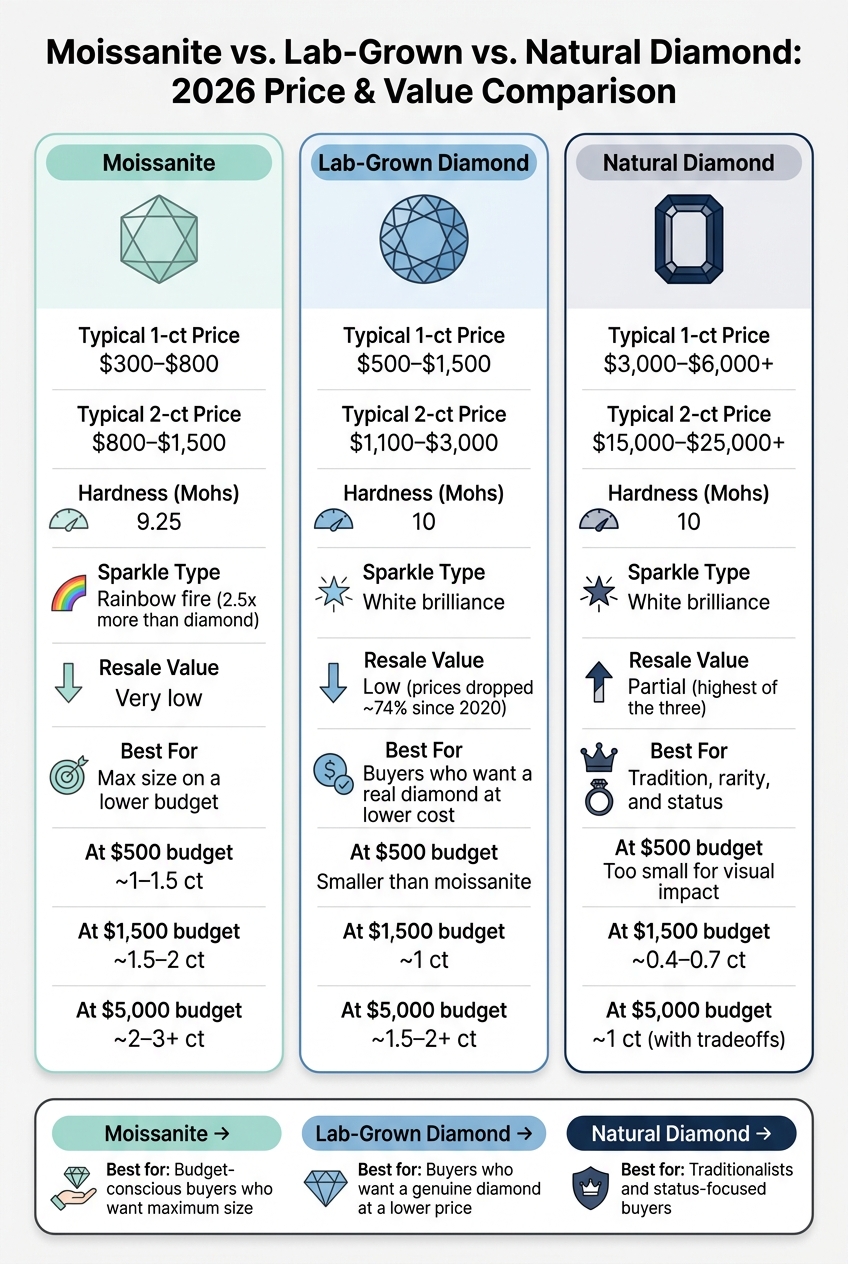
Moissanite vs. Lab-Grown vs. Natural Diamond: 2026 Price & Value Comparison
The real question isn’t just price. It’s which stone lines up with your budget, the look you want, and what you expect over time. “Worth it” changes a lot depending on what matters most to you. And that becomes much easier to see when you compare what the same budget buys across moissanite, lab-grown diamonds, and natural diamonds.
| Stone | Typical 1-ct Price (U.S., 2025–2026) | Typical 2-ct Price (U.S., 2025–2026) | Best-Fit Buyer |
|---|---|---|---|
| Moissanite | ~$400–$600 | ~$800–$1,500 | Buyers who want the largest look for the budget |
| Lab-Grown Diamond | ~$500–$1,500 | ~$1,100–$3,000 | Buyers who want a genuine diamond at a lower price |
| Natural Diamond | ~$3,000–$6,000+ | ~$15,000–$25,000+ | Traditionalists; status-focused buyers |
The same dollar amount can lead to very different results. It mostly comes down to one thing: do you care more about visible size, or do you care more that the stone is a diamond?
What each budget gets you: $500, $1,500, and $5,000
At $500, moissanite usually gives you the biggest look. You’re often looking at about 1 carat, and sometimes closer to 1.5 carats, especially in a simple gold setting. A lab-grown diamond at that price point will usually be smaller, and a natural diamond is often too small to give the same visual punch.
At $1,500, moissanite still leads on size, with a center stone around 1.5 to 2 carats. Lab-grown diamonds hit a nice middle zone at about 1 carat. Natural diamonds, by comparison, usually stay much smaller, around 0.4 to 0.7 carat.
At $5,000, the gap is still clear. Moissanite can move into the 2 to 3+ carat range. Lab-grown diamonds often land in a strong sweet spot at 1.5 to 2+ carats. Natural diamonds remain the premium option, but that budget usually gets you around 1 carat, often with some tradeoffs in color, clarity, or cut.
Resale value, symbolism, and status: what to expect
None of these stones should be viewed as an investment. Moissanite has little resale value. Lab-grown diamonds also tend to resell poorly. Natural diamonds usually bring back only part of what you paid at retail. That gap has been even tougher for lab-grown diamonds because prices have dropped hard - about 70% to 75% between 2020 and 2024 - which keeps secondhand value low.
Where the difference gets sharper is symbolism, not resale. In the U.S., natural diamonds still carry the most weight in engagement ring tradition, especially in more old-school social circles. Lab-grown diamonds are chemically and optically identical to natural diamonds, so you’re still getting a genuine diamond, just at a lower price. Moissanite is a different gemstone altogether, and people usually pick it because they want more size for the money or because diamond status simply isn’t the main thing driving the choice.
Which stone fits which buyer in 2026
If your main goal is the biggest visible look for the money, moissanite is usually the practical pick. If you want a stone that is, in fact, a diamond, lab-grown sits in the middle. It’s chemically and optically identical to a natural diamond, and it’s often priced at about 20%–30% of a similar natural stone.
Natural diamonds still appeal most to buyers who care most about tradition, rarity, and long-term symbolism. That appeal comes with a steep premium. So the choice tends to come down to what you value most: size, diamond identity, or symbolism.
Once the stone choice is set, the setting and fit decide how the ring actually feels and wears day to day.
Long-Term Ownership: Maintenance, Settings, and Ring Fit
Long-term value comes down to three everyday things: cleaning, setting, and fit. Get those right, and a ring stays easy to wear. Miss them, and even a pretty ring can end up sitting in a drawer. A ring that stays bright, secure, and comfortable keeps paying off in daily life.
Will moissanite scratch, chip, or get cloudy over time?
Modern moissanite does not usually develop internal clouding. If a ring starts to look dull or hazy, the cause is most often surface buildup from skin oils, lotion, soap residue, or dust - not a change in the stone itself. A good cleaning usually brings the sparkle back.
A simple routine works well every one to two weeks: soak the ring in warm water with a few drops of mild dish soap for about 10–20 minutes, scrub it gently with a soft toothbrush - especially underneath the stone, where grime likes to hide - rinse under lukewarm water, and dry with a lint-free cloth.
The nice part? All three stones follow the same basic cleaning routine.
| Moissanite | Lab-Grown Diamond | Natural Diamond | |
|---|---|---|---|
| Hardness (Mohs) | 9.25–9.5 | 10 | 10 |
| Scratch Risk (Daily Wear) | Very low | Very low | Very low |
| Chip Risk | Low; higher with exposed settings | Low; higher at thin edges or points | Low; higher at thin edges or points |
| Long-Term Visual Stability | Very high; dullness is usually surface buildup | Very high | Very high |
| Professional Check Frequency | Every 6–12 months | Every 6–12 months | Every 6–12 months |
In day-to-day wear, scratching is uncommon. Still, a hard direct hit can chip a stone, especially if the setting leaves it more exposed. Over time, the metal tends to wear before the stone does: prongs get thinner, bands can narrow, and stones may loosen. That’s why a professional inspection every 6–12 months is a smart habit.
Best settings for daily wear and active lifestyles
Cleaning protects the stone. Setting design protects the whole ring.
A bezel setting - where metal wraps around the edge of the stone - gives the most protection. It helps prevent snagging on clothes or equipment and adds a buffer against knocks. The tradeoff is simple: less light enters from the sides, so the sparkle looks a bit softer. For nurses, parents with young kids, gym regulars, or anyone who works with their hands, a bezel is often the practical pick.
A low-profile solitaire keeps the stone closer to the finger. That cuts down on snagging compared with taller cathedral styles, while still giving you that classic bright look. Halo and pavé settings can look more dramatic and can make the center stone seem larger, but they also bring more upkeep. Extra prongs and small accent stones collect more dirt and need more frequent cleaning and inspection. Over years of active wear, the small side stones in pavé bands are also more likely to loosen.
For active lifestyles, the goal is pretty plain: fewer exposed edges, a lower profile, and simpler metalwork. A 14K solid gold band is a strong long-term pick because it keeps its color as the ring wears.
Why ring sizing flexibility matters more than most buyers expect
Fit is the long-term issue many buyers brush off at first.
Finger size is not fixed. It can change by about a quarter size from day to day and by as much as half a size with the seasons as temperatures shift. Pregnancy can increase finger size by half a size or more. Arthritis, certain medications, weight changes, and aging can also change both finger and knuckle size over time.
When a ring fits poorly, its day-to-day value drops fast, no matter how tough the stone is. A ring that’s too tight can become hard - or impossible - to remove. A ring that’s too loose tends to spin, so the stone keeps turning into the palm. And some styles can’t be resized at all, especially bands with stones set all the way around.
Resizable or adjustable bands give you more room to deal with those changes. Satinski's adjustable rings use a hidden mechanism that flexes from sizes 5–9. That kind of sizing range matters because fingers don’t stay the same forever.
Who Should Buy Moissanite in 2026: Final Verdict and Buying Path
Once cost, look, toughness, and fit are clear, the next step is simple: who actually gets the most out of moissanite?
When moissanite is worth it for engagement rings and everyday jewelry
Moissanite makes sense when you want the biggest look for the money without paying diamond prices. It also works well for travel rings, stacking sets, and everyday pieces where losing or damaging a high-priced stone would sting.
Its 9.25 Mohs hardness handles daily wear well. And because the price is lower, there’s usually less stress about putting it on every day.
When buyers may want a different option
Moissanite won’t be the best match for every buyer. If diamond symbolism matters to you, your partner, or your family, then a lab-grown or natural diamond will line up better with that meaning.
There’s also the look. Moissanite has more rainbow fire, which stands apart from a diamond’s more classic white sparkle. If you want a quieter, more understated style, moissanite may feel a bit too flashy.
A clear 2026 buying path, including adjustable options from Satinski
The choice comes down to four things:
- Your budget
- Whether diamond symbolism matters to you
- The kind of sparkle you like
- Whether fit flexibility matters in day-to-day life
A fast way to sort it out is to look at budget, style, and sizing needs side by side.
| Buyer Profile | Best Stone | Best Setting & Sizing |
|---|---|---|
| Budget under $2,000, wants max size | Moissanite | Solitaire or halo in 14K gold; adjustable if fit is uncertain |
| Wants classic diamond look or tradition | Natural or lab-grown diamond | Traditional fixed-size solitaire |
| Active lifestyle, daily wearer | Moissanite | Low-profile bezel or secure prong in 14K solid gold |
| Needs flexible fit (swelling, arthritis, proposal) | Moissanite | Adjustable or resizable band |
| Travel or backup ring | Moissanite | Sterling silver or gold vermeil adjustable style |
The real test for any ring is everyday value, not status. For buyers who need more room on sizing, Satinski’s adjustable moissanite rings adjust from US sizes 5–9 and start at $190, using a hidden sliding mechanism that adjusts from US size 5 to 9. That makes them a smart pick when ring size may shift over time.
For buyers who want the biggest look, daily wear, and flexible sizing, moissanite remains one of the best-value options in 2026.
FAQs
Can moissanite pass as a diamond?
To most people, yes - moissanite can look like a diamond at a glance. Both stones are colorless, hard, and bright enough to look very similar in everyday wear.
That said, they’re not the same gem. Diamonds tend to have a more classic, quieter sparkle. Moissanite, on the other hand, throws off stronger, rainbow-like flashes. And in some lighting, especially in larger stones, moissanite can show faint yellow or green tones.
Which moissanite shape looks most diamond-like?
There’s no single moissanite shape that everyone agrees looks most like a diamond.
Moissanite has a higher refractive index than diamond, so it gives off more brilliance and more rainbow-like flashes in any shape. Because of that, the shape you choose mostly comes down to personal preference.
How do I choose between moissanite and a lab-grown diamond?
Choose based on budget, appearance, and value. Moissanite is often the better pick if you want a lower price, strong durability, and extra rainbow-like sparkle. Lab-grown diamonds cost more, but they give you the classic look and same composition as natural diamonds.
If your goal is a larger stone or a more luxurious setting for the same budget, moissanite is a smart choice. If you lean toward a classic aesthetic and better long-term resale value, a diamond may be the better fit.


