


Engraving Guide: What Fits, What Lasts, What to Say
Start with space, not the message. If I want an engraving that still looks good years from now, I need to check fit, metal, and method before I settle on the words.
Here’s the short version:
- Small rings fit less than most people think. A 2–3 mm band often holds about 8–15 characters.
- Adjustable rings hold even less. The usable area can drop to about 50%–70% of a closed ring.
- Short text lasts better. Fewer characters mean larger letters, and larger letters stay easier to read.
- Deeper cuts usually wear better. Laser marks are often around 0.05–0.15 mm deep, while hand engraving is often 0.25–0.5 mm+.
- Metal matters. Sterling silver can show wear sooner, while 14k gold and platinum tend to keep engraved detail longer.
- Future repairs can blur or cut through text. Polishing, replating, and resizing all matter.
If I had to boil it down to one rule, it would be this: pick a short message that fits the piece comfortably, then choose a metal and engraving style that can handle daily wear.
A few safe picks:
- Initials: “J&A”
- Date: “09/22/2026”
- Short phrase: Be Brave
- Coordinates: better on bracelets or pendants than slim rings
| Piece | What usually works best | Main limit |
|---|---|---|
| Narrow ring | Initials, short date | Very little space |
| Adjustable ring | Compact date, initials | Open back cuts usable area |
| Bracelet plate | Short phrase, coordinates | Line length and plate width |
| Pendant | Name, date, short word | Shape affects layout |
In plain terms: I’d keep the wording short, use a simple font, avoid tight or fancy script on small surfaces, and think about wear before engraving anything permanent.
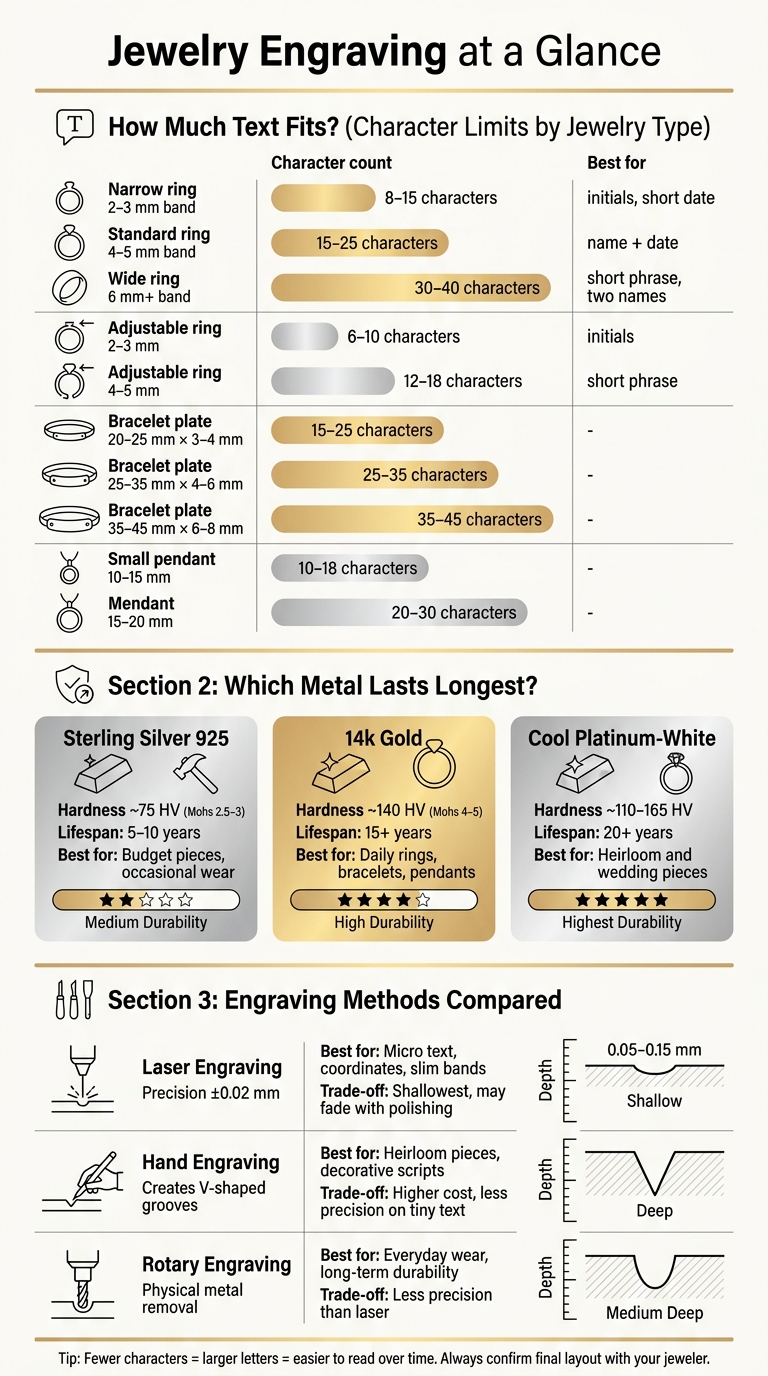
Jewelry Engraving Guide: Character Limits, Metals & Methods
Everything You Need for Engraving - Rio Buying Guide
sbb-itb-9da40c1
How Much Text Fits on Rings, Bracelets, and Pendants
The amount of text you can engrave comes down to a few simple things: the type of jewelry, the width of the band or plate, the curve of the surface, and the font size. The ranges below are a solid starting point, not a hard rule. Exact fit changes by model and layout, so it’s smart to treat these numbers as a guide and then confirm the final setup with your jeweler.
| Jewelry Type | Width / Size Range | Approx. Character Count (rough ranges, incl. spaces & punctuation) | Good Uses |
|---|---|---|---|
| Narrow ring (inside band) | 2–3 mm | 8–15 characters | Initials, short date ("A & B 10/21") |
| Standard ring (inside band) | 4–5 mm | 15–25 characters | Name + date ("Alex 10/21/26") |
| Wide ring (inside band) | 6 mm+ | 30–40 characters | Short phrase, two names + date |
| Adjustable ring | 2–3 mm (usable zone) | 6–10 characters | Initials, compact date |
| Adjustable ring | 4–5 mm (usable zone) | 12–18 characters | "Be Brave", "A & B 10/21" |
| Bracelet plate – small | 20–25 mm × 3–4 mm | 15–25 characters | Name + short date |
| Bracelet plate – medium | 25–35 mm × 4–6 mm | 25–35 characters | Coordinates, short phrase |
| Bracelet plate – large | 35–45 mm × 6–8 mm | 35–45 characters | Longer phrase, two names |
| Pendant – small (round/heart) | 10–15 mm | 10–18 characters | Initials, one short word |
| Pendant – medium (round/oval) | 15–20 mm | 20–30 characters | Name + date, short phrase |
| Pendant – rectangular bar | 25–35 mm × 4–6 mm | 25–35 characters | Phrase, coordinates |
Rings and Adjustable Rings: Character Limits by Band Width and Usable Area
A 2–3 mm band usually fits about 8–15 characters. That’s enough for initials or a short date, but not much beyond that. Move up to a 4–5 mm band, and you’re in the 15–25 character range, which works for a name plus a date like "Alex 10/21/26." With a 6 mm or wider band, 30–40 characters can fit, so a short phrase or two names plus a date becomes much more realistic.
One small catch: comfort-fit rings tend to hold a bit less text. Because the inside surface is more curved, letter size gets tighter. In U.S. sizes 4–5, you can usually expect room for 2–5 fewer characters than on larger sizes with the same band width.
Adjustable rings are a different story. The opening or sliding section on the back has to stay clear, so the usable inside area is often only the front and side portions. That usually means about 50–70% of the interior space of a standard closed ring. In plain terms, an adjustable ring with a 4–5 mm band may fit around 12–18 characters in that center zone, while a closed band of the same width might hold 15–25. That’s why the exact model matters so much here. Give your jeweler the precise piece, not just the band width.
Flat bands also tend to give you a bit more room than heavily curved ones. Even then, line length still matters. A phrase that technically fits can still look cramped if the letters have to be squeezed too tightly.
Bracelets and Pendants: Single Line or Two Lines
Bracelet plates and pendants usually give you more room than rings because the engraving surface is flatter. Still, there’s a practical limit, and it mostly comes down to plate length and width. A medium bracelet plate - about 25–35 mm long and 4–6 mm wide - usually fits around 25–35 characters on one line. That’s enough for coordinates or a phrase like "You are my home." A large bar bracelet in the 35–45 mm by 6–8 mm range can often handle 35–45 characters, which makes longer phrases or date-and-location combinations much easier to place.
Once a plate reaches 6–8 mm in width, many jewelers will suggest using two lines instead of forcing everything onto one. That often looks better and reads better too. Two lines with about 18–22 characters each are usually easier on the eyes than one line packed with 35+ characters. Think of it like trying to fit a long sentence on a tiny sticky note: yes, it can be done, but it won’t be pleasant to read.
Many jewelers can also provide a digital proof before engraving. That helps you compare a one-line layout with a two-line version and pick the one that looks best on the actual piece.
For pendants, shape plays a big role. A small round or heart pendant in the 10–15 mm range usually fits about 10–18 characters, which makes it best for initials or a single short word. A medium oval or round pendant at 15–20 mm can hold around 20–30 characters per line. Even if a pendant can technically hold more by shrinking the font, most engravers suggest keeping the inscription short. Fewer characters mean larger letters, and larger letters stay easier to read over time.
What Lasts: Metals and Engraving Methods
Once the inscription fits, the next thing to think about is how long it will stay clear. A shallow mark can fade into a light groove within a few years - or stay readable for decades. It all comes down to the metal and the way the inscription was made.
Gold, Platinum, and Sterling Silver: How Metal Choice Affects Wear
The harder the metal, the longer the engraved edges tend to stay crisp. Sterling silver is the softest of the three, so its engraved lines round off faster with daily wear. 14k gold holds detail longer, and platinum tends to last the longest because it develops patina instead of wearing away in the same way.
| Metal | Approx. Hardness | Typical Daily-Wear Engraving Lifespan | Best For |
|---|---|---|---|
| Sterling silver 925 | ~75 HV (Mohs 2.5–3) | 5–10 years | Budget pieces, occasional wear |
| 14k gold | ~140 HV (Mohs 4–5) | 15+ years | Daily rings, bracelets, pendants |
| Platinum 950 | ~110–165 HV | 20+ years | Heirloom and wedding pieces |
White gold adds one more wrinkle. If the engraving is shallow, repeated rhodium replating can make the lettering lose definition faster.
After metal choice, the engraving method has a big effect on how well the letters hold up.
Laser, Hand, and Rotary Engraving: Precision vs. Depth
Engraving method matters just as much as metal. Laser engraving gives the highest precision. Modern jewelry lasers can hit accuracy around ±0.02 mm, which makes them a strong fit for micro text, coordinates, or tiny initials on slim bands. The trade-off is depth: most laser marks land in the 0.05–0.15 mm range, so repeated polishing can smooth them out sooner than deeper cuts.
Hand engraving usually goes much deeper - about 0.25–0.5 mm or more. It also creates V-shaped grooves, which helps the cut stay readable even after the surface is refinished. Rotary engraving removes or shifts metal by physical contact and often cuts deeper than standard laser etching, so it works well for pieces meant for everyday wear where long-term durability matters most.
Resizing, Replating, and Polishing: How Future Changes Can Affect an Inscription
Even a deep engraving isn't safe from later work on the piece. Resizing can slice through letters or pull them out of shape. Polishing removes a thin surface layer each time. Replating can blur very shallow marks.
For adjustable rings, keep the engraving away from the open shank or sliding mechanism. That's the part that sees the most flex and wear. It's also smart to avoid any area that might need resizing later. Deep engravings on solid 14k gold or platinum handle future polishing much better than shallow marks on plated or very soft pieces.
Making the Message Fit: Fonts, Layout, and Character Count
Once you know how much room you have, the next limit is formatting. First, write the inscription exactly as it should appear. Then count every single character - letters, spaces, numbers, and symbols.
Count Every Character: Spaces, Numbers, and Symbols All Add Up
Every character matters. Spaces, slashes, dots, hyphens, ampersands, hearts, and infinity signs all take up room. A date like 09/22/2026 uses 10 characters, while September 22, 2026 uses 18.
It’s smart to ask the jeweler to confirm the count for the exact piece instead of leaning on a rough estimate.
Use Simple Fonts on Small Surfaces
With rings and small pendants, readability beats style. Font choice affects both how much text fits and how easy it is to read. On ring interiors and small pendants, letter height is often around 1.5 to 2.5 mm, so fine details can blur on tight curves. Simple sans serif or serif fonts usually stay clearer than fancy scripts on small, curved surfaces.
| Font Category | Small-Size Readability | Best Uses |
|---|---|---|
| Sans Serif | High – strokes stay clear | Dates, initials, short phrases on rings and small pendants |
| Classic Serif | Medium–High – readable | Traditional monograms, names, dates on rings and bracelets |
| Simple Script | Medium – needs more space | Short names or words on pendants, lockets, wider bands |
| Ornate Script | Low – strokes merge | Larger engraving areas only |
| Decorative/Display | Low – shapes distort | Larger pendants where text is more graphic than functional |
If the surface is narrow, stick with simple lettering. For very small engravings, preview the text in a basic font at 6–8 pt on screen. If it already looks cramped there, it’ll look cramped on metal too. Ornate script works better on wider, flatter surfaces.
Once the layout is set, the next step is choosing the wording itself.
What to Say and How to Keep It Readable Over Time
Message Ideas That Fit: Initials, Dates, Coordinates, and Short Phrases
Once you know how much room you have, the next step is simple: pick wording that fits the piece. Shorter is usually better. You want the message to say enough without looking cramped.
A good way to think about it is by purpose:
- Who: initials or a monogram
- Where: coordinates
- Why: a short phrase or date
| Message Type | Best Jewelry Category | Typical Format | Character Range |
|---|---|---|---|
| Initials / monogram | Rings, adjustable rings (compact only), small pendants | "J&A", "JRA", "A.J.K." | 3–7 characters |
| Date | Rings, adjustable rings (compact only), bracelets, pendants | "10/12/24" | 6–8 characters |
| Coordinates | Bar bracelets, pendants | "40.7128° N, 74.0060° W" | 15–30+ characters |
| Short phrase | Bracelets, pendants, wider bands | "My Person", "Be Brave" | 8–18 characters |
Coordinates work best on bar bracelets and pendants. Narrow rings usually don't have enough room for them to stay clear. On rings, a short date in U.S. format or a two- to four-word phrase like "You & Me" or "I Choose You" is often the safer pick.
Care Habits That Keep Engravings Clear
After you choose the message, daily wear has a lot to do with how long it stays sharp. Heavy impact can wear down engraved lines over time, so it's smart to remove engraved jewelry before rough work.
Some chemicals can also do damage. Chlorine, bleach, ammonia, and acetone may dull the metal and make the engraving look less crisp.
For cleaning, keep it simple:
- Use mild soap, warm water, and a soft toothbrush
- Skip frequent polishing, especially on plated pieces
- For adjustable rings, bend once for fit and avoid re-flexing near the engraving
That last point matters more than people think. Repeated bending can stress the metal right where the message sits.
Conclusion: Start with Space, Then Pick the Material, Then Write the Words
The best order is pretty straightforward. Start with the available space. Then pick the metal and engraving method. After that, trim the message until it fits well and stays easy to read.
For pieces meant for daily wear, platinum or 14k gold paired with laser or hand engraving tends to hold up well over time. Hand and laser engraving also tend to last longer than shallow mechanical engraving.
If you're stuck between squeezing in every word and keeping the font readable, cut the characters. A message you can still read years from now means more than one that says everything today but turns blurry later.
FAQs
How do I know if my message is too long?
Check the surface area of your jewelry piece first. Small items like rings and slim bracelets don’t give you much space, so long messages can look cramped or end up hard to read.
If you’re not sure, keep it short. Initials, a meaningful date, or a brief phrase usually work best. You can also confirm during your design consultation that your message will fit clearly and still look balanced.
Which engraving method lasts longest for daily wear?
For everyday wear, hand engraving and laser engraving tend to last the longest. That’s because both methods leave deeper, more permanent marks than surface-level mechanical engraving.
The metal matters too. Platinum and 14K or 18K solid gold hold up best with daily use, which helps the engraving stay clear and readable over time.
Can resizing or polishing ruin an engraving?
Yes. Resizing may mean cutting or shifting the metal, and that can harm an engraving. Polishing also takes off a thin layer of metal, so if it’s done too often or too aggressively, the engraving can fade or disappear over time.
With plated jewelry, the risk is even higher. The outer finish can wear away and expose the base metal underneath.
Before you move ahead, ask a jeweler how resizing or polishing might affect your specific piece.


