


Choosing a Wedding Band That Works With an Heirloom Engagement Ring
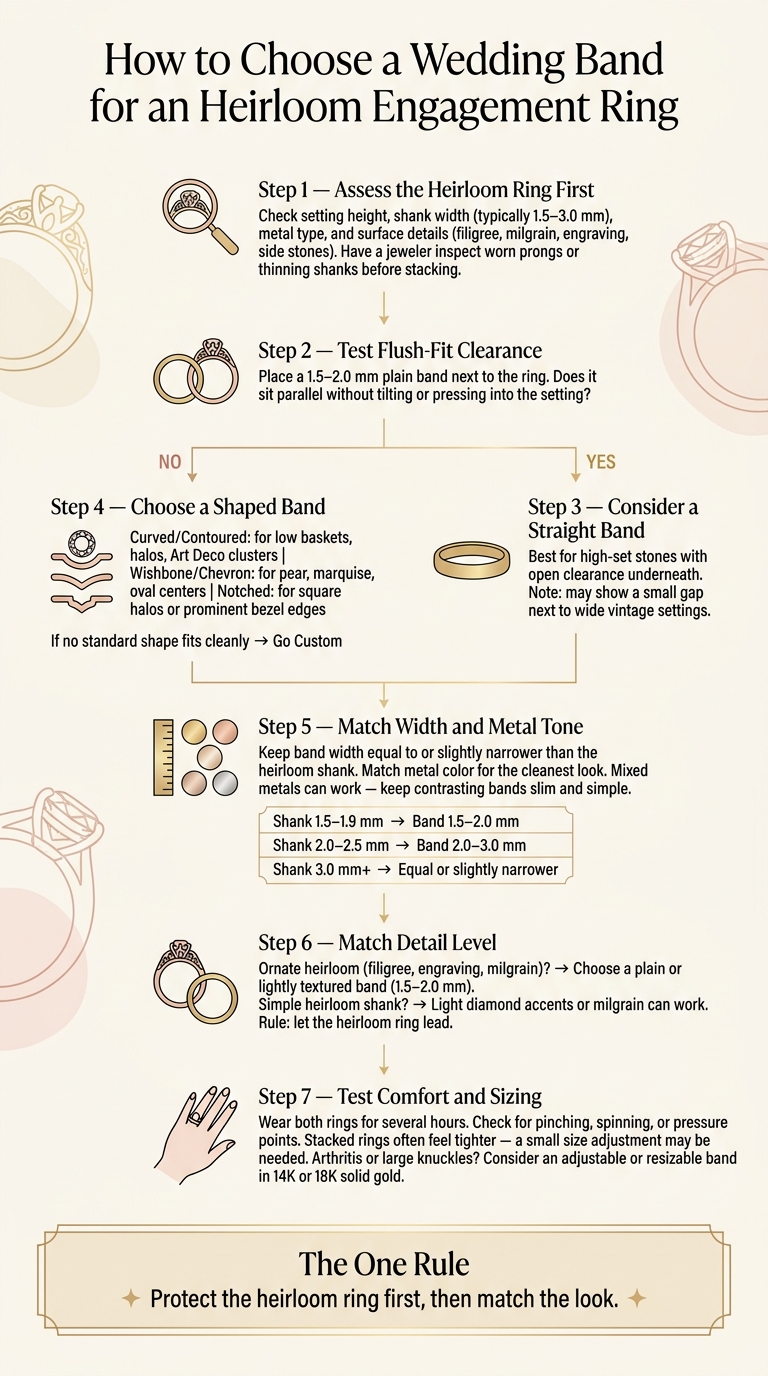
The short answer: don’t force a flush fit. With an heirloom ring, I’d check clearance first, then pick a band shape that avoids rubbing, keep the band close in width to the engagement ring, and test comfort before I buy.
A plain 1.5 mm to 2.0 mm band is often the safest starting point. If a straight band tilts, presses on prongs, or hits a low basket, I’d move to a curved, chevron, or notched band instead. And if the ring has thin prongs, worn metal, filigree, milgrain, engraving, or side stones, I’d ask a jeweler to inspect it first.
Here’s the whole decision path in one place:
- Check the setting from the side. Low-set stones and low baskets often need a shaped band.
- Test clearance with a slim plain band. If it touches the setting, skip a straight band.
- Match width carefully. Many heirloom shanks fall around 1.5 mm to 3.0 mm, so I’d keep the band equal to or a bit narrower.
- Match metal tone if I want the cleanest look. Mixed metals can work, but contrast shows more next to older rings.
- Keep detail in check. Ornate heirloom ring? I’d usually pair it with a plain or lightly textured band.
- Pick comfort over a tight stack. Two rings can feel smaller than one, so sizing may need a small change.
- Leave a small gap if needed. A tiny space can be safer than metal-on-metal contact.
- Go custom when stock bands still rub or rock.
- Think about finger size changes. Swelling, arthritis, and large knuckles can make a resizable or adjustable band easier to wear.
How to Choose a Wedding Band for an Heirloom Engagement Ring
Quick Comparison
| Check | What I’d Look For | What It Usually Means |
|---|---|---|
| Setting height | Low stone, low basket, overhang | Curved, chevron, or notched band |
| Flush-fit clearance | Straight band tilts or hits prongs | Don’t force a flush fit |
| Shank width | Heirloom shank is 1.5–3.0 mm | Keep band close in width |
| Metal | White, yellow, rose, platinum | Matching tone keeps the set calm |
| Surface detail | Filigree, engraving, milgrain, side stones | Slimmer, simpler band often works best |
| Comfort | Pinching, spinning, pressure points | Try lower profile, narrower width, or size change |
| Daily wear | Fragile prongs or worn shank | Jeweler check before stacking |
| Finger size shifts | Swelling, arthritis, large knuckle | Resizable or adjustable option may help |
If I had to boil it down to one rule, it’s this: protect the heirloom ring first, then match the look.
sbb-itb-9da40c1
1. Assess the Heirloom Ring Before You Shop
Before you shop for a band, take a close look at the heirloom ring itself. The ring’s height, width, and surface details will show you which bands are likely to fit well - and which ones could cause wear or sit awkwardly. Start with height and clearance, then check shank width and metal.
Setting height, stone placement, and flush-fit clearance
Look at the ring from the side to see how much space the stone leaves above the shank. If the stone barely clears the shank and you can almost touch its edge when you run a finger across it, it’s a low-set stone. If the stone sits higher with open space underneath, it’s medium to high-set.
Low-set and basket settings often need a curved, contoured, or notched band. A simple way to test this is to place a 1.5 to 2 mm plain band next to the ring. If the band sits parallel with only a hairline gap near the prongs, there’s probably enough clearance. If it tilts, stops short, or presses into the setting, a straight band isn’t the right match. That check helps you avoid a band that pushes on prongs or rubs against delicate parts of the setting.
If the heirloom ring already shows wear - like thinning at the back of the shank, prongs that look slightly bent, or stones that seem off-center - have a jeweler inspect it before you add a band. They can check prong strength and shank thickness under magnification and tell you if the ring should be repaired first.
Shank width, metal type, and vintage details
Once fit is sorted out, match the band’s scale to the ring itself. Measure the shank width in millimeters with a ruler that has mm markings or with digital calipers. Measure across the widest point at the base of the finger. Most heirloom engagement rings fall between 1.5 mm and 3.0 mm wide, and that number should guide your band choice.
| Shank Width | Band Width That Looks Balanced |
|---|---|
| 1.5–1.9 mm (very thin) | 1.5–2.0 mm |
| 2.0–2.5 mm (medium) | 2.0–3.0 mm |
| 3.0 mm and above (wide) | Equal to or slightly narrower than the heirloom shank |
Keep the band equal to or slightly narrower than the heirloom shank.
Then check the metal color and type. Matching the metal color and purity gives you the cleanest look. If you mix tones, the contrast will stand out more next to an antique ring.
Now zoom in on the shoulders and sides of the ring. Look for filigree, milgrain, engraving, or side stones. These are often the parts most at risk on an older ring. A wide band pressed against fine filigree can block the openwork visually and, over time, crowd or wear down those edges. That’s why a lighter-looking band tends to work better with ornate heirloom settings. In many cases, a slim band with a little texture - or one worn with a small intentional gap - makes more sense.
With the ring mapped out, the next step is choosing a band shape that follows its profile.
2. Pick the Band Shape That Fits the Ring's Profile
Band shape is the next fit check. Use your measurements to narrow the options. The goal is simple: pick a band that clears the setting and sits flat on the finger.
The right shape depends on how far the heirloom ring’s setting hangs over the shank. A straight band usually works when the stone sits high and there’s open space underneath. Lower settings often need a curved or notched band instead.
| Band Shape | Best For | Main Tradeoff |
|---|---|---|
| Straight | High-set stones with clearance | Visible gap next to wide vintage settings |
| Curved / Contoured | Low baskets, halos, Art Deco clusters, Edwardian settings | Less versatile worn alone |
| Wishbone / Chevron | Pear, marquise, and oval centers; low solitaire baskets | Pronounced V-shape limits future stacking |
| Notched | Square halos, prominent galleries, and bezel edges that jut out | Precise cut-out can limit future stacking |
Curved and contoured bands are also called shadow, tracer, or nesting bands. Check the ring from the side before you decide. That view tells you whether the band has enough clearance. One small miss here can lead to rubbing, tilting, or a band that never quite sits right.
There’s also a style point to think about. Some curved bands can look a bit unfinished when worn on their own. If you plan to wear the band solo on some days, that’s worth weighing now instead of later.
When a custom band is the right choice
If no standard shape clears the setting cleanly, it’s time to go custom. That’s often the best move when ready-made bands still tilt or touch a delicate area. Asymmetrical Art Nouveau scrollwork, extended hand-engraved shoulders, or wide halo edges that overhang the shank at uneven points can make even a well-fitted contoured band rock or press on the weakest part of the setting.
A custom band is made to clear those problem spots instead of resting against them. In most cases, a jeweler will start with a consultation, then test the fit with a 3D CAD model or a wax prototype before casting.
Once the shape is set, the next step is matching the metal tone and width to the ring’s details.
3. Match Metal Tone, Width, and Stone Detail to the Heirloom Ring
Once the band shape is settled, the next step is how the band looks next to the heirloom ring, not just whether it fits.
Metal tone and visual weight
Matching metal tone usually gives the set a more unified look and helps the heirloom ring stay front and center. It can also help limit wear on older shanks.
Mixed metals can still work, but the contrast should play a supporting role. If you want a rose gold band with a white gold heirloom ring, keep the band slim and simple. A wider band or one with a lot of decoration in a contrasting metal can steal focus from the heirloom ring. Let the engagement ring lead, and let the wedding band act as a quiet accent.
Visual weight comes from a few things: width, profile, and surface detail. In most cases, the band should be equal to or a bit narrower than the heirloom shank.
After tone and scale, check one more thing: does the band's detail level make sense with the heirloom's design?
Slim plain bands, diamond accents, and engraved details
The easiest rule here is simple: match the band's detail level to the ring's detail level. Plain bands often work best with ornate heirlooms, while light texture can echo older design features without making the set feel crowded.
If the ring has filigree, a cluster setting, or hand-engraved shoulders, a plain band in the 1.5–2.0 mm range is often the best pick. It frames the heirloom without boxing it in.
Diamond-accented or pavé bands tend to work best when the heirloom ring has a fairly simple shank or already includes diamond accents. Keep the band slim, around 1.5–2.0 mm, and choose low-profile stones so the band adds sparkle without competing with the heirloom. Skip high-set shared-prong bands that sit taller than the heirloom setting. Over time, they can rub against vintage prongs and loosen stones.
Engraved and milgrain bands are a natural match for Art Deco, Edwardian, and Victorian heirlooms. A slim milgrain band in matching platinum can echo the beaded borders often seen in early 20th-century rings without looking out of place. Keep the engraving fine and low-profile. It also helps to place the most detailed work along the sides instead of across the full top surface, so the heirloom stays the most intricate part of the set when viewed straight on.
Once the look feels right, the next step is checking how the set feels in daily wear.
4. Check Comfort, Sizing Flexibility, and Long-Term Wear
Profile, spacing, and daily comfort
Once you’ve settled on the shape and metal, the next thing to check is simple: how the rings feel when you wear them together.
A rounded inside edge can make a stack more comfortable for daily wear because it cuts down on friction and pinching. The ring should feel snug, move very little, and never cut off circulation.
It’s worth wearing both rings for several hours and going through normal daily movement. Type, carry bags, grip a steering wheel, wash your hands, open doors. Then pay attention to what happens. If you notice pinching, spinning, or pressure points after a few hours, that’s a sign the stack needs work. Small pressure points may slowly wear down fragile prongs or vintage edges over time.
A low-profile band often feels better than a thick or highly domed band when it sits next to an older ring with delicate prongs or a raised center setting. It also helps limit repeated metal-to-metal contact, which can wear on those details over time.
If the stack feels tight, a few small changes can help:
- Go up slightly in size
- Try a narrower band
- Pick a lower-profile design
Stacked rings often feel tighter than a single ring, so a small size change may be needed.
If the set still feels unstable after a wear test, sizing flexibility is the next thing to look at.
Resizable and adjustable options for changing finger size
Finger size can shift because of heat, cold, swelling, pregnancy, medications, arthritis, and aging. That matters even more with two rings, because even a small change can make the pair feel too tight, too loose, or awkward when your hand moves.
For someone with arthritis, the knuckle may be larger than the base of the finger. That creates a common problem: a fixed-size band may need to be large enough to get over the knuckle, but then it spins once it settles at the base. An adjustable band can help here because it can open enough to pass the knuckle and then close more snugly at the base.
A sizing option that works with your hand can also help you avoid changing an older setting. For daily wear, 14K or 18K solid gold is a better pick for an adjustable band because the metal stays the same all the way through. That means friction at the sliding contact point won’t expose a different-colored base metal the way gold vermeil can over time.
Choose a standard band when the heirloom ring has a simple shape and the fit stays steady. Go with an adjustable or resizable band when finger size shifts with the season, swelling, or arthritis. If the ring profile still causes rubbing or leaves gaps, a custom band is usually the better path.
Conclusion: A Simple Decision Path Before You Buy
Before you buy, run through a short checklist. Start with four checks: look at the ring’s setting and any fragile details, pick a shape that clears the profile, match the metal tone and visual weight, and test how it feels in daily wear.
If the ring profile is still tough to fit, custom or adjustable options usually fix more issues than trying to force a standard band to work.
Match the band’s metal to the heirloom ring for the cleanest look and the most even wear.
If swelling, arthritis, or a large knuckle makes a fixed band hard to wear, go with an adjustable or resizable design. Just check the overlap for wear.
FAQs
Can I have a gap between my rings?
Yes. A gap between your wedding band and engagement ring is completely fine. In many cases, it’s not just a style choice. It may be needed, especially if your heirloom ring has a low-set stone or an unusual shape that prevents a standard band from sitting flush without rubbing or causing damage.
If you’re not a fan of the look, you’ve got options. A contoured band or shadow band can follow the shape of your vintage ring more closely and create a neater fit. Some adjustable-style bands can also be customized or placed in a way that makes the two rings look like they belong together.
Will stacking damage an antique ring?
Yes. Stacking can damage an antique ring because older settings are often more delicate and can wear down faster when they rub against other bands.
That kind of metal-on-metal contact may lead to scratches, thinning, and general wear over time. If you want to protect an heirloom piece, store each ring separately when you’re not wearing it. It also helps to have a professional jeweler check the ring from time to time to make sure the gemstone settings stay secure.
Should I choose a custom wedding band?
A custom wedding band can be a great option when standard sizes don’t let the band sit flush against your heirloom engagement ring.
This is often the case with unusual settings or tricky fit issues, like getting over a larger knuckle while still fitting snugly at the base of your finger. A jeweler can shape the band to match your ring’s profile, width, and support needs, so you get a better fit without changing what makes the ring so meaningful.


