

Second Marriage Ring Etiquette: Choosing a Band Later in Life
There’s no fixed rule for a second marriage ring. If I were choosing one later in life, I’d focus on four things first: meaning, comfort, budget, and what to do with older rings.
Here’s the short answer:
- I can choose a wedding band, an engagement ring, both, or neither
- If I’m divorced, I’d usually stop wearing my old wedding set
- If I’m widowed, I might keep a late spouse’s ring as a keepsake or wear it on my right hand
- If I still own an older ring, I can store it, remake it, sell it, or pass it down
- A ring that sits low, feels good, and is easy to size often makes more sense than a large set
- Budget matters more than old “rules” like three months’ salary
- Lab-grown stones can cost 20% to 50% less than natural diamonds
- Basic ring resetting often starts around $100 to $500, while bigger redesign work may run $800 to $2,000
If finger size has changed with age, swelling, or arthritis, I’d also look at comfort-fit, hinged, or adjustable bands. The goal is simple: pick a ring that fits my life now, not my first marriage.
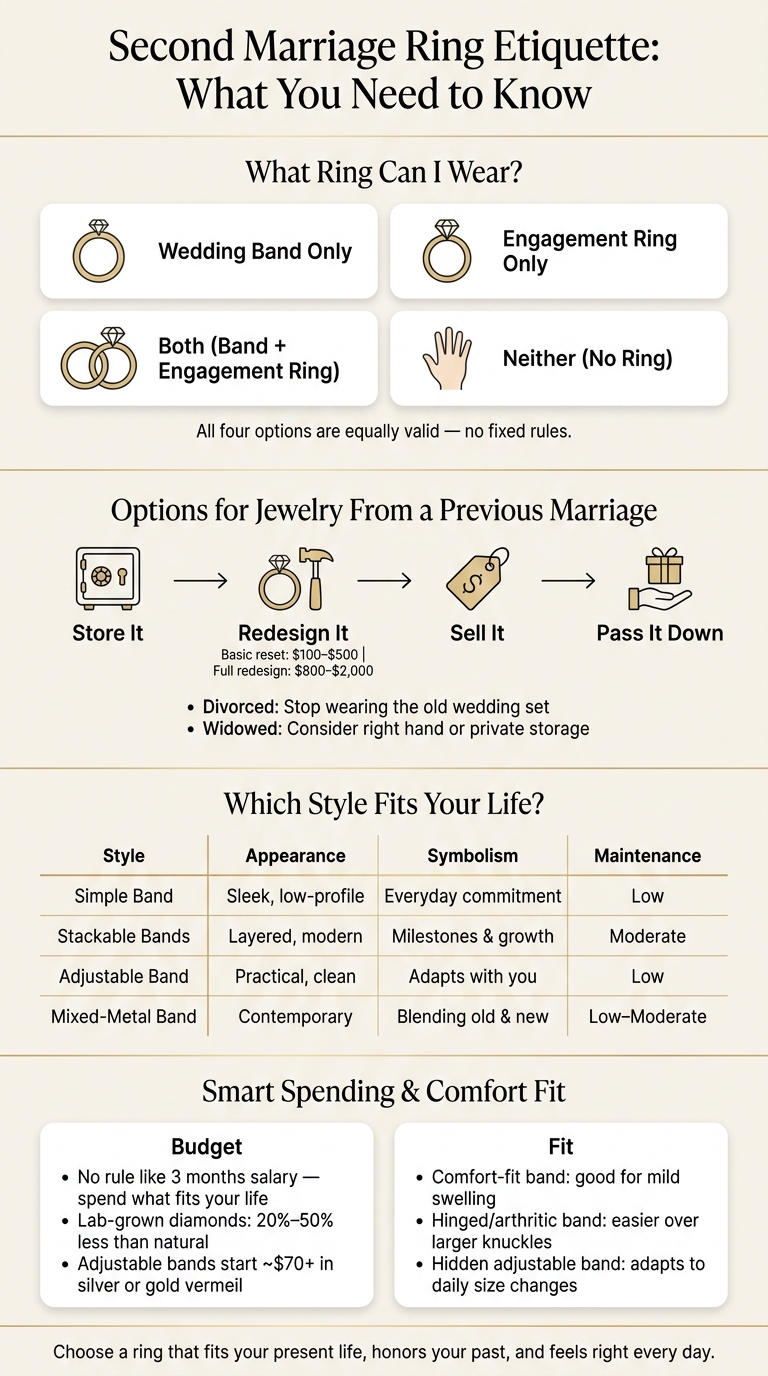
Second Marriage Ring Options: Styles, Fit & Budget at a Glance
Quick comparison
| Topic | Main point | Best plain-language takeaway |
|---|---|---|
| Ring choice | Band, engagement ring, both, or neither all work | I don’t need to follow an old script |
| Old wedding set | Usually not worn with a new ring | Keep meanings clear |
| Widowhood | Keepsake use may be more layered | Right hand or private storage can work |
| Past jewelry | Store, remake, sell, or pass down | I don’t have to decide at once |
| Budget | No set spending rule | Spend what fits my life now |
| Daily wear | Low-profile rings are often easier | Comfort comes first |
| Sizing | Finger size may shift over time | Hinged or adjustable rings may help |
The bottom line: I’d treat the past with respect, keep the message of each ring clear, and choose a band that feels right every day.
sbb-itb-9da40c1
What Modern Etiquette Actually Says About Second Marriage Rings
For a second marriage, the etiquette question is usually a lot simpler than people think. In modern U.S. etiquette, there isn't one "right" ring for a second marriage. What matters is choosing a ring that clearly reflects the relationship you have now.
Older etiquette rules leaned toward smaller, simpler rings for remarriage. That idea doesn't carry much weight anymore. These days, the focus is on personal meaning, clarity, and comfort, not rigid rules. In practice, that leaves four common paths: a band, an engagement ring, both, or neither.
Wedding Band, Engagement Ring, Both, or Neither: What Works Later in Life
All four options work.
Some people wear only a wedding band. Others pair a slim engagement ring with a simple band. Some go with stackable rings so the set can grow into a more personal look over time. And some skip a formal engagement ring altogether and exchange bands during the ceremony.
That last option can feel especially right for people who want something that doesn't resemble a first-marriage bridal set. It's a simple way to mark a new chapter without repeating the old script.
How Divorced and Widowed Readers May Approach Ring Etiquette Differently
The starting point often depends on how the earlier marriage ended.
For divorced individuals, the usual etiquette is to stop wearing the prior wedding set once the marriage is legally or emotionally over. Wearing a previous wedding set alongside a new engagement ring can send mixed signals, especially to a new partner or family members. So the general advice is pretty plain: don't wear the old wedding set with the new one.
For widowed individuals, the situation is often more layered. Many keep a late spouse's ring as a keepsake. Some move it to the right hand as a sign of remembrance. Others store it privately. During a transition, some people wear the new ring on the left hand and the keepsake ring on the right.
The main goal is to keep the meaning of each ring clear for the people around you, especially children. In other words, the exact setup matters less than making sure everyone understands what each ring stands for.
Once the ring choice is settled, the next step is figuring out what to do with jewelry from a previous marriage.
What to Do With Jewelry From a Past Marriage
You don't need to make this call on day one. Putting the ring in a jewelry box or a safe-deposit box is a sensible first move. That gives you some breathing room.
After that, the choice usually comes down to three paths: keep it as it is, change it into something new, or let it go. There isn't one "right" answer here. Keeping it, redesigning it, selling it, or passing it down can all make sense.
It helps to split the decision into three parts:
- Emotional: Does the ring still feel meaningful, painful, neutral, or too tied to the old marriage?
- Financial: Does it have resale value worth looking into?
- Design: Could it become something that clearly belongs to your life now, not your life then?
That kind of sorting can make the decision feel less tangled and more personal to your current relationship.
Store, Redesign, Sell, or Pass Down Older Rings
A smart first step is to get the ring appraised, document its condition, and think through any legal or family ties before you decide what comes next. If you're leaning toward repurposing it, a design that looks plainly different from the original can help mark a new chapter. A diamond from a first engagement ring, for example, could become a solitaire pendant or a right-hand ring.
Redesigning also makes sense if you want to keep the stone or metal but leave the old setting behind. In the U.S., basic resetting work often starts at about $100 to $500, while more involved redesigns usually land around $800 to $2,000. If the piece no longer feels personal, selling it may turn that value into something more useful.
Passing the ring to a child or another heir can also be a respectful option, especially when the piece has family history but no longer works as a personal symbol. If you go that route, be plain about the story behind it. Is it meant to be a keepsake, a future engagement stone, or simply a family memento? That detail matters.
How to Handle Family Heirlooms With Care and Clear Communication
Things get more sensitive when the ring is a family heirloom. If it came from your former spouse's family, the most respectful default is to ask whether they want it returned. Even if the law says you can keep it, etiquette sources suggest offering family heirlooms back to the family they came from, or at least talking through the choice with them. If they don't want it back, repurposing may still make sense, especially if the new design looks clearly different from the old one.
Whatever you choose, calm and direct communication matters most, especially with your new partner, your children, and anyone else who feels tied to the piece. Respect the ring's history, but make its meaning clear in the present. Once you've sorted that out, the next step is finding a style that fits the new relationship and how the piece will be worn day to day.
How to Choose a Ring Style That Fits Your Relationship and Daily Life
After you’ve looked at past jewelry, the next step is simpler: pick a ring that fits the way you live now. The main things to weigh are symbolism, day-to-day wear, upkeep, and budget.
Simple Bands, Stackable Rings, Mixed Metals, and Nontraditional Symbols Compared
For daily wear, simpler styles often make the most sense. A low-profile band is less likely to catch on clothing, easier to clean, and usually more comfortable when you wear it all the time. Mixed-metal designs - like a band that combines white and yellow gold - can be a smart fit if you already mix metals in your other jewelry.
Stackable bands give you room to add meaning over time. You might add one for an anniversary or a blended-family milestone, instead of starting with a larger or more detailed ring right away. Adjustable or resizable bands also make sense if finger size may change later. Many come in open-shank or hinged styles that can be sized without a full remake.
| Style | Appearance | Symbolism | Maintenance |
|---|---|---|---|
| Single simple band | Sleek, low-profile, understated | Partnership and everyday commitment | Low; occasional polishing only |
| Mixed-metal band | Contemporary, versatile, easy to pair with other jewelry | Blending old and new; a fresh but practical choice | Low to moderate |
| Stackable minimalist bands | Layered, modern, customizable | Personal milestones and growth | Moderate; multiple pieces need coordination |
| Adjustable or resizable band | Clean, wearable, practical | Long-term commitment that adapts with you | Low; no resizing fees as size changes |
| Custom band | Unique, personal, designed to order | Deep personal meaning tied to this relationship | Varies by setting and stone choice |
| Nontraditional commitment piece | Non-ring symbol, such as a pendant | Personal meaning; for couples who prefer no ring | Varies; generally low |
If you want to add meaning, small details can go a long way. An engraving, a birthstone, or a two-tone metal can make even a plain band feel tied to this relationship without making it look busy. In most cases, one or two details are enough.
How to Set a Realistic Budget Without Comparing It to a First Marriage
Once the style is clear, set a budget based on what you can spend comfortably now. In the U.S., there’s no etiquette rule saying a second ring should cost more - or less - than the first. The “three months’ salary” idea is a marketing concept, not a rule. What matters is whether the ring works for your current finances and priorities.
Set a firm cap using your income, savings goals, and near-term costs - whether that means retirement contributions, travel, or helping children or aging parents. Then find the best ring within that amount. Adjustable and minimalist bands can start at around $70+ in sterling silver or gold vermeil, while solid 18K gold options usually cost more.
If you want a diamond look without the same price tag, lab-grown stones can cost 20% to 50% less than natural diamonds. Estate or pre-owned jewelry can also help you get a better piece for less. And if sizing may shift over time, it’s smart to leave room in the budget for an adjustable or resizable design.
After style and budget, the next decision is how the ring will fit and wear over time.
Fit, Comfort, and Customization: What to Consider Later in Life
Once you’ve picked the style, the next step is simple: will the ring feel good every day? Later in life, comfort matters just as much as looks. Swelling, arthritis, and larger knuckles or finger joints can make a fixed-size ring tough to put on, hard to take off, or annoying to wear for hours at a time. Finger shape can shift with age, swelling, and arthritis.
Fixed-Size Bands, Hinged Designs, and Adjustable Rings Compared
The main fit issue with larger knuckles or finger joints comes down to a mismatch. The ring has to be wide enough to get over the joint, but snug enough to stay in place at the base of the finger.
A ring with a domed inner edge, often called a comfort-fit band, can help. It reduces pressure and makes the ring easier to slide on. That makes it a solid middle ground if you want a classic look. Still, it’s based on one fixed size, so it may not solve bigger fit changes.
If your knuckle is much larger than the base of your finger, a hinged or arthritic band may make more sense. These rings open wide to get past the knuckle, then close at the base of the finger. They’re often easier to wear day to day, though the hinge may need more care over time than a solid band.
A hidden adjustable band works a bit differently. It shifts with day-to-day size changes without changing how the ring looks from the outside. That can make a big difference if swelling, temperature changes, or arthritis affect fit.
Here’s how the main options compare:
| Option | Comfort | Durability | Appearance | Resizing Need |
|---|---|---|---|---|
| Fixed-size metal band (comfort-fit) | Good for mild swelling | High | Traditional and seamless | May still need future resizing |
| Hinged or arthritic band | High; easier over larger knuckles | Medium to high | Usually looks standard when worn | Less need for repeated resizing |
| Hidden adjustable band | High; adapts to daily changes | High if well-made | Looks like a normal ring from the top | Minimal day-to-day resizing |
How Custom and Adjustable Options Make a Ring Easier to Wear Long Term
If standard sizing still feels too limiting, custom construction can deal with the fit issue more directly. A custom-sized ring can be shaped to suit both your knuckle and the base of your finger. For someone who wants one ring to wear every day through swelling, temperature shifts, and arthritis, a hidden adjustable mechanism can help the ring keep fitting as finger size changes.
Satinski’s adjustable wedding bands, engagement rings, and stacking rings are built around that approach. Their rings in sterling silver and 18K solid gold come in US sizes 5 to 9 and use a hidden internal mechanism that adjusts to daily swelling and gradual size shifts without visible outer hardware. Each ring also includes a resizing stick to help keep the band round during at-home adjustments.
Stackable adjustable rings offer another way to make daily wear easier. You can wear one band most days and add others for special occasions. Or you can wear pieces on their own if your comfort needs shift over time. For everyday use, a primary adjustable band is often more practical than depending on repeated resizing.
Conclusion: Choose a Ring That Respects the Past and Fits the Present
After looking at etiquette, past jewelry, style, and fit, the last step is pretty simple. Second marriage ring etiquette comes down to this: choose the ring that fits your relationship, your day-to-day life, and your comfort. There aren't fixed rules here. Pick what fits this marriage.
Handle jewelry from a past marriage in the way that feels respectful and clear to you. That might mean keeping it, remaking it, or letting it go. The point is to treat the past with respect while being clear about your present.
Once that piece is settled, comfort should lead the decision. Comfort matters most, so lean toward low-profile, comfort-fit, hinged, or adjustable designs.
Set a budget that matches your life now, not what you spent on your first wedding. That's the best way to judge a second marriage ring.
The best second marriage ring fits who you are today. Choose the ring that works for your present life, honors your past, and feels right every day.
FAQs
Can I wear my second ring on a different finger?
Yes. You can absolutely wear your second ring on a different finger.
Modern adjustable rings are made for comfort and flexibility, so you can wear them in the way that suits you best. Maybe it matches your outfit better on another hand. Maybe it feels better day to day. Maybe you just like the look. That’s all fair game.
They can work as a wedding band, a stackable ring, or a statement piece, and you can adjust them to fit different fingers.
How do I talk to family about reusing an old ring?
Focus on honoring the ring’s history while keeping it wearable and secure. I want to cherish the piece, not tuck it away in a box, and keep it in active use as part of this new chapter.
If changes are needed, modern, non-invasive adjustments can help preserve the original design and sentimental value without permanent resizing.
What ring style is easiest to wear every day?
An easy-to-adjust, clean-looking band with a smooth, comfortable fit is often the simplest choice for daily wear.
A hidden adjustment feature, such as an open back, can help the ring fit better as your finger changes during the day due to swelling, temperature changes, or arthritis - without tools or standard resizing.


