

Anniversary Band Guide: Choosing a Ring That Still Fits in 10 Years
A ring that fits today can feel too tight later. In just one day, heat, salt, and activity can shift finger size by about 0.25 ring size. Over 10 years, weight change, pregnancy, aging, or arthritis can move it by 0.5 size or more.
So if I were choosing an anniversary band for long-term wear, I’d focus on more than looks. I’d look at:
- How finger size changes in the short term and over time
- How to measure the base of the finger and the knuckle
- How band width can make a ring feel tighter
- Why comfort-fit interiors often feel easier to wear
- Which metals are easier to resize later
- Which designs make resizing harder, like full eternity bands
- How stacking rings changes fit and feel
- When fixed-size, resizable, adjustable, or custom bands make more sense
A few simple rules do most of the work:
- Measure when your hands are warm, not cold
- Check both the finger base and knuckle
- Expect wide bands and ring stacks to feel tighter
- Pick a style and metal that leave room for later changes
- If your size shifts a lot, think past a fixed-size ring
Here’s the short version: the safest long-term pick is often a medium-width band, with a comfort-fit interior, in a metal like gold or platinum, and in a style that can still be resized later.
That’s the lens I’d use for every choice in this guide.
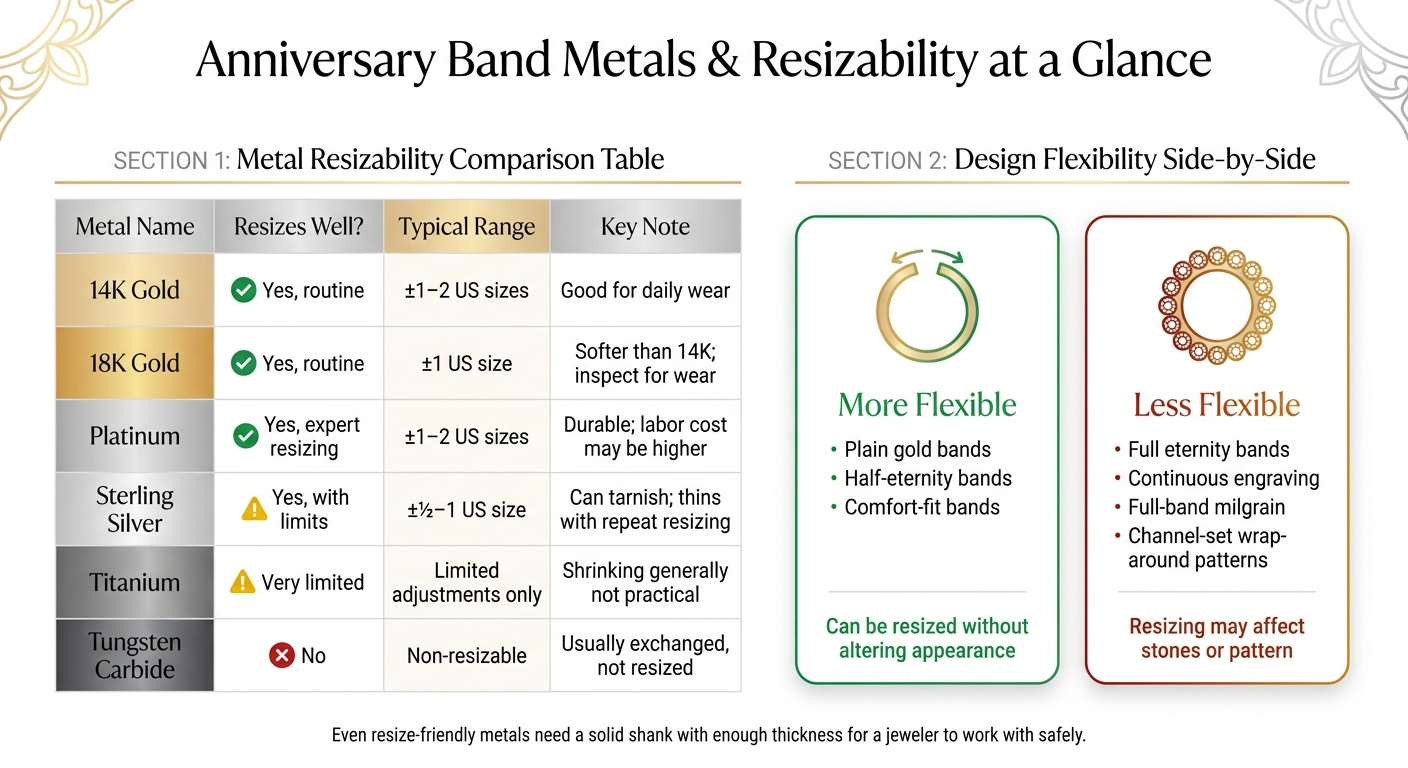
Anniversary Band Metals & Resizability: Quick Comparison Guide
How to Find Your Ring Size at Home
sbb-itb-9da40c1
1. Why finger size changes over time
Finger size changes in two ways: short-term shifts and long-term changes. That’s why an anniversary band needs a long-term fit plan, not just a number.
Temporary vs. permanent size changes
Some changes don’t last long. Heat, cold, exercise, salty meals, and shifts in hydration can all change finger size for a short time - sometimes enough to make a favorite ring feel off for a few hours before it goes back to normal.
Other changes stick around longer. Pregnancy often increases ring size by 1–2 US sizes because of higher blood volume and fluid retention, and fingers may stay a bit larger after delivery. Weight change can move ring size by about half a size. Aging can make joints thicker and skin less elastic. Arthritis - especially osteoarthritis - can enlarge knuckles while the base of the finger stays narrower, which creates a sizing mismatch and makes fixed-size rings harder to put on and take off over time.
A ring that feels tight only after a workout or on a hot afternoon is usually reacting to a temporary shift. A ring that leaves a deep mark every evening, causes tingling, or won’t get past the knuckle even when your hands are cool points to a longer-term fit problem.
Short-term swelling usually passes. Longer-term changes may mean resizing, an adjustable band, or custom sizing.
Once you know which type of change you’re dealing with, the next step is looking at width and interior shape.
How to measure for the most accurate everyday fit
Measure at the end of the day, when your hands are warm and the room is at a normal temperature. Morning measurements - especially in cool air - often come in smaller, which can leave you with a ring that feels too tight later.
Two measurements matter more than one:
- The base of the finger, where the ring sits
- The knuckle, the widest point the ring has to pass over
If you size only to the base, the ring may be hard to slide on and off. If you size only to the knuckle, it may spin once it’s in place. A well-fitted anniversary band should move over the knuckle with gentle resistance, not pain, and then sit at the base without too much spinning. If you’re between sizes, go with the larger measurement.
If a ring gets over the knuckle but spins at the base, the issue is the gap between those two measurements. That mismatch is often what turns a ring that seems fine now into one that becomes frustrating later.
That measurement gives you a baseline fit to compare every other ring choice against.
2. Band shape and width for long-term comfort
A measured size is just the starting point. What matters day to day is how the band is built. The width and the inside shape play a big role in whether a ring feels easy to wear or slowly starts to feel snug.
Band width, ring profile, and when to size up
Band width can change the feel of a ring even when the inner diameter is exactly the same. A slim 2 mm band touches less skin, so it usually feels a bit looser at your measured size. A 6–8 mm band covers more of the finger, which adds friction and makes the ring feel tighter. Because of that, many jewelers suggest going up about ¼ to ½ US size for bands 6 mm and wider, especially if you plan to wear the ring every day or stack it with other bands.
That difference can sneak up on people. If your fingers swell during the day, a wide band has less room to “forgive” those changes. Small sizing errors that feel minor at first can turn into daily annoyance later.
For most people, 2.5–4.5 mm is a comfortable everyday width. It feels secure without being too fussy about minor finger changes. If you want a wider band, that can work well too - you just need to account for the fit shift.
Width changes fit. Interior shape changes feel.
Comfort-fit interior vs. flat interior
A comfort-fit interior has a domed inside surface. That means it touches less skin, slides over the knuckle more easily, and often feels about ¼–½ size roomier than a flat interior. A flat interior has straight inner walls that sit flush against the finger. Some people like that steadier feel, but it can create more drag, especially when hands are warm or a bit swollen.
| Interior Type | Friction | Perceived Fit | Ease of Removal | Best For |
|---|---|---|---|---|
| Comfort-fit | Lower - domed surface reduces contact | Feels slightly roomier, ~¼–½ size larger | Easier; ring rolls over knuckle | Wide bands (5–8 mm), active lifestyles, knuckle swelling |
| Flat interior | Higher - full width contacts skin | Feels true to size or snugger | Can feel sticky when fingers swell | Thin bands, vintage styles |
For bands 5 mm and up, a comfort-fit interior is usually the better choice for long-term wear. It handles small day-to-day size changes more comfortably, and it’s often the smarter pick if you want a ring you can keep wearing for years.
What a secure and wearable fit should feel like
A well-fitted anniversary band should go over the knuckle with light resistance, then rest at the base of the finger without pinching. You should be able to twist and pull it off with dry hands. If you need soap every time, it’s too tight. If it slips over the knuckle with no resistance, it’s too loose and will spin or shift through the day.
Check the fit in both the morning and the evening. A good fit will:
- resist a little at the knuckle
- sit flat at the base of the finger
- leave no deep marks after 15–20 minutes
Constant spinning usually means the band is too loose or too slim to stay put. Deep marks that linger, or any tingling, usually mean the ring is too tight, too wide, or both. That’s worth fixing before you lock in the final design.
3. Metals and ring styles that can be resized later
A ring that fits now should still give you some room later. Bodies change. Daily habits change. Even your ring stack can change. The best anniversary band is one you can keep wearing comfortably through all of that.
That usually comes down to two things: the metal and the design.
Best metals for easy resizing later
14K gold, 18K gold, platinum, and sterling silver are some of the easiest metals to resize later. Jewelers can usually cut, solder, and reshape these metals safely.
On the other hand, tungsten carbide, titanium, ceramic, and many stainless steel alloys are often not resizable at all, or they're much harder to adjust. Tungsten carbide is one of the most limited options and is usually replaced instead of resized.
Gold and platinum can usually handle modest size changes in the future. Sterling silver can also be resized, but the adjustments tend to be smaller, and the metal can wear down faster after repeat work.
The metal alone doesn't decide everything, though. Even a resize-friendly ring can be a problem if the band is too thin, hollow, or already full of solder seams. A solid shank with enough thickness gives the jeweler material to work with, which helps lower the chance of cracking or warping the band.
| Metal | Resizes Well? | Typical Resizing Range | Care Notes |
|---|---|---|---|
| 14K Gold | Yes, routine | About ±1–2 U.S. sizes | Good for daily wear |
| 18K Gold | Yes, routine | About ±1 U.S. size | Softer than 14K; inspect for wear |
| Platinum | Yes, expert resizing | About ±1–2 U.S. sizes | Durable, but labor can be higher |
| Sterling Silver | Yes, with limits | About ±½–1 U.S. size | Can tarnish and thin with repeat resizing |
| Titanium | Very limited | Limited adjustments only | Shrinking is generally not practical |
| Tungsten Carbide | No | Non-resizable | Usually exchanged instead of resized |
The setting matters too. A workable metal doesn't help much if the ring's pattern leaves no room to make changes.
Designs that age well vs. designs that reduce resizing options
Plain gold comfort-fit bands and half-eternity bands are usually easier to resize later. They leave enough uninterrupted metal for a jeweler to make the change cleanly.
Full eternity bands are different. Since stones go all the way around, there isn't a plain section to cut without affecting the setting. The same issue comes up with continuous engraving, milgrain borders, and channel-set patterns that wrap around the whole band.
Put simply:
- Plain bands and half-eternity bands usually give you more room later.
- Full eternity bands, full-band engraving, and continuous milgrain usually give you less.
If you love the full eternity look, it helps to think of it as a less flexible choice. Many people pair that style with a simpler band for daily wear. And if this ring will be on your hand every day, it's smart to pick a design that can be resized without changing how it looks.
Choose the style with the most give for everyday wear, and keep less flexible designs for special occasions.
4. Choosing an anniversary band that works with your existing ring stack
Try an anniversary band with your full ring stack, not by itself. That’s the only way to judge fit in a way that matches daily wear. Once rings are stacked together, they act like one wider band, and that usually makes the set feel tighter.
How stack height and band width affect overall fit
What matters most is the total width of the stack, not just the width of one ring. A stack that totals 6–12 mm often feels better if you go 0.25 size larger than your usual ring size. If the stack is over 12 mm, you may need 0.5 size larger for all-day comfort.
Stack height matters too. Rings that sit higher off the finger can feel less steady over time. If you already wear a high-set solitaire or a cathedral-style engagement ring, adding a tall anniversary band can make the whole set feel top-heavy or less secure. That extra height can make the stack feel less stable as your hands change over time. A low-profile anniversary band that sits beside the engagement setting, instead of trying to match its height, usually feels steadier in day-to-day wear.
Band width should also match what you already wear. A slim band makes sense when you want less bulk. A medium band often works better when you want the stack to feel more balanced next to a solitaire or a standard wedding band.
Stack layouts that stay comfortable over time
In the classic U.S. setup, the wedding band sits closest to the hand, the engagement ring goes above it, and the anniversary band is added either on the outside or between the two, depending on its shape and height. Putting the thickest ring at the base can help steady the stack and cut down on wobble.
If your anniversary band has fine pavé or small prongs, placing it on the outer edge can cut down on ring-to-ring friction and lower the chance of scratches.
The table below compares three common anniversary band styles for stacked wear over time:
| Band Type | Comfort in a Stack | Scratch Risk | Visual Balance | Resizing in a Stack |
|---|---|---|---|---|
| Slim eternity band | Light and easy to wear; may spin if worn alone | Higher - diamonds all the way around can rub against softer nearby bands | Delicate; can look too thin next to wide or bold engagement rings | Limited; full-eternity designs are difficult or impossible to resize, which matters more as your stack changes. |
| Medium comfort-fit band | The domed inside helps it slide over knuckles more easily; feels steady in daily wear | Moderate - a smoother outside is gentler on nearby rings | Gives the stack a strong visual base; works with most classic solitaire or halo settings | High; plain or lightly set medium bands can usually be resized about 1–2 U.S. sizes without throwing off the stack. |
| Low-profile pavé band | Comfortable when the setting stays low; lower height helps reduce snagging | Moderate to higher - small prongs can scratch nearby bands over time | Sparkly but understated; pairs well with most engagement ring shanks | Limited to moderate; major resizing can loosen stones or interrupt the pattern. |
Once the stack fit feels right, the next step is figuring out how much room you want if your ring size changes later. If you expect that kind of change, the next choice is whether fixed-size, resizable, adjustable, or custom gives you the most room to work with.
5. Fixed-size, resizable, adjustable, or custom: which band type fits your situation
If your stack already feels close to its limit, the next step is simple: think about how much your finger size is likely to change. Some people stay about the same for years. Others deal with swelling, weather shifts, weight changes, or knuckles that make ring fit a moving target.
Each band type deals with long-term fit in a different way. So the best pick comes down to one thing: how steady your size is now, and how steady it's likely to stay.
A fixed-size band makes sense if your ring size has stayed the same for several years, you live in a mild climate, and you don't expect major weight changes or joint problems. It gives you a precise fit at the time you buy it. But there isn't much room for change, so even normal day-to-day shifts can make it start to feel too tight or too loose.
A resizable plain band in sterling silver or 18K gold is often the practical middle option. It looks and feels like a standard band, but a jeweler can adjust it if your size changes in a meaningful way. That makes it a smart pick if you expect one or two actual size changes over the next decade, like a planned pregnancy, gradual weight gain or loss, or normal aging.
If your size changes often, a ring that adjusts on its own is usually easier to live with than one that needs repeated trips for resizing.
Who should consider adjustable or custom anniversary bands
Adjustable bands tend to work best when your ring size changes often and in ways you can predict, like heat, swelling, or shifting weight. They can also help if your knuckles are larger than the base of your finger, which is one of the most common ring-fit headaches.
Go with custom when standard sizes don't work, your stack is more complicated than usual, or your knuckle and finger-base measurements don't line up. At that point, a standard off-the-shelf fit can turn into a hassle fast.
The table below shows the trade-offs more clearly.
| Fixed-Size Band | Resizable Plain Band | Adjustable or Custom Band | |
|---|---|---|---|
| Handles daily swelling | Minor fluctuations only | Minor fluctuations only | Yes - adjusts within its size range |
| Adapts over a decade | Usually needs resizing or replacement if size shifts significantly | Safe for modest size changes; limited number of resizes over its lifetime | Adjusts at home within the size range, or built to fit from the start |
The right band type depends on how steady your size is, how your rings stack together, and how much flexibility you want from the band day to day.
FAQs
How do I know if my ring is too tight or just snug?
A ring that fits well should slide over your knuckle with just a little resistance, then rest at the base of your finger without slipping off or turning too much.
If it feels too tight, it can be tough to get past your knuckle, pinch your skin, or leave marks. Finger size can also shift during the day due to temperature, hydration, and activity.
Can an anniversary band be resized more than once?
Usually, yes. But resizing a fixed-size ring again and again can wear down the band over time.
Why? Because resizing means cutting the ring, adding or removing metal, and soldering it back together. Do that many times, and you may start to affect both how the ring looks and how well it holds up.
Adjustable rings work differently. They’re built for repeated size changes without that same risk to the ring’s structure.
So if your finger size tends to change often, an adjustable ring may be the more practical long-term choice.
What band style works best with my engagement ring?
Choose a band that looks right with your engagement ring and still works well years from now. Stackable, minimalist styles are an easy pick, and bands with hidden adjustable features can help if your finger size changes over time.
Band width and metal tone matter too. Gold and platinum go well with many rings and stand up well to daily wear. And a band that looks good on its own or stacked with other rings gives you more comfort and flexibility day to day.


