

Retrofit Your Ring or Replace It? An Honest Cost and Emotion Guide
If your ring needs more than a small fix, I’d compare the total repair bill to the cost of a new ring right away. In many U.S. cases, a basic resize runs about $40–$120, while a more involved resize can hit $120–$350. A reset can jump to $350–$1,800+, and a new engagement ring often lands around $4,600–$5,500.
Here’s my short take:
- I’d retrofit if the ring has strong personal meaning, needs a small size change, and is still safe to wear.
- I’d replace if repairs stack up, the band is worn out, or my finger size changes a lot.
- I’d reuse the stone if I want to keep the history but need a ring that fits my life better.
- I’d pause before changing an heirloom if I might miss the original look later.
The core question isn’t just price. It’s cost + comfort + meaning + how often you’ll wear it.
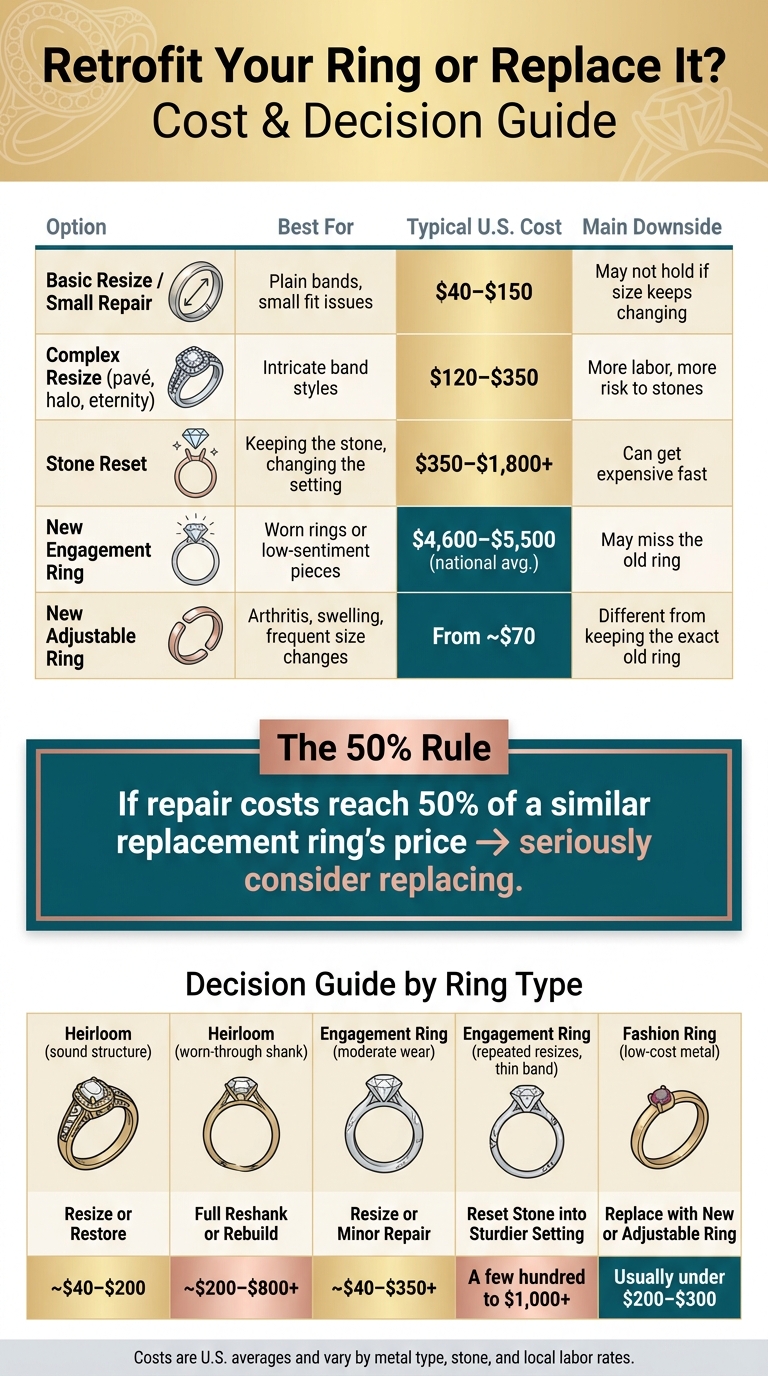
Ring Retrofit vs. Replace: Cost & Decision Guide
Resizing a ring – EVERYTHING you need to know - Tutorial l Gem Collectors

sbb-itb-9da40c1
Quick Comparison
| Option | Best for | Typical U.S. cost | Main downside |
|---|---|---|---|
| Resize or small repair | Plain bands, small fit issues | $40–$150 | May not hold up if size keeps changing |
| Complex resize | Pavé, halo, eternity styles | $120–$350 | More labor, more risk to stones |
| Reset original stone | Keeping the stone, changing the setting | $350–$1,800+ | Can get expensive fast |
| Buy a new ring | Worn rings or low-sentiment pieces | From about $70 to $5,500+ | You may miss the old ring |
| Buy an adjustable ring | Swelling, arthritis, fit changes | From about $70 | Different from keeping the exact old ring |
I’d use a simple rule: if repair costs get close to 50% of a similar replacement, I’d look hard at replacing instead. That rule changes if the ring is tied to a marriage, family history, or a person I don’t want to let go of.
This guide helps sort that choice in plain English.
Cost Comparison: What You Can Expect to Spend in the US
Retrofitting usually costs less at the start. But once repairs get tricky, that savings can shrink in a hurry.
Typical Retrofit Costs: Resize, Reset, and Band Repair
For a basic resize on a plain band, you’ll usually pay about $40–$120 for 14k gold, $25–$60 for sterling silver, and $90–$250 for platinum. Sizing a ring down tends to cost less than sizing it up.
If the ring has a pavé, halo, or eternity band, the job gets more involved. In those cases, a complex resize usually runs $120–$350, since the jeweler has to protect the stones and tighten them again after reshaping.
A stone reset can cost $350–$1,800+. That range depends on the stone type, the stone size, and how involved the setting is.
For band repair - like fixing a crack, dealing with a thin shank, or re-rounding the ring - you’ll often see $40–$150 for gold or silver. Platinum or heavy damage can push the price higher.
These numbers are U.S. averages. Your quote can shift based on the metal, the stones, and local labor rates.
Typical Replacement Costs: New Ring, New Setting, or Adjustable Design
A simple fashion ring can cost under $100. Solid 10k–14k gold bands usually land in the low hundreds.
For engagement rings, the spending jump is much bigger. The national average for a new engagement ring is about $4,600–$5,500, and that number is shaped mostly by stone size and setting choice.
There’s also a middle ground worth looking at. If resizing is getting close to the $120–$350 range, an adjustable ring can make more sense over time. That’s especially true if your finger size changes often, since one adjustable ring can spare you from paying for resize after resize.
Side-by-Side Price Check
| Service or Option | Typical U.S. Cost Range | Notes |
|---|---|---|
| Basic resize (plain gold or silver band) | $40–$120 | Sizing down is cheaper than sizing up |
| Complex resize (pavé, halo, or eternity band) | $120–$350 | Stone protection and re-tightening add labor |
| Stone reset (center stone into new head/prong) | $350–$1,800+ | Varies by stone type and setting complexity |
| Band repair (crack, thin shank, re-rounding) | $40–$150 | More for platinum or extensive rebuilding |
| New adjustable ring | From ~$70 | Adjustable fit avoids repeat resize costs |
| New engagement ring (national average) | $4,600–$5,500 | Typical for fine-jewelry engagement rings |
A one-time retrofit is almost always cheaper than buying a new engagement ring. But if the ring needs resizing, repair work, and maybe a reset too, the math can start to look different. At that point, a new setting or adjustable ring may cost about the same as fixing the old one.
And that’s where this choice stops being just about dollars. Some people want to keep the original ring no matter what. Others care more about day-to-day comfort and wear.
Emotion and Meaning: What You Keep, Change, or Let Go
When the cost is close, meaning often makes the choice for you. At that point, the big question is simple: what does this ring mean to you?
Why Retrofitting Often Feels Right for Sentimental Rings
With heirlooms, engagement rings, and wedding bands, the emotional weight usually comes from a certain stone, a certain moment, or a certain person, not just the ring’s dollar value. That’s why many people choose to retrofit instead of replace. The ring can feel like a physical record of vows, a proposal, or a family member who is no longer here.
Keeping the original stone and band helps preserve that story. Even if the setting changes a bit or the fit gets fixed, the piece still feels like the same ring.
When Replacing the Ring Can Feel Like Relief
Not every ring needs to be saved in its current form. If it’s structurally unsafe, uncomfortable all the time, or tied to a relationship or version of yourself that no longer fits, wearing it every day can start to feel heavy.
Some people feel stuck with a ring they don’t want to wear anymore. Others worry they’ll damage it again. In those cases, getting a new ring isn’t a betrayal. It’s a practical choice. The original can stay safe in a jewelry box, while a ring that suits your life better takes over.
A Short Regret Check Before You Decide
Before you decide, separate the story from the design.
Ask yourself:
- Would I still care about this ring if the look changed?
- Would I wear it every day after the fix?
- Would changing it feel like an update or like an erasure?
Writing down your answers before you visit a jeweler can save you from a choice you second-guess later. That might be a permanent resize you end up wishing you hadn’t done, or a new ring you bought too fast before realizing how much you’d miss the old one.
If you’re still unsure, day-to-day comfort and long-term wear tend to make the answer clearer.
Fit, Safety, and Long-Term Wear: How Each Option Holds Up
When Resizing or Repair Is Still a Safe Choice
A one-time resize on a plain gold, silver, or platinum band is often simple and low risk when a skilled jeweler does the work. For many plain solitaires and standard bands, a small change - often about 1–2 sizes - is a routine fix if the ring is still in good shape.
The trouble starts when resizing turns into repeat work. Each time the band is cut and soldered, the metal takes on a bit more stress, especially near the solder joint and along thin shanks. Over time, that can lead to cracks, thinning, or a band that’s more likely to break during normal wear.
Some styles just aren’t good candidates for this kind of fix. Full eternity bands, tension settings, and rings made from tungsten or titanium are often hard - or flat-out impossible - to resize cleanly without changing the look or putting stone security at risk.
When a New Adjustable Ring Is the More Useful Option
If your finger size changes often - because of arthritis, pregnancy, medication, seasonal swelling, or weight shifts - a one-time resize usually won’t hold up for long. You can end up stuck in a cycle of repeat changes, and every trip to the jeweler adds more cost and more wear to the band.
That’s where a ring built to adjust makes more sense. Satinski’s hidden adjustable mechanism, for example, is made for repeat fit changes and covers US sizes 5–9 with an ergonomic fit that accounts for enlarged knuckles and day-to-day swelling. It stays discreet, with no visible open back, but still lets you fine-tune the fit without repeat jeweler visits.
Daily-Wear Comparison: Retrofit vs. Replace
Here’s how the two options stack up in day-to-day wear:
| Feature | Retrofit (Resizing/Repair) | Replace (Adjustable Ring) |
|---|---|---|
| Fit stability | Fixed; may become too tight or loose as size changes | Flexible; adjusts to daily swelling or joint changes |
| Structural risk | Goes up with each resize; thin bands can become fragile | Low; built to move without hurting the ring’s strength |
| Fluctuating finger size | Poor; needs a jeweler for each major change | Great; works well for arthritis, pregnancy, and heat-related swelling |
| Future maintenance | Periodic inspections and occasional repairs over time | Occasional cleaning of the adjustment mechanism |
| Design integrity | Risk of thinning the band or warping engravings | Keeps the original look and symmetry |
Put simply, retrofitting helps preserve the original ring, but it works best when size changes are small and don’t happen often. Replacement - especially with an adjustable ring - is the better bet for long-term comfort when your finger size doesn’t stay the same.
Best Choice by Ring Type and Budget
Heirloom, Engagement, and Fashion Ring Scenarios
Ring type, daily wear, and sentimental value usually make the decision much easier.
Heirloom rings are often worth repairing when the structure is still sound. In that case, resizing or shank repair lets you keep the original metal and design. A simple resize often runs about $40–$200, and jewelers often use partial shank reinforcement when the bottom of the band has worn thin.
Engagement and wedding rings sit in the middle. If the stone is secure and the ring shows only modest wear, a resize or small repair usually makes sense. But if the band has already been resized several times or has started to thin out, it may be smarter to reset the stone into a sturdier mounting.
Fashion rings are usually the clearest case for replacement. Once repair costs climb into the low hundreds, or get close to the price of a new ring, replacing it is often the better call.
Budget Rules That Make the Choice Clearer
At a certain point, this stops being emotional and starts being math.
A simple rule of thumb: if resizing, shank work, and prong repair add up to about half the cost of a similar new ring, replacement is usually the better value. The big exception is a sentimental piece, where repair can still make sense.
| Ring Type | Recommended Path | Typical US Cost Range |
|---|---|---|
| Heirloom (sound structure) | Resize or restore | About $40–$200 |
| Heirloom (worn-through shank) | Full reshank or rebuild | About $200–$800+ |
| Engagement (moderate wear) | Resize or minor repair | About $40–$350+ |
| Engagement (repeated resizes, thin band) | Reset stone into a sturdier setting | A few hundred to $1,000+ |
| Fashion (low-cost metal) | Replace with new or adjustable ring | Usually under $200–$300 |
Conclusion: The Simplest Way to Choose
Three questions usually cut through the noise: How much does this ring mean to you? What will the repair actually cost? And will you wear it comfortably every day?
Retrofitting often costs less and keeps the ring’s history intact. Replacement or a full reset makes more sense when the ring has structural trouble, the repair bill gets steep, or your finger size changes often. If sizing is an ongoing issue, an adjustable design can help preserve the look while making the ring easier to wear.
Choose the ring you’ll actually wear.
FAQs
How do I know if my ring is worth repairing?
Ask whether the repair preserves more than it risks.
Standard resizing can weaken the band, warp engraving, or loosen stones. And that risk goes up if the ring has been resized more than once.
Repair often makes the most sense for high-value or sentimental rings, especially when keeping the original design matters most. But if your ring size changes often, repeated resizing can get expensive and put more stress on the ring.
It also helps to look at the metal itself. Some harder metals can’t be repaired in the usual way, so if they’re damaged, replacement may be the better path.
Can I resize my ring more than once?
Yes, but there are trade-offs.
Traditional resizing means cutting the band, adding or removing metal, and soldering it back together. If that’s done over and over, it can weaken the ring and make it more likely to bend or break over time.
If you expect your ring size to change often because of swelling, weight changes, or temperature, a ring with a built-in adjustable mechanism may be a better fit.
Should I keep the original stone if I replace the ring?
Yes - if you replace the ring, you can still keep your original stone.
A professional jeweler can remove the gemstone, reset it into a new setting or band, and polish the finished piece so it looks clean and polished. This is a common choice for sentimental heirlooms. It lets you keep the stone and its history while giving the ring a new look.


