

You Can Only Resize a Ring 2-3 Times - Here's What Happens After
Most rings should only be resized about 2–3 times total. After that, the band can get thinner, solder points can weaken, and stones may come loose. For some styles - like pavé, channel, halo, and eternity rings - the limit is often lower.
If I had to sum it up in plain English, it’s this:
- Plain 14K gold and platinum bands often handle 2–3 resizes
- 18K gold bands often top out at 1–2 resizes
- Pavé, channel, and partial eternity rings may allow only 1 resize
- Full eternity rings, tungsten, and titanium usually can’t be resized in the normal way
- Once a ring reaches its limit, the next step is often a shank repair, a reset, or a remake instead of one more size change
A standard resize may cost about $50–$250, but if the ring gets too worn, repairs can jump to $149–$800+. That’s why fit isn’t the only issue here. Structure matters too.
| Ring type | Usual resize range | What often goes wrong |
|---|---|---|
| 14K gold plain band | 2–3 times | Thinning at the bottom, seam wear |
| 18K gold plain band | 1–2 times | Soft band, shape change |
| Platinum plain band | 2–3 times | Stress marks, small cracks |
| Pavé or channel band | 1 time | Loose accent stones |
| Halo ring | 1–2 times | Prong shift, loose melee |
| Full eternity ring | Usually not resized | Stone spacing problems |
| Tungsten or titanium | Usually not resized | Cracking or tool limits |
The short answer: if your ring has already been resized a few times, I’d stop thinking only about size and start thinking about wear, seams, and stone security. That’s the point where a jeweler may suggest repair or rebuilding instead of another resize.
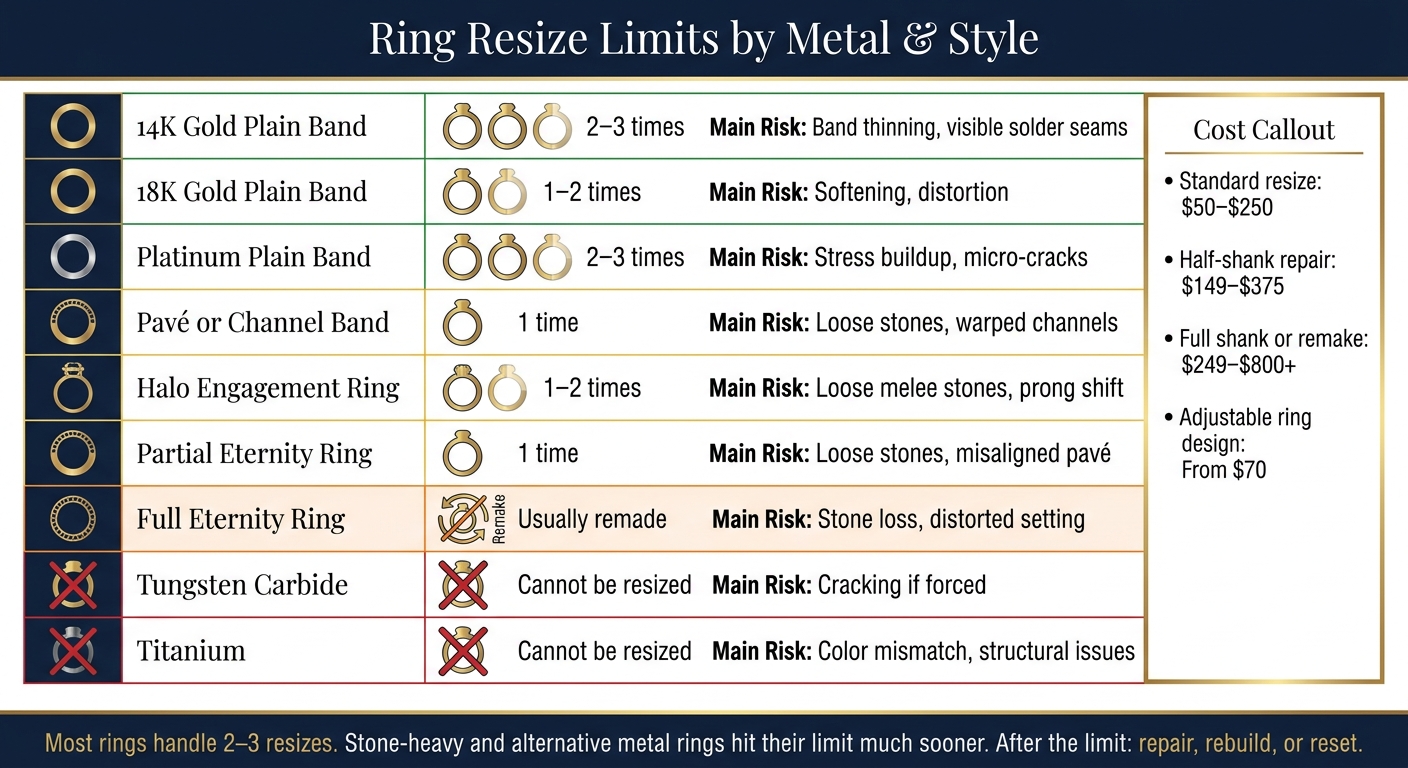
Ring Resize Limits by Metal & Style: How Many Times Can You Resize a Ring?
What Are The Effects Of Resizing A Ring?
sbb-itb-9da40c1
What Happens to a Ring After Being Resized Multiple Times
Resizing a ring over and over wears it down bit by bit. The band, seams, and stone settings all take some strain. At first, the damage can be easy to miss. But after several changes, the signs often start to show.
Band Thinning, Weak Spots, and Shape Distortion
The underside of the shank usually takes the biggest hit during resizing. Each time a jeweler cuts the metal, adds or removes a section, and files it smooth, that area ends up a little thinner than before. Polishing adds to that wear, since it removes a tiny layer of metal each time the seam is blended in.
A resize of more than about 2 ring sizes puts extra stress on the shank. After several resizes, the bottom of the band can get thin enough to feel less comfortable on the finger.
The ring’s shape can change too. Instead of staying perfectly round, it may slowly turn slightly oval. When that happens, the ring may spin more on the finger, sit at an angle, or just feel a bit off compared with how it used to fit.
How much this happens depends a lot on the ring’s metal and how it was made.
Solder Seams, Heat Exposure, and Metal Fatigue
Every resize creates another seam in the shank. That seam marks a spot where the original metal was cut and then joined again. If the work is done well, one seam can be nearly as strong as the metal around it. But after several resizes, those seams can start stacking up in roughly the same place. That turns one small repair area into a repeated stress point.
Heat is part of the issue too. Repeated torch work can soften the metal around the seam, which makes it less able to handle bending or impact. This matters even more with 18K gold. It’s softer than 14K to begin with, and repeated heating can make it lose hardness more easily. Thin bands have less metal to absorb that change, so even a small drop in hardness can make cracking more likely. Engraved shanks have another problem: heating and polishing can blur the pattern while also making those spots weaker.
A few warning signs can hint that past resizes are starting to show:
- Seam lines that reflect light a little differently from the rest of the band
- Slight color changes where different solder types meet
- Micro-cracks near old resize points along the bottom of the shank
Loose Stones, Shifted Prongs, and Damaged Details
Resizing doesn’t just affect the band. It changes the shape and tension of the whole ring, and that can affect stone security right away.
In pavé settings, the tiny beads or prongs holding the accent stones rely on even tension across the band. Stretch or compress the ring, and that tension shifts. Stones along the lower half of the ring, closest to the resize area, are the most likely to loosen or fall out.
Channel settings can run into similar trouble. The channel walls are meant to keep the stones lined up in a straight, exact row. Resizing can make that channel open slightly or drift out of line, which can leave stones rattling, shifting, or showing small gaps. Halo rings can also twist a bit, making the halo sit off-center from the center stone.
Large center stones add more pressure to the setting. If the shank has lost stiffness from thinning or metal fatigue, the prongs can slowly shift or open. That can lead to a tilted stone - or, in the worst case, a lost one.
That’s why experts recommend a full prong and setting inspection after every resize. In many cases, it also makes sense to tighten or re-tip prongs during the resize itself, instead of waiting for a problem to show up.
Some rings handle repeated resizing better than others. A lot depends on the ring’s metal and setting.
How Resize Limits Vary by Metal and Ring Design
Resize limits depend on two big things: the metal and the ring’s design. Some rings can handle a few changes without much trouble. Others start to weaken much sooner because the metal, setting, and band shape create different stress points.
Plain Gold and Platinum Bands
14K gold is usually the easiest metal to resize. A plain 14K gold band can often handle 2–3 resizes. It has a good balance of hardness and workability, so jewelers can make changes without the band giving out too fast.
18K gold is softer, so its limit is lower. In most cases, it can handle 1–2 resizes before the risk goes up. Repeated heating and cutting can distort the band more easily, especially if the ring is thin.
Platinum also tends to allow 2–3 resizes, but there’s a catch. With each resize, stress can build in the metal, and over time that may lead to micro-cracks. On the surface, the ring may still look fine, but the strain adds up.
Band thickness matters too. A very thin 18K gold band may reach its limit after just one resize. A thicker comfort-fit band in 14K gold usually has more room to take the work before strain starts to show.
Stone settings usually hit the limit faster than plain bands.
Eternity, Pavé, Channel, and Halo Rings
Stone-heavy rings play by tighter rules.
Full eternity rings - with stones going all the way around the band - are usually not resizable. Change the circumference, and you also change the spacing and tension that help hold the stones in place. That can lead to stone loss.
Partial eternity rings may allow one resize if the plain section at the bottom of the band is wide enough. If there isn’t enough plain metal to work with, the risk climbs fast.
Pavé and channel-set bands are also usually limited to one resize. Shared prongs can loosen, and channel walls can shift or warp during the process. Even a small change can throw things off.
Halo engagement rings sometimes allow 1–2 resizes in the lower shank. But the small melee stones around the center setting are more likely to loosen from repeated heat and stress, so there’s less margin for error.
Metals That Generally Cannot Be Resized
Some metals are poor candidates for resizing from the start.
Tungsten carbide, titanium, and most stainless steel rings usually cannot be resized.
- Tungsten carbide is extremely hard and brittle. If you try to cut or solder it, the ring can crack.
- Titanium and stainless steel don’t respond well to standard jeweler’s tools. Even with specialized methods, strength and color matching aren’t assured.
For these metals, the usual path is a size exchange, a remake in the right size, or having the design remade in a metal that can be resized.
Here’s a quick guide to the most common limits.
Use this as a quick comparison, not a strict rule.
| Ring Type | Typical Limit | Main Risk |
|---|---|---|
| 14K Gold Plain Band | 2–3 resizes | Band thinning, visible solder seams |
| 18K Gold Plain Band | 1–2 resizes | Softening, distortion |
| Platinum Plain Band | 2–3 resizes | Stress buildup, micro-cracks |
| Partial Eternity | 1 resize | Loose stones, misaligned pavé |
| Full Eternity | Usually remade | Stone loss, distorted setting |
| Pavé or Channel Band | 1 resize | Loose stones, warped channels |
| Halo Engagement Ring | 1–2 resizes | Loose melee stones, prong shift |
| Tungsten Carbide | Cannot usually be resized | Cracking if forced |
| Titanium | Cannot usually be resized | Color mismatch, structural issues |
Once a ring reaches its limit, the next step is usually repair, rebuilding, or another fit solution.
What to Do When a Ring Can No Longer Be Resized
When a ring has been resized too many times, there comes a point where it’s smarter to stop. If the band has gotten too thin or the setting no longer feels stable, further resizing can do more harm than good. At that stage, the job shifts from resizing to repair or replacement.
The next move depends on three things: the condition of the band, how secure the stones are, and how much of the original ring you want to keep. The aim is simple: keep the parts that still matter and avoid pushing damaged metal any further.
Inspect, Repair, or Replace the Shank
A jeweler will usually start by checking the shank closely. That means measuring its thickness, looking for thin spots, pits, or weak areas inside the band, and making sure the stones are still secure. Some warning signs are hard to miss: flat spots on the bottom of the ring, a crack that keeps coming back at the same solder seam, or prongs that keep moving out of place. If those issues are there, another resize can turn the ring into a break waiting to happen.
In many cases, the top setting and center stone are still fine, and the trouble is limited to the lower part of the band. When that happens, a half-shank repair can be the right fix. The jeweler removes the worn section at the bottom and attaches new metal, which brings back strength without changing the original head. You can expect to pay about $149–$375, depending on the metal and band width.
If the whole shank is worn out, a full replacement may make more sense. That usually runs about $249–$800+.
If the top setting is also damaged, it’s time to skip more patchwork and move to a full reset.
Reset the Stones or Rebuild the Ring
Sometimes the band is past saving, but the stones still hold deep personal or financial worth. In that case, resetting the stones is often the smart call. A jeweler removes the stones, makes a new mounting, and sets them into that new piece instead of working on weak metal again.
This tends to work very well for engagement rings and family pieces, where the stones are the part people care about most. And if the old setting had a look you want to hold onto, a skilled jeweler can often recreate that style in a stronger new build. You end up with a ring that fits well, wears safely, and keeps the original stones.
If the ring is still sound but just moves around too much on the finger, there’s a simpler option.
Use Fit Aids or Switch to an Adjustable Ring Design
For rings that are only a little loose and still in good shape, fit aids can do the job. Sizing beads add small bumps inside the band to help stop spinning. A ring guard helps a loose ring sit more securely. These fixes work best for about a half to one full size of correction. Beyond that, a lasting repair is usually the better path.
If your ring size changes often, adjustable ring designs can help you avoid repeat resizing altogether. These rings use hidden mechanisms that let the wearer change the fit across U.S. sizes 5–9. They’re sold in sterling silver and 18K gold, and you can find them in engagement rings, wedding bands, and stacking rings.
Here’s a side-by-side look at which option fits which problem:
| Option | Best For | Cost | Main Limit |
|---|---|---|---|
| Half-shank repair | Worn lower band, sound top setting | $149–$375 | Alters original metal; requires bench work |
| Full shank or remake | Widespread damage, over-worked bands | $249–$800+ | Higher cost; more significant change to original ring |
| Stone reset into new band | Compromised structure, valuable or sentimental stones | Varies | Stones preserved; original band is retired |
| Sizing beads or ring guard | Slightly loose ring, temporary or seasonal changes | Varies | Best for small adjustments only |
| Adjustable ring design | Ongoing size changes, everyday flexibility | From $70 | Fits sizes 5–9; not every setting style available |
Conclusion: How to Protect Your Ring and Plan for Future Size Changes
After a ring has been resized a few times, the issue is no longer just fit. It becomes preservation. Most rings can handle about two to three resizes before the band and settings start to lose strength. Eternity and pavé rings often hit that point even sooner because there’s very little plain metal to work with.
Once a ring reaches that stage, it’s time to stop resizing. The next step is structural repair. In plain terms, the answer becomes repair, rebuild, or reset - not one more resize.
It also helps to think ahead before the first resize, especially if your finger size may change because of pregnancy, arthritis, medication, weight changes, or swelling.
For rings that deal with repeated size swings, a different design can solve the problem much earlier. An adjustable ring design can help you avoid resizing again and again.
Think of resizing as a limited-use fix. At some point, pushing the metal further can do more harm than good, so it makes sense to change course before the ring is overworked.
FAQs
How do I know if my ring has been resized too many times?
The only dependable way to know is to have a jeweler inspect it. They can look for weakened structure caused by repeated cutting and soldering.
Common signs include:
- Visible resize marks
- Metal fatigue
- Loss of shape
- Risk to delicate settings and intricate bands
Can a jeweler resize my ring if it has pavé stones or an eternity band?
Usually not, or only with extreme difficulty. Eternity bands have stones set all the way around the ring, so changing the size means cutting or moving metal near those stones. That can damage the settings.
Pavé rings run into a similar issue. They often don't have enough plain metal for a standard resize. If you try to resize either style, you can weaken the ring, disturb the setting, and make stone loss more likely.
Is it better to repair, reset, or remake a ring that no longer fits?
The best choice comes down to the ring’s design and what you need from it. Professional resizing is often the better route for sentimental pieces or detailed heirlooms because it gives you a permanent fit.
That said, resizing isn’t always a one-and-done fix. If it’s done again and again, it can weaken the ring over time. And some metals, like tungsten and titanium, can’t be resized at all. If your finger size tends to change, an adjustable ring may be the better fit since it gives you more flexibility without putting stress on the ring’s structure.


