

Proposal Backup Plan: What to Do If the Ring Is Too Small
If the ring is too small, stop right away and don’t force it. In most cases, the fix is simple: keep the proposal going, use a safe short-term option, and ask a jeweler about a resize, exchange, or remake.
Here’s the short version:
- Don’t force the ring on. That can cause swelling, pain, or a stuck ring.
- Watch for warning signs. Redness, throbbing, numbness, tingling, deep marks, or color change mean it’s time to stop.
- Try safe removal only. Use hand elevation, cool water, and a small amount of soap, lotion, or petroleum jelly.
- Use a short-term backup plan. Wear it on a chain, try another finger only if it slides on and off with no trouble, or keep it in the box for photos.
- Talk to a jeweler soon. Most simple U.S. resizes cost about $20 to $100, while platinum or pavé styles can cost $80 to $150+.
- Know when resizing may not work. Full eternity bands, tension settings, and metals like tungsten or titanium often need an exchange or remake.
- Keep future fit changes in mind. Finger size can shift by up to ½ size from heat, travel, exercise, or weather.
What I’d do is simple: protect the finger first, keep the moment calm, and sort out the fit after the proposal. That keeps the focus where it should be.
| Situation | What I’d do |
|---|---|
| Ring won’t pass the knuckle | Stop and don’t force it |
| Ring gets stuck | Cool the finger, add lubricant, and remove it slowly |
| Finger turns red, numb, or swollen | Stop home attempts and get help |
| Ring is only a little tight | Wait a day or two, then get sized by a jeweler |
| Ring can’t be resized safely | Ask about exchange or remake |
This guide is about staying calm, avoiding finger injury, and choosing the safest next step.
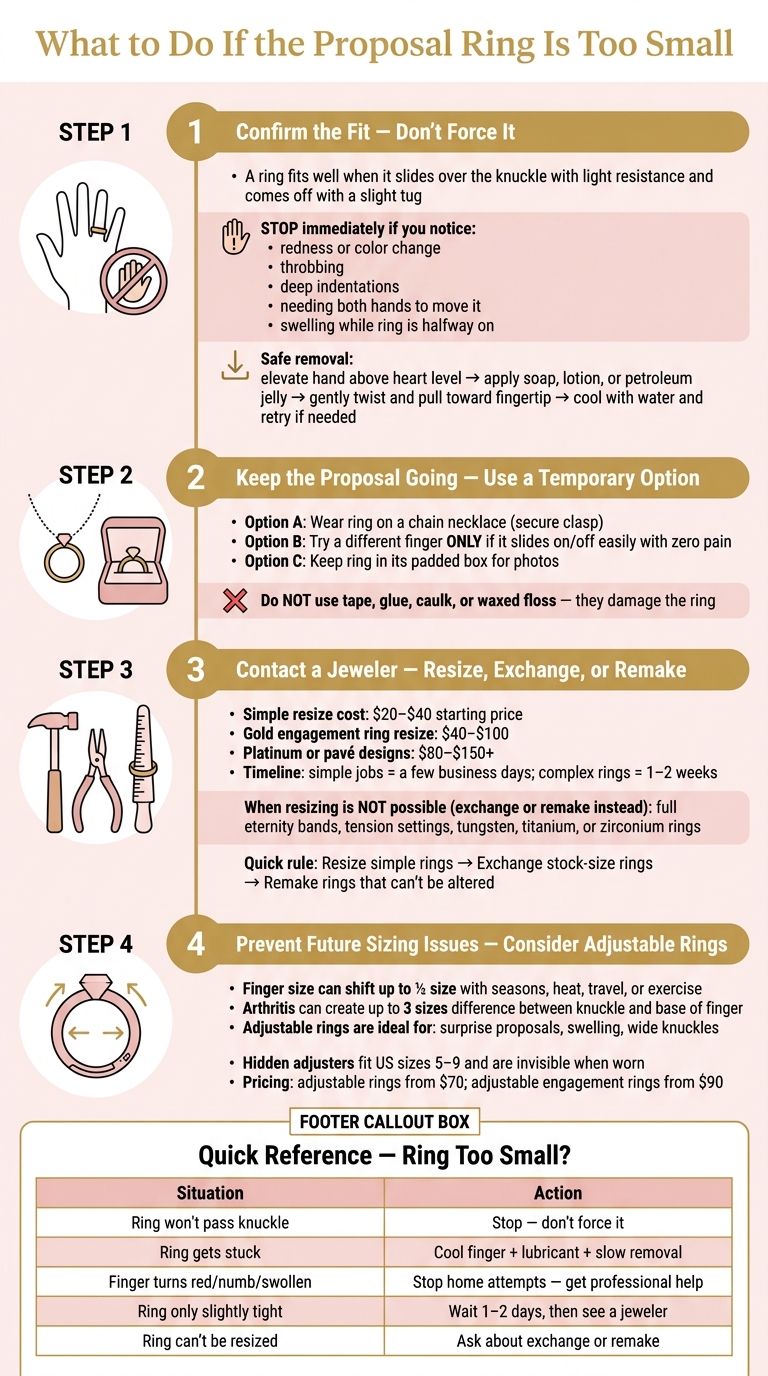
What to Do If the Proposal Ring Is Too Small: Step-by-Step Guide
Step 1: Confirm the Ring Is Too Small Without Forcing It
A ring fits well when it goes over the knuckle with light resistance, feels snug once it's on, and comes off with a slight tug. If getting it on or off takes real effort, it's too small.
Finger size can shift more than people expect. Heat, humidity, salt, exercise, and travel can make fingers swell by as much as half a size. So if the ring feels only a little tight, it's smart to wait a day or two and have a jeweler check the fit.
Signs You Should Stop Trying to Put It On
Stop right away if you notice any of these:
- Redness or color change around the knuckle that gets darker fast
- Throbbing in the finger, which can point to restricted blood flow
- Deep indentations in the skin from the ring pressing down
- Needing to twist hard or use both hands to move the ring
- The finger starting to swell while the ring is still halfway on
If the ring needs to be forced past the knuckle, the size is too small.
How to Remove a Ring That Gets Stuck
If the ring gets stuck, first raise your hand above heart level for a few minutes. That can help bring swelling down. Then put a small amount of soap, hand lotion, or petroleum jelly around the ring and knuckle, and gently twist and pull it toward the fingertip with slow, steady movement.
If that doesn't do the trick, cool the finger with water or a compress for a few minutes. Then add lubricant again and try once more. Skip dental floss wrapped tightly around the finger, and don't use tools to force the ring off. Those moves can make swelling worse and can damage both the ring and your skin.
If the finger swells, feels numb, tingles, or changes color, stop trying at home and get help from a jeweler or urgent care right away.
If the ring still won't fit, use a temporary wearing option while you set up the fix.
sbb-itb-9da40c1
Step 2: Keep the Proposal Going With a Temporary Wearing Option
Once you stop forcing it, keep the proposal moving. You can fix the fit later. For now, use a short-term wearing option while you set up the resize.
Propose First, Resize Later
Call out the fit issue, say the ring will be resized, and keep going with the proposal. Simple as that.
For photos, you can rest the ring on the finger or leave it in the box. If that doesn't work, use a chain, another finger, or a jeweler-approved adjuster.
Wear the Ring on a Chain or a Different Finger
If you want the ring worn in the moment, check whether it slides onto a different finger with no trouble, like the middle finger or the right-hand ring finger. Only do this if it goes on and off easily, with no pain, redness, tingling, or risk of getting stuck.
Your other option is a sturdy necklace chain. Use one with a secure clasp. If neither option feels safe, keep the ring in its padded box and take photos that way instead.
Use Only Jeweler-Approved Temporary Sizing Aids
Use temporary ring adjusters only for rings that already fit but spin or feel loose. They will not make a too-tight ring fit.
If you use one, place it on the underside of the band so it doesn't press on prongs or stone settings. Skip tape, glue, caulk, and waxed floss. They can damage the ring and trap moisture.
After the proposal, take the ring to a jeweler for resizing or exchange.
Step 3: Contact a Jeweler About Resizing or Exchange
Once the proposal is out of the way, move fast on the permanent fix.
Contact the jeweler as soon as you can, ideally the original seller. Ask whether resizing, exchange, or a remake is the safest path.
The jeweler should measure the wearer’s finger with a ring sizer or mandrel. It’s best to do this later in the day, when fingers are often at their widest.
Before any work starts, ask for a written estimate that covers:
- the resizing method
- the final cost
- the pickup date
- any extra work, such as stone tightening, rhodium plating, or polishing
Once you approve the quote, the jeweler can begin the repair.
How Ring Resizing Works
If a ring is too small, jewelers usually cut the shank, add matching metal, solder the band, and then polish the repaired area. For a very slight size increase, a jeweler may be able to stretch the band a bit. That said, this only works for some simple designs.
The jeweler should also confirm the target size, check the metal and stone settings, explain any size limits, and have the wearer confirm the fit at pickup.
In the U.S., simple resizes often start at about $20–$40. Most gold engagement ring resizes land around $40–$100, while platinum or pavé designs can run $80–$150+. Simple jobs often take a few business days. More complex rings can take 1–2 weeks.
When Exchange or Remake Is the Better Choice
Sometimes resizing just isn’t a safe option.
Some rings can’t be resized without risk. That includes full eternity bands, tension settings, and rings made from tungsten, titanium, or zirconium. If your ring falls into one of those groups, ask the jeweler about an exchange or a remake in the right size.
A simple rule of thumb helps:
- Resize most simple rings
- Exchange stock-size replacements
- Remake rings that can’t be altered safely
Get the warranty and future resizing policy in writing before you approve the work.
Step 4: Avoid Future Sizing Problems With Adjustable Ring Options
If you want to avoid the same sizing issue later, adjustable rings can solve it from the start. Finger size can shift by up to ½ a size with the seasons, and arthritis can create a gap of up to three sizes between the knuckle and the base of the finger.
When an Adjustable Ring Is the Right Call
Adjustable rings make the most sense when finger size is tough to pin down. They're a smart pick for surprise proposals, swelling, and wide knuckles. In those cases, a fixed-size ring can be hit or miss.
How Satinski Adjustable Rings Help With Fit
If you want a ring that looks normal on the hand but still gives you room to adjust, hidden adjusters do the job well. Satinski adjustable rings use hidden adjusters inside the band, so they aren't visible when worn, and they fit US sizes 5–9.
You can find adjustable engagement rings, wedding bands, and stacking rings in sterling silver or 18K gold. Pricing starts at $70 for adjustable rings and $90 for adjustable engagement rings.
Conclusion: The Action Plan to Follow
If the proposal ring is too small, don't force it. Use a temporary wearing option, then have a jeweler take care of the permanent fix. Next time, an adjustable ring can help you skip the same problem.
FAQs
How tight is too tight for a proposal ring?
A proposal ring is too tight if it feels uncomfortable, hurts, or leaves marks on your skin. It should slide over your knuckle without a struggle and sit snugly at the base of your finger without feeling restrictive.
If the ring can’t move or rotate at all, it’s probably too small. Finger size can also change with temperature, hydration, and daily activity.
Should I resize or exchange the ring?
It depends on the ring’s design and what you need down the road. If the ring is adjustable, you can usually change the fit yourself. If it’s a standard non-adjustable ring, it’s best to ask a professional jeweler whether resizing can be done.
Some rings, like eternity bands and rings made of tungsten or titanium, usually can’t be resized. And there’s one more thing to know: resizing is a permanent change. If it’s done over and over, it may weaken the ring over time.
Can a too-small ring be worn temporarily?
Yes, but be careful. If the ring feels uncomfortable or seems to cut off circulation, don’t force it. Wear it on a necklace chain instead.
Stop wearing it if it causes pain, numbness, or discoloration. If that happens, contact a professional jeweler or medical provider right away. Temporary ring adjusters are usually made for rings that are too large, not too small.


