

Engagement Ring Shopping Timeline: How Early Is Too Early?
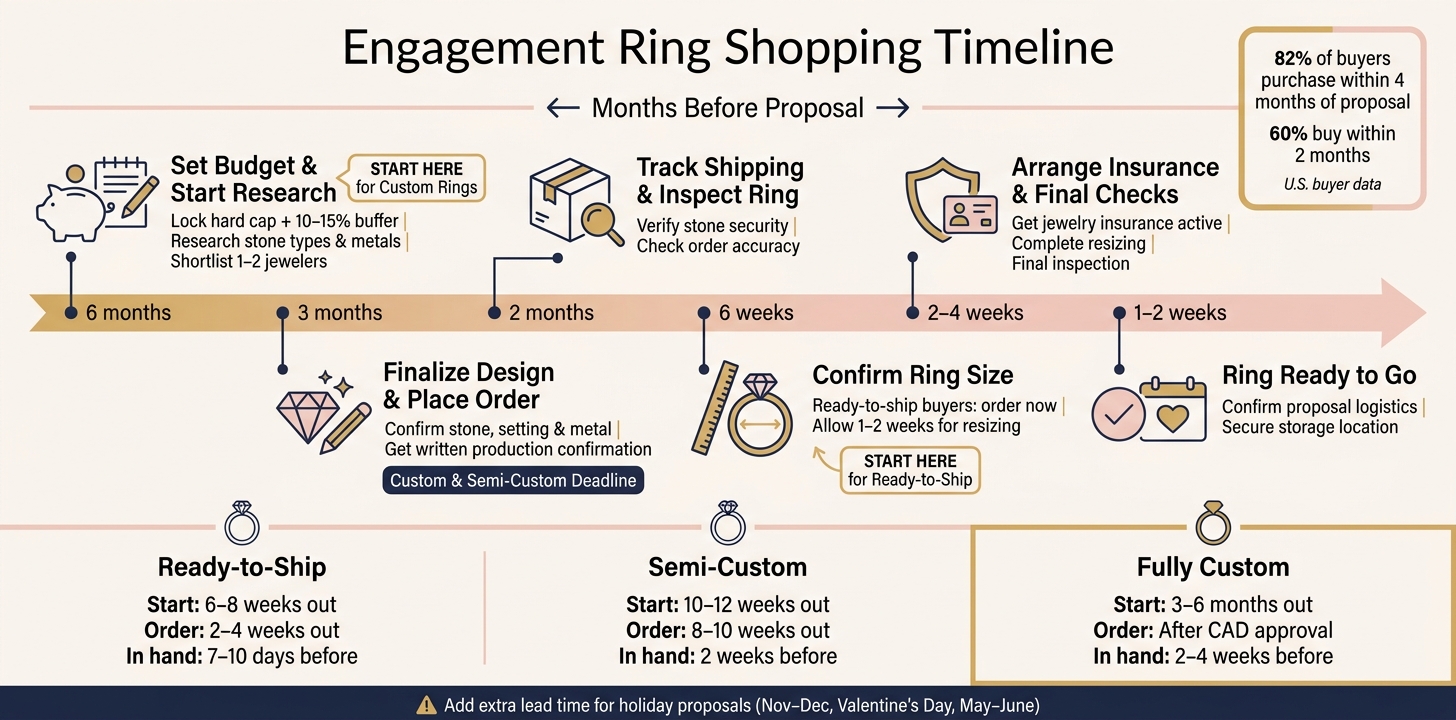
If I want the least stress, I start ring shopping 3–6 months before I plan to propose, and I try to buy the ring about 2–3 months before the date. That lines up with how most U.S. buyers shop: 82% buy within 4 months of the proposal, and 60% buy within 2 months.
Here’s the short answer:
- Too early usually means buying before I know the proposal date, budget, size, or ring style.
- Best window for research: 3–6 months out
-
Best window to order:
- Ready-to-ship: about 2–4 weeks out
- Semi-custom: about 8–10 weeks out
- Fully custom: about 3–6 months out
- Extra time matters if I’m proposing during November–December, around Valentine’s Day, or near busy wedding months like May and June
- I also need room for shipping, resizing, engraving, inspection, and insurance
A few budget points shape the timeline fast. A 1-carat natural diamond often runs about $3,836–$5,823, while a 1-carat lab-grown diamond may land around $779–$1,381. Moissanite and sapphire can cost less than that. And I should leave a 10%–15% budget cushion for shipping, resizing, insurance, and small add-ons.
Engagement Ring Shopping Timeline: When to Start, Order & Receive
Engagement Ring Shopping BASICS! Where Do You Begin?!
sbb-itb-9da40c1
Quick Comparison
| Ring type | When I start | When I order | When I want it in hand |
|---|---|---|---|
| Ready-to-ship | 6–8 weeks before proposal | 2–4 weeks before | 7–10 days before |
| Semi-custom | 10–12 weeks before proposal | 8–10 weeks before | About 2 weeks before |
| Fully custom | 3–6 months before proposal | After design approval | 2–4 weeks to 1 month before |
My rule: research early, buy later. That gives me time to compare stones, lock the budget, pick the setting, confirm the size, and avoid buying so early that return windows or sizing become a problem.
Set Your Budget and Core Ring Choices First
With your proposal date locked in, the next move is to narrow down what you can spend and what can realistically be finished in time. Start with three calls: your budget, your stone type, and your setting style.
How to Set a Ring Budget With a Hard Cap and a Buffer
Start from the proposal date and work backward. Add your current savings to what you can put aside each month, then treat that number as your hard cap. For example, if you have $900 saved and can add $300 per month for six months, your ceiling is $2,700.
Then add a 10%–15% buffer for the extras people often miss, like shipping, insurance, resizing, and engraving. That extra cushion can save you from getting blindsided at checkout.
Natural Diamonds, Lab-Grown Diamonds, and Colored Gemstones: What to Know Before You Shop
Your stone choice will shape the price more than anything else. It can also affect how long the ring takes to make. Here’s a simple side-by-side look:
| Stone Type | Typical 1-Carat Price | Durability (Mohs) | Ideal For |
|---|---|---|---|
| Natural Diamond | $3,836–$5,823 | 10 | Buyers who want a classic choice |
| Lab-Grown Diamond | $779–$1,381 | 10 | Buyers who want the diamond look at a lower cost |
| Moissanite | $400–$600 | 9.25 | Budget-conscious buyers who want strong sparkle |
| Sapphire | $800–$3,000 | 9 | Buyers who want color and a distinctive look |
The gap between natural and lab-grown diamonds is huge. A 1-carat natural diamond averaged around $6,100 in 2023, while a comparable lab-grown diamond averaged about $1,200 - roughly 80% cheaper. In plain terms, that could mean choosing between a 0.7-carat natural stone and a 1.5-carat lab-grown stone on the same budget.
Moissanite and sapphire can stretch your dollars even more. They also offer strong durability and a look that feels a bit less standard. Make these calls early, and you’ll cut down on delays later.
Narrow Down Your Setting Style and Metal Before Requesting Quotes
Once you’ve picked the stone, the setting starts to shape both the final cost and the production schedule. Solitaire settings are usually the fastest. Halo, three-stone, and vintage styles often take longer because they need more handwork.
Metal matters too. 14K gold, 18K gold, and platinum differ in price, wear, and production time. Pick your style and metal before you ask for quotes. That gives jewelers enough detail to share accurate pricing and timing, and it helps you avoid a messy mid-process remake.
Match Your Shopping Window to the Type of Ring You Want
Once you've locked in the stone and setting, the next step is simple: match the ring type to the time left before the proposal.
Ready-to-Ship Rings: Best When You Have a Shorter Timeline
If your proposal is 6–8 weeks away, a ready-to-ship ring is usually your best bet. Aim to buy 2–4 weeks before the proposal and have the ring in hand at least 7–10 days early. That buffer gives you time for shipping, a close inspection, and small sizing fixes if needed.
Semi-Custom and Custom Rings: Plan Further Ahead
Semi-custom rings usually take 8–12 weeks from the first consultation to delivery. And during busy seasons like Valentine's Day and the winter holidays, that timeline can stretch.
Fully custom rings need more runway. In most cases, you're looking at 3–6 months of lead time. Simpler designs may be done in 6–8 weeks, while more detailed work can take 10–16 weeks or longer.
| Ring Type | Start Shopping | Place Order | Ring In Hand |
|---|---|---|---|
| Ready-to-Ship | 6–8 weeks out | 2–4 weeks out | 7–10 days before proposal |
| Semi-Custom | 10–12 weeks out | 8–10 weeks out | 2 weeks before proposal |
| Fully Custom | 3–6 months out | After CAD approval | 2–4 weeks to 1 month before proposal |
How Adjustable Rings Can Help When You Are Not Sure of the Size
Not knowing the exact ring size is one of the biggest reasons proposals get messy at the last minute. If your partner's finger size changes with temperature, pregnancy, arthritis, or swelling, an adjustable engagement ring can take a lot of stress off your plate.
These rings work well when sizing is uncertain because they cut down the need for last-minute resizing. Since the size isn't locked in at purchase, you can shorten your shopping window to 4–6 weeks and order as close as 2–3 weeks before the proposal, with the ring arriving ready to wear.
Before you buy, check that the adjustable size range fits your best estimate.
After you pick the ring type, work backward week by week so nothing sneaks up on you.
Build a Simple Week-by-Week Shopping Timeline
Turn your proposal date into fixed shopping deadlines.
A Clear Timeline From 6 Months Out to Proposal Week
| Time Before Proposal | Key Task | If Missed |
|---|---|---|
| 24 weeks (6 months) | Set a firm budget, research stone types and metals, shortlist 1–2 jewelers | Late decisions; overspending |
| 12 weeks (3 months) | Finalize design and stone, place order with written confirmation of lead time | Missed production window |
| 8 weeks (2 months) | Track shipping, inspect ring on arrival, verify stone security | No time to fix errors |
| 4 weeks (1 month) | Arrange jewelry insurance, confirm proposal logistics, secure storage location | No coverage before proposal |
| 1–2 weeks | Complete any resizing, do a final inspection, confirm ring is ready to go | No buffer for final fixes |
Ring Sizing and Resizing Should Never Be an Afterthought
Lock in sizing early, because one small change here can throw off the whole plan.
For custom rings, confirm the size, or your best estimate, at least 8–10 weeks before the proposal so it can be part of the original order. For ready-to-ship rings, pin it down around the 4–6 week mark. Plain gold or platinum bands can often be resized in a few days. Stone-set rings - solitaires, halos, and pavé bands - usually need 1–2 weeks, since prongs and stone security have to be checked again after the change. Leave at least 1–2 weeks of buffer before the proposal for any ring that may need resizing, and treat that appointment like a fixed deadline, not a last-minute chore.
Use a Milestone Checklist to Stay on Track
A smooth proposal usually comes down to dates. If each step has a deadline, there's less chance anything drifts.
- Budget set and documented - done before you contact any jeweler
- Stone type chosen (natural diamond, lab-grown, or gemstone) - decided during early research, before final quotes
- Setting style and metal finalized - finished before requesting quotes
- First jeweler consultation completed - wrapped up by the 12-week mark
- Ring ordered with written production and shipping confirmation - no later than the 8–12 week window for custom rings, or 4–6 weeks for ready-to-ship
- Ring delivered and inspected - check prongs and stone security, and make sure the order matches what was confirmed
- Resizing or adjustments completed - finished at least 1–2 weeks before the proposal
- Jewelry insurance arranged - active before the ring leaves your home
- Proposal logistics finalized - location, timing, and how you'll carry and store the ring confirmed
Give each item a real date on your calendar. “Complete consultations by April 15” or “place the order by May 1 for an August proposal” works much better than “order a few months ahead.”
Once every milestone has a date, you're not guessing anymore. You're working a plan.
Conclusion: Start Early Enough to Keep Your Options Open
Start browsing 3–6 months before the proposal, and aim to buy 2–3 months before the big day. The safest move is still simple: work backward from your proposal date. That gives you time to compare stones, talk with jewelers, and deal with shipping or sizing without a last-minute scramble.
If you’re planning a custom ring or proposing during the holiday season, start even earlier. Custom designs often take 8–12 weeks from design approval to delivery. On top of that, holiday demand can slow shipping. Starting sooner is the best way to protect your timeline.
Work backward from the proposal date, then map out the key steps:
- finalize the design
- place the order
- receive the ring
- handle any sizing changes
Starting early keeps your options open and helps you avoid rushed decisions. A clear deadline doesn’t just cut stress. It also helps keep sizing, shipping, and delivery on track.
FAQs
What if I don't know the ring size yet?
If you don’t know your partner’s ring size, an adjustable engagement ring can be a smart option. It usually fits sizes 5 to 9, so you can skip the hassle of getting it resized by a jeweler.
If you’d rather go with a standard ring, there are a few low-key ways to find the right size. You can borrow one of their rings and have a jeweler measure it, trace the inside of the band, use an at-home sizing chart printed at 100% scale, or ask a close friend or family member for help.
How much extra should I budget beyond the ring price?
Beyond the ring’s price tag, set aside money for added costs like insurance and, if the design can’t be adjusted, professional resizing.
If you spend less on the center stone, that can free up room in your budget for upgrades like a platinum setting, a hidden halo, custom engraving, or a more detailed setting design.
Should I start earlier for a holiday proposal?
Yes. If you're planning a holiday proposal, it's smart to get started early. Production, customization, and shipping often take longer during busy engagement seasons.
To help avoid delays, place your order well ahead of time. If you're on a tight timeline, a ready-to-ship or adjustable ring can be a faster pick and may arrive within a few business days with expedited shipping.


