

Perimenopause: Tight Rings Are Often the First Sign You Notice
If your ring feels tight again and again, especially in the morning or on hot days, it can be an early clue that perimenopause is starting. Hormone shifts can lead to fluid retention, so your fingers may swell before you notice other changes. A tight ring alone does not prove perimenopause, but a repeat pattern matters.
Here’s the short version:
- Perimenopause can cause finger swelling because estrogen and progesterone shift in uneven ways.
- Morning swelling, heat, exercise, and salty meals can make rings feel tighter.
- A one-time snug fit is common. A ring that gets tight over and over is more worth tracking.
- Track it for 2 to 4 weeks if it keeps happening, especially if you also have irregular periods, hot flashes, night sweats, or sleep changes.
- Take the ring off early if it starts to feel tight.
- Get urgent help if your finger turns pale, blue, cold, numb, or very painful.
- Adjustable, resizable, or temporary rings may be easier to wear while your size changes.
A simple example: if your ring is tight at 7:00 AM for several mornings in a row, then loosens by afternoon, that pattern is worth noting. If it happens with other midlife symptoms, it’s a good idea to bring it up with a doctor.
The article below explains the cause, how to tell a short-term issue from a repeat pattern, what to do if a ring gets stuck, and which ring options may help.
Why Rings Feel Tight During Perimenopause
During perimenopause, estrogen and progesterone don't drop in a smooth, steady way. They tend to swing up and down. Those hormone shifts can affect how the body handles fluid, which may lead to temporary water retention in the hands and fingers. When that happens, a ring might catch at the knuckle or leave a deeper mark than usual.
This tends to show up most in the morning, during hot weather, or after a salty meal.
How Hormones, Heat, and Morning Swelling Change Finger Size
A common pattern is morning tightness. When you lie flat overnight, fluid can move toward the upper body and hands. So a ring that slips off with no trouble later in the day may feel snug when you first wake up, then loosen once you're up and moving.
Heat can do the same thing. A ring may feel fine in an air-conditioned room, then suddenly feel tighter after time outside on a hot day or after a warm shower. As the body tries to cool itself, blood vessels near the skin widen, and more fluid can move into the fingers.
Exercise and arm position can add to it too. During a workout, or even after a long stretch with your arms hanging down, blood flow shifts and gravity can let fluid collect in the fingers. A ring may feel normal before activity, tighter afterward, and then easier to wear again once your hands cool down.
Salt matters as well. After a salty dinner, rings may feel tighter the next morning. That usually eases as the body settles its fluid balance again, although the timing can vary from person to person.
Sometimes a ring feels tight even when the finger doesn't look very swollen. That's because the issue may be a slightly fuller knuckle or a stiff joint. In that case, the ring may get stuck at the knuckle, feel hard to rotate, or leave a deeper indentation.
A Tight Ring Is Not Always a Sign of Perimenopause
Ring tightness can happen for many reasons, so it doesn't prove perimenopause on its own. It can also come from heat, exercise, medication side effects, arthritis or other joint inflammation, thyroid disease, an allergic reaction, or problems that affect the heart, kidneys, liver, or circulation.
Some cases need medical attention. Swelling that is persistent, severe, painful, or limited to one hand or one finger shouldn't be brushed off. The same goes for swelling that comes with redness, warmth, numbness, weakness, rash, fever, shortness of breath, or swelling in other areas. Those signs point to more than everyday fluid shifts and should be discussed with a healthcare professional, not treated as just a ring issue. If it keeps happening, track the pattern instead of writing it off as random.
sbb-itb-9da40c1
How to Tell Short-Term Snugness From a Pattern Worth Tracking
Not every tight-ring morning means much. Sometimes your fingers are just a little puffy for a short time. Other times, the same fit problem keeps showing up, and that’s when it makes sense to pay closer attention.
The main thing to ask is simple: does the tightness keep happening under the same conditions, or does it pass once the trigger is gone?
Signs of Normal, Temporary Snugness
Short-term tightness usually has an easy-to-spot cause. Maybe your ring feels snug at 7:00 AM after a salty dinner the night before, then slips off with no trouble by 10:00 AM. Or maybe it gets tight after a walk in 88°F heat, then loosens once you cool off inside. Heat, exercise, or a salty meal can lead to short-lived puffiness.
The biggest clue? The ring still comes off easily, without force.
That kind of snugness is usually temporary. A fit change that keeps coming back is different.
Signs the Fit Change Keeps Repeating
A pattern worth tracking tends to look more consistent. The ring catches at the knuckle several mornings in a row. Taking it off gets harder on multiple mornings or evenings. The tightness shows up even when there’s no clear reason for it, like heat, exercise, or a salty meal.
That repeat pattern is the part that matters. It matters even more when it shows up along with other symptoms, such as hot flashes, night sweats, poor sleep, mood changes, or shifts in your menstrual cycle. Put together, those signs are worth bringing up with a clinician.
How to Use a Simple Ring-Fit Log
If ring tightness keeps happening, a simple log can help you spot what’s going on. Track it for 2–4 weeks and see if the same type of episode keeps returning. You don’t need anything fancy. Just write down what you notice.
Use one row for each check-in, plus any time the ring suddenly feels tight.
| Field | What to Write |
|---|---|
| Date | MM/DD/YYYY, for example, 09/23/2026 |
| Time | 12-hour format, for example, 7:00 AM or 9:00 PM |
| Temperature | Approximate °F indoors or outdoors, for example, 72°F |
| Ring fit | Comfortable / snug / sticks at knuckle / leaves a mark / cannot remove easily |
| Visible swelling | None / mild / moderate / marked; one or both hands |
| Recent activity | Exercise, travel, repetitive hand use, or inactivity |
| Food and fluids | High-sodium meal, alcohol, or unusually low fluid intake |
| Other symptoms | Hot flashes, night sweats, poor sleep, menstrual-cycle changes, mood changes, pain, numbness |
| What changed after | Did it loosen after cooling, elevating the hand, moving the fingers, or waiting? |
The log helps organize what you’re seeing. It does not diagnose anything by itself.
If swelling is severe, gets worse fast, hurts, looks discolored, feels numb, or limits movement, don’t wait to log it. Those signs call for prompt medical attention.
What to Do Right Away When a Ring Feels Too Tight
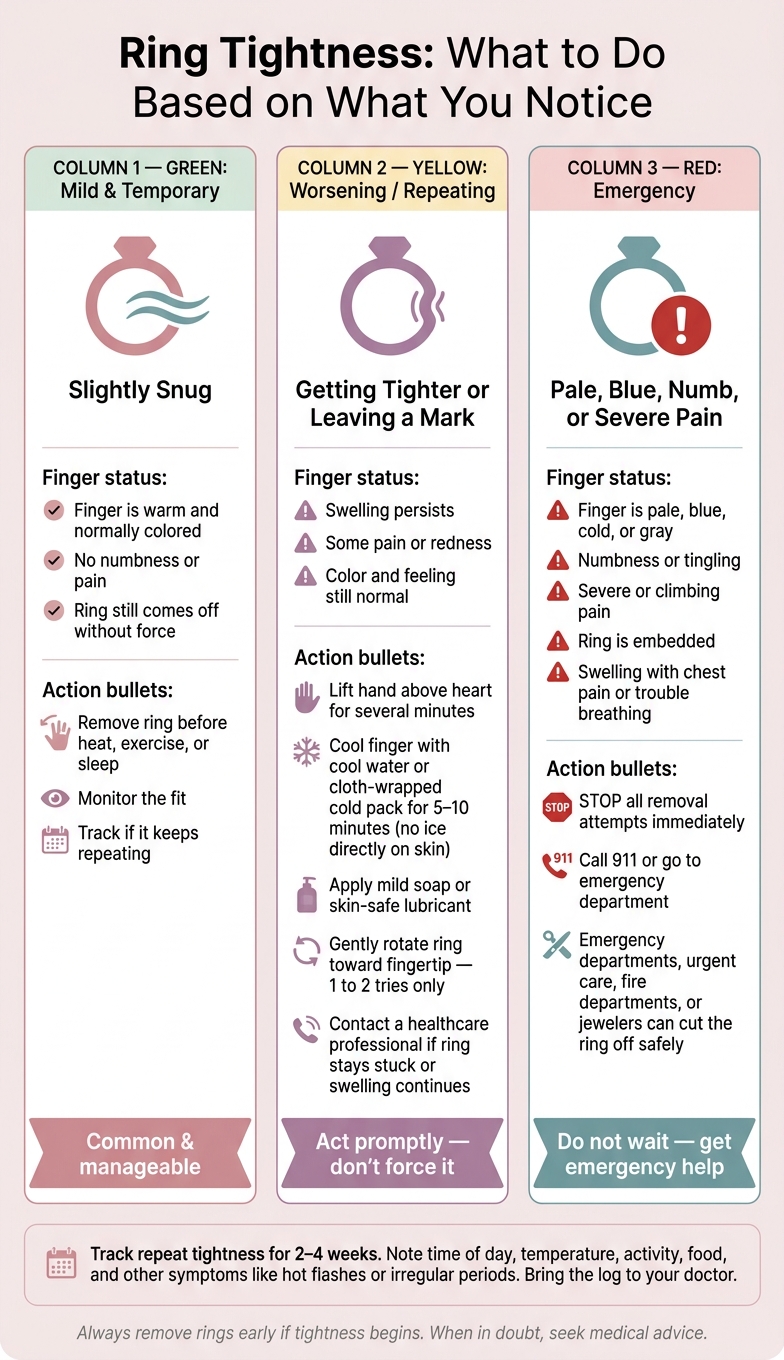
Ring Tightness During Perimenopause: When to Track, When to Act
Take the ring off as soon as it starts to feel tight. Even a little snugness can turn into a stuck ring once swelling kicks in. And if this keeps happening, pay attention. A ring that gets tight again and again can become trapped fast.
Safe Steps for Removal and Short-Term Relief
First, stop anything that may be making the swelling worse. Heat can do it. So can letting your hand hang down below heart level. Rest your hand, lift it above your heart for several minutes, and cool the finger with cool water or a cloth-wrapped cold pack for about 5–10 minutes. Don’t put ice right on the skin, and don’t keep cooling until the finger goes numb.
When the swelling goes down a bit, use mild soap and water or a skin-safe lubricant. Then gently rotate the ring toward the fingertip. Be gentle here. Don’t yank it, don’t twist hard, and don’t keep going if the finger is swelling more or starting to hurt. If the ring still won’t move after one or two careful tries, stop. Pushing through can compress the tissue more and make the ring even harder to remove.
Pay close attention to warning signs: a deep pressure mark, more pain, tingling, numbness, or skin that looks pale, blue, gray, or unusually dark. Those signs can mean the ring is putting harmful pressure on the finger.
When to Call a Healthcare Professional
Get medical help soon if gentle attempts don’t work, the swelling gets worse, or the finger becomes painful, red, hot, numb, tingling, pale, blue, cold, misshapen, or hard to move. The same goes for one finger or one hand that is much more swollen than the other, especially if the change happens suddenly.
Call 911 or go to an emergency department right away if the swelling comes with chest pain or trouble breathing. Also, if the finger is blue, pale, cold, numb, or very painful and the ring still won’t move, stop trying to handle it at home and get help fast. Emergency departments, urgent care clinics, fire departments, and some jewelers can cut the ring off safely.
Quick Ring Safety Guide
| What you notice | What to do | Why it matters |
|---|---|---|
| Ring is slightly snug, but the finger is warm, normally colored, and not numb or painful | Keep it on only briefly, then remove it before heat, exercise, sleep, or more swelling; keep an eye on the fit | Mild, temporary snugness can happen, but taking the ring off early helps keep it from getting stuck |
| Ring feels tighter and tighter or leaves a pressure mark; swelling sticks around; there is some pain or redness, but color and feeling are still normal | Remove it gently, lift and briefly cool the hand, make one or two gentle tries with lubricant, and contact a healthcare professional if swelling continues or the ring stays stuck | Continued pressure can make swelling worse and make later removal harder |
| Finger is pale, blue, cold, numb, or tingling; pain is severe or climbing fast; the ring is embedded; swelling comes with breathing trouble or chest pain | Stop all forceful removal attempts and get emergency medical help fast | These signs may point to poor circulation, nerve compression, injury, infection, or a serious body-wide problem |
Once the ring is off and the swelling settles down, the next step is finding a fit that can handle normal day-to-day size changes.
Jewelry Options for Fingers That Change Size
If your ring size shifts from morning to night, you need a fit that gives a little without putting pressure on your finger. When one ring feels tight early in the day but fine later, a flexible fit usually makes more sense than a fixed band.
That’s why adjustable, resizable, or custom-fit jewelry is often the best next step.
Adjustable and Resizable Rings for Day-to-Day Comfort
Adjustable rings use an open, split, or flexible band, or a hidden adjustment mechanism, to make room for size changes in a way a fixed-size ring can’t. Satinski's adjustable designs generally cover U.S. sizes 5–9, which can help if a ring feels fine in the morning but snug later in the day or in hot weather. Sterling-silver styles start around $70. Solid gold starts around $990.
When you adjust the band, make small changes with both hands. Don’t use pliers, and don’t keep bending the ring near stones. If you expect to adjust the ring often, solid gold tends to hold up better than gold vermeil.
Engagement Rings, Wedding Bands, Stacking Rings, and Custom Orders
Satinski offers resizable engagement rings, wedding bands, and stacking rings in U.S. sizes 5–9.
If your finger falls outside that range - or you have a larger knuckle with a slimmer finger base - a custom order may fit better. Custom work can also include engraving and a preferred adjustment mechanism. The tradeoff is simple: it often costs more and may limit future resizing.
Before production starts, confirm the details up front, including:
- the return policy
- whether the ring can be altered again later
Fixed-Size, Adjustable, and Temporary Ring Options Compared
Use the table below to match the ring type to how often your size changes.
| Fit flexibility | Best use | Key limit | Care point |
|---|---|---|---|
| Fixed-size jewelry | Stable, long-term fit when finger size is consistent | Can become uncomfortable during heat-related or day-to-day swelling | Remove before discomfort develops; store in a ring box or separate pouch |
| Adjustable rings | Everyday wear when finger size varies modestly; Satinski styles cover approximately U.S. sizes 5–9. | Adjustment range is limited; excessive bending can weaken the band | Adjust in small steps with both hands; inspect for cracks; store where it cannot be crushed |
| Temporary stand-ins | Short-term style, travel, or occasions when a valued ring is too tight | May not match the materials, symbolism, or durability of the original ring | Remove before activities that could loosen or damage it; store the original ring safely and dry |
| Custom resizing | A lasting solution for a ring that no longer fits or falls outside standard adjustable ranges | Requires professional assessment; may cost more; not suitable for every setting or engraving | Use a qualified jeweler; confirm future resizing options and follow metal- and gemstone-specific care instructions |
Remove any ring right away if it becomes painful, numb, pale, blue, or hard to move.
Conclusion: Track the Pattern, Keep Your Finger Safe, and Choose a Flexible Fit
A tight ring is often one of the first changes people notice. And when it keeps happening at the same times, or shows up with other changes like irregular periods or hot flashes, it’s worth paying attention to. Hormonal shifts during perimenopause can change how the body handles fluid, and fingers are often one of the first places where that shows up. A tight ring by itself isn’t a diagnosis. But it is a sign to take note.
Try tracking what’s happening for 2–4 weeks. Write down the time of day, temperature, activity, salty meals, cycle stage, which fingers are affected, and whether the swelling goes down later. If your ring catches on your knuckle every morning for weeks, then loosens by afternoon, that’s worth bringing up with your doctor.
No matter what pattern you notice, ring safety comes first. Take the ring off early. If it becomes painful, numb, pale, blue, or stuck, get urgent care.
For daily wear while your size is changing, an adjustable or resizable ring can make life a lot easier. If your main ring still feels tight, use a temporary stand-in on another finger or store it safely until your size settles.
The pattern matters. Finger safety matters more.
FAQs
Can tight rings be an early sign of perimenopause?
Yes. Tight rings can be an early, easy-to-spot sign of perimenopause. Hormone changes often lead to fluid retention, which can make your fingers swell and your rings feel snug out of nowhere.
Hormones also affect how your body holds fluid. So your finger size may shift with heat, cold, exercise, or just the time of day. If your rings keep feeling tight or start getting uncomfortable on a regular basis, that’s a pattern worth tracking.
How do I know if ring tightness is a pattern?
Ring tightness is probably part of a pattern when it happens in a steady rhythm. For example, the ring feels snug in the morning and then loosens up later in the day. The same goes if it keeps showing up after the same triggers, like heat, humidity, exercise, salty foods, or certain hormonal phases.
When the fit shifts during the day or changes with the seasons, that usually points to temporary swelling instead of a one-off sizing problem. If the tightness keeps getting worse, doesn’t fade, or shows up with lasting joint pain, stiffness, or other symptoms, it may be time to get medical input.
When should I get help for a stuck ring?
Get medical help right away if a stuck ring causes acute pain, visible redness, deep throbbing, numbness, tingling, or if your finger turns blue or white.
If simple steps like raising your hand or using lubrication don't work, stop. Pushing harder can damage the tissue.
See a healthcare professional if swelling or discomfort doesn't go away. A jeweler can also cut the ring safely.


