

Moissanite vs Lab-Grown Diamond: The Comparison Nobody Does Properly
If I had to sum it up fast: choose moissanite for lower cost, more size, and stronger rainbow sparkle; choose a lab-grown diamond for the classic diamond look, top scratch resistance, and the fact that it is a diamond.
I’d make the choice based on 6 things: appearance, durability, price, maintenance, resale, and setting fit. The biggest split is visual: moissanite has about 2.5x more fire than diamond (0.104 vs. 0.044), while lab-grown diamond gives more of the white sparkle most people expect from a diamond ring. On price, moissanite often lands around $300 to $800 for a 1 ct stone, while a 1 ct lab-grown diamond can range from about $295 to $1,500+, with many options sitting higher once cut, color, and clarity are factored in.
Here’s the short version I’d want before reading the full piece:
- Moissanite is not a diamond. It’s silicon carbide.
- Lab-grown diamonds are diamonds. Same material as mined diamonds.
- Moissanite usually looks flashier.
- Lab-grown diamonds usually look more classic.
- Both work for daily wear.
- Diamond is harder: 10 on Mohs vs. 9.25–9.5 for moissanite.
- Moissanite often gives you a bigger stone for the same budget.
- Neither should be bought for resale. Lab-grown resale often falls around 10% to 30% of retail, and moissanite is often lower.
- Settings matter a lot, especially for adjustable rings, larger stones, and active daily wear.
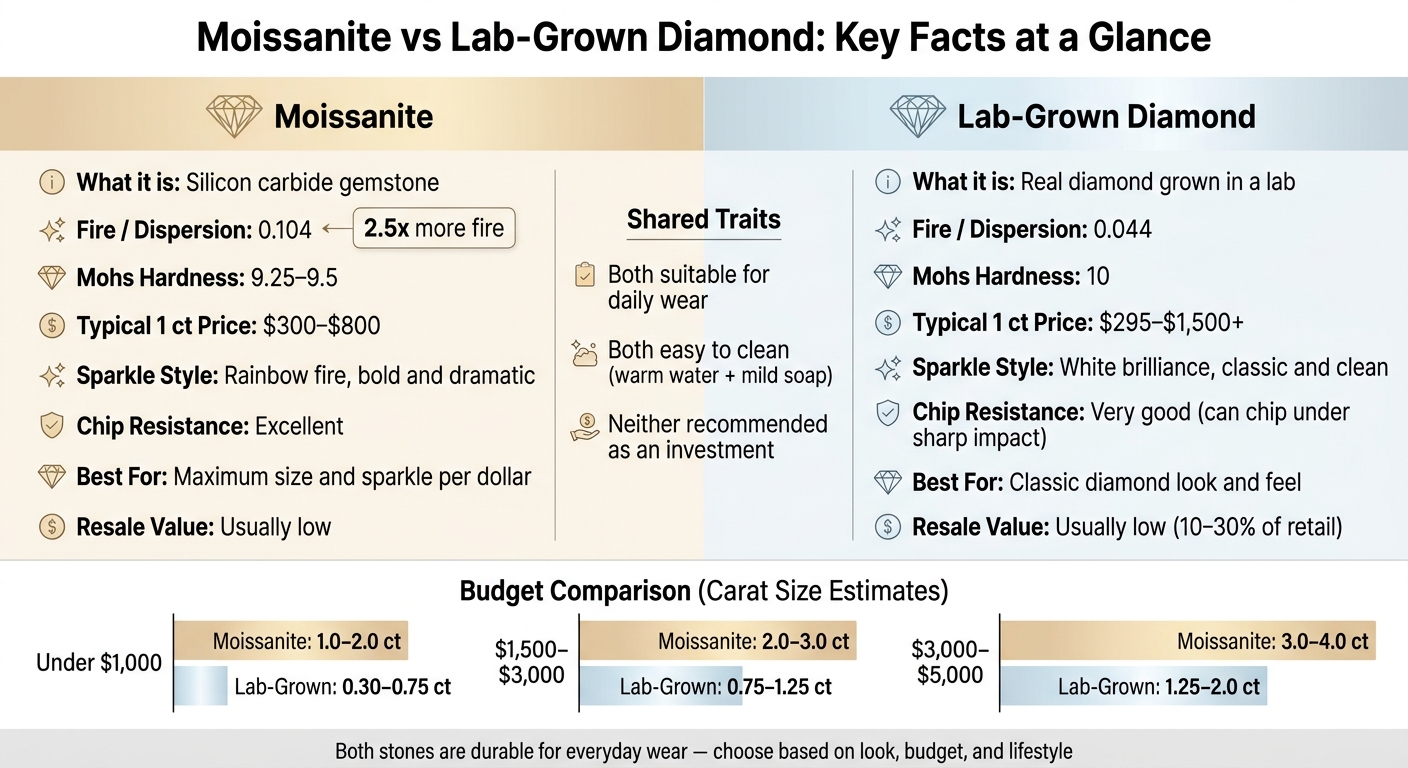
Moissanite vs Lab-Grown Diamond: Key Facts at a Glance
Moissanite vs. Lab-Grown Diamonds: The Ultimate Comparison Guide
sbb-itb-9da40c1
Quick Comparison
| Factor | Moissanite | Lab-Grown Diamond |
|---|---|---|
| What it is | Silicon carbide gemstone | Diamond grown in a lab |
| Look | More rainbow fire | More white brilliance |
| Fire / dispersion | 0.104 | 0.044 |
| Hardness | 9.25–9.5 | 10 |
| Daily wear | Good for everyday use | Good for everyday use |
| 1 ct price | $300–$800 | $295–$1,500+ |
| Best for | Bigger look on a lower budget | Classic diamond style |
| Resale | Usually low | Usually low |
My bottom line: if you want the diamond look, go lab-grown diamond. If you want the most size and sparkle per dollar, go moissanite. And if your ring size changes, I’d pay as much attention to the setting style and metal as the center stone itself.
Now the rest of the article can help you match that choice to your budget, style, and daily wear.
How moissanite and lab-grown diamond look in real life
The main visual difference comes down to sparkle style.
Moissanite throws off more rainbow fire. Lab-grown diamond gives you more white brilliance and that classic diamond look people know right away. If this is a ring you’ll wear every day, that difference tends to matter a lot more than it does in a jewelry store case.
Daylight, indoor light, and evening light side by side
You’ll notice the gap most in direct sunlight. Moissanite’s dispersion is 0.104, while diamond’s is 0.044 - about 2.5x more fire. In bright outdoor light, moissanite sends out bold rainbow flashes. For some people, that’s the whole appeal. For others, it can feel a bit more flashy than they want.
Lab-grown diamonds in the same light give off strong white brilliance with softer colored flashes. That’s the look most people connect with a classic diamond ring.
Indoors, the difference gets smaller. Both stones still look bright and lively, but moissanite usually keeps that colorful twinkle. Under warm evening light, moissanite can look more dramatic, while lab-grown diamonds tend to look cleaner and more understated.
| Lighting condition | Moissanite | Lab-grown diamond |
|---|---|---|
| Daylight / direct sun | Strong rainbow flashes; very dramatic fire | Balanced white sparkle; classic diamond look |
| Indoor lighting | Lively and bright; colorful flashes still present | Crisp, clean brilliance; consistent and elegant |
| Evening / soft light | High-energy, glam appearance; intense scintillation | Restrained, refined shimmer; understated luxury |
When the extra fire works for you and when it does not
This contrast tends to stand out more as the stone gets larger, especially in round brilliant cuts.
If your style leans bold, glam, or sparkle-first, moissanite’s extra fire can be a big plus. It’s not a flaw. It’s the point.
If you want a classic, clean, or pared-back look - or you want your ring to blend in more easily in work or low-key settings - a lab-grown diamond usually fits better because its white brilliance looks more familiar.
Looks are only one part of the decision. For a ring you wear every day, durability matters just as much.
Durability for daily wear and long-term upkeep
Appearance shapes the first impression. Durability decides if the ring still feels right years later.
Both stones are fit for daily wear. The main differences come down to scratch resistance, chip resistance, and how much the setting shields the stone.
Hardness, scratching, and why ring settings matter
Lab-grown diamond rates 10 on the Mohs hardness scale, the same as a natural diamond. Moissanite comes in at 9.25 to 9.5. In plain English, hardness is about scratch resistance. Toughness is about how well a stone handles impact without chipping.
Moissanite is highly resistant to chipping, which helps when life happens and the ring gets knocked around a bit. Diamonds are harder, but they can still chip if they take a hit at the wrong angle.
| Property | Moissanite | Lab-Grown Diamond |
|---|---|---|
| Mohs hardness | 9.25–9.5 | 10 |
| Scratch resistance | Excellent | Excellent; highest scratch resistance in this comparison |
| Toughness (chip resistance) | Excellent; highly resistant to chipping | Very good; can chip under sharp impact |
In many cases, the setting matters more than the stone itself. A hard stone in a high-set solitaire is still more exposed than that same stone in a lower-profile setting. If the ring will see a lot of movement during the day, settings like bezel, half-bezel, or channel can help cut down on snagging and reduce stress on prongs. That matters most for rings that catch on clothes, gym gear, gloves, or everyday objects.
Cleaning, maintenance, and setting checks over time
Both stones are simple to care for. Warm water, a drop of mild dish soap, and a soft brush will keep both moissanite and lab-grown diamond looking their best at home.
Moissanite can sometimes develop a temporary oily haze. That’s a surface issue, not damage, and it usually comes off with proper cleaning. Lab-grown diamonds wear and clean the same way mined diamonds do.
It also helps to have a jeweler check the prongs once a year, or twice a year if the ring gets heavy daily wear. If the ring starts snagging on clothing or other objects, or if the stone feels even slightly loose, stop wearing it and have a jeweler inspect it before the stone falls out.
Once durability is sorted out, price and resale expectations become the next filter.
Price, long-term value, and resale expectations
Price is where this choice stops being abstract and starts feeling real. Moissanite usually gets you more size for the money. Lab-grown diamond gets you diamond as the material. And that difference shows up fast when you compare what the same budget can buy.
What your budget usually buys in each category
Moissanite is usually the lower-cost option. A 1-carat moissanite often costs $300 to $800, depending on quality and brand. A similar 1-carat lab-grown diamond can range from about $295 to $899 in some July 2026 benchmarks, while many buying guides put a similar stone closer to $725 to $1,500 or more.
That low-end overlap can throw people off. On paper, the prices can look close. But in practice, the same budget usually buys a larger moissanite center stone.
For example, $2,000 can buy a 2.0 ct moissanite solitaire or about a 1.0 ct lab-grown diamond solitaire.
Here’s how those budget ranges usually play out:
| Budget | Moissanite | Lab-Grown Diamond |
|---|---|---|
| Under $1,000 | 1.0–2.0 ct center stone in a 14K gold setting | 0.30–0.75 ct center stone in a basic setting |
| $1,500–$3,000 | 2.0–3.0 ct stone; room for pavé or halo settings | 0.75–1.25 ct stone in G–H color, VS–SI clarity |
| $3,000–$5,000 | 3.0–4.0 ct look; larger or custom settings | 1.25–2.0 ct stone with good cut and mid-to-high color |
Routine upkeep is usually pretty low for both. Most of the cost comes from the setting and the metal, not day-to-day care. If you ever need to replace the center stone, moissanite is much cheaper to swap than a lab-grown diamond of similar size, simply because the per-carat price is lower.
Price tells you what you can get today. Resale tells you what not to count on later.
How to think about resale without unrealistic assumptions
Neither stone should be treated like an investment. Resale is limited on both sides: lab-grown diamonds often recover about 10% to 30% of retail, and moissanite usually gets back less.
A better way to think about value is cost per wear. A $1,000 ring worn almost every day for 10 years costs less than $0.30 per day. That’s where the value tends to show up - not in a future payout, but in years of use and enjoyment.
Next comes the practical part: which stone works best for engagement rings and adjustable settings.
Best use cases: engagement rings, adjustable rings, and the right choice for you
Which stone fits classic, budget-conscious, and daily-wear needs
Once sparkle, durability, and price are clear, the next step is simple: think about how you’ll wear the ring in real life. The easiest way to decide is to match the stone to your style, budget, and day-to-day habits.
A lab-grown diamond is the better pick when the classic diamond look matters most. That could mean family expectations, a timeless solitaire, or simply wanting a real diamond. Its sparkle looks bright and even, with the white-light brilliance most people picture when they think of a classic engagement ring.
Moissanite usually makes more sense when budget and visible size matter most. It throws off more rainbow fire, while lab-grown diamond has a calmer, more classic look. If you like bold sparkle and want the biggest center stone for your money, moissanite is hard to beat.
| Buyer priority | Better fit | Why |
|---|---|---|
| Biggest center stone under $1,000 | Moissanite | More stone for the money |
| Classic diamond look | Lab-grown diamond | Classic diamond look and feel |
| Strong rainbow fire | Moissanite | Higher fire and color flash |
| Low-key, professional-friendly sparkle | Lab-grown diamond | Balanced brilliance, less color flash |
What to look for in adjustable or resizable ring settings
If a ring needs to change size, the setting matters just as much as the stone. That’s especially true if your finger size shifts because of arthritis, swelling, pregnancy, or large knuckles. A secure, well-made adjustable ring helps protect the center stone through repeated size changes.
Focus on settings that can handle movement. 4–6 prong solitaires, partial bezels, or full bezels usually hold stones more securely than delicate micro-prongs on a shank that bends all the time. Stone sizes in the 1.0–1.8 ct range also tend to feel more balanced on an adjustable band. Go much larger, and the ring can start to feel top-heavy and spin.
A low-profile setting is often the easier daily-wear option because it snags less and sits closer to the hand. For metal, 14K solid gold is the practical pick for adjustable rings you plan to wear every day. Gold vermeil can wear through at the sliding contact points within 1–3 years, which may expose the silver base underneath.
Because adjustable rings have more moving parts than fixed bands, it’s smart to have a jeweler check the prongs and mechanism every 6–12 months.
The simplest way to choose without confusion
For adjustable rings, the same basic idea still applies: don’t just choose the stone, choose the setting that fits your life too. It helps to narrow the decision down to three direct questions:
- What’s your budget?
- Do you want classic diamond brilliance or maximum fire?
- Does your ring size change?
Answer those, and the right mix of stone and setting usually becomes pretty clear.
Choose moissanite for maximum size and fire. Choose lab-grown diamond for the classic diamond look and feel.
FAQs
Can most people tell moissanite from a lab-grown diamond?
Usually, no - not at a glance. Both look beautiful and durable, and most people won’t spot the difference right away.
The biggest visual difference comes down to sparkle. Moissanite tends to give off more fiery, rainbow-like flashes. Lab-grown diamonds, on the other hand, have the classic diamond look most people expect.
In larger stone sizes, moissanite can also show slight yellow or green tones in certain lighting.
Which stone looks better in larger carat sizes?
It comes down to the style you're after.
If you want maximum sparkle, moissanite often stands out more, especially in larger carat sizes. It throws off a lot of brilliance, so it tends to look brighter and flashier.
Diamonds, on the other hand, usually have a more classic and understated look. Their sparkle is still beautiful, but it’s often less intense and a bit more restrained.
One thing to watch with larger moissanite stones: in some lighting, they can show slight yellow or green tints.
What setting is safest for daily wear?
For daily wear, the safest choice is 14K solid gold or platinum.
Platinum is very strong, which helps hold stones in place and lowers the chance that they come loose or fall out.
If you need a ring that can be resized often, 14K solid gold is the better pick. It handles repeat adjustments well and avoids the surface wear that can expose a different base metal at sliding contact points.


