

How to Tell Moissanite From Diamond With Your Own Eyes
You can make a first guess by sight, but you can’t confirm it by eye alone. In most cases, I’d check 3 things first: the type of sparkle, how sharp the facets look, and how the stone looks when I move it under normal light.
Here’s the short version:
- Moissanite often shows more rainbow fire because it disperses light about 2.4x more than diamond.
- Diamond usually looks more white-dominant, with cleaner flashes and sharper-looking facet lines.
- The difference is often easier to spot on stones around 1 carat or larger.
- A ring setting, dirt, light, and cut can make both stones look close.
- A visual check is only a first pass. For a stone that costs serious money, I’d still want a jeweler’s opinion or a lab report.
If I wanted a fast at-home check, I’d do this:
- Look at the stone in soft indoor light or near a window.
- Move it side to side.
- Watch for rainbow-heavy sparkle vs whiter flashes.
- Look closely to see if the facet pattern seems clean and sharp or a bit busy and soft.
- If I can, compare it side by side with another stone under the same light.
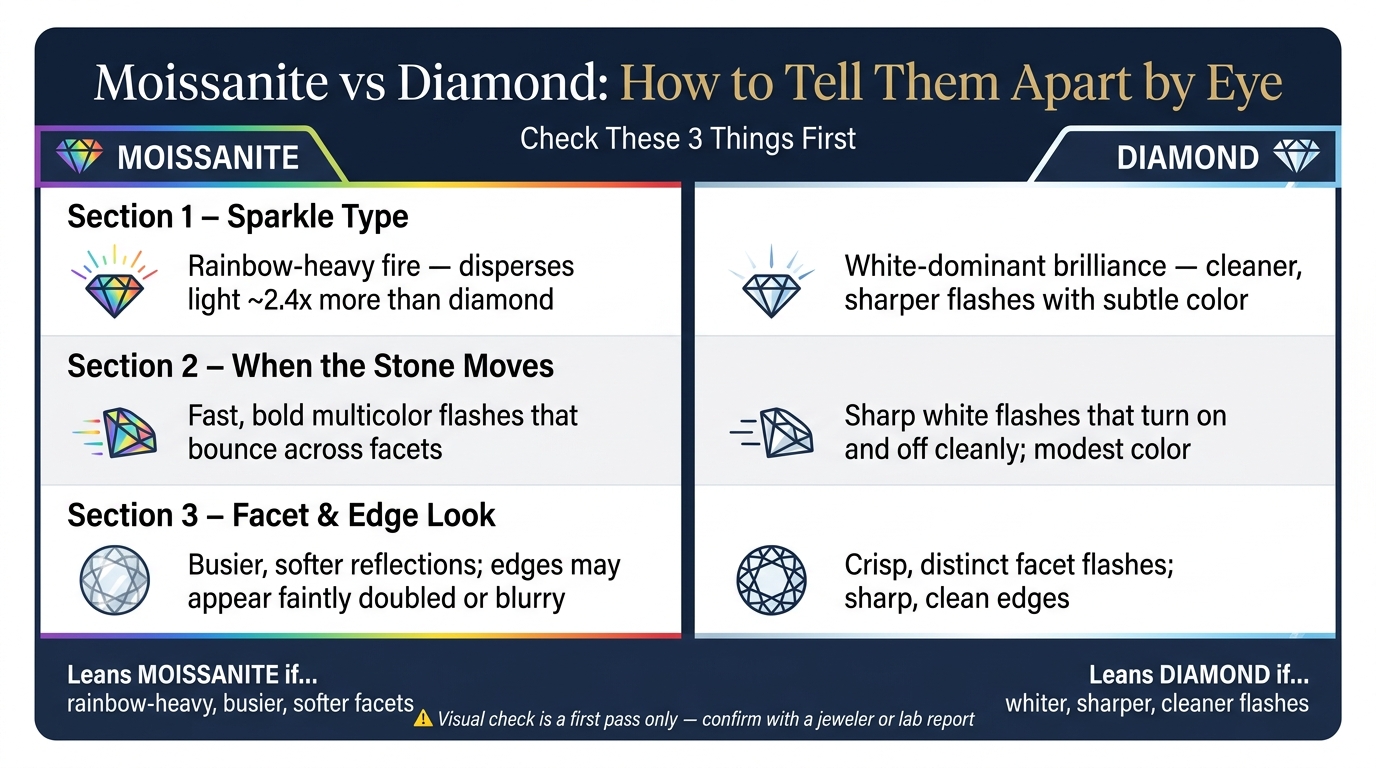
Moissanite vs Diamond: Visual Differences at a Glance
Diamond v Moissanite v CZ: How You Can Spot the Difference
sbb-itb-9da40c1
Quick Comparison
| What I’d Look At | Moissanite | Diamond |
|---|---|---|
| Sparkle type | More rainbow flashes | More white flashes |
| When moved | Fast, bold multicolor flashes | Cleaner on/off white flashes |
| Facet look | Can seem busier or a bit softer | Usually sharper and cleaner |
| Edge look | May show faint doubling on some stones | Usually crisp |
| Best time to spot it | In normal light, while moving the stone | In normal light, while moving the stone |
Put simply: if the stone looks more rainbow-heavy and slightly busier, I’d lean moissanite. If it looks whiter, sharper, and cleaner, I’d lean diamond. That won’t prove what it is, but it gives me a solid first impression before I ask for proof.
Check the Sparkle in Normal Light First
Start with plain, everyday light. Hold the stone under a ceiling light or near a window, then look at the type of sparkle it gives off. After that, move it a bit and see how it reacts as the light shifts.
Rainbow Fire vs White Brilliance
For a fast naked-eye check, the easiest place to start is fire. Moissanite disperses light about 2.4 times more than diamond.
For the clearest view, use indirect daylight or soft indoor light. In that kind of lighting, moissanite usually throws more rainbow flashes across the stone. A diamond, by contrast, tends to show sharper white flashes with just a little color mixed in. Put simply, diamond looks more white-dominant.
What Changes When the Stone Moves
Movement makes this easier to spot. Tilt or rock the stone side to side under a lamp. Moissanite often gives off fast, intense multicolor flashes that seem to bounce across the facets. A diamond usually shows sharp white flashes that turn on and off more cleanly as the angle changes, with only modest color in the mix.
This works best on larger stones. Small accent stones can look a lot alike.
Brightness by itself isn't the tell. The main thing to watch is whether the sparkle looks rainbow-dominant or white-dominant. That difference tends to stand out most when the stone is moving. If the sparkle still doesn't give you a clear answer, the facet pattern is usually the next clue.
Look at the Facets, Edges, and Overall Pattern
If the sparkle still feels hard to read, shift your attention to how the reflections are laid out. A diamond usually looks crisp, with each flash coming from a separate facet. Moissanite often looks busier, with a softer mix of reflections. When sparkle alone doesn't give you a clear answer, the facet pattern is often the next thing to check.
Facet Sharpness and Edge Definition
Look closely at whether the flashes seem clean or crowded. A diamond usually shows neat flashes from separate facets. Moissanite often looks more packed, with reflections that seem to run together.
Facet Doubling and a Softer Overall Look
Moissanite can also show facet doubling, where edges look faintly doubled or a little blurry. This tends to be easier to spot on larger stones in bright light, especially when you tilt the stone.
What to Look for in a Ring Setting vs a Loose Stone
This is much easier to spot in a loose stone, but you can still learn a lot from a ring. A loose stone gives you more freedom to tilt it and inspect the edges from different angles. In a ring, prongs and side stones can block part of the view, so pay close attention to the center stone from the top. Check whether the facets flash in clean, distinct bursts or melt into a more continuous, rainbow-heavy shimmer.
Compare Two Stones Side by Side
Looking at one stone on its own can be tricky. Put two stones next to each other under the same light, and the differences usually show up much faster. That head-to-head view makes it easier to judge fire, brightness, and how clearly the facets show.
What Usually Stands Out First
The first thing most people notice is color. In a direct comparison, moissanite usually throws more colored flashes. Diamond usually looks cleaner and more white-dominant. Side by side, moissanite often reads as more rainbow-heavy, while diamond tends to look cleaner and whiter.
This is usually easier to spot when both stones have a similar size and cut, especially around 1 carat or more.
A Simple Side-by-Side Checklist for Rings
If you're comparing two rings in person, check these three things first:
| What to Check | Moissanite | Diamond |
|---|---|---|
| Color flashes | More frequent, larger rainbow bursts when moved | Fewer, subtler color flashes; more white return |
| Flash pattern | Broader, less pinpoint flashes across the stone | More controlled, pinpoint flashes in distinct areas |
| Facet crispness | Facet edges can look less crisp | Facets usually look sharper and cleaner |
Keep both stones at the same angle while you look. If one faces the light more directly, it can seem brighter for that reason alone.
Final Check Before You Decide
At the end, look at the full picture instead of leaning on just one sign. Put the three visual clues together: fire, facet crispness, and the overall pattern. Moissanite often looks more rainbow-heavy and a bit busier. Diamond, by contrast, usually looks whiter, sharper, and cleaner.
Here’s the main idea: one clue on its own can throw you off. Lighting changes things. So does the cut. Even the angle you’re viewing from can shift what you think you see. That’s why the combination matters more than any single check.
No single clue settles it. But when all three point in the same direction, you’ve got a much stronger first impression and a better starting point for asking the right questions.
FAQs
Can lighting make moissanite look like a diamond?
Yes. Lighting can strongly change how a stone looks, and it can soften or shift both sparkle and color.
Moissanite is known for intense brilliance and rainbow-like flashes. But that look can change a lot from one setting to another. Under some lights, the sparkle may seem sharper or more colorful. In others, it can look more muted. In larger stones, you may also notice slight yellow or green tones in certain lighting.
That’s why it helps to view moissanite in different conditions before making a call. A stone that looks great under bright store lighting may give off a different feel in daylight, indoor light, or softer evening light.
Why is moissanite easier to spot in larger stones?
Moissanite is easier to spot in larger stones because its optical traits stand out more as the stone gets bigger. In larger carat sizes, the strong sparkle and rainbow-like flashes are much easier to see with the naked eye.
Bigger moissanite stones can also show slight yellow or green tints in certain lighting. As the stone size goes up, those color hints may become easier to notice.
Should I trust a visual check before spending serious money?
No. A visual check by itself isn’t enough for a major purchase.
Moissanite and diamond can look very similar, and the differences in how they handle light are often hard to judge without special tools. To the naked eye, it’s easy to miss details or make the wrong call.
A visual inspection still helps. Just treat it as one part of your research, not the whole thing. It also makes sense to compare price and key traits side by side, and check for certifications from recognized gemological organizations.


