

Is Moissanite Ethical? Sourcing and Environmental Facts
Yes - moissanite can be an ethical ring stone, but only if the brand can show where it was made, how it was powered, and what metal it used. Most jewelry moissanite is lab-created, so it avoids mining damage, mine waste, and many conflict risks tied to mined stones. But it still takes high heat, heavy electricity use, and the ring setting can add a big footprint if it uses newly mined gold.
If I wanted the short answer, I’d judge a moissanite ring on three things:
- The stone: Is it clearly labeled lab-created moissanite? Can the seller say where it was grown, cut, and treated?
- The energy: Was it made on a cleaner grid or with renewable power? Emissions can range from about 15–50 kg CO₂ per carat on renewable-powered grids to 200–480 kg CO₂ per carat on coal-heavy grids.
- The setting: Does it use recycled metal? Recycled gold can cut emissions by about 99.8% compared with mined gold.
Here’s the plain-English takeaway: moissanite usually beats mined stones on land use, water use, mine waste, and conflict risk. It does not automatically win on emissions. That depends on the factory power source, the maker’s records, and whether the ring is built to last.
If I were buying, I’d look for:
- Lab documents for the stone
- Country of growth and cutting details
- Recycled gold or silver
- Hallmarks like 925, 585, or 750
- Repair or resize options
- Third-party audits or clear sourcing statements
| What to check | Why it matters |
|---|---|
| Lab-grown disclosure | Confirms the stone was not mined |
| Energy-source details | Power source changes the ring’s carbon output |
| Recycled metal | The band can carry a large share of the ring’s footprint |
| Repairable design | A ring that lasts longer uses fewer new materials |
| Supply-chain records | Shows the brand has proof, not just claims |
So my bottom line is simple: moissanite is often a lower-impact choice, but not by default. The best option is a lab-grown stone, cleaner power, recycled metal, and a ring made to stay in use for years.
How Moissanite Is Sourced and Made
Why Nearly All Moissanite in Jewelry Is Lab-Created
Natural moissanite does exist, but only in microscopic grains found in meteorites, kimberlite pipes, lamproites, and diamond inclusions. In plain English: it does not show up in the kind of gem sizes used for jewelry.
That’s why nearly all moissanite sold today is lab-grown. So the ethics question changes too. Instead of asking about mining, buyers should look at manufacturing. The main issue isn’t whether the stone came from the ground. It’s whether the seller can show how the stone was grown and back that up with records.
Production Methods, Materials, and Energy Use
Lab-grown moissanite is produced as single-crystal silicon carbide through Physical Vapor Transport (PVT), also called the modified Lely method.
Put simply, makers heat purified silicon and carbon in a PVT process at very high temperatures under argon. That takes a lot of electricity. So while this method cuts out mining harm, it doesn’t erase the energy question. Buyers should ask brands to share what that energy use looks like instead of glossing over it.
What Supply-Chain Transparency Should Look Like
Since moissanite is lab-grown, supply-chain transparency should center on manufacturing records rather than mine provenance.
Strong sourcing claims are specific and easy to check. A brand should be able to tell you:
- where the stone was grown
- where it was cut and polished
- whether any treatment was used after growth
Third-party documentation carries more weight than broad labels like "ethical" or "eco-friendly."
sbb-itb-9da40c1
Ethical Engagement Rings | Buying a Lab-Grown Moissanite Ring | My Engagement Story | Eshi Jay
Moissanite vs. Mined Stones: Ethics and Environmental Impact
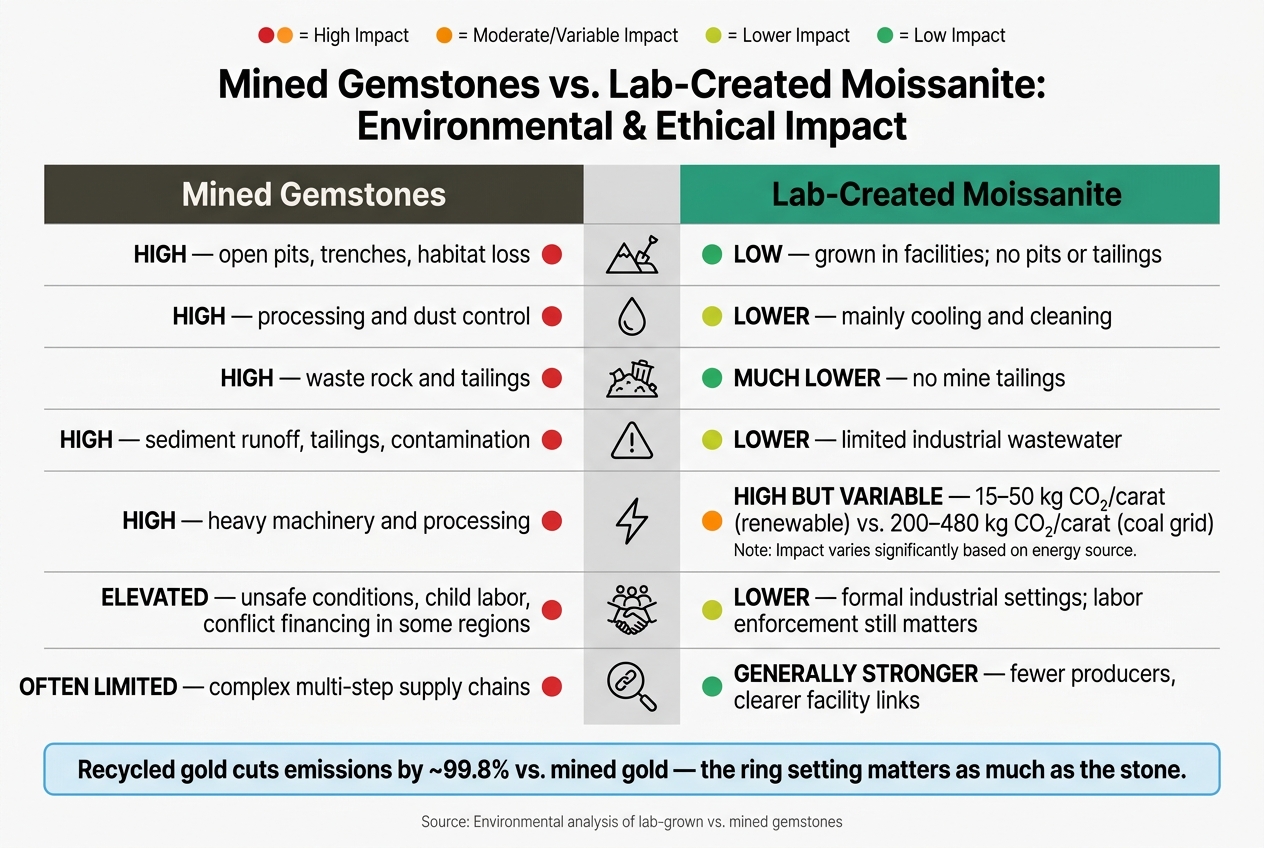
Mined Gemstones vs. Lab-Created Moissanite: Environmental & Ethical Impact
Mining-Related Harms That Moissanite Avoids
With the growth process in view, the next issue is simple: what does moissanite avoid that mined stones do not?
Traditional gemstone mining can produce heavy waste, disrupt land, and consume large amounts of water. Some mining supply chains also come with labor abuse and conflict concerns, and certification programs do not always catch every problem.
Moissanite skips the excavation side of the equation. That means no open pits, no habitat damage from digging, no tailings piles, and no local water pollution tied to mining activity.
Where Moissanite Still Has an Environmental Footprint
That said, lab-grown does not mean impact-free.
Moissanite is made with high-heat processes that use electricity for long stretches of time. To grow it, producers heat purified silicon and carbon above 2,500°C, so the carbon footprint can swing a lot based on where the facility operates and how that grid is powered.
One analysis puts the footprint at about 15–50 kg of CO₂ per carat on renewable-powered grids and 200–480 kg of CO₂ per carat on coal-heavy grids. That’s a big gap. So the label lab-grown by itself doesn’t settle the emissions issue. The location of the plant, its power source, and how well it runs all shape the result.
Comparison Table: Mined Gemstones vs. Lab-Created Moissanite
Here’s the side-by-side view:
| Impact Category | Mined Gemstones | Lab-Created Moissanite |
|---|---|---|
| Land use | High: pits, trenches, habitat loss | Low: grown in industrial facilities; no pits or tailings |
| Water use | High: processing and dust control | Lower: mainly cooling and cleaning |
| Mineral waste | High: waste rock and tailings | Much lower: no mine tailings |
| Pollution risk | High: sediment runoff, tailings, contamination | Lower: limited industrial wastewater; chemical management still matters |
| Energy use | High: heavy machinery and processing plants | High but concentrated: electricity-intensive crystal growth |
| Emissions | Significant: mining and multi-step supply chains | Variable: depends on power grid and production efficiency |
| Labor/conflict risk | Elevated in some regions: unsafe conditions, child labor, conflict financing | Lower: formal industrial settings; labor enforcement still matters |
| Traceability | Often limited: complex supply chains | Generally stronger: fewer producers, clearer facility links |
Moissanite comes out ahead on land use, water use, waste, and conflict-related concerns. But energy use and emissions are a different story. Those depend less on the word lab-created and more on what the brand is doing behind the scenes. And ethics goes past the stone itself - the setting materials and sourcing details matter just as much.
How to Tell If a Moissanite Ring Matches Your Values
Questions to Ask a Brand Before You Buy
Once you start looking at sourcing and impact, the next step is simple: ask the brand to show its work.
Start with the stone itself. Ask if it’s clearly labeled lab-created moissanite, where it was grown, and whether it comes with third-party documentation. If a seller dances around the word moissanite and leans on fuzzy labels instead, that’s a red flag. You should also ask where the ring was assembled and where the metal was refined. Ideally, the brand should give you that in one clear sourcing statement.
After that, look at how the ring was made. Ask whether the maker uses renewable energy or shares lifecycle data tied to energy use, carbon, and water.
Labor matters too. Does the brand use independent audits for its cutting and assembly sites? Are workers covered by a code of conduct that lines up with International Labour Organization principles?
Why Recycled Metals and Durable Design Matter
The stone is only one part of the story. The band and setting have their own footprint, and this is where recycled metals can make a big difference.
Recycled gold can cut emissions by about 99.8% compared with mined gold, while matching it in purity, durability, and appearance. That’s a huge gap. Ask what percentage of the metal is recycled and whether the refiner goes through independent audits.
Design matters just as much. A ring with thicker prongs, solid metal, and settings that can be repaired tends to stay in use longer. That means fewer remakes, less material use, and less shipping waste. Check for hallmarks like 925, 585, or 750 to confirm solid metal. Adjustable or resizable designs can also help a ring last longer as sizing needs change. For buyers whose ring size shifts over time, those features can cut waste by lowering the need for a full replacement.
That’s the difference between a brand with proof and one leaning on vague marketing.
Comparison Table: What to Look for in an Ethical Moissanite Ring
Use these signals to judge whether the ring matches your priorities.
| Aspect | Better Practice | Why It Matters |
|---|---|---|
| Gemstone origin disclosure | Clearly labeled lab-created moissanite with disclosed country of production and lab documentation | Confirms no mining-related land disturbance; prevents mislabeling |
| Energy-source transparency | Manufacturer references renewable energy use or publishes lifecycle emissions data | Emissions vary with grid and process |
| Third-party standards | Suppliers follow ISO 14001, independent social audits, or ILO-aligned codes of conduct | Verifiable oversight beyond marketing claims |
| Recycled precious metals | 100% recycled gold, platinum, or sterling silver with a disclosed refiner | Up to 99.8% lower emissions than mined gold; same quality |
| Repairability | Solid metal construction with hallmarks; brand offers repair or refurbishment service | Keeps materials in use longer; reduces full replacement |
| Adjustable or resizable design | Band can be adjusted or resized with minimal material loss | Extends ring life when fit changes without new metal demand |
Conclusion: A Straight Answer on Moissanite Ethics
Moissanite is often the ethical option buyers are looking for, but that only holds up when the stone, metal, and manufacturing are all backed by clear documentation. Lab-created moissanite is generally conflict-free because it’s grown in factories, not mined.
That gives the stone a strong ethical starting point. But it’s not the whole picture. A product’s footprint still depends on things like the factory’s power source and how efficiently it runs. Using recycled metals can cut the impact of the setting even more.
So the final test is pretty simple: verify the stone, the metal, and the maker’s transparency. Look for clear disclosure that the moissanite is lab-grown and check for a recognized precious-metal hallmark. It also helps to choose a design that can be repaired or resized, so it stays in use longer.
For most U.S. buyers, moissanite is an ethical choice only when the brand can show responsible sourcing and lower-impact production.
FAQs
Is moissanite always lab-created?
Yes. All moissanite used in modern jewelry is lab-created.
The mineral was first found in nature in 1893. But today, it’s made only in controlled lab settings. That helps jewelers keep quality consistent and gives buyers an ethical option instead of mined gemstones.
How can I verify a moissanite ring’s sourcing?
Choose vendors that clearly explain how they make their products, where their materials come from, and what they’re doing to cut harm. It also helps to look for documentation and certifications from recognized gemological organizations. Those records can help confirm the stone’s quality and ethical standards.
You can also check for official hallmarks or stamps from reputable assay offices. These marks help verify authenticity, quality, and responsible material sourcing.
Does recycled gold matter as much as the stone?
Yes. Recycled gold matters just as much as the stone when you judge a ring’s overall ethical impact.
Lab-created moissanite avoids many of the problems linked to mining. But the setting matters too. Using recycled gold or other responsibly sourced precious metals helps the whole piece line up better with strong ethical and environmental standards.


