

Long-Distance Proposals: Sizing a Ring You Can't Measure For
If I can’t measure a finger in person, I try to get close, not perfect. The best path is simple: check a ring they already wear, ask one trusted person, or use a paper/string measurement in millimeters and compare it to a U.S. size chart. If the answer is still unclear, I go up when stuck between sizes and pick a ring that can be resized later.
Here’s the short version:
- Best first move: measure the inside diameter of a ring they already wear on the left ring finger
- Next best move: ask one friend or family member to confirm the size
- If I need a direct measurement: use non-stretch string or a 3–5 mm paper strip
- Good rule: if the size falls between two options, choose the larger one
- Watch for changes: heat, cold, workouts, flights, and swelling can shift finger size
- Knuckle check matters: if the knuckle is much bigger than the base, size for the knuckle
- Safer fallback: choose a ring that can be resized after the proposal
A few numbers help right away. In U.S. sizing, 16.5 mm inside diameter is about a size 6, and 17.3 mm is about a size 7. For circumference, 49 mm is about a size 5, while 59 mm is about a size 9. Those small gaps show why even a 1 mm mistake can change the fit.
| Method | How close it gets | Best use |
|---|---|---|
| Borrow a ring | High | They already wear a ring on the correct finger |
| Ask a trusted helper | Medium | You can’t access their jewelry |
| Printable size chart | Medium | You only have the ring for a moment |
| Paper or non-stretch string | Medium | You can get them to measure without giving away the plan |
Bottom line: I’d use at least two clues before buying. If those clues don’t match, or the ring style is hard to resize, I’d stop guessing and choose the safer fit option.
The most discreet ways to estimate ring size
Start with the most discreet option that gives you an actual number.
Borrow a ring they already wear and measure the inner diameter
This is one of the best starting points. If your partner already wears a ring on their left ring finger, that ring gives you a strong clue about size. Wait for a normal moment when they take it off, like before a shower, while washing dishes, or before bed, and borrow it for a few minutes.
Then measure the inner diameter straight across the center of the opening, edge to edge, with a ruler. Use millimeters for the closest result. For example, an inner diameter of about 16.5 mm matches a U.S. size 6, while 17.3 mm is closer to a size 7. If you need to put the ring back right away, trace the inside circle on paper or take a photo next to a ruler so you can check it later.
If the ring is worn on another finger, use it only as a rough guide.
Ask a trusted friend or family member to quietly confirm the size
If you can't get access to a ring yourself, one trusted person can help confirm what your partner already wears. Pick someone who knows their ring habits well, and keep the circle small. Ask them to check the left ring finger and confirm the ring size, along with whether the fit is snug without sliding off.
If they can quietly bring a ring to a local jeweler and have it checked on a mandrel, that can give you a very close answer without tipping off your partner.
A trusted helper can confirm the size when you cannot access a ring yourself.
Compare a borrowed ring to a printable ring size chart
If you can only borrow a ring for a moment, a printable ring size chart gives you a simple at-home check after you return it. Print the chart at 100% scale, then verify the reference line with a ruler before you compare the ring. After that, match the ring to the circle that fits with no gap and no overlap. If the ring lands between two sizes, go with the larger one.
Here’s a quick side-by-side look:
| Method | Best for | Advantage |
|---|---|---|
| Borrow and measure inner diameter | They wear rings often and you can access one | Most direct real-world reference |
| Ask a trusted friend or family member | Someone close already knows their ring habits | No need to handle a ring yourself |
| Compare to a printable chart | You only have the ring briefly | Quick and private; done at home |
If none of these gives you a size you feel good about, move to an indirect measuring method or pick a ring with a flexible fit.
sbb-itb-9da40c1
Measuring methods that work when you can collaborate indirectly
When you can’t borrow a ring, indirect measuring is usually your best move. It’s not perfect, but with a bit of quiet teamwork, you can get a solid estimate without tipping your hand.
Use a strip of paper or non-stretch string to measure finger circumference in millimeters
If your partner can help without suspecting a proposal, this method works well. Ask them to use a 3 to 5 mm strip of paper or a piece of non-stretch string, like dental floss. They should wrap it snugly around the base of the finger where the ring will go, usually the left ring finger, mark the overlap with a pen, then lay it flat and measure from the end to the mark with a ruler in millimeters.
That measurement is the finger’s circumference. From there, match it to a U.S. ring size chart. As a quick guide, 49 mm is about a U.S. size 5, and 59 mm is about a U.S. size 9.
Keep the ask casual and practical. You can say it’s for a custom gift or some other accessory. Also, get two or three readings and use the average. Tiny changes in how tightly the strip is wrapped or where the mark lands can shift the result.
One thing matters a lot here: don’t use stretchy material. Elastic thread or yarn can pull in under tension and give you a smaller number than the finger’s actual size. That’s how you end up ordering a ring that feels too tight.
Measure at a normal temperature and account for the knuckle
Take the measurement at room temperature. Finger size can change with cold weather, heat, exercise, and even air travel. A reading taken right after a winter walk or a workout may not match the person’s usual size.
The knuckle is the other part people miss. A ring has to get over the knuckle, but it also needs to sit well at the base of the finger. If your partner’s knuckle is clearly wider than the base, have them measure both:
- the circumference at the base of the finger
- the circumference around the widest part of the knuckle
If those two measurements differ by 5 mm or more, size to the knuckle. A jeweler can adjust the fit later if needed.
Use this number as your starting point before you compare it with any other estimate.
Size up when the estimate falls between two sizes
If the measurement lands between two sizes, go with the larger one. If half sizes are available, choose the nearest half size. If not, round up.
That rounded size should be the one you use when checking it against your other sizing methods.
Compare your options and decide when to stop guessing
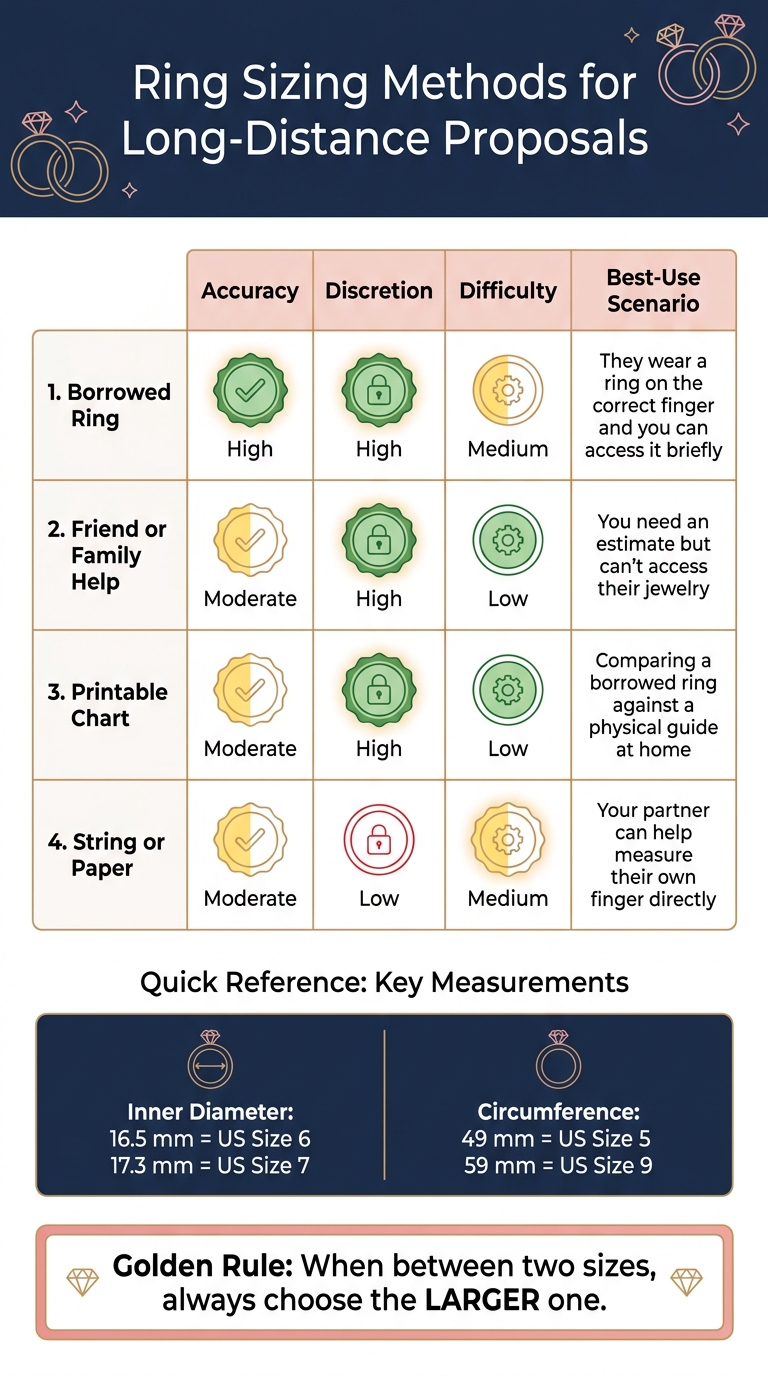
Ring Sizing Methods for Long-Distance Proposals: Accuracy vs. Discretion
It helps to put each method next to the others before you make a call.
| Method | Accuracy | Discretion | Difficulty | Best-Use Scenario |
|---|---|---|---|---|
| Borrowed Ring | High | High | Medium | They wear a ring on the finger it was made for and you can access it briefly |
| Friend or Family Help | Moderate | High | Low | You need a size estimate but can't access their jewelry |
| Printable Chart | Moderate | High | Low | Comparing a borrowed ring against a physical guide at home |
| String or Paper | Moderate | Low | Moderate | Your partner can help measure their own finger directly |
Which sizing method works best for your situation
Start with the borrowed ring method. It tends to give you the best shot at a close match without tipping your hand.
No ring to borrow? Ask a trusted friend or family member. Just don't treat their guess as your only answer. It's better as a second check than your main source.
As for string or paper, use it as a backup. It can help confirm what you already think, but it shouldn't carry the whole decision on its own.
When the uncertainty is too high to risk a fixed-size ring
At some point, it's smart to stop forcing a hard number. If your estimates don't match, nobody can confirm a size, or finger swelling is common because of heat, pregnancy, or health issues, a fixed-size ring starts to feel like a gamble. The same goes for wide bands or full-eternity bands, since those can be hard or not possible to resize.
If any of those warning signs show up, switch to a flexible-fit ring instead of locking yourself into a fixed size.
Choose an adjustable or resizable ring as the safest fallback
Why adjustable rings lower the risk on proposal day
If your size estimate still feels shaky, don't force a fixed number. Go with a ring that has some give.
Unlike a fixed-size ring, an adjustable design can be worn right away and fine-tuned later. That matters more than most people think. Finger size can shift with temperature, swelling, and even the time of day.
A resizable band can also adapt to the finger and help cut down on spinning.
Another plus: an adjustable ring can open enough to get over the knuckle, then sit more neatly at the base of the finger. So if there's a gap between the knuckle size and the base size, this type of ring handles it with less fuss. Satinski's adjustable rings fit U.S. sizes 5–9, which makes them a practical fallback when the size isn't clear.
What to look for in a resizable ring before you buy
Look for a low-profile adjustment mechanism that resizes smoothly and still feels comfortable on the hand. You want something that works without looking bulky or feeling awkward.
It's also smart to choose durable metals like sterling silver or 18K gold. That gives you a ring that can stand up to regular wear after the proposal.
Conclusion: Use your best estimate, then protect the surprise with a flexible fit
If the size still isn't clear after your checks, stop chasing an exact number. Use the best clue you have, then pick an adjustable ring if there's still doubt.
If your estimate lands between two sizes, go larger. If the clues are thin or they point in different directions, a proposal-ready ring with a flexible fit helps protect the surprise, even if your first guess wasn't perfect.
FAQs
What if my clues suggest different ring sizes?
If your clues point to different sizes, don’t lean on a single measurement. Finger size can shift during the day based on temperature, hydration, and activity.
Your safest bet is to go with the size that comes up most often, or pick the larger one. A ring that’s a little loose is usually much easier to deal with than one that feels too tight. And if you still aren’t sure, a Satinski adjustable ring is the safest choice.
Can all proposal rings be resized later?
No. Not every ring can be resized later.
A jeweler can often adjust a fixed-size band, but usually only by one or two sizes. And there’s a catch: if a ring gets resized again and again, the band can weaken over time.
Satinski adjustable rings work differently. They’re made to skip the usual resizing process. Thanks to the built-in mechanism, the wearer can change the fit when needed without going to a jeweler.
How do I measure without ruining the surprise?
If you want to keep the proposal a surprise, quietly borrow a ring she already wears on her left hand. A jeweler can measure it for you, or you can trace the inside of the ring on a piece of paper.
There are a few other low-key ways to check the size too:
- Press the ring into soap to make an impression
- Slide it onto your finger and mark the spot where it stops
If that’s not possible, ask a close friend or family member if they happen to know her ring size. And if you want the safest pick, go with an adjustable ring.


