

Using Inherited Stones in a New Custom Setting
Yes, you can reset a family stone into something you’ll wear - but I’d start with the stone, not the design. If the stone has chips, edge cracks, treatments, or a thin girdle, that changes what setting, metal, and ring style make sense. In many cases, the best path is simple: inspect the stone, decide what parts must stay, pick a setting that protects it, and choose a size plan that still works if your finger changes later.
Here’s the short version:
- I’d get the stone checked first under magnification for chips, fractures, old repairs, and treatments.
- I’d document everything with photos, past appraisals, grading reports, receipts, and family notes.
- I’d decide early what stays - the center stone, engraving, side stones, or a family detail.
- I’d ask if a ring is the right use at all. Softer stones like opals, pearls, and some emeralds may do better in a pendant.
- I’d lean toward lower-profile settings for daily wear since they snag less and often protect the stone better.
- I’d use new metal in most resets because older metal may have wear from past sizing or solder work.
- I’d think about sizing now, not later. Standard resizing usually works for about 1–2 U.S. sizes, while some adjustable bases cover about U.S. sizes 5–9.
- I’d get the handling and insurance details in writing before the stone leaves my hands.
If I wanted a fast gut check, I’d use this:
| Question | What I’d look for |
|---|---|
| Is the stone safe to reset? | Chips, cracks, worn edges, treatments |
| Should it stay a ring? | Daily wear risk, stone hardness, damage |
| Which setting fits best? | Bezel for more cover, low solitaire for a simple look, halo for added size look |
| Which metal makes sense? | 14K for day-to-day wear, 18K for richer color, silver only with care |
| How should sizing work? | Fixed if size stays steady, resize for small changes, adjustable for shifting sizes |
I’d also keep budget and timing in mind from the start. A simple reset may run about $800–$2,000 and take 2–3 weeks, while a full custom rebuild can land around $3,200–$6,800 and take 6–12 weeks. More involved multi-stone work can go much higher.
So before I think about style, I’d ask one plain question: will this new piece protect the stone and fit my life? That answer should drive every choice that follows.
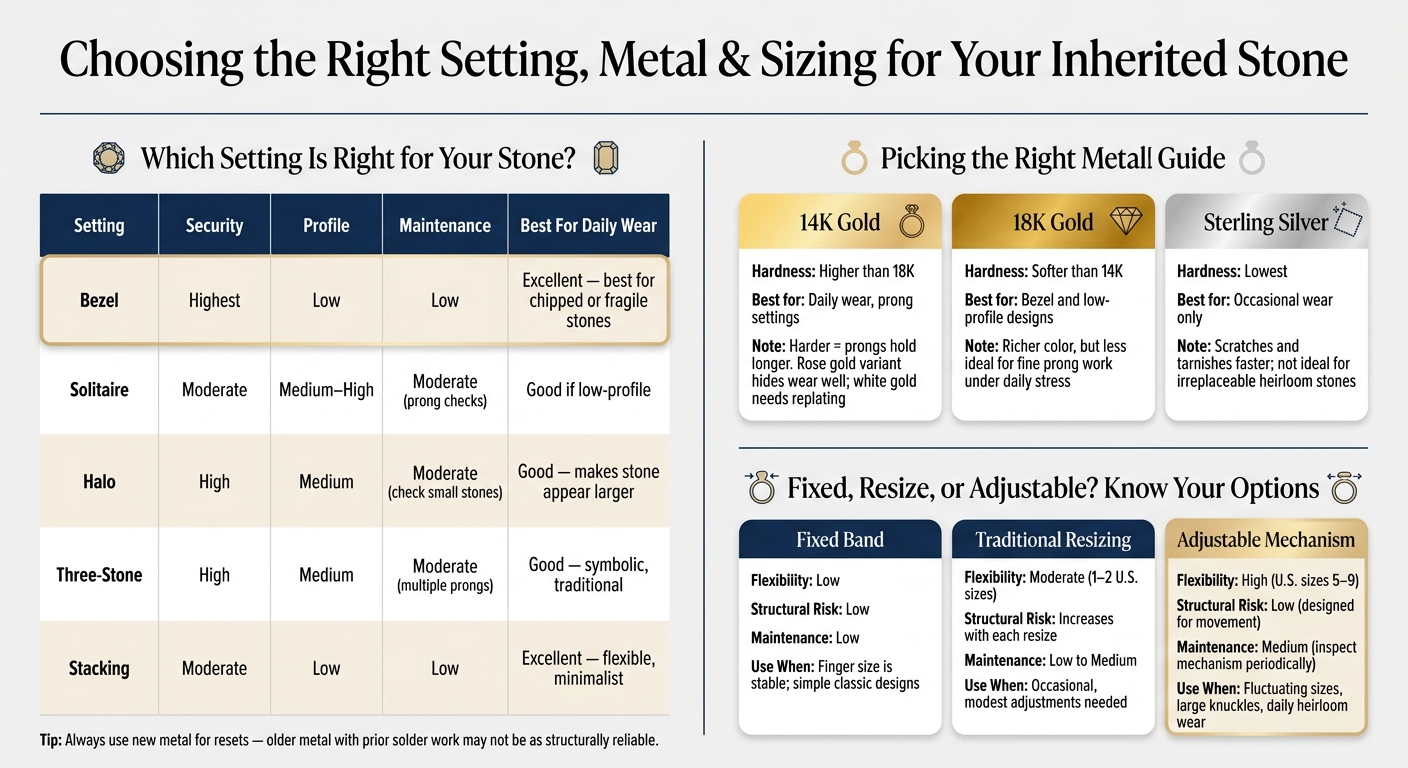
Inherited Stone Reset: Setting Styles, Metals & Sizing Options Compared
How to Decide What to Do With a Family Diamond
sbb-itb-9da40c1
1. Check the stone's condition and document what you have
Before you change anything, document the piece exactly as it is.
Take clear, well-lit photos from every angle: the top, sides, underside, and close-ups of the center stone, any side stones, prongs, and the inside of the band. If there's an engraving, photograph it. If you can see damage, photograph that too. It also helps to place the ring next to a ruler in at least one photo so the size is clear. Save the digital files with dates if possible.
This gives the jeweler a starting record. It also makes it easier to protect the stone and hold on to the piece's history. After that, have a jeweler check the stone in person.
Along with the photos, gather any paperwork you have. That can include:
- A prior appraisal
- A grading report
- A receipt
- Family notes, even informal ones
- Hallmarks or maker's marks
These records can confirm value, treatments, metal, and purchase date. Family notes can also show which parts of the piece matter most. Bring all of this to the consultation. Once it's organized, it becomes much easier to decide what has to stay and what can change.
Then comes the in-person inspection. A jeweler should examine the stone under magnification for chips, fractures, and a thin girdle. They should also inspect the setting for worn or thinning prongs, warped bezels, and signs of past solder repairs. On top of that, they should look for treatments such as fracture filling, laser drilling, or surface coatings.
If anything is unclear, ask the appraiser to confirm in writing whether the stone is natural, lab-grown, or treated before it is removed from the original mounting. That written report can shape the whole redesign. It may show that the stone needs a more protective setting, a different type of jewelry, or no change at all. Ask for written notes or marked photos before the stone leaves the original setting.
Separate what must stay from what can change
Start by naming the non-negotiables. That often means the center stone, an engraving, or a family motif.
A family motif, like a certain scrollwork pattern or floral detail, can sometimes be copied onto a new band even if the original setting changes from top to bottom. Other parts of the piece, such as band width, side stones, metal color, and overall style, are often open to change.
This is also the point where family conversation matters. More than one relative may feel attached to the piece, and even a switch from yellow gold to platinum can create tension if no one saw it coming. A short talk, paired with photos that show exactly what's staying and what's changing, can head off a lot of trouble.
When a ring is not the right use for the stone
Not every inherited stone belongs in a ring.
Rings go through the most day-to-day wear. Diamonds and sapphires usually do well with that, as long as the setting is chosen with care. But stones with major internal fractures, badly worn or chipped girdles, or softer makeup - such as opals, pearls, or some emeralds - may be better in a pendant or an occasional-wear piece.
A shallow-cut stone with thin edges can also be at more risk in an open prong setting, where the girdle stays exposed. If the jeweler finds that kind of weakness or damage, a pendant or a more protective setting is often the safer move. A bezel can help too, since it shields the edges and lowers the odds of impact.
That isn't settling. It's the kind of choice that helps the stone last for years. If the stone is in good enough shape for daily wear, the next step is choosing a setting and metal that will protect it.
2. Choose a setting style and metal that protect the stone and improve comfort
Once the stone is documented, the next job is pairing it with a setting that keeps it safe and feels good on your hand. The right setting should match the stone's shape, depth, and how it has worn over time. A shallow, wide diamond often sits more securely in a bezel or halo, since those styles support the stone's edge all the way around. A deeper stone may work better in a slightly taller solitaire or three-stone design, so it can sit properly without riding too high on the finger.
Low-profile settings sit closer to the finger and tend to snag less than high-set designs. That's why bezels, flush mounts, and low baskets are often easier to live with day to day.
Solitaire, halo, bezel, three-stone, and stacking ring designs compared
Each setting style comes with its own trade-off between protection, looks, and comfort. A bezel wraps the stone in a continuous metal rim, which gives it the most protection. It also has a smooth surface, so there are no exposed prong tips to catch on clothes.
A solitaire puts all the attention on the inherited stone and is simple to care for. That said, a high-prong solitaire leaves the girdle more open to bumps and can snag more easily. For daily wear, a low-profile solitaire with short claw prongs is usually the better move.
A halo places small accent diamonds around the center stone. That can make a modest heirloom stone look noticeably larger while also adding side protection. The catch is maintenance: those tiny stones and their prongs need regular checks.
For example, a grandmother's diamond often works well as a low solitaire, halo, or stacking ring.
A three-stone ring adds meaning and more visual presence, but it also adds more wear points to inspect over time. A stacking ring can be a smart fit for smaller heirloom stones if you want a low, flexible profile that sits neatly with other bands.
| Setting | Security | Profile Height | Maintenance | Visual Impact | Daily Wear |
|---|---|---|---|---|---|
| Bezel | Highest | Low | Low | Modern, substantial | Excellent |
| Solitaire | Moderate | Medium–High | Moderate (prong checks) | Classic, stone-forward | Good if low-profile |
| Halo | High | Medium | Moderate (check small stones) | Maximizes apparent size | Good |
| Three-Stone | High | Medium | Moderate (multiple prongs) | Symbolic, traditional | Good |
| Stacking | Moderate | Low | Low | Flexible, minimalist | Excellent |
If the stone is damaged, a bezel or another low-profile setting is usually the safer pick.
After the setting style is set, metal color and durability become the next design choices.
How to pick the right metal for your budget, color preference, and durability needs
14K gold is often the best day-to-day option because it is harder and less likely to bend than 18K, which matters a lot for prongs that need to keep a stone secure for years. Rose gold tends to hide wear nicely, while white gold usually needs replating from time to time.
18K gold has a richer color and feel, but it's softer. Because of that, it often makes more sense for bezel and low-profile designs than for very fine prong work in a ring worn hard every day. Sterling silver costs less up front, but it scratches and tarnishes faster than gold. It also tends to need more upkeep, which makes it a less ideal choice for an irreplaceable heirloom stone.
It's also often smarter to use new metal for a reset. Older metal that has already been resized or repaired may not be as dependable, so new metal is usually the safer base. In many cases, the original metal can be credited at melt value toward the cost of the new setting.
Once the setting and metal are chosen, the sizing plan comes next.
3. Choose between a fixed-size ring, traditional resizing, or an adjustable design
Once you’ve chosen the setting and metal, the next step is deciding how the ring will deal with size changes over time. In plain terms: should it stay fixed, be resized later, or be adjustable from day one?
Match the ring design to real sizing challenges
Finger size can shift over time. And if someone has larger knuckles, a ring may fit one way at the joint and another at the base. Those details matter more than people think, especially for a ring meant for daily wear.
If a ring spins, pinches, or feels like a hassle to put on, it often ends up sitting in a drawer. That’s the last thing you want when resetting an heirloom stone.
When Satinski adjustable ring bases make sense
For fluctuating finger sizes or more pronounced knuckles, Satinski adjustable ring bases can be a strong fit. The mechanism is hidden inside the band, so the outside still looks clean and polished. A jeweler can mount a solitaire, halo, or stacking design on top.
These bases usually cover U.S. sizes 5–9 and can be made in sterling silver or 18K solid gold. The top design is then customized to match the inherited stone’s shape and dimensions, so the stone and setting stay front and center.
Fixed bands, traditional resizing, and adjustable mechanisms compared
Traditional resizing works well for one-time, modest changes, usually about one to two U.S. sizes up or down. Past that point, repeated resizing can weaken solder joints and put stress on the setting. That matters a lot when the stone can’t be replaced.
A fixed band is the simplest route if the wearer’s size stays steady and the design is fairly simple. An adjustable base makes more sense when size changes keep happening or when knuckle fit makes a fixed ring hard to wear.
| Option | Flexibility | Structural risk | Maintenance | Use when |
|---|---|---|---|---|
| Fixed band | Low | Low | Low | Stable finger size, classic designs |
| Traditional resizing | Moderate (1–2 sizes) | Increases with each resize | Low to medium | Occasional, modest adjustments |
| Adjustable mechanism | High (US sizes 5–9) | Low (designed for movement) | Medium (inspect mechanism periodically) | Fluctuating sizes, large knuckles, daily heirloom wear |
With the sizing method chosen, the consultation can turn to the stone, the setting, and final approval.
4. Work through the custom design process and final decisions
Once you've picked the sizing method, the next step is consultation and approval. This is where the loose stone or old ring starts turning into a finished piece.
What to bring to a consultation and how the design gets approved
Bring the original ring or loose stone, any accent stones, appraisals or grading reports, your ring size, and 2–3 inspiration photos. If there are details you want to keep from the original piece, bring those too - engraved elements, side stones, or anything else tied to its identity.
That gives the jeweler what they need to:
- verify the stone
- measure it with care
- inspect its condition under magnification
- build the first design around the stone and any parts you're keeping
From there, the jeweler will usually share sketches or CAD renderings that show the ring from more than one angle. You'll be able to review the parts that matter most before anything is made: stone placement, prong style, band width, and setting height.
If the design is more involved, the jeweler may also show a 3D model or resin prototype. You review the draft, ask for changes, and then approve the final specs. That usually includes the metal type, finish, setting height, ring size or adjustable base choice, and any engraving. Once you sign off, fabrication starts.
Confirm the setting height in millimeters before you approve the design, especially if this will be a stacking ring.
Budget, timeline, insurance, and stone handling: what to expect
After design approval, the main decisions left are cost, timing, and how the stone will be handled.
Cost and timing depend on how involved the project is.
| Project Type | Typical Cost | Typical Timeline |
|---|---|---|
| Simple reset into new setting | $800–$2,000 | 2–3 weeks |
| Stone reset in new band | $1,800–$4,200 | 6–10 weeks |
| Full custom rebuild | $3,200–$6,800 | 6–12 weeks |
| Bespoke multi-stone remodel | $7,200–$18,500 | 12–20 weeks |
Ask for a written intake receipt that records the stone's condition at drop-off. It should note any chips, inclusions, and visible wear, and photos are a smart add-on. That record matters. It shows the stone's condition before work begins and creates a clear custody trail while the inherited stone is being reset.
Once the mounting is done, the jeweler will test-fit the stone in the setting and check alignment and security from several angles. It's also worth asking a plain question here: Who will physically handle the stone, and for how long will it be out of your possession?
Before fabrication begins, nail down the insurance and custody details. Confirm that the jeweler's insurance covers customer stones during the job. Then update your own jewelry insurance - either through a homeowner's or renter's rider, or with a standalone policy - so it matches the finished ring's appraised value.
After delivery, ask for an updated appraisal and new photos so your records stay current.
Conclusion: Keep the stone's history and make it work for your life
An inherited stone carries family history and meaning that no new purchase can replace. A custom reset should keep that story alive in a ring you’ll want to wear, not leave tucked away in a box.
Once the design choices are set, the last test is simple: how will the ring wear day to day? Start with inspection and documentation. If the stone has a chipped girdle or another weak spot, go with a protective setting. Then shape the ring’s structure around daily wear and sizing needs, including a resizable or adjustable base if your finger size changes or a larger knuckle makes fit harder.
FAQs
Can any inherited stone be reset safely?
Not always. An inherited stone can only be reset safely if it's still in good shape and the new setting can hold it firmly.
A jeweler should check the stone first. Hard stones like diamonds and moissanite are often solid options, but the biggest factor is the stone’s condition. If it has chips, cracks, or weak spots, resetting may be risky. Strong metals like platinum can also make the new setting more secure and longer-lasting.
Should I keep the stone in a ring or switch it to a pendant?
It comes down to how you live and how you plan to wear the piece.
A pendant makes sense if you want to protect an inherited stone from the day-to-day wear that rings often take on, like friction, bumps, and repeated resizing.
If you want to keep it as a ring, go with a sturdy metal like platinum or 18K gold to help keep the setting secure for daily wear.
How do I choose between a fixed, resized, or adjustable ring?
Choose a fixed ring if your finger size stays about the same and you want the simplest, lowest-maintenance option. A resized ring works best if you need a one-time size correction and don’t expect the fit to change often.
Choose an adjustable ring if your fit may shift from day to day or by season due to temperature, swelling, pregnancy, weight changes, or arthritis. It can flex with those changes without repeated resizing, but you should check the fit and stone security on a regular basis.


