

Pave Engagement Rings and Resizing: The Risk Nobody Mentions
If your pavé ring is the wrong size, cutting it may cost you stones.
My short take: plain bands are usually easy to resize, but pavé, micro-pavé, full pavé, and eternity bands are not. Once a jeweler cuts, heats, and reshapes a stone-set band, small diamonds can loosen, beads can flatten, and the shank can weaken. In many cases, a small fix - often around 0.5 to 0.75 U.S. sizes - is the most that makes sense. Beyond that, a shank remake or a no-cut fit aid is often the safer path.
Here’s what you need to know right away:
- Half-pavé rings may allow a small resize if there’s 3–5 mm of plain metal at the bottom.
- Full pavé and eternity bands are often poor resize candidates because there’s little or no plain section to cut.
- Thin shanks under about 1.5 mm are more likely to bend or weaken during sizing work.
- Sizing down is often less risky than sizing up, but both can disturb the stone line.
- No-cut options like sizing beads, sizing bars, guards, or inserts can fix minor fit issues without touching the stones.
- If a jeweler does resize a pavé ring, ask for magnified inspection and stone tightening before and after.
A plain band and a pavé band may look similar from a distance. But at the bench, they are not the same job. That’s the whole point of this piece: fit changes can be simple on one ring and risky on another.
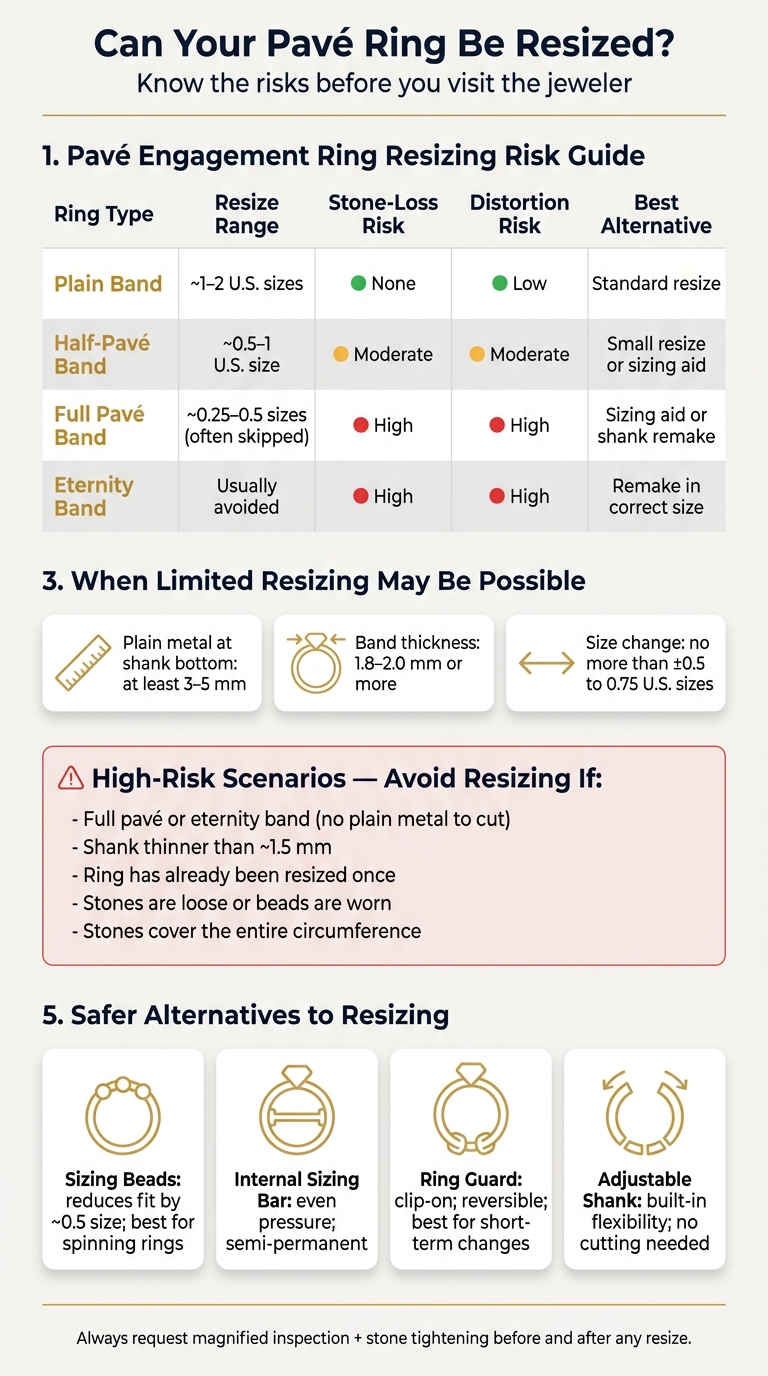
Pavé Ring Resizing Risk: Which Ring Types Can Be Resized?
Quick Comparison
| Ring type | Usual resize room | Main risk | Better fallback if fit is off |
|---|---|---|---|
| Plain band | About 1–2 sizes | Low | Standard resize |
| Half-pavé | About 0.5–1 size | Loose accent stones, shape change | Small resize or sizing aid |
| Full pavé | About 0.25–0.5 size, often skipped | High stone-loss risk | Sizing aid or shank remake |
| Eternity band | Usually avoided | High risk across whole band | Remake in correct size |
If I were buying a pavé engagement ring, I’d treat sizing as part of the ring design - not as a small fix for later.
sbb-itb-9da40c1
How resizing a pavé ring can loosen stones and weaken the band
What happens when the band is cut, heated, and reshaped
Here’s what changes inside the ring during a resize.
Resizing a pavé ring usually means cutting the shank, adding or removing metal, soldering the seam, and then rounding and polishing the ring back into shape. In a pavé band, that work happens right next to tiny stones held in place by small beads and prongs.
That’s where the risk comes in.
Soldering heat can soften the tiny prongs that hold each stone, even when the jeweler uses a laser welder. When those prongs soften, they don’t grip as firmly. Then the ring gets rounded on a mandrel, which can put uneven pressure on the stone seats. After that, filing and polishing may thin the metal near the joint.
On a plain band, this kind of work is usually straightforward. On pavé, there’s a lot less room for error because the setting itself is so fine.
The most common failure points after a resize
The most common issue is loose or missing accent stones. A stone may rattle, shift under light pressure, or fall out during normal wear. This often begins near the resize joint, where the metal changed the most, and can move into nearby stones as the ring flexes.
Another issue is bent or flattened beads. This one is easier to miss. When the band is rounded after soldering, the tiny beads that overlap each stone can shift a bit out of place. At a glance, the stone may still look secure. But if the bead is no longer making clean contact with the girdle, the hold is weaker than it looks. With daily wear and small knocks, that grip can keep slipping. And because pavé stones often share prongs, one weak bead can affect two or more stones in a row.
Then there’s an out-of-round band, which can do more damage than people expect. Pavé sections are stiffer than plain metal. So when the ring is reshaped, the plain parts tend to flex more while the stone-set areas resist. The end result can be a slightly oval band. That can make the ring spin more on the finger and put uneven pressure on the shank.
A related problem is stress at the resize joint. After cutting, soldering, and filing, the seam can turn into a weak spot. If the ring ever needs another adjustment, that weak seam matters even more. A second resize often calls for reinforcement or partial shank replacement.
Resizing risk by ring style: a comparison
The more stones cover the band, the less working room the jeweler has. As more of the shank is set with stones, the risk climbs fast. Most jewelers treat about ±0.5 to 0.75 U.S. ring sizes as a practical upper limit for pavé and micro-pavé bands; beyond that, remaking the shank is often the safer path.
| Ring Style | Approximate Resize Range | Stone-Loss Risk | Distortion Risk | Maintenance After Resize |
|---|---|---|---|---|
| Plain band | About 1–2 U.S. sizes | None | Low | Simple polishing |
| Half-pavé band | About 0.5–1 U.S. size | Moderate | Moderate | Stone checks; micro-prong tightening |
| Full pavé / eternity band | About 0.25–0.5 U.S. sizes, usually avoided | High | High | Frequent inspections; re-setting may be needed |
That’s why a small resize may be workable for one ring, while the same change can be a bad bet for another.
When a pavé engagement ring can be resized and when it cannot
Use these checks to figure out whether resizing makes sense or whether it's asking for trouble.
Cases where limited resizing may be possible
Three things tell you whether a pavé ring is even a decent candidate for resizing.
First, there should be a plain metal section at the bottom of the shank - ideally at least 3–5 mm wide. That gives the jeweler a place to cut without getting into the stone line. Second, the band needs enough thickness to handle the work, usually around 1.8–2.0 mm or more. Third, the size change has to be small. Those are the main checks jewelers use before they agree to resize a pavé ring.
The big issue isn't just, "Can it be resized?" It's whether it can be resized without throwing off the stone line. A bench jeweler can only try this if the cut stays clear of the pavé. If the stones stop before the bottom of the band, a skilled bench jeweler may be able to cut into that plain section, remove or add a small piece of metal, and solder the seam without touching the pavé itself.
Sizing a ring down is often easier than sizing it up. When you size up, the jeweler has to add metal and reshape the band, and that can put extra stress on the stone seats. After any resize, the ring should be inspected and the stones should be tightened. No shortcuts there.
Cases where resizing is high-risk or off-limits
Full pavé and eternity bands usually can't be resized with standard methods. The reason is simple: there is no plain metal to cut into. When stones go all the way around the ring, changing the circumference also changes the spacing between those stones. That can make them tilt, loosen, or chip.
Very thin shanks - under about 1.5 mm thick - also don't resize well. Cutting and soldering a band that thin can weaken it so much that normal hand pressure can bend the ring and put stress on the pavé. The same caution applies to older rings with worn beads, rings that have already been resized once, and rings with loose stones. In those cases, the metal holding each accent stone may already be near its limit, and heat or reshaping can push it too far.
At that point, remaking the shank is often the safer move.
A simple decision table to use with your jeweler
Use this table as a starting point when you talk with a jeweler. It helps frame the conversation, but it doesn't replace a close look at your exact ring.
| Style | Plain metal at bottom? | Recommended action |
|---|---|---|
| Half-pavé | Yes (lower shank) | Consider limited resize with experienced jeweler; close inspection under magnification required after |
| Three-quarter pavé | Yes, but shorter | Evaluate individually; favor non-destructive methods if unsure |
| Full pavé | Minimal or none | Generally avoid; consider sizing aids or shank remake |
| Eternity band | No | Do not resize; remake for the correct size |
If a jeweler says they can resize your ring without first checking shank thickness, stone coverage, and bead condition, that's a red flag. A careful jeweler will want to know where the pavé stops, measure the band, and show you exactly where they would cut - or explain why another option may be safer.
If your ring doesn't pass these checks, look at non-destructive fit options instead of forcing a resize.
Safer options that protect the pavé setting
If a ring doesn’t pass the resize checks, it’s usually better to use a non-destructive fit aid than to cut into a pavé band.
Non-destructive fit options for small size changes
The main choices are sizing beads, internal sizing bars, ring guards, and removable inserts.
Sizing beads are two small metal balls soldered inside the lower shank. They’re especially helpful when the knuckle is bigger than the base of the finger, because they help stop the ring from spinning without changing the band’s structure. Sizing guides note that beads usually reduce the effective ring size by about half a size or less, so they’re best for small corrections, not big ones. The downside? Some people feel them right away, and they can collect lotion or soap.
Internal sizing bars are smooth metal strips added inside the lower shank. They tend to feel more even than beads and are less likely to create pressure points, though they can still wear down and may need adjustment over time.
Ring guards are clip-on or wrap-around metal pieces that make a ring fit smaller without changing the band for good. They make sense for short-term shifts, like pregnancy or seasonal swelling. But they can show from the side, and if the fit isn’t done well, they may catch on things.
Temporary silicone or plastic inserts are the most reversible choice. They’re low-cost, hard to see from the top, and easy to remove or swap out as finger size changes. The trade-off is simple: the material can compress or wear out over time, so you may need to replace it now and then.
With a pavé ring, it’s smart to think twice about any add-on that creates friction or snag points near the underside of the band, especially if you use your hands a lot or wash them often.
For repeated size changes, a built-in adjustable shank is a cleaner long-term fix.
Adjustable ring designs that avoid stressing the stone line
If size changes happen again and again, adjustable shank designs usually make more sense than fit aids.
These rings use engineered parts in the lower shank so the fit can change while the pavé stone line stays untouched. Some use a hinged shank that opens and closes with a locking mechanism. Others use an internal spring or tension system, sliding segments, or flex shanks. The stones stay in a rigid, unchanged part of the ring, while the adjustable section takes the movement and stress. That cuts down on repeated cutting and soldering, which can disturb a pavé setting over time.
How Satinski addresses pavé sizing problems
Built-in adjustability protects the pavé line better than repeated resizing.
Satinski adjustable engagement rings and wedding bands keep the stone line fixed while the shank handles the fit. The designs cover about U.S. sizes 5–9 in sterling silver and 18K gold. The adjustment mechanism stays underneath the band, so the top view looks the same. If you want pavé style with some built-in wiggle room, adjustable shank options can be added before the ring is made.
Here’s how the main choices stack up for a pavé ring:
| Option | Risk to pavé stones | Longevity | Comfort | Best use case |
|---|---|---|---|---|
| Sizing beads | Low; added inside the band, away from the stone line | Semi-permanent; may need adjustment | Good for minor looseness; can feel noticeable to some | Slightly loose rings, top-heavy rings, rings that spin |
| Ring guards | Low to moderate; no cutting, but can scratch the band over time | Temporary/reversible | Decent, but can feel bulky or catch on things | Short-term or trial fit correction |
| Adjustable shanks | Low; movement stays in the shank, not the stone section | Good with periodic mechanism checks | High; accommodates fluctuating sizes comfortably | Chronic changes: arthritis, large knuckles, long-term size variability |
| Satinski adjustable rings | Minimal; stone settings stay in a fixed, stable zone | Strong within the designed size range | High; smooth interior and hidden mechanism | Shoppers who want pavé styling and flexible sizing built in from the start |
Conclusion: How to protect a pavé ring before and after sizing decisions
When a resize puts the stone line at risk, the priority changes. At that point, the main job isn't changing the size. It's protecting the setting.
Pavé engagement rings are more likely to have problems after resizing than plain bands. Why? Because cutting and reshaping the ring can loosen stones, warp the setting, and weaken the band.
The safest sizing choice happens before you buy. Get your finger measured more than once, and do it at different times of day. Fingers swell and shrink, and that small step can help you avoid a risky resize later.
A small resize may be possible on a sturdy half-pavé ring. But full pavé and micro-pavé bands are usually not safe to resize. In many cases, they need a non-destructive fit aid or a custom remake instead. The rule is pretty simple: the more stones that wrap around the shank, the less safe the resize becomes.
Before any resize, ask for:
- A magnified inspection
- Stone tightening
After the work is done, wear the ring for a few days and then go back for a follow-up check. Some loose stones don't show up right away. They only appear after normal daily wear.
Put the pavé first. Change the fit only if the setting can take it.
FAQs
How do I know if my pavé ring is safe to resize?
A professional jeweler should check whether your pavé engagement ring can be resized without putting the setting at risk. In many cases, a ring can go up or down by one to two sizes. But pavé rings - especially eternity bands - are often much harder to change safely.
The first thing to ask is simple: Is there enough plain metal on the band? If the ring has stones all the way around, detailed patterns, or tension settings, resizing can cause problems. It may loosen stones, warp the setting, or weaken the metal.
What should I ask a jeweler before resizing a pavé ring?
Before resizing a pavé ring, first ask whether the ring can be resized safely at all. Some pavé rings and other complex settings are hard to adjust, and in some cases, resizing can damage the ring.
You should also ask about the structural risks. For example, could small accent stones come loose? Will any of them need to be reset after the sizing work? That stuff matters, because a ring can look fine at a glance but still lose strength during the process.
It also helps to get clear on the full price, how many sizing revisions are included, and whether the work will visibly change the original design or make it weaker.
What if my pavé ring needs a bigger size change?
If your pavé engagement ring needs a big size change, ask a professional jeweler to check whether the setting can handle it safely.
Standard resizing can warp the pavé, weaken the ring, and loosen the small accent stones. Some standard rings can be resized by one or two sizes, but intricate or continuous pavé designs are often more risky. If the ring can't be altered safely, a custom remake or an adjustable ring option may be the better path.


