

How to Choose an Engagement Ring When She's Between Two Sizes
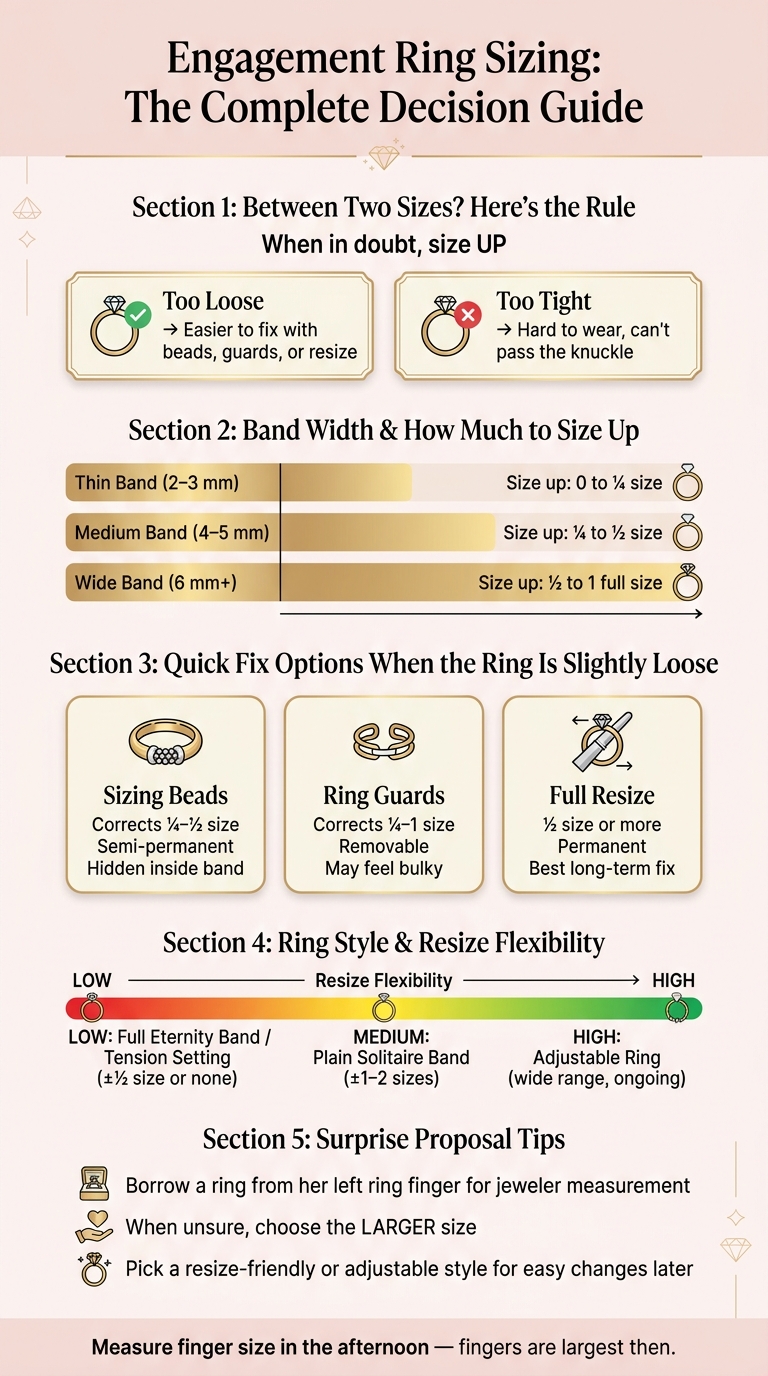
If she falls between two ring sizes, I’d usually go slightly larger. A ring that’s a bit loose is often easier to fix than one that won’t pass the knuckle. In many cases, a jeweler can tighten a close fit by about ¼ to ½ size with sizing beads, while guards can help with about ¼ to 1 size.
Here’s the short version:
- Go up if the fit is close and you’re unsure
- Watch band width: a 6 mm+ band often feels tighter than a 2–3 mm band
- Measure later in the day since fingers often swell in the afternoon
- Pick resize-friendly styles like plain solitaire bands
- Be careful with full eternity and tension settings, since they can be hard to resize
- For surprise proposals, a slightly larger ring is usually the safer call
If I were buying the ring, I’d focus on two things: comfort now and room to fix the fit later.
| Situation | Best move | Why |
|---|---|---|
| Between two sizes | Size up | Tight rings are harder to wear |
| Thin band | Stay close to measured size | Thin bands usually fit closer to true size |
| Wide band | Go up more | Wide bands feel tighter on the finger |
| Surprise proposal | Pick the larger option | She can wear it right away, then adjust it later |
| Small loose fit | Use beads or a guard | No need to resize right away |
| Future size changes likely | Choose a plain band or adjustable ring | Easier to deal with later |
The main goal is simple: choose a ring she can wear comfortably on day one without boxing yourself into a hard fix later.
Ring Sizing Guide: When to Size Up, Down, or Adjust
How to Find Your Ring Size at Home
sbb-itb-9da40c1
Should you size up or size down?
If you're stuck between two sizes, size up.
A ring that's a bit loose is usually easier to fix later. A ring that's too tight is much harder to live with day to day. It can feel annoying fast, especially when your fingers swell.
The main time to size down is when the larger size would spin around a lot or feel like it could slip off. A good fit should pass over the knuckle with slight resistance, then sit in place without pinching.
How band width and ring profile affect fit
Band width changes fit more than most people expect, even if the size number stays the same.
Thin bands (2–3 mm) usually fit closest to your measured size.
Medium bands (4–5 mm) often still fit true to size, but going up about ¼ to ½ size makes sense in many cases.
Wide bands (6 mm or more) touch more of the finger, which means more friction and a tighter feel. In that case, going up ½ to 1 full size is often the safer move.
A comfort-fit interior - the rounded inner edge - can make a ring feel less tight. That softer inner shape may mean you don't need to size up as much as you would with a flat, wide band.
How swelling, temperature, and time of day affect ring size
Finger size changes during the day. Heat can make fingers swell. Exercise can do the same. Cold usually makes them shrink.
That's why it's best to measure in the afternoon, when fingers are often at their largest. If a ring feels good at that point, it'll usually still work when your fingers are smaller. The opposite is where people get into trouble.
If the fit still feels borderline, the next move is to pick a style that can be adjusted later.
Comparison table: when to size up or down by ring style
| Ring Style | Typical Width | How It Usually Feels | Between Sizes: Size Up or Down? | Comfort Over Time | Possible Drawbacks |
|---|---|---|---|---|---|
| Thin band | 2–3 mm | True to size | Slightly up is safer; can stay true if fit is close | Comfortable | May spin on slender fingers |
| Medium band | 4–5 mm | Standard fit | Size up about ¼ to ½ size | Comfortable with proper fit | Minimal if sized correctly |
| Wide band | 6 mm+ | Fits tighter | Size up ½ to 1 full size | Comfortable once sized up | Can feel restrictive if undersized |
| Comfort-fit band | Varies | Slightly less snug | Size up, but less aggressively than flat wide bands | Comfortable | Slightly harder to resize |
| Stacking set | Multiple bands combined | Tighter as more rings are added | Size up to account for combined width | Good if sized for the full stack | Stack may shift if too loose |
Choose a ring style that allows fit changes later
If she's between sizes now, there's a good chance her ring size could shift again later. Pregnancy, weather-related swelling, and simple aging can all change how a ring fits. So it’s not just about getting the size right today. It’s also about picking a style that gives you some room to work with down the road.
Adjustable engagement rings for built-in fit flexibility
Adjustable rings are made with a split or flexible band, which lets the ring widen or tighten for a better fit. The adjustment sits under the band, so the ring still looks classic from the top. That makes this style a smart pick for surprise proposals, when you may not know her exact size, and for days when finger size changes from morning to night.
It also works well if you want a ring that can shift with her over time instead of locking her into one exact fit.
If you'd rather go with a fixed band, then the setting matters a lot. Some styles are simple for a jeweler to resize later. Others can be a headache.
Which ring settings are easier or harder to resize
For a fixed ring, the safest bet is usually a plain solitaire with a smooth gold or platinum band. Plain gold or platinum bands are the easiest to resize later.
At the other end, full eternity bands can be tough to deal with. Because stones run all the way around the shank, they're usually not resizable, or they can only be changed in a small way. Tension settings can also be risky. The stone stays in place through exact pressure, so resizing may loosen it.
If she's between sizes now and you expect her fit to change later, those styles can box you in. A ring that looks perfect today may not stay comfortable.
Comparison table: adjustable rings vs. resize-friendly styles
Use the comparison below to line up the ring style with the amount of fit flexibility she may need.
| Feature | Adjustable Rings | Plain Solitaire Band | Full Eternity Band / Tension Setting |
|---|---|---|---|
| Size flexibility | High - fits a wide range of sizes | Moderate - ±1–2 sizes | Very low - ±½ size or none |
| Adjustment visible? | Hidden under band | None (requires jeweler) | None (often impossible to alter) |
| Comfort with swelling | Excellent | Moderate | Poor |
| Surprise proposal suitability | Best fit - no size guessing | Requires a close estimate | Wrong size may be permanent |
| Long-term resizing options | Ongoing, at home | Limited professional resizings | Replacement often needed |
Small fixes when the ring is close but not quite right
If you picked the safer size and the ring still feels a little loose, don't jump straight to a full resize. When the fit is close but not exact, it's smarter to start with the smallest fix that does the job. The right choice comes down to three things: how much extra room there is, how the band is made, and whether you want a short-term fix or a more lasting one.
Sizing beads and ring guards for minor size corrections
Sizing beads are small metal bumps added to the inside of the band, usually around the 5 o'clock and 7 o'clock positions. They make the inside of the ring slightly smaller by about ¼ to ½ of a US size and add light friction, which helps keep the ring from spinning. Since the beads are made from the same metal as the ring, they don't change how the ring looks from the outside.
They work best when the ring is only a bit loose and tends to rotate on the finger. They're semi-permanent too, so a jeweler can remove or adjust them later if needed.
If you want something you can take off yourself, ring guards are usually the next move.
Ring guards and adjusters clip onto or wrap around the band so a loose ring fits more securely right away. Based on the style, they usually tighten the fit by about ¼ to 1 US size. Plastic and silicone versions are soft and low-cost, while metal guards are more sturdy. Because they're fully removable, they make sense after a surprise proposal or while you're waiting to decide on a permanent resize.
The trade-off is comfort. If the fit is off, they can feel bulky or awkward.
A jeweler can tell you if one of these small fixes is enough or if a full resize would be cleaner.
Jeweler tools that confirm the best fit before choosing a fix
A professional fit check does more than give you a number. Jewelers use ring sizer sets - keyring-style sample bands in whole and half US sizes - to see how the ring fits both at the base of the finger and over the knuckle. In most cases, the goal is simple: the ring should slide over the knuckle with mild resistance, then sit snugly without feeling too tight.
A jeweler can also test the fit in the actual band width, which tends to give a better result. That matters because a slim band and a wide band can feel different even at the same size.
They'll often use a ring mandrel too - a tapered metal rod marked with US sizes - to confirm the ring's actual size and shape. That's helpful when deciding between beads, a guard, or a full resize. If the band is slightly out of round, a jeweler may re-round it first before making any other change.
Comparison table: sizing beads, ring guards, resizing, and adjustable rings
| Feature | Sizing Beads | Ring Guards / Adjusters | Permanent Resizing | Adjustable Rings |
|---|---|---|---|---|
| Amount of correction | About ¼–½ size | About ¼–1 size | ½ size or more, up or down | Wide range |
| Comfort | High - helps stop spinning with a low profile | Low to moderate - can feel bulky if poorly fitted | High - feels most like a standard band once done | High - designed for built-in flexibility |
| Visibility | Hidden inside the band | Often visible from the underside | Invisible if done well | Mechanism is discreet |
| Permanence | Semi-permanent - removable by a jeweler | Temporary and removable | Permanent structural change | Built-in adjustability |
| Maintenance | Low | Moderate - may need cleaning or replacement | Low | Low |
| Best for engagement rings? | Yes - when the ring is only slightly loose and spins | Yes - for short-term fixes | Yes - when a stable, permanent size change is appropriate | Yes - when size may continue to change |
Planning for surprise proposals and future size changes
How to estimate her size without asking directly
If you need to narrow it down without asking her outright, keep it simple and low-key.
The best option is to borrow a ring she already wears on her left ring finger and let a jeweler measure it. If borrowing it isn't possible, trace the inside of the ring on paper and bring that tracing to a jeweler.
No ring to work with? Ask her mother, sister, or a close friend, especially someone who may already know her ring size. And if you can combine methods, do it. A traced ring plus a friend's input gives you a better starting point than relying on just one clue.
If you're still not sure, go a little larger rather than smaller. A ring that slips over the knuckle on proposal day can be held in place with a guard or sizing beads and adjusted later. A ring that won't get past the knuckle can't be worn at all in that moment, which is much tougher to fix.
How to choose a ring that still fits years from now
Once you have a workable size, the next step is picking a setting that can handle changes later.
Bodies change. Weight shifts, pregnancy, arthritis, and swelling can all affect how a ring fits over time. Plain bands and classic solitaire settings are usually the safest picks because they can often be resized up or down without hurting the design. Full eternity bands and tension settings are a different story. Those can be hard, and sometimes impossible, to resize cleanly.
If future flexibility matters most, an adjustable ring may make sense. This can be a smart pick if pregnancy, arthritis, or steady weight changes may affect fit down the road.
Conclusion: the clearest path to choosing with confidence
The safest move is to pick a ring that works now and still gives you room to adjust later.
If the proposal is a surprise, choose the safer larger size and plan to resize it afterward. If long-term flexibility matters most, go with an adjustable design or a setting that's easy to resize.
FAQs
How loose is too loose for an engagement ring?
An engagement ring should feel comfortable, not tight or annoying. It should slide over the knuckle with a little resistance, then sit snugly at the base of your finger.
A ring is too loose if it spins around on its own or seems like it could slip off during everyday tasks. If it leaves clear marks or dents in your skin, it’s too tight.
Can every engagement ring be resized later?
No. Many engagement rings can be resized by a jeweler, but usually only by one or two sizes without harming the ring’s structure.
That said, some ring styles are much harder to resize, and some can’t be resized at all. This often includes:
- Eternity bands
- Rings with continuous engravings
- Delicate tension settings
- Metals like titanium or tungsten carbide
There’s one more thing to know: frequent resizing can weaken the metal over time.
What if her ring size changes often?
If her finger size tends to shift because of temperature, pregnancy, arthritis, or just day-to-day activity, an adjustable engagement ring is often the smartest pick. It gives you a simple way to loosen or tighten the fit at home, which helps with both comfort and security.
That matters more than people think. A ring that fits well in the morning can feel tight by evening, or the other way around. With an adjustable style, you can make small changes as needed instead of dealing with repeat trips for resizing.
It can also help you avoid frequent professional resizing, which may weaken the ring over time. At the same time, the ring still looks polished and elegant while staying easy to wear through seasonal swelling or weight changes.


