

Adjustable Wedding Bands: What Guests and Jewelers Get Wrong
Yes - an adjustable wedding band can be a smart long-term ring. I’d judge it by fit, metal, comfort, and build, not by old ideas about what a wedding band “should” be.
Here’s the short version:
- Fit changes are normal. Fingers can shift by about 0.5 ring size between 40°F and 85°F.
- Bad adjustable rings do exist. The usual problems are thin metal, sharp edges, big gaps, and weak parts.
- Good ones solve common fit issues. They can help with swelling, large knuckles, stacking, travel, pregnancy, arthritis, and weight changes.
- Not every style should be adjustable. Full eternity bands, very thin shanks, and some mixed-metal styles are often a poor match.
- The main test is simple: if the ring looks clean, feels smooth, and stays secure within a small sizing range, it can work well for daily wear.
If I were choosing one, I’d look for:
- 14K gold, 18K gold, platinum, or 925 sterling silver
- A stated size range like US 5–9, not “one size fits all”
- Smooth inner edges
- A hidden or low-visibility adjustment point
- A shape that still looks like a normal wedding band after adjustment
Quick Comparison
| Point | Low-end adjustable band | Well-made adjustable band |
|---|---|---|
| Look | Visible gap or hardware | Clean outer look |
| Fit | Loose, pinchy, or spins | Stable within a small range |
| Metal | Unnamed alloy or thin plating | 925 silver, 14K/18K gold, or platinum |
| Comfort | Sharp edges, rough inside | Smooth, rounded interior |
| Use over time | Can bend or wear down fast | Built for repeat daily wear |
So the mistake many guests and some jewelers make is simple: they treat adjustability itself as the problem. In most cases, the issue is poor design, not the fact that the ring adjusts.
What Guests and Jewelers Often Get Wrong
These objections usually fall into three buckets: appearance, meaning, and durability.
Myth: Adjustable Bands Look Cheap or Casual
Let’s start with the easiest one to judge at a glance: appearance.
When an adjustable band looks cheap, the cause is usually easy to spot. You’ll see visible gaps, overlapping ends, exposed springs, or uneven finishing. Those are build issues, not proof that adjustability is the problem. A well-made adjustable band keeps the mechanism out of sight and the outer shape smooth and clean.
Metal matters too. Bands made in 14K or 18K gold, sterling silver, or platinum still give off the same visual signals people expect from fine jewelry. In a quality band, the part that adjusts is there - but you won’t see it.
Myth: They Are Only Temporary and Less Meaningful
This idea assumes that a fixed shape means a deeper commitment. But that doesn’t hold up very well in daily life.
A ring that doesn’t fit and ends up sitting in a drawer isn’t more meaningful than one someone wears every day. For people whose fingers change size because of pregnancy, arthritis, or weight fluctuation, an adjustable band can make daily wear possible for years.
Meaning comes from commitment and daily wear, not from a fixed shank.
Myth: They Always Fit Badly or Wear Out Fast
Bad fit and short life usually point to poor construction, not adjustability by itself. Low-end versions tend to fail for familiar reasons:
- adjustment ranges that are too large
- thin shanks
- rough edges
Quality adjustable bands usually allow only about 1–2 U.S. sizes of adjustment, which helps the ring stay stable on the finger. The main issue is how the ring adjusts.
sbb-itb-9da40c1
The Real Problems Adjustable Wedding Bands Solve
Once you get past the myths, the point of adjustable bands is pretty simple: they help with fit changes that happen in daily life and over the years. And those changes are common. The main cases are swelling, large knuckles, uncertain sizing, and stacking.
Finger Swelling, Large Knuckles, and Daily Size Changes
Heat, humidity, exercise, flying, and some medical issues can change finger size enough to make a fixed ring uncomfortable. Fingers can swell by about half a ring size between winter temperatures around 40°F and summer conditions around 85°F, even in people with no medical conditions.
That matters more than it sounds. A ring that fits fine in the morning can feel tight later in the day. On a flight or after a workout, it can be a different story altogether.
Knuckles add another fit problem. A ring sized for the knuckle may spin at the base. But if it’s sized for the base, it may not get over the knuckle at all. Adjustable shanks are made to open over the knuckle and close securely at the base.
That same give can also help when the size isn’t known yet.
Unknown Sizes, In-Between Sizes, and Stacking Changes
Sometimes you just don’t know the exact ring size ahead of time. That’s common with surprise proposals, online orders, and people who fall between standard sizes. An adjustable band takes a lot of the guesswork out of that process.
It also helps with stacking. A wedding band can feel tighter once it sits next to an engagement ring. Even a small change in how the rings sit together can affect comfort. An adjustable band lets you fine-tune the fit to handle that added bulk without going through resizing.
And this isn’t only a short-term issue. It can show up again and again with travel and life changes.
Travel and Long-Term Comfort
For frequent travelers, or for anyone whose weight shifts over time, a fixed ring can turn into a repeat hassle. After years of daily wear, a ring that fit perfectly on the wedding day may not fit the same way anymore.
That’s the main tradeoff in plain English: an adjustable band can cut down on repeated resizing when life changes your finger size.
Once that use case makes sense, the next step is build quality - how the ring is made, how it feels on the hand, and how much adjustment it can handle.
How to Judge a High-Quality Adjustable Wedding Band
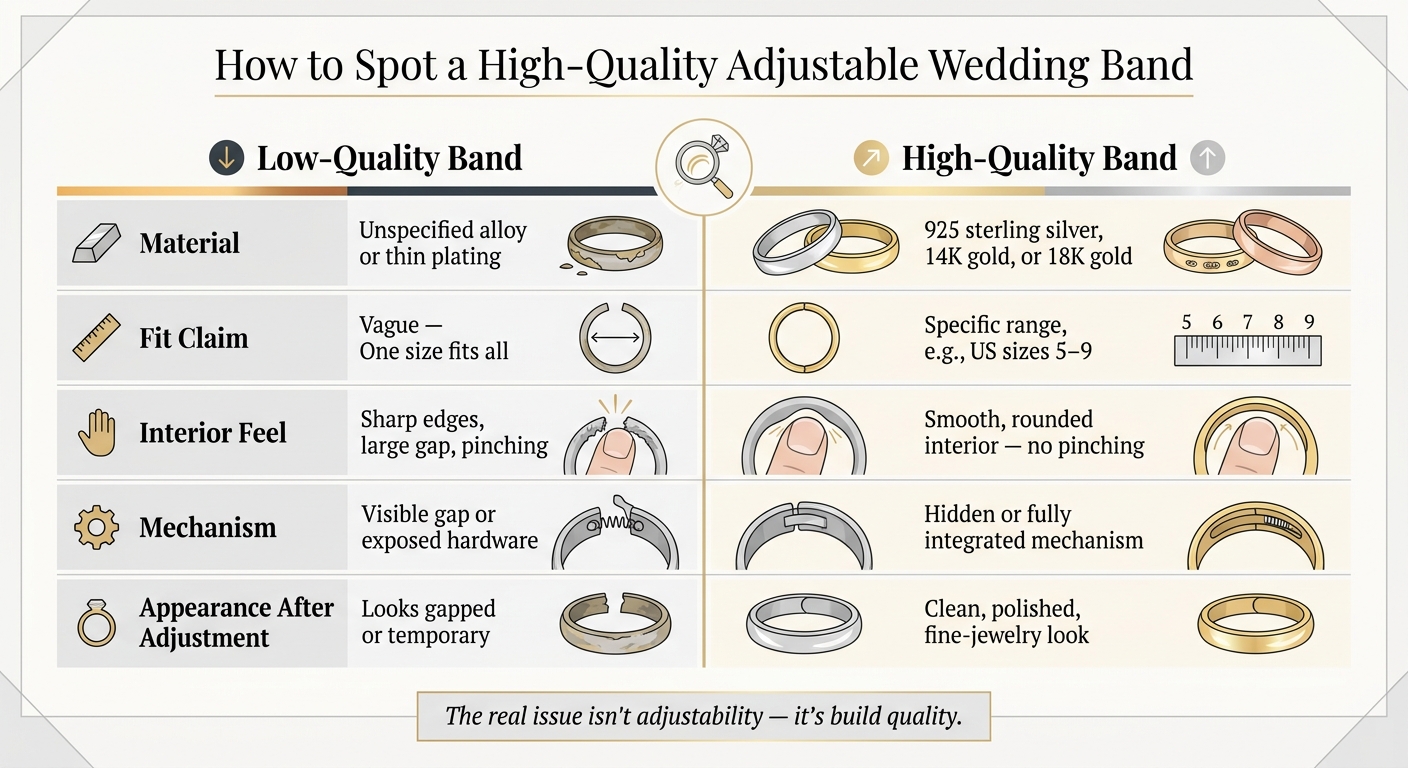
Low-Quality vs. High-Quality Adjustable Wedding Bands: Key Differences
Materials, Construction, and Adjustment Range
Once the fit issue is handled, the next thing to look at is durability. Start with the metal. A well-made adjustable wedding band should clearly list what it's made of: 925 sterling silver, 14K gold, or 18K gold. If the product page only says “alloy” or skips the metal name altogether, that’s a warning sign. Base metals and thin plating tend to tarnish sooner, may irritate skin, and often bend or break after repeated size changes.
14K gold is harder and better suited for daily wear. 18K gold has a richer look, but it’s softer.
The adjustment range matters just as much. A good band will give a specific range, such as US sizes 5–9, instead of vague claims like “one size fits all.” That kind of range suggests the ring was made to keep its shape within those sizes, not just pulled open and squeezed shut whenever needed.
Comfort Details That Matter in Daily Wear
After the metal checks out, look at the inside of the band. A good ring has smooth, rounded inner edges that slide over the knuckle without scratching. If the adjustable gap is visible, it should be small, softly rounded, and polished so it doesn’t pinch skin or snag fabric. That matters even more when the ring needs to move over a knuckle, deal with swelling, or sit next to another band.
A well-made adjustable band should feel stable on the finger without sliding around or spinning.
When Design Quality Matters More Than Convention
A good adjustable wedding band should still look like fine jewelry, not a ring sizer or a stand-in piece. One of the clearest signs of quality is a hidden or built-in mechanism. Visible springs, exposed cuts, or bulky overlapping metal usually suggest the ring was made as a gimmick, not for daily wear. The real test is how the mechanism holds up with use, not just how it looks out of the box.
Here’s a simple way to tell the difference between shortcuts and solid construction:
| Quality Marker | Low-Quality Band | High-Quality Band |
|---|---|---|
| Material | Unspecified alloy, thin plating | 925 silver, 14K gold, or 18K gold |
| Fit claim | "One size fits all" | Clear range, such as US sizes 5–9 |
| Interior | Sharp edges, large gap, pinching | Smooth, rounded interior |
| Mechanism | Visible gap, exposed hardware | Hidden or integrated |
| Appearance after adjustment | Looks gapped or temporary | Clean, polished look |
The key issue isn’t just whether the band adjusts. It’s whether it’s made to wear well for years. That sets up the next part: when does an adjustable band make the most sense for the long haul?
When an Adjustable Wedding Band Is a Smart Long-Term Choice
Situations Where Adjustable Bands Work Best
Once you move past the myths, the better question is simple: when does an adjustable band make more sense for the long haul?
Adjustable bands tend to work best when finger size shifts a lot or when the exact size isn't known yet. That can happen with swelling, large knuckles, surprise gifts, or frequent travel.
Surprise gifts are a good example. The ring can be worn right away and adjusted later. And a useful adjustment range, like US sizes 5–9, gives buyers room to work with in many common ring-buying cases.
Cases Where Shoppers Should Be More Selective
That said, adjustability isn't right for every ring. Some designs just aren't built to handle a mechanism safely. Full eternity bands, very thin shanks, and mixed-metal designs with a lot going on usually can't support adjustability without making the ring weaker.
In those cases, a fixed-size band or a partial eternity style with a thicker shank is often the better pick. Adjustability is a feature, not a cure-all. The best ring is the one made to stand up to daily wear.
Conclusion: What Matters More Than Other People's Assumptions
At the end of the day, the best choice is the ring that fits the wearer's life, not the one that matches someone else's assumptions. A well-made adjustable band earns its place the same way any wedding ring does: by fitting well, feeling comfortable, and lasting.
FAQs
How adjustable should a wedding band be?
A wedding band should adjust within a small, practical range. In most cases, that means about US ring sizes 5–9, and usually only a few sizes within that span.
That kind of range helps the ring deal with normal day-to-day finger changes while still staying snug and secure at the base of your finger.
A good fit should feel simple: the ring slides over your knuckle without a fight, then sits tighter once it's in place. It shouldn't pinch. It shouldn't leave marks. It should just feel right.
And when it comes to adjustability, more isn't always better. A hidden, smooth adjustment mechanism is the better bet, especially if you want comfort without making the band feel bulky or awkward.
Can an adjustable band be resized later?
Yes. These bands are made to change size without standard resizing. They use a hidden part inside the band that lets it loosen or tighten as your finger changes size, like after exercise or in hot weather.
So if the fit feels off, you can usually adjust it within the band’s size range when needed, often without a trip to the jeweler.
Will an adjustable band work with an engagement ring?
Yes. An adjustable band can pair beautifully with an engagement ring. Satinski’s hidden mechanism lets the band expand or contract for a more comfortable fit, without the hassle of professional resizing.
It’s built to hold its shape even with frequent adjustments. That makes it a smart pick whether you stack it with an engagement ring or wear it on its own, especially if your finger size shifts during the day.


