

Recreating a Lost Wedding Ring: What's Possible
Yes - you can often replace a lost wedding ring, but how close the new ring gets depends on your records. If you have photos, receipts, appraisals, CAD files, or insurance paperwork, a jeweler may be able to make an exact copy or something very close. If you have less to work with, a redesign is often the better path.
Here’s the short version:
- Best case: clear photos + appraisal + jeweler design files = near-exact rebuild
- Middle ground: a few photos + a matching ring = close look and fit
- Least info: memory alone = new design based on the old ring’s main details
- Fit matters too: finger size can change over time, so the new ring may need a different size, profile, or band style
- Time and cost vary: simple remakes can start around $1,500, while more detailed rings can run $5,000+
- Resizing is not always possible: full eternity bands, tungsten, and titanium can be hard or impossible to resize later
What I’d do first is simple: gather every photo, invoice, appraisal, grading report, insurance file, and related band you still have. That gives the jeweler the best shot at rebuilding the ring in a way that looks right, fits well, and still feels like yours.
Recreating a Lost Diamond Ring from Photos | Custom Jewelry
sbb-itb-9da40c1
Quick Comparison
| Option | Best when you have | What to expect | Typical cost |
|---|---|---|---|
| Exact replica | CAD files, appraisals, clear photos | Closest match to the lost ring | $1,500–$3,000 for simpler styles; $5,000+ for detailed work |
| Close reproduction | Partial photos, receipts, matching band | Same general look, not every small detail | Often mid-range bridal pricing |
| Custom redesign | Basic notes, memory, a few visual references | Keeps the meaning, changes the design | About $350–$12,000+ |
If you’re moving forward after a loss, the main goal is not just replacing metal and stones. It’s making a ring you’ll want to wear every day.
How to gather the evidence a jeweler needs
The more proof you bring in, the better shot a jeweler has at rebuilding the ring with close detail. Start with the items that usually stick around after a loss: photos, paperwork, and any rings from the same set.
Photos, receipts, appraisals, and insurance records
Start with photos. Wedding pictures, proposal shots, social media posts, and old phone images can all help. The best ones show the ring from the top, the side, and at an angle. Those views help reveal the setting style, prong type, band width, and surface details like milgrain or pavé.
Then pull together any paperwork you still have. Your original receipt or invoice will often list the metal type, stone carat weight, and purchase price in U.S. dollars. An insurance appraisal may add more detail, such as metal purity, dimensions, gemstone grades, and replacement value. If you have a GIA or IGI grading report for the center stone, bring that too. It includes exact specs like carat weight, cut proportions, and a report number, which can help a jeweler find a close match for the stone.
Insurance records matter too. Check your policy for the scheduled item description. In the U.S., jewelry insurance policies and homeowners policy riders often include the appraised value, item description, and sometimes photos. If you already filed a claim, the insurer’s replacement estimate can give the jeweler a solid starting point.
CAD files, wax models, and jeweler design records
If the ring was custom-made, design records can do a lot of the heavy lifting. Photos only show so much. The original jeweler may still have CAD files on record. Those files can show details like band thickness, prong layout, gallery shape, and engraving placement.
Reach out to the original jeweler with your name, an approximate purchase date, and any invoice or order numbers you can find. Ask if digital design files are still on file.
If the ring was made from a wax or resin prototype, bring that in too. A model like that can preserve parts photos often miss, such as the under-gallery shape and comfort-fit curve. A jeweler can measure the model with calipers or scan it to make updated CAD files.
Using surviving rings and bands as references
If you don't have much paperwork, the rings you still own may be your best guide. An engagement ring or a wedding band from the original set can show the exact metal color, finish, and the way the lost ring was shaped to sit on the finger. That includes whether it sat flush, had a curved profile, or used interlocking parts.
Bring every related ring with you, and wear them the way you normally stack them. That tells the jeweler a lot. The spacing, fit, and alignment can show how the missing ring should look and feel, including stack height, contour, and how the new ring should sit on your hand.
Choosing between a replica, a close match, or a redesign
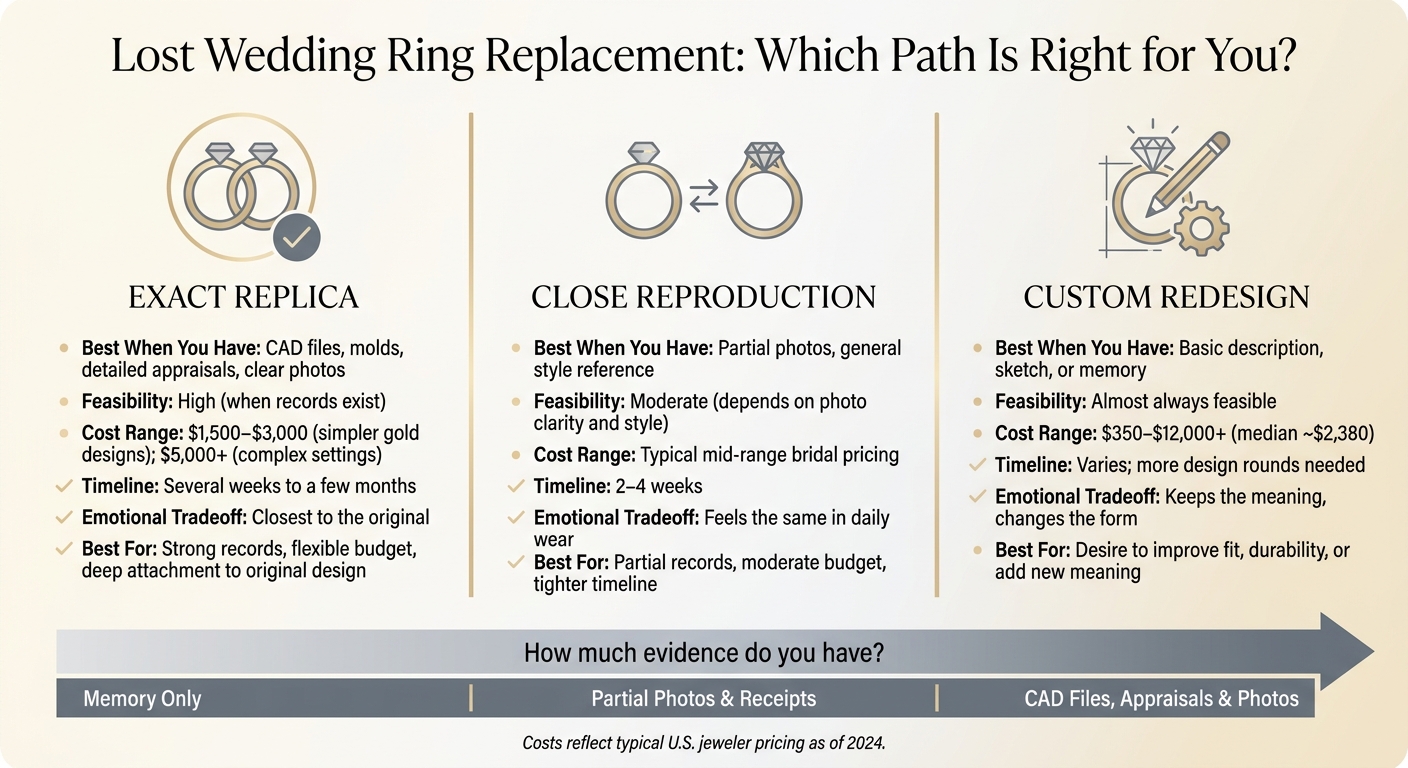
Lost Wedding Ring Replacement Options: Cost, Timeline & Best Fit
Once you’ve gathered your evidence, the next step is picking the path that fits your records, budget, and timeline. In plain English: the better your records, the closer you can get to the original. If your records are thin, a close match or a redesign usually makes more sense.
When an exact replica is possible
An exact replica is most likely when the original jeweler still has design records and you also have clear photos, plus stone and metal paperwork. Many jewelers keep digital design files and order records for several years. So if the ring was custom-made within the last 10 to 15 years, there’s a decent chance those files are still around.
That said, stone matching has limits. Natural diamonds aren’t identical, so a replacement usually comes down to finding a diamond that matches the original’s general grade and overall look. Some policies even allow a replacement diamond within one color or clarity grade of the original. An exact replica also calls for more custom labor, which usually makes it the more expensive route.
When a close match is the best outcome
If your records are incomplete - a few photos, a rough memory of the style, and no appraisal - a close match is usually the smarter goal. A jeweler can often rebuild the overall look, band width, metal color, and near stone size from partial photos and measurements.
This option works especially well for common styles like solitaires and halo settings. In those cases, stock or semi-custom mountings can get very close to the original feel. It may not copy every last detail, but in day-to-day wear, it can still feel like the same ring.
The tradeoff comes down to accuracy, cost, and flexibility.
Comparison table: Exact replica vs. close reproduction vs. custom redesign
| Exact Replica | Close Reproduction | Custom Redesign | |
|---|---|---|---|
| Best evidence on hand | CAD files, molds, detailed appraisals, and clear photos | Partial photos and a general style reference | Basic description or sketch |
| Feasibility | High when records exist; lower without them | Moderate; depends on photo clarity and style | Almost always feasible |
| Typical U.S. cost range | About $1,500–$3,000 for simpler gold designs; $5,000+ for complex settings | Often in typical mid-range bridal pricing | $350–$12,000+; median around $2,380 |
| Typical timeline | Several weeks to a few months | 2–4 weeks | Varies; more design rounds needed |
| Emotional tradeoff | Closest to the original | Feels the same in daily wear | Keeps the meaning, changes the form |
| Best suited for | Strong records, flexible budget, deep attachment to the original design | Partial records, moderate budget, tighter timeline | Desire to improve fit, durability, or add new meaning |
A custom redesign can be a good middle ground when you don’t want a strict copy. It lets you keep the details that mattered most - like a stone shape, engraving, or motif - while fixing issues such as a high setting or a thin band.
Once you choose the path, the next step is making sure the replacement fits well, wears comfortably, and still carries the original meaning.
Building a replacement ring that works for everyday wear
Once you know the design direction, the next big decision is fit. And fit can change more than people expect.
A ring that slid on easily on your wedding day might now stick at the knuckle or spin around all day. Weight changes, hot weather, swelling, pregnancy, arthritis, and age can all affect finger size. So if daily comfort matters more than a near-perfect visual match, it may make sense to pick a comfort-fit interior, a lower profile, or a thicker shank.
Preserving meaning through engraving, motifs, and design details
A replacement ring doesn't have to be an exact copy to still feel personal. In many cases, the meaning lives in just one or two details, like an inscription, a stone shape, or a small motif. Bring those back, and the new ring can still feel like your ring.
Interior engraving is one of the easiest ways to carry that meaning forward. Jewelers can use laser engraving to recreate original dates, initials, or short phrases inside a new band. If you remember the wording, or you have a photo of the original inscription, that same text can move into the new ring even if the rest of the design changes. Some couples also use the replacement as a chance to add a second line - keeping the original wedding date and adding the year the ring was replaced, so both moments stay with the piece.
You can also echo the original with matching stone shapes, similar prong styles, or repeated details like milgrain beading or a braided band pattern. Those small touches often do a lot of the emotional heavy lifting.
Resizing options, metal limits, and adjustable ring choices
If you're remaking a ring and need a different fit than the first one, metal choice matters more than it seems at first.
Gold (10K–18K), platinum, and sterling silver can all usually be resized by a bench jeweler. Simple resizing often costs about $35–$150, depending on the metal and whether extra material has to be added. Platinum work usually costs more - often $50–$150+ - because the metal is denser and takes more labor to shape.
Some ring styles are much harder to change. Full eternity bands have stones set all the way around, so there isn't a plain section to cut and rejoin. That means standard resizing isn't possible, and a size change may require a full remake. Tungsten and titanium bring a different problem: they're too hard or too brittle to cut and solder safely, so resizing usually isn't offered at all. If your fingers change size day to day because of swelling or arthritis, those styles can turn into a headache fast.
For people dealing with regular size changes, adjustable ring designs can be a practical option. Satinski's adjustable rings use a hidden sliding mechanism at the back of the band. It opens to get over the knuckle and closes at the base of the finger. These designs cover about U.S. sizes 5–9 and come in sterling silver and solid 14K or 18K gold. For daily wear, solid gold is the better pick, especially if you'll adjust it often. The slide point wears over time, and solid gold handles repeated adjustment better, while plated finishes may need replating every one to three years.
Use the chart below to match your fit needs with the right replacement type.
Comparison table: Fixed-size replica vs. resized traditional ring vs. adjustable ring
| Fixed-Size Replica | Resized Traditional Ring | Adjustable Ring | |
|---|---|---|---|
| Fit over time | Rigid; may become too tight or loose as finger size changes | Adjusted to one specific size; periodic resizing possible | Adapts to daily and seasonal swelling |
| Maintenance | Low initially; may need future resizing or remaking if size changes | $35–$150 per resize; repeated resizing can stress the shank | Low for solid gold; vermeil may need replating every 1–3 years |
| Arthritis/swelling suitability | Poor; difficult to pass over enlarged knuckles | Limited; resizing changes the static size, not daily fluctuations | Excellent; opens for the knuckle, closes at the base |
| Size flexibility | Single fixed size | Typically ±1–2 sizes before structural concerns arise | Covers approximately U.S. sizes 5–9 |
| Best suited for | Stable finger size, strong design records | Gradual, modest size changes over time | Arthritis, pregnancy, weight fluctuations, daily swelling |
Next steps: Moving from loss to a wearable replacement
What to do right after the loss
Once you pick the replacement route, move fast on the claim and the jeweler brief. In the first 24–48 hours, retrace your steps before deciding the ring is gone for good. Rings often show up in places people overlook: sink and shower drains, laundry, vacuum bags, car seats, pockets, bags, nightstands, and couch cushions. If you were at a gym, hotel, airport, or workplace, check with lost-and-found too.
If the ring still doesn't turn up, contact your insurer right away. Many homeowners and renters policies require notice within 24–72 hours. Unscheduled jewelry coverage is often capped at $1,500 to $5,000. If theft is part of the loss, file a police report immediately; many insurers want the report number before they process the claim. Pull together every record you have and take it to the jeweler.
How to brief a jeweler for the best result
After the claim is filed, turn to the details that will shape the rebuild. Be clear about what needs to stay the same and what you're open to changing. When the jeweler shares a CAD rendering, review it from every key angle: top, side, and profile. Check the band width in millimeters, the stone diameter, the engraving text, and whether the inside has a comfort-fit interior.
This is the moment to slow down and look closely. Don't approve the design until every detail is right. Once casting starts, changes are hard or impossible. If your insurer needs pre-approval, send the written design summary before production begins.
Conclusion: Finding the most accurate and wearable path forward
With the claim underway and the design choices set, the last step is picking the version you'll actually wear. Strong records give you the best shot at a close replica. Partial records usually lead to a near match. If your fit or day-to-day life has changed, a redesign or adjustable ring may make more sense. A replacement ring can still carry the story forward.
FAQs
Can a jeweler copy my ring from photos alone?
Yes. Photos can be a strong starting point for recreating a lost ring, even if they don’t show every exact dimension.
A jeweler can use them during the design consultation, along with sketches, receipts, or insurance records, to guide the choice of metal, stone layout, and overall style. From there, digital renderings and 3D models help fine-tune the design before crafting.
How long does it take to remake a lost wedding ring?
It depends on how complex the design is. A custom-made ring usually takes 4 to 8 weeks for design and production.
If you need something sooner, an adjustable ring can work as a practical short-term replacement. Those are often available within a few business days. Holidays and busy engagement seasons can push custom order timelines out, so it helps to order early and leave yourself some breathing room.
Should I recreate the original ring or choose a redesign?
Choose a redesign if making an exact copy wouldn’t feel safe or comfortable to wear. That’s often the smarter move when the original proportions are hard to reproduce or when resizing would be awkward later on.
For a piece you plan to wear often and keep for years, a custom reinterpretation usually makes more sense than forcing a perfect replica. You can keep the spirit of the original while using proportions that feel better on the hand and a fit that leaves room for later changes.
That matters more than it may seem. Finger size can shift over time, so an adjustable or resizable style can make day-to-day wear much easier.


