

Knuckle vs Base Measurement: The Millimeter Gap Explained
A ring can fit your knuckle and still feel loose at the base - and a gap of just 2–3 mm can change the size you need.
If I had to sum up the article in one line, it’s this: measure both the knuckle and the base, compare the gap, and let that gap guide the ring type. For many people, the difference is about 1–3 mm, and that can equal about half to one full U.S. ring size. That’s why a ring may go on fine but spin all day, or feel good at the base but fight the knuckle.
Here’s the short version:
- Knuckle measurement tells me what the ring must pass over
- Base measurement tells me how the ring will feel once it’s on
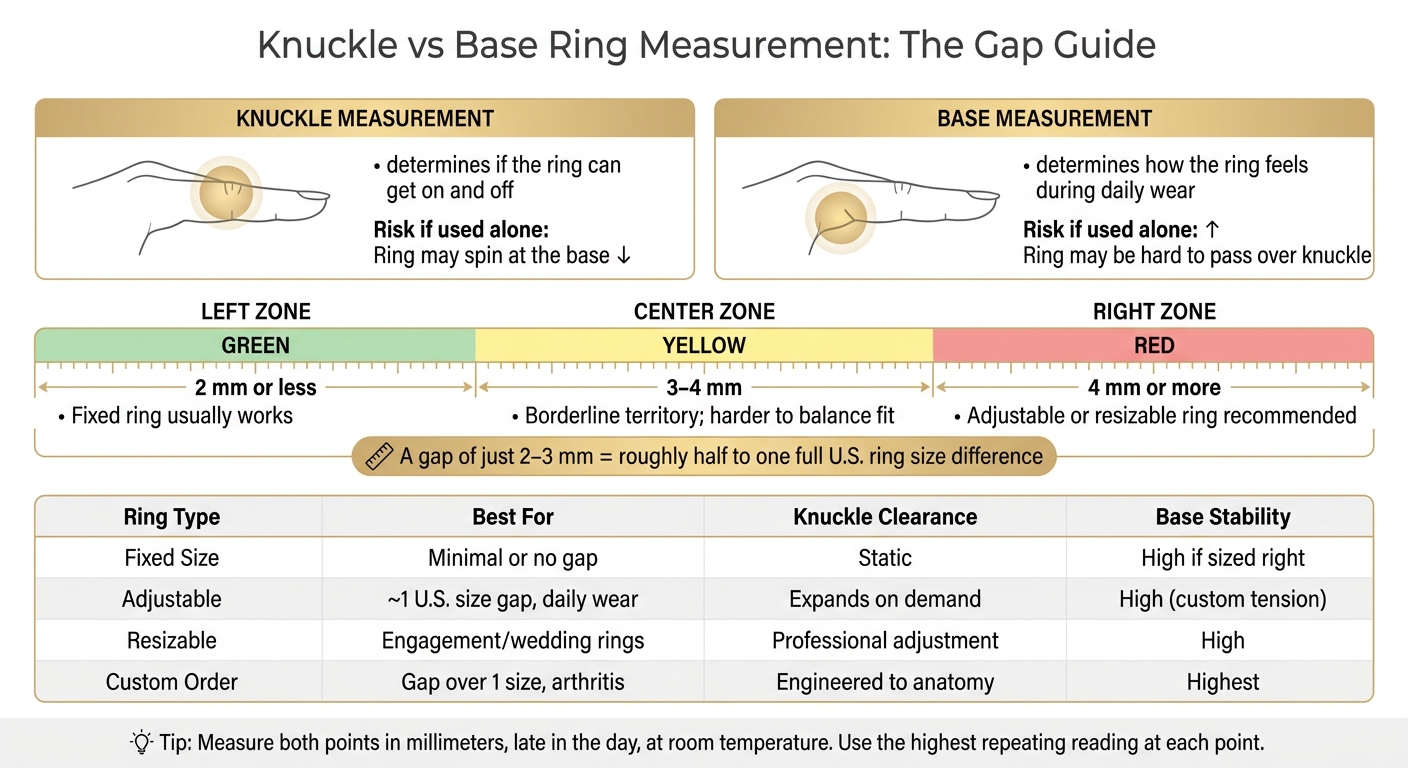
- About 2 mm or less: a fixed-size ring often works
- About 3–4 mm: fit gets harder to balance
- About 4 mm or more: adjustable or resizable options often make more sense
- Heat, swelling, and time of day can shift finger size by 1–3 mm
- A jump from U.S. size 6 to 7 changes circumference by only about 2.55 mm
If I’m checking ring fit, I’d measure both spots in millimeters, take a few readings, and use the repeat high reading at each point. That one step cuts down a lot of sizing mistakes.
Quick comparison
| Measurement | What it tells me | Main risk if used alone | Best use |
|---|---|---|---|
| Knuckle | Whether the ring can get on and off | Ring may spin at the base | Bigger joints, arthritis, swelling |
| Base | How the ring feels during daily wear | Ring may be hard to pass over the knuckle | Better stability and alignment |
Bottom line: if you want a ring that goes on without a struggle and stays put once worn, the gap between those two measurements matters more than most people think.
Knuckle vs Base Ring Measurement: Gap Size Guide
Knuckle vs Base Measurement: The Core Fit Tradeoff
Ring fit comes down to a simple tradeoff: you need enough room to get past the knuckle, but enough grip to keep the ring secure at the base.
And even a small size change can make a big difference. A ring that slips over the knuckle easily may feel loose once it settles. A ring that feels great at the base may take some effort to get on and off. So the better measurement depends on how big that gap is.
Sizing to the Knuckle
When you size to the knuckle, the ring is large enough to slide over it with only mild resistance. The downside is what happens after that. At the base, the ring can feel loose, especially with slim bands or top-heavy settings like solitaires and halos. In those cases, gravity pulls the heavier top toward the palm, and the ring starts to spin.
This option tends to work best for people with prominent knuckles, arthritis, or regular daytime swelling who need the ring to get over the knuckle without a struggle.
Sizing to the Base
Sizing to the base means the ring fits snugly where it actually sits. It stays put, lines up well, and feels steady during daily wear. The tradeoff is that a larger knuckle takes more effort to get past. Sometimes that means a twist or a bit of light lubrication. If the knuckle is much larger than the base, that step can feel tight or briefly uncomfortable.
This option makes the most sense when security and alignment matter most, like with a wedding band or an engagement ring with a centered stone. In most cases, the size gap leads to one of these fit patterns.
Common Fit Scenarios
| Gap Size | What Typically Happens | Best Fit Approach |
|---|---|---|
| ~½ size | Mild looseness at the base; ring may shift slightly | Size to the base or split the difference with a half-size up |
| ~1 full size | Noticeable spinning, especially with heavy settings | Size to the knuckle; add sizing beads or an insert to secure the base |
| More than 1 size | Ring either spins constantly or is very hard to remove | Fixed sizing rarely works well, and adjustable solutions may be the better choice |
For most people, the knuckle-base difference is around half a size, while those with arthritis or enlarged joints may see a gap of a full size or more.
Fit also changes with conditions. Temperature can shift finger size by up to half a size, so a fixed size may feel snug in heat and loose in cold. That can widen or narrow the same knuckle-base gap and change whether a fixed size works at all. For people dealing with daily swelling, a fixed size often feels like a compromise that never quite solves either problem.
sbb-itb-9da40c1
How to Measure Both Points Accurately
Once you know which measurement is causing the fit issue, measure both spots the same way. Then, before you check any size chart, record the base and knuckle in millimeters.
Measure at Home with a Ring Sizer or Tape
The easiest way to do this is with a thin strip of paper, a non-stretch string, or a flexible measuring tape. Wrap it snugly around the base of your finger first, mark where the ends meet, then lay it flat on a millimeter ruler and write down the measurement. Then do the same thing at the widest part of your knuckle. Measure the base while your finger is relaxed. Measure the knuckle at its widest point with your finger slightly bent.
Your finger size can change by about 1–3 mm in circumference from morning to evening because of normal fluid shifts during the day. That’s why it helps to measure in the evening, when your hands are at room temperature. Skip it right after a workout or a hot shower. Take two or three readings at each spot on different days, then use the highest reading that repeats for each point.
Once you have both numbers, subtract the base measurement from the knuckle measurement to find the gap. If the gap is 2 mm or less, sizing from the base usually works. If it’s more than that, size for the knuckle first and use an adjustment to keep the base secure.
Use Printable Charts and U.S. Size Conversions
Next, turn those millimeter readings into ring sizes. A circumference-to-U.S.-size chart lets you convert both measurements into actual U.S. sizes. For a quick reference, size 7 ≈ 17.35 mm inner diameter. If you want to calculate it yourself, use this formula: U.S. size = (diameter in mm − 11.63) ÷ 0.8128.
Check both your knuckle and base numbers on the same chart. That makes the size gap much easier to see in U.S. sizing terms, and it shows which measurement should guide the final choice.
If you print a ring chart, print it at 100% scale with no “fit to page” setting. Then check the calibration line with a physical ruler before you trust the result. One common slip-up is mixing up circumference and diameter columns, so look closely and make sure the chart clearly shows which one it uses.
When to Get a Jeweler's Measurement
If your numbers are close, a chart may do the job. If they’re not, it’s smart to get a professional fitting. See a jeweler when your knuckle-to-base gap looks like half a size or more, when your fingers swell a lot between seasons, or when you’re buying a high-value ring like an engagement or wedding band. Jewelers use metal or plastic ring sizing sets in U.S. whole and half sizes, and they check how each ring moves over the knuckle and sits at the base in practice.
Before your appointment, let your hands stay in normal day-to-day conditions. Don’t go right after the gym, and don’t go after sitting in heavy air conditioning. Bring your home measurements in millimeters so the jeweler has a reference point. It also helps to ask about adjustment options, like sizing beads or comfort-fit bands, if your size tends to shift. The point is to check that knuckle-to-base gap in person and pick a size that can get over the knuckle but still stay put at the base.
When Adjustable or Resizable Rings Are the Better Choice
When the gap gets too big for a fixed size, the issue is no longer just about measurement. At that point, it becomes a design problem.
Signs a Fixed Size Will Not Work
Even with correct measurements, some fingers still need a ring that can change shape slightly to fit well. The clearest sign is a full U.S. size difference between the knuckle and the base of the finger.
A few simple checks can help spot the issue. If the ring spins during normal movement, the base fit is too loose. If taking it off leaves redness or soreness, the knuckle clearance is too tight. Swelling can change finger size by half to a full size. Arthritis or inflammation can also make the gap grow over time.
How Satinski Adjustable Rings Address the Gap
Satinski's adjustable and resizable rings are made for this exact knuckle-to-base tradeoff. The hidden adjustment mechanism sits inside the band, so the ring looks like a standard closed band when worn. There are no visible gaps and no exposed edges.
The ring opens enough to pass over the knuckle, then tightens at the base. That matters when a fixed ring would force you to choose between getting it over the knuckle and keeping it steady once it's on.
For larger knuckle-to-base gaps, an adjustable or resizable ring gives you both: room to pass the knuckle and a tighter fit at the base.
Adjustable, Resizable, or Custom: Which One to Pick
The best ring type depends on how much the knuckle and base size differ.
| Ring Type | Best Fit Scenario | Knuckle Clearance | Base Stability | Swelling Comfort |
|---|---|---|---|---|
| Fixed size | Very small or no measurement gap | Static | High if sized right | Low |
| Adjustable | Gap of about 1 U.S. size, everyday wear | Expands on demand | High (custom tension) | High |
| Resizable | Engagement/wedding rings, gradual changes | Professional adjustment | High | Moderate |
| Custom order | Gap over 1 size, arthritis, unusual sizes | Engineered to anatomy | Highest | Highest |
Use the table as a quick guide. Fixed sizing works best for minimal gaps. Adjustable rings fit moderate gaps well, especially for daily wear. Custom orders make more sense when the gap is large, irregular, or affected by arthritis.
Start with the gap size to narrow down the ring type, then confirm the final fit with measurement.
Conclusion: Measure Both Points, Check the Gap, Pick the Right Fit
Once you have both numbers, the choice gets pretty simple: check the gap and match it to the ring type. Measure your knuckle and the base of your finger in millimeters at room temperature, late in the day. Then subtract the base measurement from the knuckle measurement.
Here’s the rule of thumb:
- 2 mm or less: a fixed ring usually works
- 3–4 mm: borderline territory, where pass-through fit and daily stability often stop lining up
- 4 mm or more: an adjustable or resizable ring is usually the better pick
A quick example makes this easier to picture. Alex measures 55 mm at the knuckle and 54 mm at the base. That leaves a 1 mm gap, and both measurements land near a U.S. size 7. In that case, a fixed ring in that size should go over the knuckle with mild resistance and stay in place.
On Satinski, convert both measurements with the size chart, then pick an adjustable style with a size range that covers your gap. If your measurements fall outside that range, use the custom order options. And if you land between sizes, contact support for a size-range match. The goal is simple: the ring should get over the knuckle without spinning at the base.
FAQs
Should I size my ring to my knuckle or my base?
Don’t use one measurement for your whole finger. Measure the base and the knuckle separately, then pick a size between the two. That way, the ring can get over the knuckle without feeling too tight at the base, and it can sit comfortably without spinning or pinching.
If there’s a big difference between those two measurements, or your fingers tend to swell during the day or when the temperature changes, an adjustable ring is often the best choice.
How much does a 2–3 mm gap change ring size?
A 2–3 mm gap in circumference is a big deal in ring sizing. A full US ring size is about 2.4 mm of inner circumference, so that difference is roughly one full size.
That’s why a ring might feel fine at the base of your finger but get stuck at the knuckle. Or it may slide over the knuckle, then spin once it settles at the base.
When should I choose an adjustable or resizable ring?
Pick a resizable ring if your finger size tends to change with heat, humidity, exercise, or hydration. It also helps if arthritis or swelling makes it harder for a ring to pass over your joints without discomfort.
It can be a smart pick for engagements or gifts when the exact size isn’t clear yet, while giving you more comfort as things change over time.


