

Open vs Adjustable vs Expandable Rings: The Terminology Finally Explained
Most ring fit problems come down to 3 different ring builds. If you only need about 0.5 to 1 U.S. size of give, an open ring may work. If you need a ring that covers about 2 to 4 sizes, look for an adjustable ring. If your ring must get over a large knuckle and then sit snug at the base of your finger, you’re looking for an expandable ring.
Here’s the short version:
- Open ring = a visible gap in the band
- Adjustable ring = made to fit a stated size range
- Expandable ring = opens with a mechanism, then closes again
That’s why these terms should not be used as if they mean the same thing. An open ring helps with small fit changes. An adjustable ring covers more size uncertainty. An expandable ring deals with knuckle clearance, swelling, or arthritis-related fit issues.
If I had to simplify the whole topic into one line, it would be this: gap = open, size range = adjustable, knuckle mechanism = expandable.
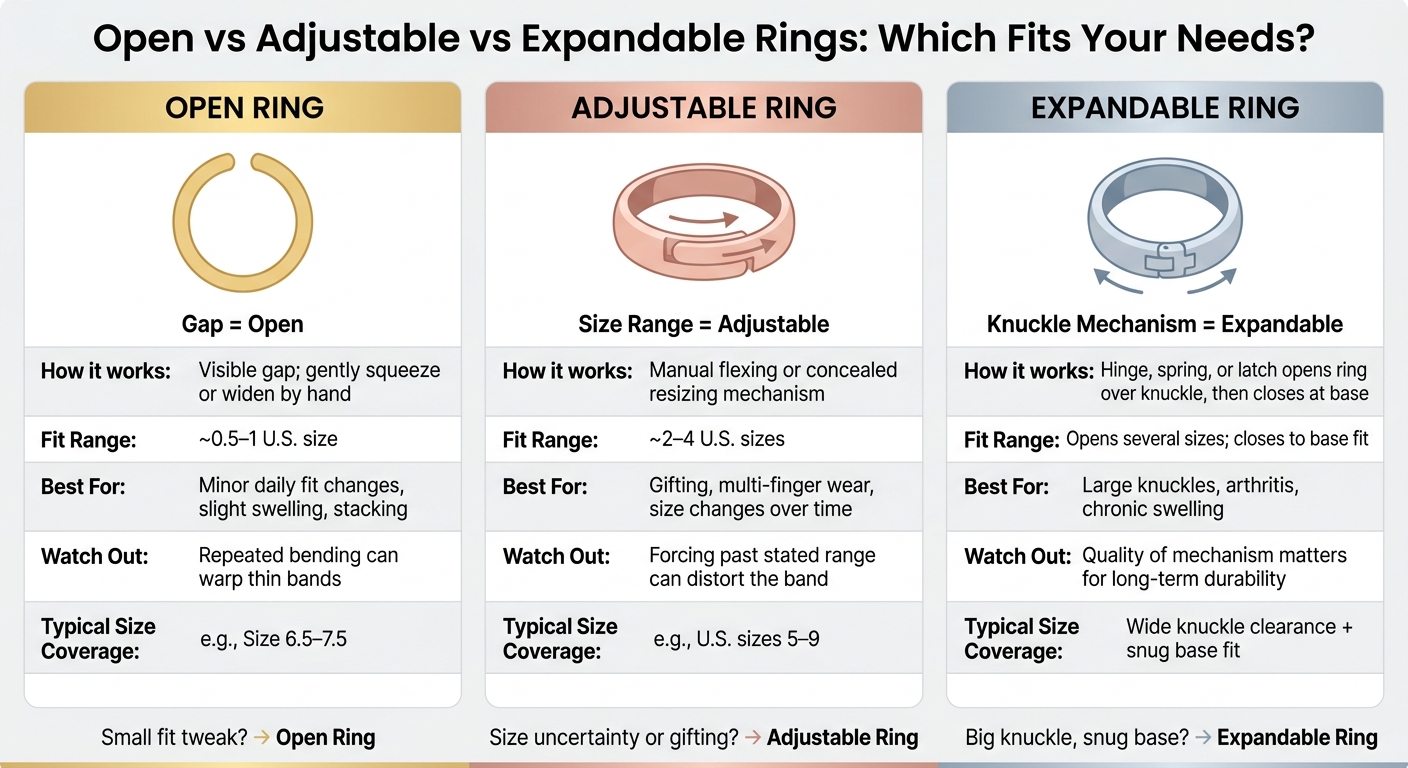
Open vs Adjustable vs Expandable Rings: Which Fits Your Needs?
Adjustable Rings Guide: Types, Pros & Cons + How Resizable Rings Work
sbb-itb-9da40c1
Quick Comparison
| Ring type | How it works | Best for | Fit range | What to watch for |
|---|---|---|---|---|
| Open | You gently squeeze or widen the visible gap | Small day-to-day fit changes | About 0.5–1 size | Too much bending can warp the band |
| Adjustable | You change the fit by hand or with a hidden part | Gifts, switching fingers, size changes over time | About 2–4 sizes | Pushing past the stated range can bend the ring |
| Expandable | A hinge, spring, or latch opens the ring over the knuckle | Large knuckles, swelling, arthritis | Opens several sizes, then closes to base fit | Depends on how well the mechanism is made |
So when I compare these ring types, I don’t start with the name. I start with the fit problem the ring is meant to solve.
Open Rings: A Visible Gap With Limited Size Flexibility
An open ring has a band that doesn't fully close. There’s a visible gap where the two ends stop before meeting. You’ll often see this in bypass and crossover designs, where that opening is part of the style. That detail matters because the gap can help fine-tune fit a bit, but it’s not meant for big size changes.
| Feature | Open Rings | Fixed Closed Bands |
|---|---|---|
| Structure | Non-continuous band with a visible gap | Complete, unbroken circle |
| Adjustment range | Small manual flexibility around the base size | None without jeweler resizing |
| Durability | More vulnerable to distortion if bent often | More robust for long-term wear |
| Typical use | Fashion, stacking, and modest fit flexibility | Engagement rings, wedding bands, and heirloom pieces |
That basic design is why open rings give you only a small amount of fit flexibility.
How Open Rings Fit and When They Help
An open ring is made in one base size. From there, you can make small fit changes by gently pressing the gap a little tighter or easing it slightly wider. In most cases, that gives you about 1/2 to 1 U.S. size of movement, not more. So if a ring starts at size 7, it can often fit somewhere around 6.5 to 7.5 with care. In jewelry terms, that still counts as an open ring, not a true adjustable ring.
This small amount of movement can help when your finger size shifts a bit during the day or between summer and winter. It can also work well if your knuckle is only slightly larger than the base of your finger. You can open the gap just enough to get the ring on, then ease it back so it feels more secure.
Where Open Rings Fall Short
The downside shows up with thin or delicate bands. If you bend them again and again, the gap can lose its shape and the band can weaken over time. Softer alloys like sterling silver and 14K gold are more likely to have this problem than harder metals.
Too much bending can also throw off the ring’s shape. Decorative ends may twist out of line, and the ring might stop sitting evenly on the finger. If you need more than a small fit change, adjustable rings make more sense.
Adjustable Rings: Built to Fit a Range of Sizes
An adjustable ring is made to fit more than one size. It does that through manual flexing or a concealed resizing mechanism. Here's the key point: adjustable rings can include open designs, but they aren't limited to them. Many use hidden mechanisms instead. So the category is broader than open rings, but narrower than expandable rings built mainly for knuckles.
Common Adjustable Designs and Typical U.S. Size Ranges
These styles change size in different ways.
| Design Type | Adjustment Method | Visible Gap | Typical U.S. Size Range |
|---|---|---|---|
| Open Ring | Manual squeezing or widening at the gap | Yes | 5–9 |
| Wrap or Coil | Overlapping ends or spirals shift to change fit | Yes (overlapping) | 5–9 |
| Slider | A movable section or internal track changes fit | No | 5–9 |
| Hidden Adjustable Shank | Concealed internal mechanism changes fit | No | 5–9 |
Fit Problems Adjustable Rings Solve for Everyday Shoppers
Once you understand the build, the next thing to look at is the problem it solves.
Adjustable rings help if you want to wear the same ring on different fingers without buying several sizes. They're also handy when finger size changes during the day. Heat, diet, and daily activity can all make fingers swell a bit, and an adjustable ring gives you some room to loosen the fit and tighten it again later.
They can also make stacking a lot less frustrating. Instead of hoping a fixed-size ring sits just right every time, you can fine-tune the fit of each piece. That said, there's a limit. If you force an adjustable ring past its size range, you can bend or distort the band.
Satinski Adjustable Ring Example
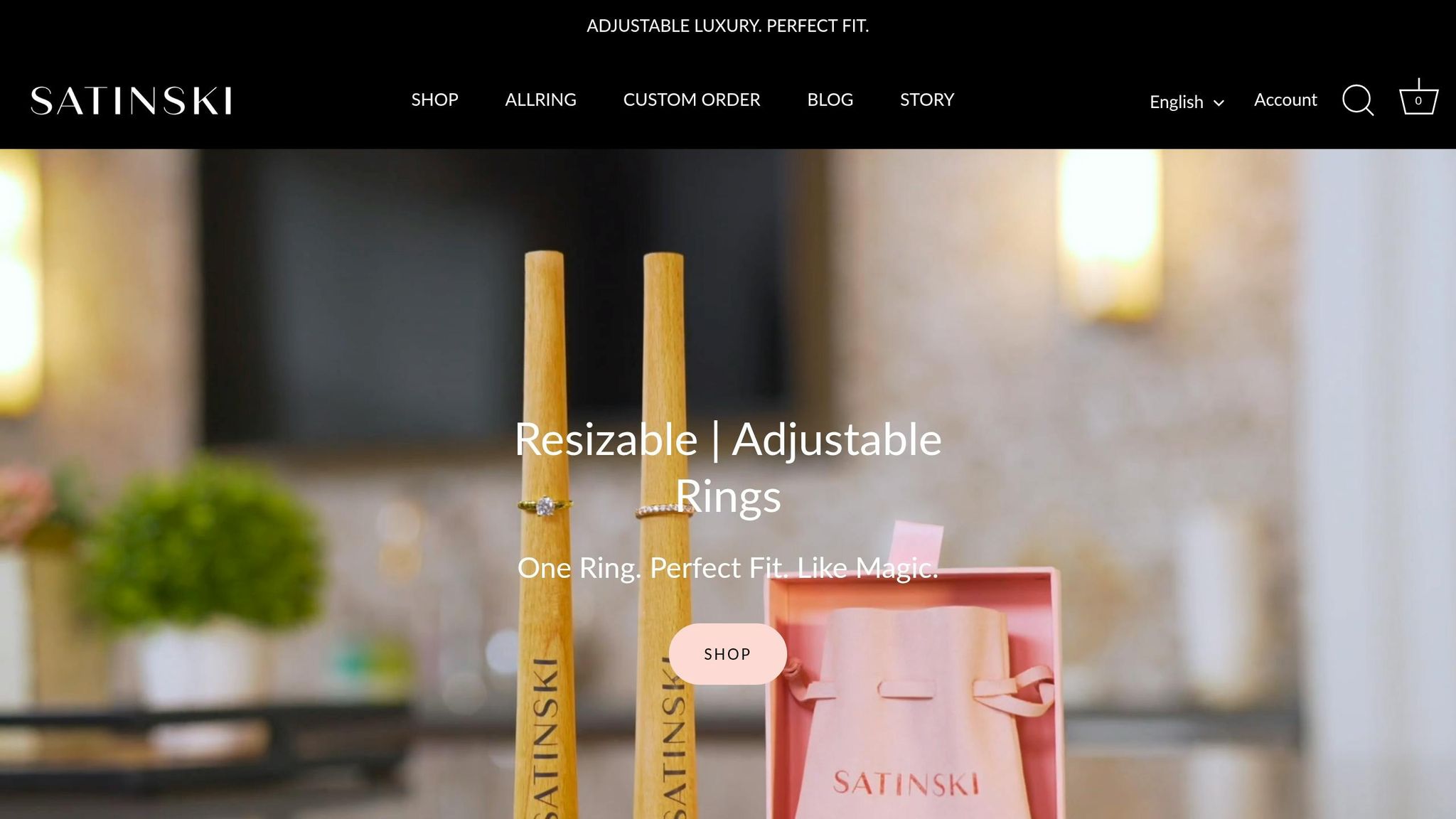
Satinski's ALLRING uses a concealed adjustable design and fits U.S. sizes 5–9, which makes it a practical pick for an engagement ring, stacking ring, or daily band.
Next comes expandable rings, which solve a different fit problem entirely.
Expandable Rings: Mechanical Fit Solutions for Knuckle and Arthritis Issues
Expandable rings fix a different sizing issue than adjustable rings. Instead of making small fit changes at the band, they’re made to get past the knuckle first. The ring opens with a built-in hinge, spring, or latch, moves over the knuckle, and then closes and locks at the base of the finger.
How Expandable and Hinged Shanks Work
The main mechanism types are hinged shanks, spring-assisted sections, and locking shanks. Hinged shanks swing open. Spring-assisted designs flex outward, then move back into place. Locking shanks snap or fasten shut to hold the ring in place. A Euro shank can also help cut down on spinning, especially on heavier settings.
When Expandable Rings Are the Better Choice
These rings are made to solve one clear problem: a knuckle that’s much larger than the base of the finger. That makes them a strong pick for chronic swelling, injury-related finger changes, or a big size gap between the knuckle and the lower part of the finger.
They also work well for heavier ring settings. Why? Because the locking mechanism helps keep the top of the ring centered on the finger, instead of forcing the wearer to size up the entire ring just to slide it on.
| Feature | Expandable / Hinged Rings | Standard Adjustable Open-Band Rings |
|---|---|---|
| Adjustment range | Mechanical; opens several sizes and then closes securely | Manual; adjusted by bending the band wider or narrower |
| Ease over large knuckles | Excellent; opens fully to bypass the knuckle | Moderate; the band still has to slide over the knuckle |
Expandable rings handle knuckle clearance with a mechanical closure. Open-band adjustable rings handle smaller day-to-day fit changes. That difference matters when you’re deciding which ring style fits your hand best.
How to Choose the Right Ring Type
Match the Ring Type to the Fit Problem
Once you know the three ring builds, the fastest way to pick the right one is to start with the fit issue itself.
Use open rings for small fit changes. Go with adjustable rings when you need a broader stated size range. Choose expandable rings when the main issue is getting past the knuckle.
Here’s a quick side-by-side view:
| Open Ring | Adjustable Ring | Expandable Ring | |
|---|---|---|---|
| Adjustment range | About 0.5–1 U.S. size | About 2–4 U.S. sizes | Opens wide for knuckle, then closes to a set base size |
| Best use case | Minor fit uncertainty, slight daily swelling | Gifting, multi-finger wear, changing sizes over time | Large knuckles, arthritis, joint swelling |
| Durability | More prone to distortion if flexed repeatedly | Depends on metal quality and mechanism design | Durable when the hinge or expansion system is well made |
| Appearance | Visible gap is part of the design | Looks like a standard ring; adjustment is often hidden underneath | Normal look from the top; hinge or joint shows on the underside |
Conclusion: The Simplest Way to Tell Them Apart
A simple way to sort them out is this: gap = open, size range = adjustable, mechanical knuckle clearance = expandable.
If the fit issue is minor, pick an open ring. If you need room across a range of sizes, pick an adjustable ring with a stated size range. If the ring must get over a larger knuckle and then sit snug at the base, pick an expandable ring.
FAQs
How do I know my knuckle is too large for an open or adjustable ring?
If your ring feels loose at the base of your finger but hurts or gets stuck when it passes over the knuckle, your knuckle may be larger than what a standard fit works well for.
In that case, an open or adjustable ring can be a smart fix. It can help if the ring is hard to take off, causes discomfort or numbness, or spins and slips because it had to be made larger just to get over the joint.
Which ring type is best for everyday wear?
For everyday wear, adjustable and expandable rings are both great picks because they can handle normal finger-size changes caused by temperature, activity, or health conditions.
Adjustable rings - especially ones with hidden mechanisms - give you a polished look that still feels like a permanent ring, with simple at-home resizing. Expandable rings, which are often made from flexible materials, are especially handy if you need to slide a ring over sensitive or swollen knuckles.
Can a jeweler turn one ring type into another?
Usually, no. A jeweler usually can’t turn one ring type into another because open rings, adjustable rings, and expandable rings are made with different structures and sizing systems.
A standard ring can often be resized for good by cutting the band or adding metal. But that’s not the same as the built-in open back, flexible design, or brand-specific mechanism these ring styles are made with.


