

What "One Size Fits Most" Really Means for Rings
“One size fits most” for rings usually means a limited range, not one ring for every finger. In most U.S. listings, that range is about US 5–9, and each full ring size changes diameter by about 0.8 mm. That means the full span is only about 3.2 mm.
If I had to sum it up fast, I’d say this:
- It fits a range, not everyone
- US 5–9 is common
- Open-band, wrap, hinged, and spring styles fit differently
- Large knuckles, very small fingers, and larger sizes can still be a problem
- Daily wear can wear out moving parts faster than fixed rings
Put another way: if your finger sits inside the stated range and your size shifts a little from heat, swelling, or pregnancy, this type of ring can work well. But if your size is outside that window - or your knuckle is much larger than the base of your finger - the label starts to mean a lot less.
| Ring type | Best use | Main issue |
|---|---|---|
| Open-band / wrap | Gifts, casual wear | Gaps, snagging, shape loss |
| Hinged / spring | Big knuckles, all-day wear | More parts that can wear |
| Fixed-size | Long wear, heavy stones | No built-in size give |
For me, the bottom line is simple: ignore the phrase and check the number range. That tells you far more about fit, comfort, and wear than “one size fits most” ever will.
Adjustable Rings Guide: Types, Pros & Cons + How Resizable Rings Work
sbb-itb-9da40c1
What 'One Size Fits Most' Means in U.S. Ring Sizing
In U.S. ring sizing, "one size fits most" means the ring is made to work across a stated size range, not for every finger. A common women's range is US 5–9, which includes the size 5–7 group where most sales happen. That range isn't just a label on a product page. It affects how the ring feels, how well it stays in place, and how it holds up over time.
Fixed Size vs. Adjustable 'One Size Fits Most' Rings
A fixed-size ring is made to one set diameter, like US size 6, and it stays there unless a jeweler resizes it. An adjustable ring is built to flex within a set range, often with an open band or a hidden part that lets the inner diameter expand or tighten.
The gap between the two shows up in a few clear ways:
- Fit precision: A fixed-size ring matches one size exactly. An adjustable ring is meant to work across several sizes, so the fit can feel different depending on where your finger lands in that range.
- Durability: Fixed bands have a simpler build. Adjustable parts can wear down or loosen after repeated use.
- Appearance: Fixed rings have a smooth, continuous band. Adjustable styles often show a gap, overlap, or a thicker section underneath where the moving part sits.
- Sizing information: A fixed ring should list one number, such as US 6. An adjustable ring should list a range, such as US 5–9. If a listing skips the range, the size claim is incomplete.
That's why the stated range matters more than the phrase alone. "One size fits most" sounds broad, but the actual numbers do the real work.
Why a Single Ring Size Makes a Big Difference
A one-size change may sound minor, but on a finger, it can be easy to notice. Each full U.S. ring size changes the inner diameter by about 0.8 mm, so a 5–9 range spans roughly 3.2 mm total.
That small shift can change the whole experience. A ring that's even one size too small may snag at the knuckle, leave a mark, and get tougher to remove when fingers swell in warm weather. A ring that's one size too large is more likely to spin or tilt. And if the ring has a stone or a top-facing design, that movement stands out fast.
In most cases, the best comfort sits near the middle of the stated range, where the band's tension and any adjusting part are closest to how they were meant to sit.
How Adjustable Rings Work and the Most Common Designs
Adjustable rings don't all work the same way. The big difference comes down to how the ring changes size - and that affects fit, comfort, and how well it holds up.
Open-Band and Wrap Styles
An open-band ring has a visible gap at the back of the shank. To change the size, you gently squeeze the ends together or pull them apart. Wrap and bypass styles work a bit differently. Their overlapping ends move past each other to tighten or loosen the fit, which gives them a more layered, fashion-forward look.
Both styles are a good pick for gifting and casual wear. But there are trade-offs. The gap or overlap stays visible, and the band can catch on clothing, hair, or fabric. If the band is thin, bending it again and again can weaken the metal and throw off the shape.
Hidden, Hinged, and Spring-Based Mechanisms
Some designs take a different route and hide the sizing system inside the ring instead of leaving the band open. A hinged shank opens wider so it can pass over a larger knuckle, then closes at the base of the finger. That can help a lot when the knuckle is bigger than the finger base. Spring-based designs use spring-loaded arms inside the shank, so the ring flexes as it moves over the knuckle and then settles back into place.
These concealed systems often feel more secure for daily wear. The outside keeps a round shape, so the ring looks much closer to a fixed-size style. That said, the mechanism is more involved, and build quality matters. A well-made hidden-mechanism ring spreads pressure more evenly and keeps its shape. A poorly made one can feel stiff, loosen at the joint, or wear down faster over time.
Satinski as a Documented Size-Range Example
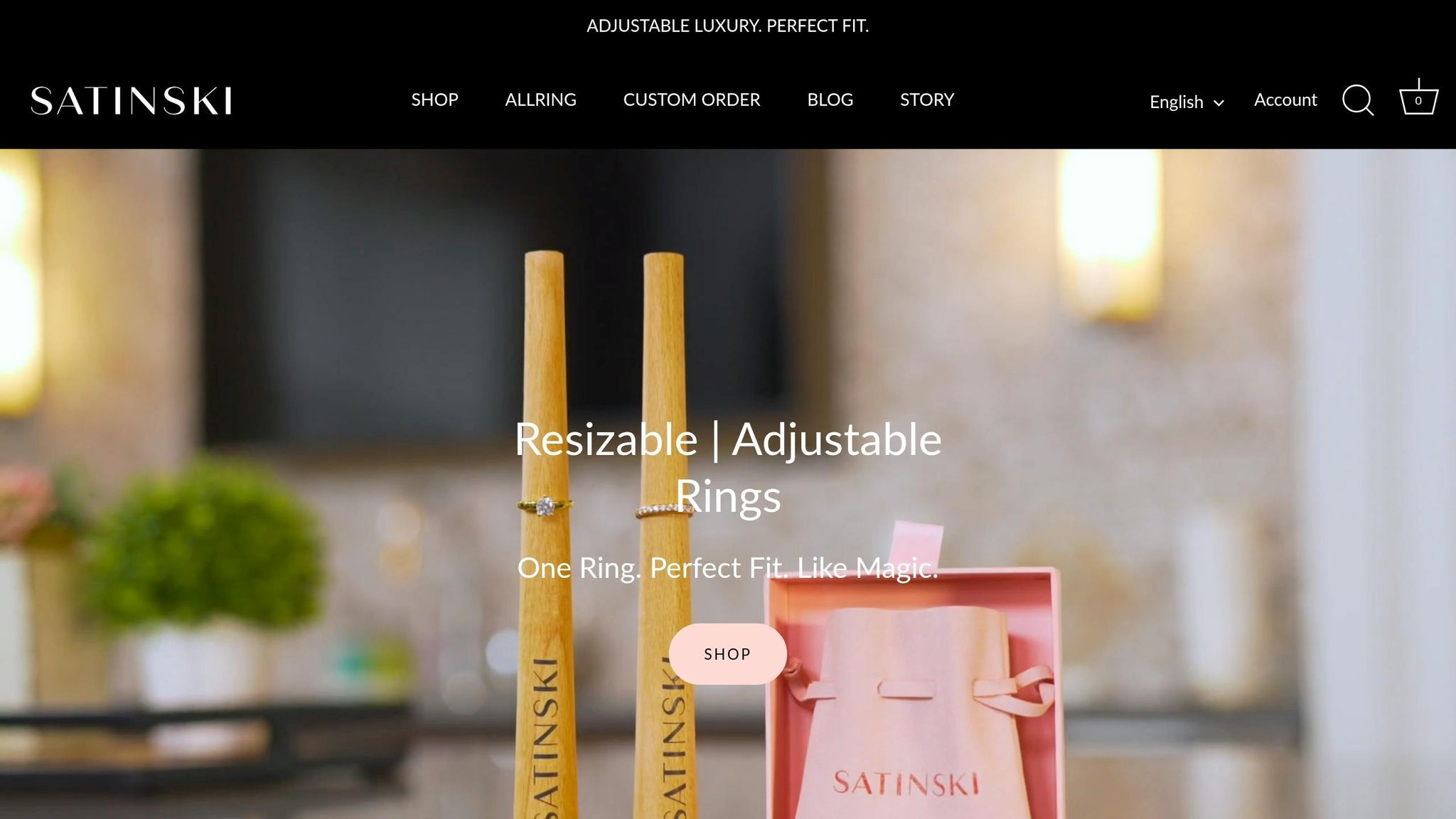
A documented concealed mechanism helps show what this looks like in practice.
Satinski's Allring™ design is a practical example of a hidden adjustable mechanism in everyday rings. The patented system keeps a classic round profile on the outside while the internal band adjusts to the finger, with styles designed to fit U.S. sizes 5 to 9. Satinski's Allring™ shows a concealed adjustable design with a stated U.S. size 5 to 9 range.
Here's a quick comparison of the main designs.
| Design Type | How It Adjusts | Best For | Main Drawback |
|---|---|---|---|
| Open-band | Squeeze or pull the ends | Gifting, casual wear | Visible gap, snagging risk |
| Wrap / bypass | Overlapping ends slide | Fashion, stacking | Can shift or expose gaps |
| Hidden mechanism | Concealed internal system | Everyday and formal wear | Quality varies by engineering |
| Hinged / spring-based | Opens wide, then contracts | Large knuckles, arthritis | More mechanical parts to wear |
When 'One Size Fits Most' Solves Sizing Problems - and When It Does Not
The main issue isn’t how adjustable a ring looks. It’s whether that adjustment lines up with the person’s actual finger shape and size. Adjustable rings can handle some day-to-day change, but only up to a point.
Good Fit: Gifting, Mild Size Changes, and Flexible Everyday Use
An adjustable ring can be a smart pick for gifts when the wearer is likely to fall within the stated size range. In many cases, that range covers common adult ring sizes, so you can get a good fit without needing an exact measurement. That also makes these rings a nice choice for stacking rings or occasional wear, where a fit that’s close - though not perfect - is often fine.
They’re also useful when finger size shifts a bit over time. Seasonal swelling, pregnancy, and arthritis-related inflammation can all cause temporary changes that still fall within the ring’s intended flex. In those cases, an adjustable ring can save you from having to get the ring resized again and again.
Poor Fit: Sizes Outside the Range and Fingers with Tricky Proportions
Problems show up once the finger falls outside the stated range. If the size is below the low end, the band may not close cleanly. If it’s above the high end, the gap can get too wide and the ring may feel less secure.
Some fingers create a tougher fit problem. A large knuckle with a narrow base is the classic example. The ring has to open enough to get over the knuckle, but once it’s on, that same opening can leave the ring spinning at the base. That can create pressure points where the ends of the band sit against the finger. Open-band styles often have a hard time with this setup. Hinged or spring-based designs tend to do a better job. And if a thin open band gets adjusted a lot, it can lose shape over time.
Comparison Table: Adjustable 'One Size Fits Most' vs. Fixed-Size Rings
The trade-offs stand out fast when you put adjustable rings next to fixed-size bands.
| Factor | Adjustable "One Size Fits Most" | Fixed-Size Rings |
|---|---|---|
| Size-range coverage | Usually around U.S. 5–9; actual range varies by design | Single exact size; no built-in flexibility |
| Fit precision | Approximate; good for fluctuation, less exact | High precision once correctly sized |
| Comfort over long wear | Comfortable within range; may pinch or spin outside it | Stable and consistent when properly fitted |
| Durability | Lower for open-band styles with frequent adjustments | Generally stronger; no moving parts or gaps |
| Swelling changes | Strong option; accommodates size changes without resizing | May need professional resizing if size varies a lot |
| Gifting | Low risk when size is likely within range | Higher risk unless exact size is confirmed |
Fit, Comfort, Durability, and How to Decide If an Adjustable Ring Will Work for You
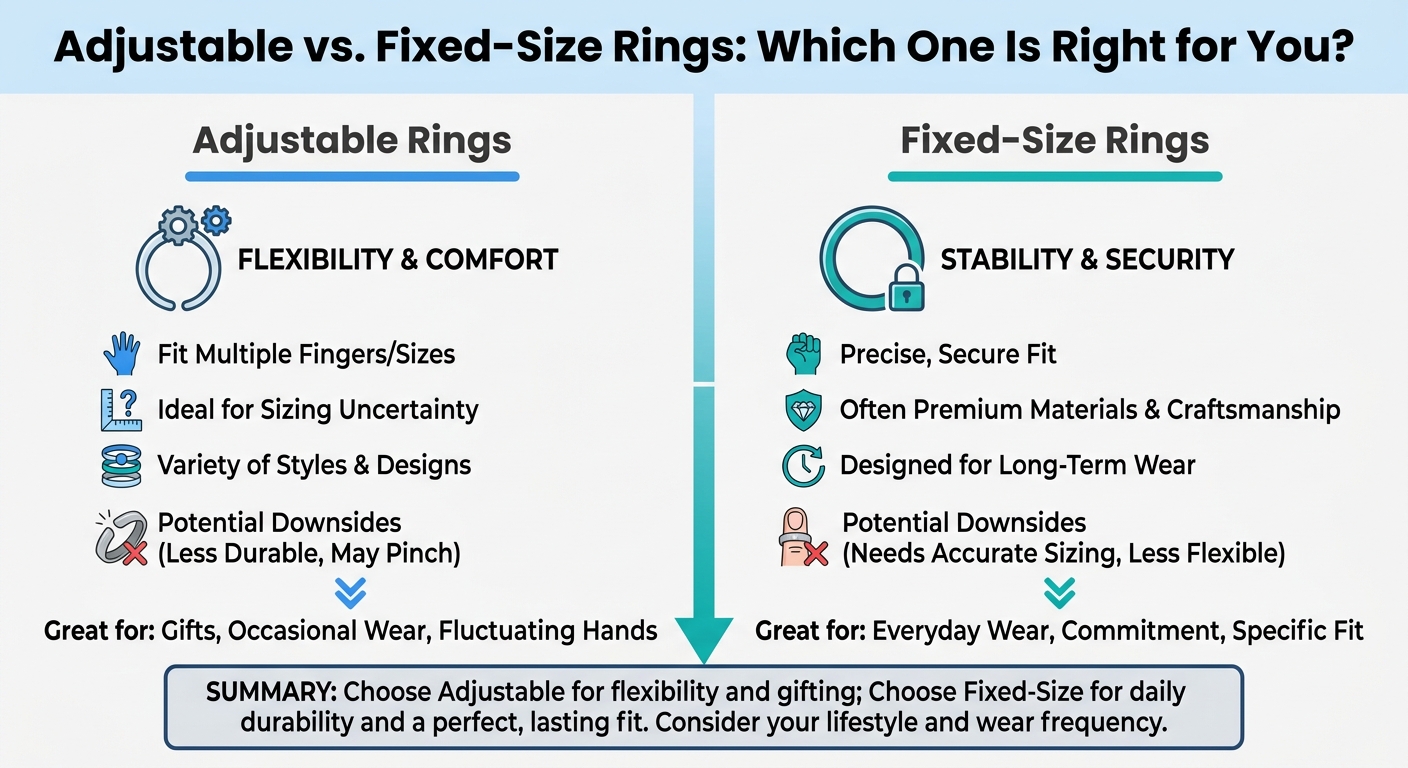
Adjustable vs. Fixed-Size Rings: Which One Is Right for You?
What to Expect from Comfort and Durability
Once you know the size range, the next step is simpler: will the ring feel good on your finger, and will it hold up?
That’s where day-to-day wear tells the truth. Adjustable rings work for more situations, but they usually give up some exact fit and long-term wear life. In plain terms, you get more flexibility, but not always the same locked-in feel as a fixed-size ring.
Design matters a lot here. Concealed mechanisms tend to spread pressure more evenly and snag less than open-band styles. Rounded inner edges and smooth overlaps also matter more than people think. A ring can seem fine for 10 minutes, then start to pinch or rub after a few hours. Those small details are often the difference.
The first parts to wear out are usually the parts that move. Adjustable rings often last 1–3 years with daily wear, compared with 10+ years for a well-kept fixed ring. That gap is hard to ignore. Still, for occasional wear, gifting, or short-term size changes, many people find that trade-off worth it. Lower-cost versions tend to use weaker metal or rougher mechanisms, so the drop-off can happen sooner.
Adjustable rings can also help in very specific cases. People with enlarged knuckles or pregnancy-related swelling often find them easier to live with than a fixed ring.
Decision Table: When an Adjustable Ring Is the Right Choice
Before you buy, check four things: the size range, the mechanism, how often you’ll wear it, and whether your finger size changes. The table below makes that decision a lot easier.
| Your Situation | Adjustable Ring (e.g., US 5–9 range) | Fixed-Size or Resized Ring |
|---|---|---|
| Gifting without knowing exact size | Strong choice; covers most common sizes | High risk of wrong fit |
| Mild swelling (pregnancy, heat, travel) | Works well within the stated range | May need repeated professional resizing |
| Arthritis or enlarged knuckles | Good if designed for easy on-and-off | Often too tight at knuckle or too loose at base |
| Size outside US 5–9 | Poor fit; standard range won't cover it | Better option; get custom or exact sizing |
| Daily wear, all-day use | Moderate; hidden mechanisms perform best | Preferred for stability and long-term comfort |
| Heavy stones or high-value settings | Not recommended; gaps reduce structural support | Strongly preferred for security and durability |
| Large knuckle, slim finger base | Open bands often spin or press unevenly | Ergonomic or custom designs work better |
Conclusion: The Realistic Meaning of 'Most'
"Most" does not mean universal. It means a limited fit window. In practice, that window is usually around US sizes 5–9, which fits a large share of common women’s ring sizes but still leaves out the smallest and largest fingers.
Inside that range, a well-made adjustable ring can be a practical pick for gifting, mild size changes, and moments when you want some flexibility without going to a jeweler.
Step outside that range, though, and the claim gets weaker. The same goes for fingers with a big difference between knuckle size and base size. And if the ring will face daily wear and constant mechanical stress, the limits become even clearer. In those cases, the safer move is to choose this format only when the stated size range and mechanism match your actual fit needs.
FAQs
How do I measure my ring size at home?
Use the size guide on the Satinski website to measure your ring size at home.
If you choose an adjustable ring, you may also get a Satinski Resizing Stick. It helps you make small, precise changes without losing the ring’s round shape. Rings in adjustable US sizes 5–9 can be loosened or tightened for a better fit.
Can I wear an adjustable ring every day?
Yes, you can wear an adjustable ring every day. But how long it lasts comes down to the metal quality and how often you resize it.
Because the band is made to flex, repeated bending can weaken the metal or lead to stress fractures over time. For daily wear, the best move is simple: set it to your size once and leave it there instead of readjusting it often.
What ring style is best for large knuckles?
For large knuckles, an adjustable ring is often the best choice. The open-band design lets the ring widen enough to slide over the knuckle, then tighten for a more secure and comfortable fit.
That solves a common headache: a ring that gets over the knuckle but spins around on the finger, or one that fits the finger yet won't make it past the joint. It can also cut down on the need for permanent resizing.


