

The Real Reason Your Ring Spins: It's Not the Size
If your ring spins but doesn’t fall off, the problem is often not ring size. In many cases, the cause is top weight, a big knuckle with a slimmer finger base, or day-to-day finger changes from heat, cold, and swelling.
Here’s the short answer:
- A heavy top can pull the stone toward your palm
- A ring sized for your knuckle can feel loose once it sits lower
- Finger size can shift by up to 0.5 size during the day
- Hot weather above 85°F can make fingers swell
- The best fix depends on the cause: euro shank, sizing beads, spring insert, adjuster, or hinged shank
Put simply: spinning and being too loose are not the same thing. If your ring stays on, needs a slight push over the knuckle, and still turns later, I’d look at balance and finger shape before I’d resize it.
Here’s a fast way to think about it:
| What you notice | Likely cause | Fix to look at |
|---|---|---|
| Stone turns toward palm | Heavy top | Euro shank or lower setting |
| Tight at knuckle, loose at base | Large knuckle / slimmer base | Sizing beads or spring insert |
| Snug at one time, loose later | Heat, cold, swelling | Adjuster or hinged shank |
| Slides on and off with little effort | Ring is too big | Resize |
A small amount of movement is normal. The goal is not to keep a ring perfectly still. The goal is to help it stay in place most of the time, feel good, and need less adjusting.
Why Your Engagement Ring Spins + 4 Solutions
sbb-itb-9da40c1
The Real Causes of Ring Spinning
Ring spinning usually comes down to one of three things: weight, finger shape, or day-to-day changes in finger size.
Top-Heavy Settings and Weight Imbalance
A ring can spin even when the size is correct. One common reason is uneven weight.
When most of the ring’s mass sits on top of the finger - like with a large center stone, a halo setting, an elevated solitaire, or a three-stone design - the ring isn’t balanced around the band. Instead, the heavier top sits high, and gravity pulls it toward the palm as your hand moves. You’ll often notice this more during gripping, lifting, or typing.
A thin or delicate shank can make the problem worse. There’s simply less metal underneath the finger to offset the heavier top. Large halos and heavy center stones add even more top weight, so the ring is more likely to rotate.
But that’s only part of the story.
Finger Shape, Knuckles, and the Base of the Finger
For many people, the knuckle is wider than the base of the finger. That changes how a ring fits.
To get the ring on, it has to be sized to pass over the knuckle. Once it slides into place, it rests on a narrower part of the finger. That extra space at the base gives the ring room to move, so it can spin even if it felt fine going over the knuckle.
This tends to happen more often with large knuckles, arthritis, or other joint changes. In those cases, the ring may need enough room to clear an enlarged knuckle, but still feel loose once it’s seated. That’s why sizing down isn’t always the answer. A smaller ring might stop the spinning at the base, but it may not go over the knuckle at all.
And finger fit doesn’t stay the same all day. Even if the ring feels right at the knuckle, swelling can shift up and down and change the fit.
Temperature, Swelling, and Time-of-Day Changes
Finger size isn’t fixed. It changes with temperature, activity, and time of day.
On warm days - especially above 85°F - blood flow increases and tissue swells, which makes fingers temporarily larger. In cold weather or heavily air-conditioned spaces, the reverse happens: fingers shrink, and a ring that felt snug earlier can start turning with little effort.
Daily fluctuation can shift ring fit by up to half a ring size.
You might notice this after exercise, while cooking over a hot stove, or after being outside in summer heat. Later, in a cool evening setting, the same ring can feel loose again. So if your ring fits in the morning but spins at night, that doesn’t always mean the size is wrong. Sometimes your fingers are just changing shape over the course of the day.
| Cause | What you'll notice | When it happens |
|---|---|---|
| Top-heavy setting | Stone consistently turns toward the palm | During gripping or hand movement |
| Tapered finger / large knuckle | Ring spins at the base but resists at the knuckle | Throughout the day |
| Temperature and swelling changes | Ring alternates between snug and loose | Cold weather, evenings, or after activity |
The next step is to match the pattern you notice with the right fix.
How to Diagnose Why Your Ring Rotates
Before you pick a fix, spend a day or two noticing when your ring moves and how it moves. That small bit of attention can tell you a lot. Start with the fit at the knuckle, then watch what happens once the ring is on.
Check the Knuckle-to-Base Fit
Slide the ring on and off slowly with dry hands. If it slips over the knuckle with little effort, it's probably too big. But if it needs a slight twist or gentle push to get past the knuckle, then feels looser at the base, that's the classic sign of a larger knuckle with a slimmer finger base.
Once the ring is in place, look at the underside of your finger. If there's a visible gap between the bottom of the band and your skin, the ring has space to turn. That's one of the clearest signs that the ring was sized for the knuckle, not for the spot where it actually sits.
Notice When and How the Ring Moves
The direction and timing matter. If the stone always turns palm-side, even when the ring feels snug and doesn't slide toward your fingertip, that usually points to a top-heavy setting rather than a sizing issue. If the ring drifts around more freely and feels looser in cold weather, it's more likely reacting to temperature-driven finger shrinkage.
Watch the pattern through a normal day or two. A ring that spins more during your morning commute but settles by evening may reflect the way fingers swell a bit later in the day. One that rotates mostly while typing or gripping a steering wheel may be reacting to finger compression during activity.
| Symptom | Most Likely Cause |
|---|---|
| Stone turns palm-side, ring still feels snug | Top-heavy setting / weight imbalance |
| Tight over knuckle, loose at base | Knuckle larger than finger base |
| Looser in cold conditions, snugger later | Temperature-related finger shrinkage |
| Spins during gripping or typing, settles at rest | Finger compression during activity |
| Slides freely, can be shaken upward | Ring oversized |
If the pattern still isn't clear, mark the top of the ring with a marker and track the rotation for one day. A steady off-center shift shows both the direction and the amount of movement. That gives you a much better sense of which fix to try next.
Fixes That Match the Cause
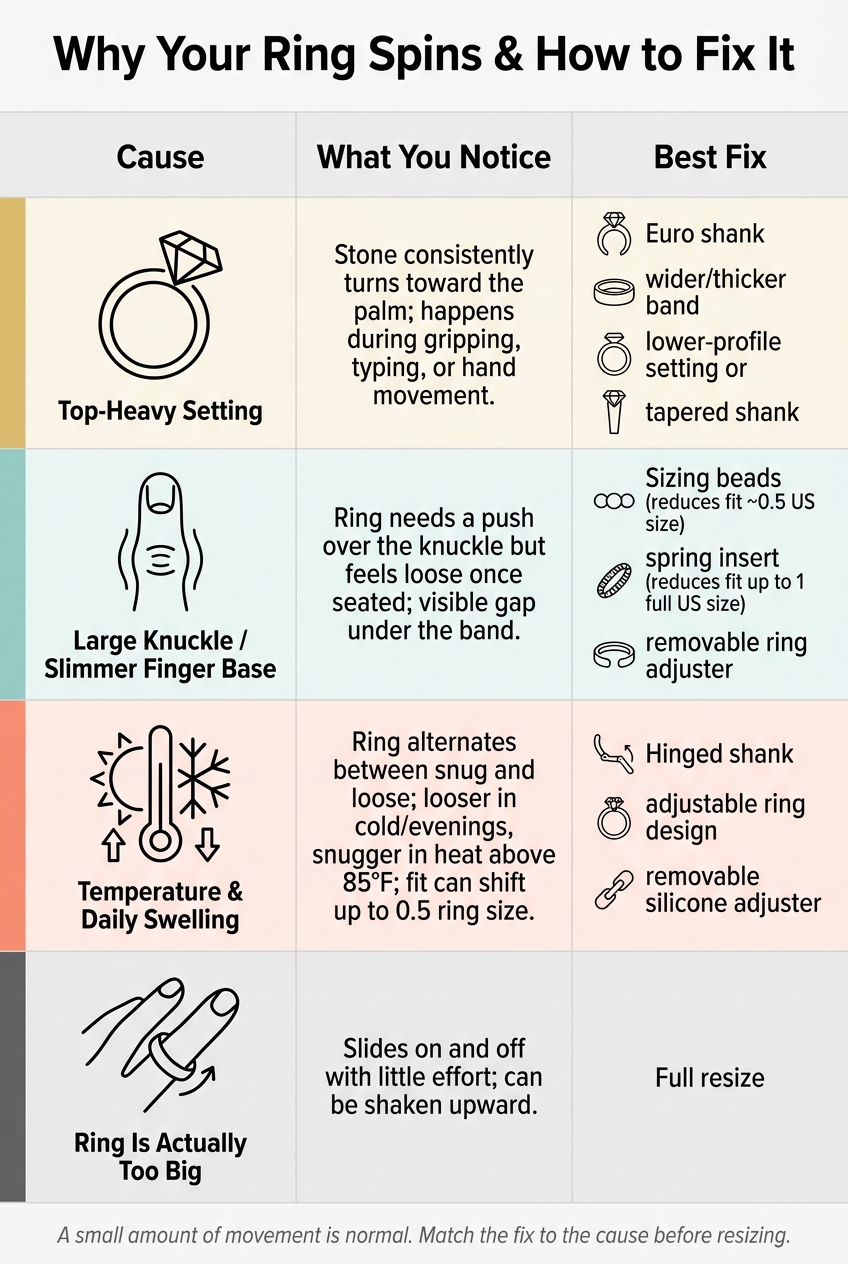
Why Your Ring Spins: Causes & Fixes at a Glance
Once you know why your ring spins, the next step is simple: match the fix to the cause. The right answer depends on whether the issue comes from the ring’s design, your finger shape, or day-to-day swelling.
Design Fixes for Better Balance
If your ring spins because the top is heavier than the band - which is common with solitaire, halo, or elevated settings - the best fix is usually a design change. A euro shank is often the first place to start. It has a slightly flattened or squared-off bottom that makes more contact with your finger and helps hold the ring upright, even when the stone pulls it forward.
| Design Fix | Best For | Main Advantage |
|---|---|---|
| Euro shank | Top-heavy rotation from large stones | Anchors the ring upright at the base |
| Wider or thicker band | General instability, thin bands that roll | More surface contact with the finger |
| Tapered shank | Better balance without extra bulk | Slimmer at the top, wider at the base |
| Lower-profile setting | Stone pulling the ring to one side | Cuts top weight by sitting the stone closer to the finger |
A wider or thicker band can also help. More band against the finger usually means less rolling. A tapered shank works in a similar way, giving you a ring that feels lighter up top but has more support at the base. And if the center stone sits high and keeps tipping the ring, a lower-profile setting can help by bringing that weight closer to your finger.
Comfort-Fit Changes Without Full Resizing
If your ring goes over the knuckle just fine but shifts around once it’s at the base of your finger, a stabilizing insert often makes more sense than shrinking the whole band. A full resize can solve one problem and create another by making the ring harder to remove.
Sizing beads are one of the most common fixes. These are small metal beads soldered inside the band. They take up just enough interior space to slow the spin while still letting the ring slide over a larger knuckle. In many cases, they reduce the effective fit by about half a U.S. size.
A spring insert does more. It’s a horseshoe-shaped liner that covers most of the inside of the band. It can reduce the effective size by up to a full U.S. size while still flexing enough to pass over a larger knuckle.
If you’re not ready for permanent work, removable ring adjusters - like silicone coils or clip-on guards - give you a low-commitment way to test different thicknesses and see what feels best before you head to a jeweler.
Hinged and Adjustable Options for Fingers That Change Size
If your finger size changes during the day, a fixed band will keep shifting with it. When the knuckle is much larger than the base of the finger - or when arthritis makes taking a ring on and off painful - a hinged shank is often the most practical fix. It opens to get over the knuckle, then closes for a snug fit at the base, so the ring no longer has to be sized for the knuckle at all.
For fingers that change size through the day, adjustable rings and hinged shanks help keep the fit steady without repeated resizing.
Conclusion: Match the Fix to the Cause
A spinning ring usually isn't a size issue. Most of the time, it comes down to weight balance, the way the ring passes over the knuckle, or day-to-day swelling. If you resize the ring before you pin down the cause, you can end up trading one fit problem for another.
Before you call a jeweler, wear the ring for a few days and pay attention to what it's doing. Notice when it spins. See whether the top keeps dropping toward the palm. That pattern tells you a lot, and it helps point you to the right fix instead of a guess.
Once you know what's causing the movement, the next step gets much clearer. Top-heavy rings often do better with a euro shank or a wider base. If your knuckle is larger but the base of your finger is slimmer, sizing beads or a discreet adjuster can help. If your finger size shifts through the day, a hinged or adjustable design may make more sense.
A little rotation is normal. The goal isn't to make the ring sit like it's glued in place. The goal is simpler than that: a ring that stays upright most of the time, feels good to wear, and doesn't need constant fiddling. For most spinning rings, the fix starts with the cause.
FAQs
Can a ring spin and still fit correctly?
Yes. A ring can fit well even if it spins a bit. The key is this: it should move over your knuckle without a struggle, then rest at the base of your finger without pinching or leaving marks.
A ring may spin when the fit is a little loose, or when your finger size shifts during the day. That can happen because of temperature, exercise, or swelling. In cases like that, an adjustable style - such as an expandable open-band resizable ring - can help it stay in place better without the need for immediate resizing.
How do I know if my ring is top-heavy or just too big?
A top-heavy ring spins because the setting weighs more than the band, which pulls the ring downward and shifts the center of gravity toward your palm. A ring that’s too big will move around your finger no matter how much the setting weighs.
If the ring spins but still feels snug and goes over your knuckle comfortably, the issue is probably a weight imbalance. If it rotates, feels loose, or slips off with little effort, it’s probably too large.
Which fix works best for a big knuckle and loose base?
For a ring that needs to get over a large knuckle but then sits loose at the base, sizing beads placed inside the band are often the best fix a jeweler can make. They help cut down on spinning while still letting the ring slide over the knuckle.
If you want something with more give, adjustable rings can open up to pass over swollen joints and then tighten for a better fit at the base, all without a permanent change.


