

Why Jewelers Won't Resize Some Rings - and Never Explain Why
Sometimes “we can’t resize it” means “we shouldn’t touch it.” In most cases, the problem comes down to metal, design, or wear. Rings made from materials like tungsten, ceramic, titanium, or stainless steel can crack, resist soldering, or fail under heat. Styles like eternity bands, tension settings, pavé bands, channel-set rings, and very thin shanks can lose shape or loosen stones during a size change.
Here’s the short version: most jewelers treat 1 to 2 U.S. sizes as the usual limit for routine resizing, and stone-set work can run about $120 to $350. If a ring has plating, engraving, old repairs, or age-related weak spots, the job can leave a visible seam, color mismatch, or stone-loss risk. At that point, the repair may cost close to - or more than - the ring itself.
If I were deciding what to do, I’d keep these points in mind:
- Safe to resize most often: plain gold, silver, or platinum bands with a smooth lower shank
- Often refused: full-eternity bands, tension-set rings, thin bands, heavily engraved rings, and many vintage pieces
- Material problems: brittle metals and heat-sensitive materials can crack, warp, or burn
- Why jewelers stay brief: risk, blame, and repair bills
- Other options: ring guards, sizing beads, spring inserts, hinged shanks, or a remake
If a jeweler says no, that answer is usually about avoiding damage - not avoiding the job.
Sizing a Ring Down - Without Sizing a Ring Down | Jewellery Repair Tutorial | @jacothejeweller
sbb-itb-9da40c1
The Real Reasons Some Rings Should Not Be Resized
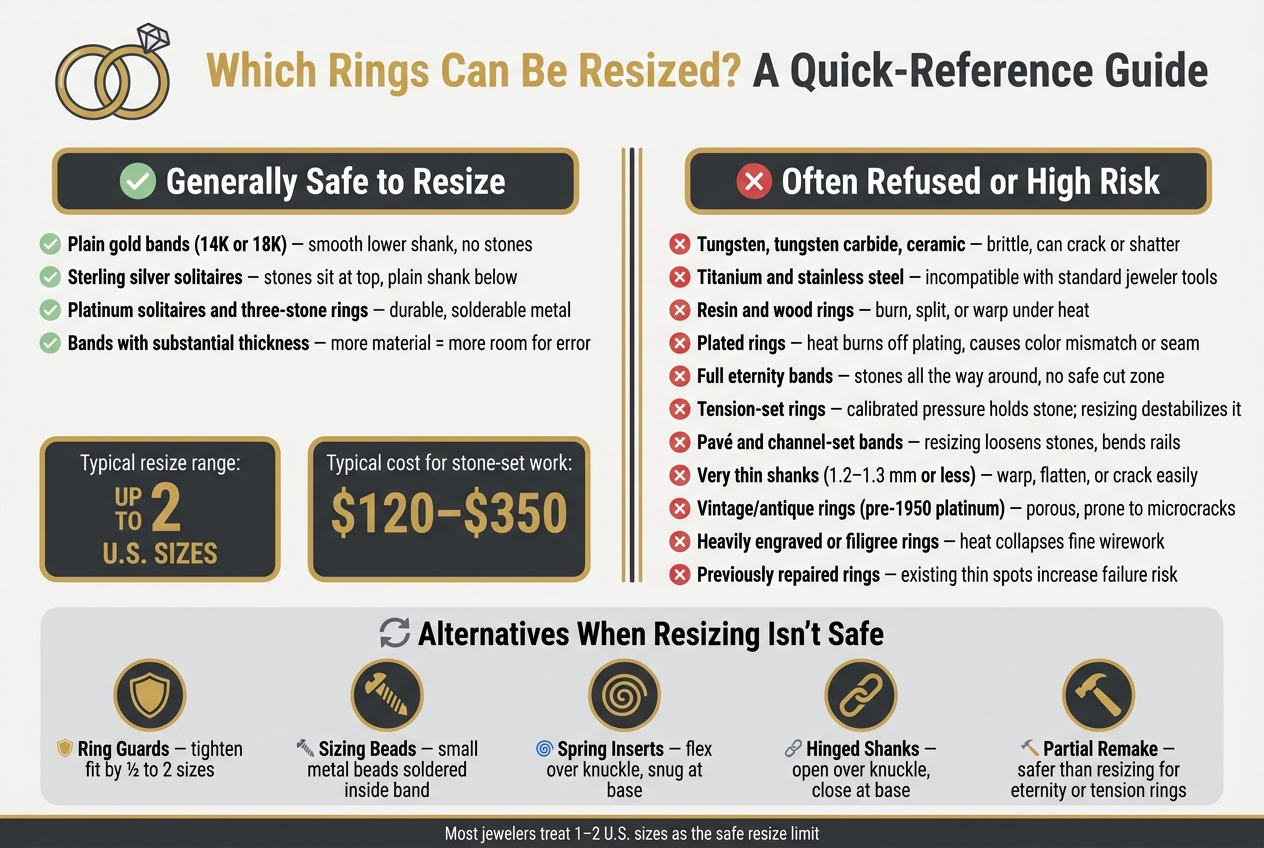
Which Rings Can Be Resized? A Quick-Reference Guide for Jewelers and Buyers
Those limits usually come down to three things: material, setting, and age. The toughest jobs almost always fit one of those buckets.
Metals and materials that cannot be resized
Some ring materials just don't handle resizing well. Tungsten, tungsten carbide, and ceramic are very hard, but they're also brittle. That means a cut can crack the ring or even shatter it. Titanium and stainless steel bring a different problem: they can't be resized cleanly with standard jeweler tools.
Other materials have their own weak spots. Resin and wood can burn, split, or warp under heat. And even if a repair seems possible, the process can still hurt the ring's finish, color, or strength. If you're drawn to these materials, it's smart to ask the retailer about exchange programs before you buy.
Plated rings are a separate issue. The heat used during resizing can burn off the plating or leave scars in the work area. In many cases, the ring then needs replating, which adds cost and may still leave a seam or slight color mismatch.
Even when the metal itself can take the heat, the design may not.
Settings and designs that become unstable when resized
Sometimes the metal isn't the problem at all. The design is.
Eternity bands are a classic example. Because stones go all the way around the shank, there isn't a plain section of metal where a jeweler can make a safe cut. Any resize breaks that continuous pattern.
Tension-set rings are another high-risk case. These rings depend on calibrated pressure to hold the center stone in place. Change the size even a little, and that pressure can shift enough to make the stone less secure. Many jewelers won't touch them for that reason.
Pavé bands and channel-set bands run into similar trouble. A size change can affect the ring's circumference, which may loosen stones, throw off spacing, or bend the rails that hold the stones in place. Very thin bands - about 1.2 to 1.3 mm or less - also don't have much room for error. They can warp, flatten, or crack more easily than thicker bands.
Older and custom rings add one more layer of risk: hidden weak spots from wear, engraving, or past work.
Vintage, engraved, and custom rings with structural weak points
A ring can look sturdy and still be a bad candidate for resizing.
Antique alloys, especially pre-1950 platinum, can be softer and more porous than modern metals. Heat can also cause microcracks in engraved grooves. Hand engraving, filigree, and milgrain details are at special risk because the resize cut may run straight through delicate surface work, or the heat can make fine wirework collapse.
Rings that have been resized or repaired before can be even trickier. They may already have thin spots, stressed joints, or tiny cracks you can't see at a glance. And each repair makes the next one riskier, which matters a lot with heirloom or vintage pieces.
In these cases, a failed resize doesn't just affect wearability. It can damage the ring's structure and lower its value. That's often why a jeweler may keep the answer short: the risk isn't cosmetic. It's structural, financial, and permanent.
Why Jewelers Often Avoid Explaining All of This
The short answer is deliberate. When a jeweler gives you a quick no, that often comes from judgment, not dodge-and-weave behavior. The main issue usually isn't just can this ring be resized? It's whether the ring should be resized at all.
Liability, reputation, and the risk of making things worse
Even if resizing is possible, a jeweler may still turn down the job because the odds of visible damage are too high. Soldering can leave a seam you can see, a color mismatch, or a band that's less strong than before. Big size changes can make the shank thinner, throw off the ring's round shape, and weaken the band. With pavé or channel-set rings, the heat and pressure from the work can loosen prongs, which may cause small stones to shift or fall out later.
And here's the hard part: customers judge the outcome, not the risk calculation behind it. A slightly uneven band or a discolored seam doesn't look like a design limit. It looks like bad repair work. In the U.S., if a jeweler damages a ring during repair, they may be on the hook for the repair or replacement cost, sometimes through small-claims court. That's a big reason many jewelers stop at "no" instead of walking through the full technical story.
When the labor or remake cost does not make sense
Some jobs get refused for a simpler reason: the math doesn't work. The ring may be resizable, but doing the job the right way can cost more than most people expect. On lower-value rings, the labor bill can end up higher than the ring itself.
That's why the next thing to ask is whether a ring is easy to resize before you buy it.
That leads to the practical question: which ring styles are safest to resize?
What to Do Before You Buy or Alter a Ring
How to spot rings that are easy to resize
Once you know why resizing can go wrong, the next step is figuring out which rings are still safe to change. Start with the lower shank. If that part of the band is smooth and plain, the jeweler usually has space to cut and join the ring back together. But if the design goes all the way around the band, that working space is gone.
Solitaire and three-stone rings made from solid 14K or 18K gold, platinum, or sterling silver are usually the easiest to resize. That’s because the stones sit near the top, while the lower shank stays plain. It also helps if the band has a bit of substance. Very thin shanks have less room for error and are more likely to bend or crack during resizing.
Questions to ask a jeweler before purchase or repair
Use these questions before you buy a ring or leave it with a jeweler.
| Question | Why It Matters |
|---|---|
| Can this ring be resized later? | Checks whether the design allows resizing at all |
| How many U.S. sizes can it safely go up or down? | Sets a clear limit before any work starts |
| Will resizing affect the stones, engraving, or finish? | Points out risk to stones, pattern, or surface finish |
| Will this require re-plating or re-polishing after the work? | White gold often needs rhodium re-plating |
| Will resizing void the warranty? | Some retailers void lifetime warranties if a third-party jeweler does the work |
| Can I get the answer in writing? | Gives you something to refer back to if the result isn't what was agreed |
The answers can tell you pretty fast whether resizing makes sense or whether it’s asking for trouble.
When replacement, remake, or sizing aids are the better choice
If a ring doesn’t pass the resize check, don’t push for a repair that isn’t a good fit. In many cases, sizing aids make more sense. If the ring is only a little loose, or your finger size shifts because of arthritis, pregnancy, heat, or medication, a permanent resize may not be the right move.
Ring guards, spring inserts, and sizing beads can help without cutting the band. Ring guards and adjusters can tighten the fit by about 1/2 to 2 sizes. Spring inserts let the ring open a bit over the knuckle, then rest more snugly at the base of the finger. For larger knuckles or swelling, hinged or adjustable shanks can get over the knuckle and then close more snugly once in place.
If the ring is a full-eternity band, a tension setting, or a heavily decorated vintage piece, a partial remake or full redesign is often safer than trying to resize it. In those cases, adjustable or custom-fit construction is usually the better option.
A Better Fit Strategy: Adjustable and Custom-Fit Rings
When adjustable rings make more sense than resizing
If a ring fails the resize test, an adjustable design can fix the fit issue without cutting the metal. In some cases, standard resizing just isn't the right move.
If your finger size changes often due to pregnancy, weight changes, arthritis, or temperature-related swelling, a fixed resize may stop fitting the way you need it to. Finger size can shift with heat, swelling, and day-to-day activity.
Adjustable rings also help when a band needs to slide over a larger knuckle but still fit snugly at the base of the finger. That's often the case with arthritis or swelling. Instead of forcing a one-size-fits-all fix, adjustability gives you more room to work with.
It also makes gift buying a lot less stressful. If you don't know the recipient's exact size, an adjustable ring that covers U.S. sizes 5–9 gives you a usable starting point without needing an immediate resize. That's where integrated adjustable rings tend to be the cleaner option.
How Satinski addresses common ring-sizing problems
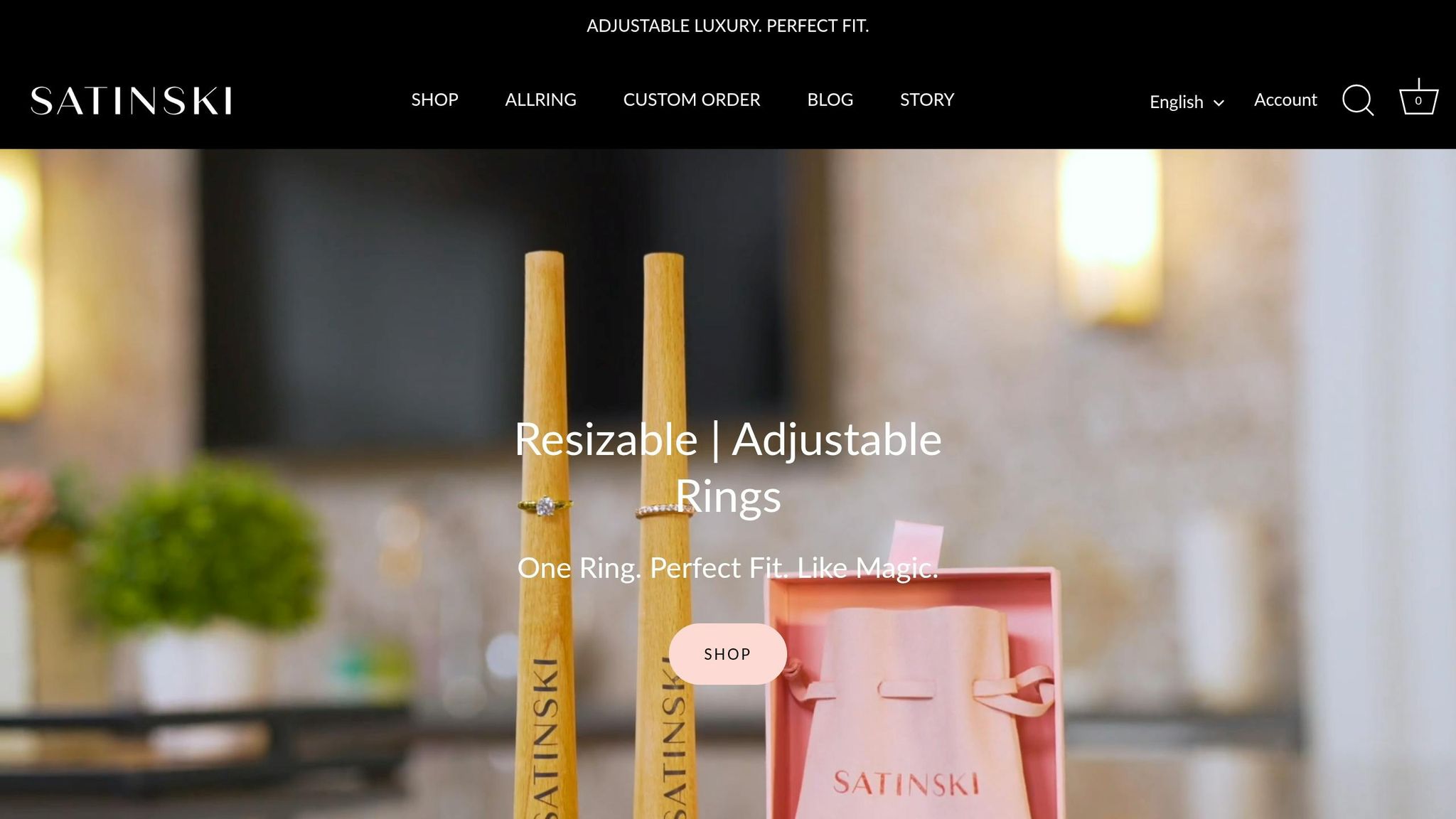
When resizing could damage a ring or still leave the fit off, built-in adjustability can solve both problems at once. Satinski builds adjustability into its rings with hidden adjustment mechanisms placed inside the band, so the outside still looks like a plain band. When worn, the mechanism stays out of sight.
Satinski's rings are made from sterling silver and 18K gold. The usual adjustable range covers U.S. sizes 5–9. For buyers outside that range, or for people with fit issues like unusually large knuckles or a very small finger base, Satinski also offers custom orders for those sizes and shapes.
Here’s the basic pricing:
- Adjustable rings start at $70
- Engagement rings start at $90
- Custom orders are priced based on the design
That shifts the next step in a practical way: buy for fit now, instead of planning for a repair later.
Conclusion: How to avoid costly damage and choose with confidence
The main issue is pretty simple: a ring's material, setting, and build can make resizing risky or not possible at all. A jeweler may turn down the job without much detail, partly because of liability concerns and partly because the repair cost may be more than the ring is worth.
Ask a few direct questions:
- Can this ring be resized?
- How far can it be resized?
- What will it cost?
If the answer isn't clear, an adjustable or custom-fit ring is often the safer path.
FAQs
Can a ring be resized more than once?
Yes, but only in limited cases.
Most rings can be resized up or down by about 1–2 sizes. That’s the usual safe range for standard resizing. Go beyond that, or do it again and again, and the band can get weaker over time. At that point, the risk of cracking or other structural damage goes up.
Some rings can’t be resized at all. That includes eternity bands and rings made of titanium or tungsten. So if a ring falls into one of those groups, resizing it more than once isn’t even on the table.
How can I tell if my ring is too risky to resize?
It mostly comes down to the ring’s design and material.
Some rings are much harder to resize than others. Eternity bands, tension-set rings, and rings with detailed patterns, engravings, or delicate gemstones can be risky. In many cases, resizing can damage the setting or alter the design.
The metal matters too. Rings made from tungsten and titanium usually can’t be resized at all.
Before you do anything, have a professional jeweler look at your ring and tell you what’s possible.
Is a ring remake better than resizing?
It depends on the ring’s design and what you need from it.
Traditional resizing means cutting and soldering the metal. That can weaken the ring over time, especially if it’s resized more than once. It can also put intricate settings and engravings at risk.
If you’re dealing with an heirloom or a ring with a more complex design, professional resizing is often the better route. It helps protect the ring’s value and keeps its look intact.
Adjustable rings, on the other hand, give you more flexibility. They’re a non-invasive pick if your ring size changes often.


