

What Can Go Wrong With a Custom Ring - and How to Avoid It
A custom ring can go wrong in four main ways: fit, comfort, build, and cost. If I wanted to avoid the biggest mistakes fast, I’d confirm the size twice, choose materials that can handle daily wear, review the ring in CAD and a sample model, and get every change in writing before paying the final bill.
Here’s the short version:
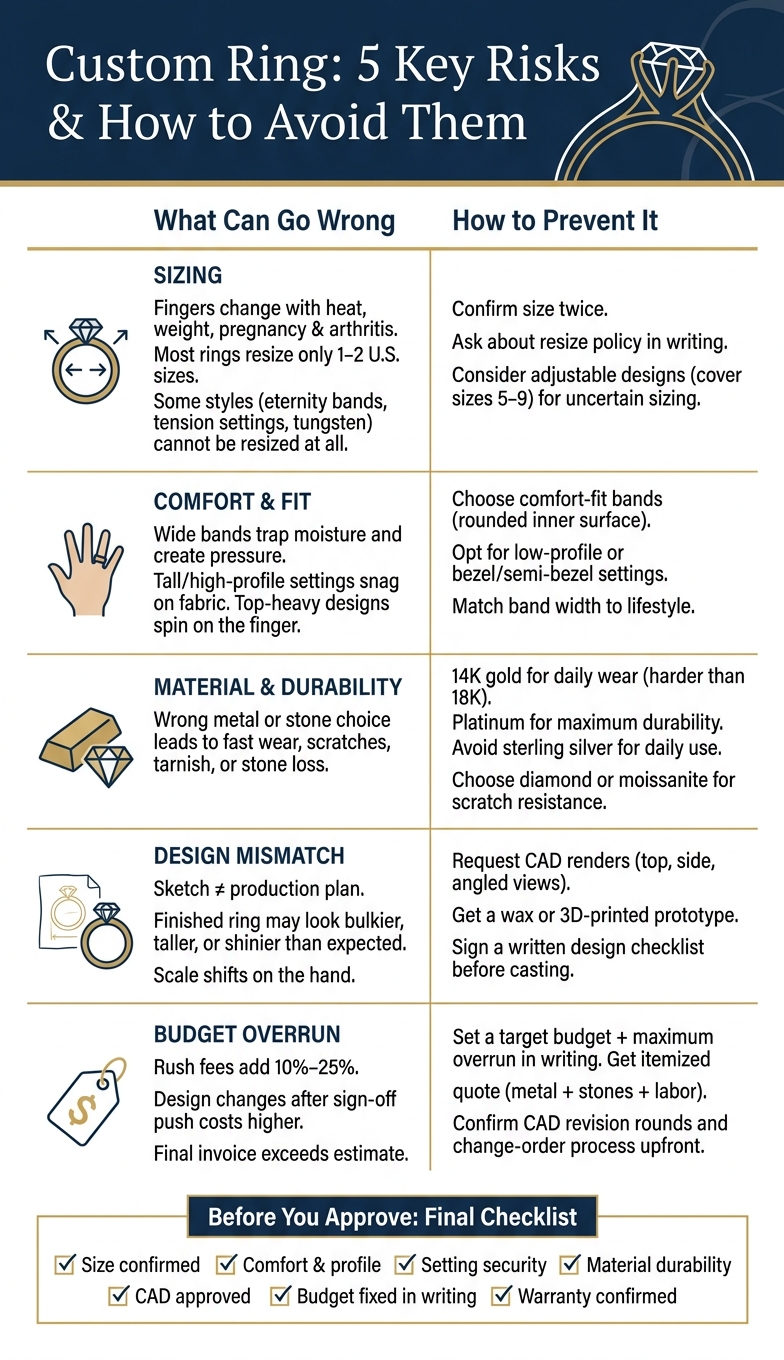
- Sizing is the first risk. Fingers change with heat, weight, pregnancy, and arthritis. Many rings can only be resized about 1–2 U.S. sizes, and some styles cannot be resized at all.
- A ring can fit but still feel bad. Wide bands, tall settings, and top-heavy designs can rub, spin, or snag on clothes and gloves.
- Material choice affects wear. 14K gold usually holds up better than 18K for daily wear. Platinum is strong but heavier. Sterling silver is softer and better for less frequent use.
- Design details matter. Bezel or semi-bezel settings, comfort-fit bands, and lower profiles can cut down on snagging and stone loss.
- The finished ring may not match the sketch. A sketch is not a build plan. CAD views, wax or 3D models, and a written checklist help catch problems before casting.
- Costs can drift. Rush work can add 10%–25%, and small design changes can push the total past your budget.
| Risk | What I’d check before approval |
|---|---|
| Wrong size | Sizing method, resize policy, and whether the style can be resized |
| Poor comfort | Band width, inside shape, setting height, and ring balance |
| Fast wear or damage | Metal hardness, stone type, prong thickness, and setting style |
| Design mismatch | CAD from top/side/angle, plus a wax or 3D sample |
| Budget overrun | Written quote, revision limits, change-order costs, and warranty |
If I were ordering a custom ring, I’d treat the approval step like a final inspection: size, profile, materials, setting, finish, and total price in writing. That is how I’d cut down the odds of paying hundreds or even thousands of dollars to fix a ring that never felt right.
Custom Ring Risks & How to Avoid Them
Sizing Problems and How to Avoid Costly Resizing
Why Custom Rings End Up Too Tight, Too Loose, or Unstable
Sizing is usually where ring problems start. The hard part is simple: finger size doesn't stay the same. It can change throughout the day, shift with the weather, and move over time. Pregnancy can lead to enough water retention to make a ring that once felt fine impossible to wear. Weight changes can alter finger circumference over a period of months. Arthritis adds another layer. In some cases, the knuckle gets larger while the base of the finger stays narrower, so the ring must be big enough to pass over the knuckle but then spins once it's on.
Custom rings face more risk here. Online orders, surprise proposals, and relying on a single measurement all make sizing mistakes more likely. And a custom ring isn't like a stock piece you can just swap out. If the fit is wrong, you're often looking at resizing or even a redesign, which can mean costly rework.
Even then, resizing isn't always simple. Most standard rings can only be adjusted safely by about 1-2 U.S. sizes before the metal gets too thin or the design starts to warp. Some styles can't be resized at all. Full eternity bands, tension settings, and rings made from tungsten carbide or ceramic either can't be resized safely or need a full rebuild.
That's why it makes sense to think about adjustability before the ring is made.
Resizable and Adjustable Ring Designs as a Sizing Solution
If finger size may change, or if you're ordering online without total certainty, an adjustable ring can cut down the risk. Satinski's adjustable rings use a hidden sliding mechanism inside the band, so the outside still looks like a regular ring. These designs cover U.S. sizes 5-9, which lets one ring handle pregnancy swelling, seasonal shifts, or weight changes without extra metalwork.
That range works for engagement rings, wedding bands, and stackable styles. If you're planning a surprise proposal and don't know the exact size, or if the wearer deals with arthritis or frequent swelling, built-in adjustability is a practical option. It's a lot better than hoping your first guess lands perfectly.
One material detail matters here. If the ring will be adjusted often, 14K solid gold tends to hold up better than gold vermeil at the sliding contact points. Vermeil can wear down from repeated friction and expose the silver base underneath. That's a big deal if the ring will be adjusted every day.
What to Confirm Before Placing Your Order
Before production starts, get the jeweler's sizing and resizing terms in writing. Once a deposit is paid, that paperwork matters.
Ask about:
- how the size will be measured
- whether the measurement will be checked more than once
- how many sizes the design can be adjusted safely
- whether side stones or engraving could be affected by resizing
- what resizing is included, and what costs extra
Many jewelers offer one free resize within a short time window. Free resizing for the long haul is uncommon. So before you approve the order, make sure you know what the policy covers and what the ring's design will actually allow.
Once fit is set, the next issue is comfort and daily wear.
sbb-itb-9da40c1
Comfort, Lifestyle, and Durability Problems
When a Ring Looks Right but Feels Wrong
A ring can be the right size and still feel off in daily life. That happens more than people expect.
Wide bands are a common issue. They can make simple things feel awkward, like typing, driving, or lifting weights. They also tend to trap moisture during workouts or frequent handwashing, and they can push into the fingers next to them. Sharp edges make that worse by creating pressure points.
High-profile settings cause their own headaches. A tall solitaire or cathedral mount may look great in a box, but in day-to-day wear it can snag on sweaters, hair, or gloves. Low-profile or flush settings sit closer to the finger, so they usually work better for people with active routines. Another problem: a heavy top setting paired with a thin shank can make the ring spin, especially if the knuckle is wider than the base of the finger.
Once the ring feels good on your hand, the next step is making sure the materials can handle daily wear.
Matching Metal, Stone, and Setting to Daily Wear
What you pick at the design stage has a big effect on how the ring wears over time.
For daily use, 14K gold is a smart pick. It’s harder than 18K, so it stands up better to scratches and dents. 18K gold has a deeper color, but daily wear usually means more polishing. If durability is the top goal, platinum is a strong option. It holds settings well, doesn’t tarnish, and feels heavier on the finger. Sterling silver is softer, bends more easily, and tarnishes faster, so it’s better for occasional wear.
For stones, diamond and moissanite both work well for everyday use. Each resists scratching in normal wear. Moissanite costs much less at a similar size, which makes it a practical pick for buyers who want a stone that lasts without the higher price tag.
Design Choices That Reduce Snagging, Loosening, and Damage
Some design details make a ring much easier to live with.
- Comfort-fit bands have a softly rounded inner surface. That shape spreads pressure more evenly and helps cut down on pinching when you grip, lift, or type for long stretches. They’re worth asking for if you work out, drive a lot, or spend hours at a keyboard.
- Bezel and semi-bezel settings cover the stone’s edge with metal. That helps protect the stone from chips and lowers the chance of snagging that comes with exposed prongs. For hands-on work, a bezel is a practical pick. If you like prongs, ask for slightly thicker, well-finished prong tips in 14K gold or platinum. They keep tension longer and are less likely to catch on fabric.
Wear shows up little by little, not all at once. That’s why routine checks matter. Have daily-wear rings inspected every 6 to 12 months. If a prong feels loose, fix it fast before a stone falls out.
Don’t Gamble on a Custom Engagement Ring
Vision Mismatch and Budget Overruns
Once fit and wearability are sorted out, the next risk is simpler but just as frustrating: the ring can look different from what you approved, or cost more than you planned.
Why the Finished Ring Can Look Different From the Sketch
A sketch is a visual guide. It is not a production plan.
That gap matters. A ring made for daily wear needs enough metal and the right proportions to hold up over time. Because of that, the finished piece can end up looking bulkier or less delicate than the original drawing.
Scale can shift on the hand too. Proportions that look balanced on paper may feel very different once the ring is actually on your finger.
Finish is another place where people get tripped up. Polish, matte, and satin can look very different in person, so it helps to spell out the finish in writing instead of relying on a quick verbal note.
How CAD Previews, Wax Models, and Design Checklists Prevent Surprises
The best way to close that gap is to review the design as CAD, not just as a sketch. Ask for CAD renders from the top, side, and angled views. The side profile matters a lot because it shows setting height and can reveal a bulky underside structure that may not stand out in a top view.
It also helps to request a wax or 3D-printed prototype made from the production CAD file. That gives you something you can actually try on. You can check if the band feels too wide between your fingers and see if the height catches when you curl your hand. It won't show sparkle, but it will show scale, bulk, and comfort before casting.
A signed design checklist makes all of this much safer. It turns casual conversations into a written record. Before you approve anything, confirm these details in writing:
- Size
- Band width
- Thickness
- Setting height
- Metal
- Stone
- Finish
- Stacking plan
- Adjustability
If something changes after sign-off, it should go through a written change order that includes the cost impact.
The fix is pretty straightforward: lock the design in writing before casting starts.
How to Keep a Custom Ring Within Budget
Custom ring prices in the U.S. can climb fast because metal, stone, and labor choices stack up. Setting complexity, hand engraving, pavé work, and rushed timelines all add labor costs. Rush fees can add 10%–25%.
The practical move is to set a target budget in USD and a maximum overrun you're willing to accept, then share both numbers upfront. Ask for a written quote with a clear breakdown of metal, stones, and labor. You should also confirm how many CAD revision rounds are included, what the payment schedule looks like, and what the warranty covers.
This helps you avoid the classic problem where the estimate sounded fine at first, then the invoice drifted upward with each change.
| Common Problem | What Goes Wrong | Preventive Step |
|---|---|---|
| Vision mismatch | Ring looks larger, taller, or more ornate than expected | Request CAD renders from top, side, and angled views and sign a detailed design checklist before casting |
| Finish disappointment | Ring is too shiny or too dull compared with the concept | Specify the exact finish in writing and review physical or digital examples if possible |
| Budget overrun | Final invoice exceeds the estimate | Set a target budget plus a maximum overrun you will accept; require written approval for any change that affects price |
Conclusion: A Custom Ring Should Fit Your Hand, Life, and Budget
After sizing, comfort, and budget, there’s one last step before you approve the design: a final check.
A custom ring is only worth buying if it fits well, feels good to wear, and stays within your budget. Get those details in writing before production begins. For daily wear, choose metal and stone pairings that can handle everyday use. CAD renders, wax models, and a signed checklist can catch small issues before they turn into expensive fixes.
Use this checklist to catch the last avoidable mistakes.
A Short Checklist to Review Before You Approve the Design
- Size flexibility - Is the ring resizable? And is one resize included?
- Comfort and profile - Do the width, height, and inside shape feel right for daily wear?
- Setting security - Is the setting secure enough for the way you’ll wear it?
- Material durability - Are the metal and stone strong enough for daily wear?
- Preview approval - Have you approved the final CAD views and the correct file version?
- Budget cap - Is the total cost in USD fixed in writing, with a clear change-order process?
- Warranty and aftercare - What does the warranty cover, and are any inspections required?
Review and sign a one-page checklist before production starts. Only sign off after each item has been confirmed in writing.
FAQs
How do I know if my ring style can be resized later?
Ask if the design will be hard - or even impossible - to resize later. Some styles, like eternity bands with stones all the way around, plus closed or tension settings, can call for major structural changes.
If resizing options are limited, look into an adjustable or resizable band with a hidden mechanism. And before you buy, confirm the jeweler’s resizing limits and policies.
What ring design is best for everyday wear?
For everyday wear, go with a hard-wearing stone like diamond or moissanite, a secure low-profile setting that won’t snag as easily, and a durable metal such as platinum or 14K/18K gold.
If your finger size tends to shift, an adjustable ring can make day-to-day wear much easier. It can handle swelling, temperature changes, and activity without the hassle of repeated resizing. Satinski’s hidden adjustable mechanisms fit sizes 5–9.
What should I approve before production starts?
Before production starts, approve the CAD preview or wax model so you can check the final design.
Also review the written agreement for materials, labor, and design details. Make sure it spells out metal choice, stone-setting durability, warranty terms, resizing policies, and your design checklist, so your expectations are clearly on record.


