

Custom vs Ready-Made Rings: When Bespoke Is Genuinely Worth It
Most people do not need a custom ring. If your size is standard, your style is simple, and your deadline is short, a ready-made ring is usually the better pick. But if fit is hard, you want to reuse heirloom stones, or you need control over metal, setting, or band shape, custom can be worth the extra time and money.
Here’s the short answer:
- Choose ready-made if you want a ring fast, want a clear price, and like a simple look.
- Choose custom if stock rings do not fit well, if you are redesigning family jewelry, or if the ring needs specific details.
- Choose adjustable or resizable if your finger size changes often due to swelling, pregnancy, weather, or larger knuckles.
A few numbers make the choice easier:
- Ready-made rings can start around $70 to $90
- Custom work often starts around $1,200 to $2,000+
- Full custom timelines are often 4 to 12 weeks
- Gold vermeil replating may cost about $30 to $100 every 1 to 3 years
- 14K solid gold adjustable rings often hold up better for daily wear than vermeil
If I had to boil the whole article down to one line, it would be this: pick the ring type based on the problem you need to solve - speed, fit, price, or meaning.
Quick Comparison
| Option | Best for | Price range | Timing | Main tradeoff |
|---|---|---|---|---|
| Custom | Hard fit issues, heirloom resets, exact design choices | $1,200 to $8,000+ | 4 to 12 weeks | More time, higher cost, fewer returns |
| Ready-made | Fast orders, lower budgets, simple styles | $70 and up | Days | Less control over details and fit |
| Adjustable / Resizable | Size changes, gifts, stacking, swollen fingers | Varies by metal and design | Often fast | Wear at flex points over time |
So before you shop, I’d ask four basic questions:
- Do I need it soon?
- Is my budget fixed?
- Is my ring size hard to fit?
- Do I want this ring to carry family or personal meaning?
Once you answer those, the right path is usually pretty clear.
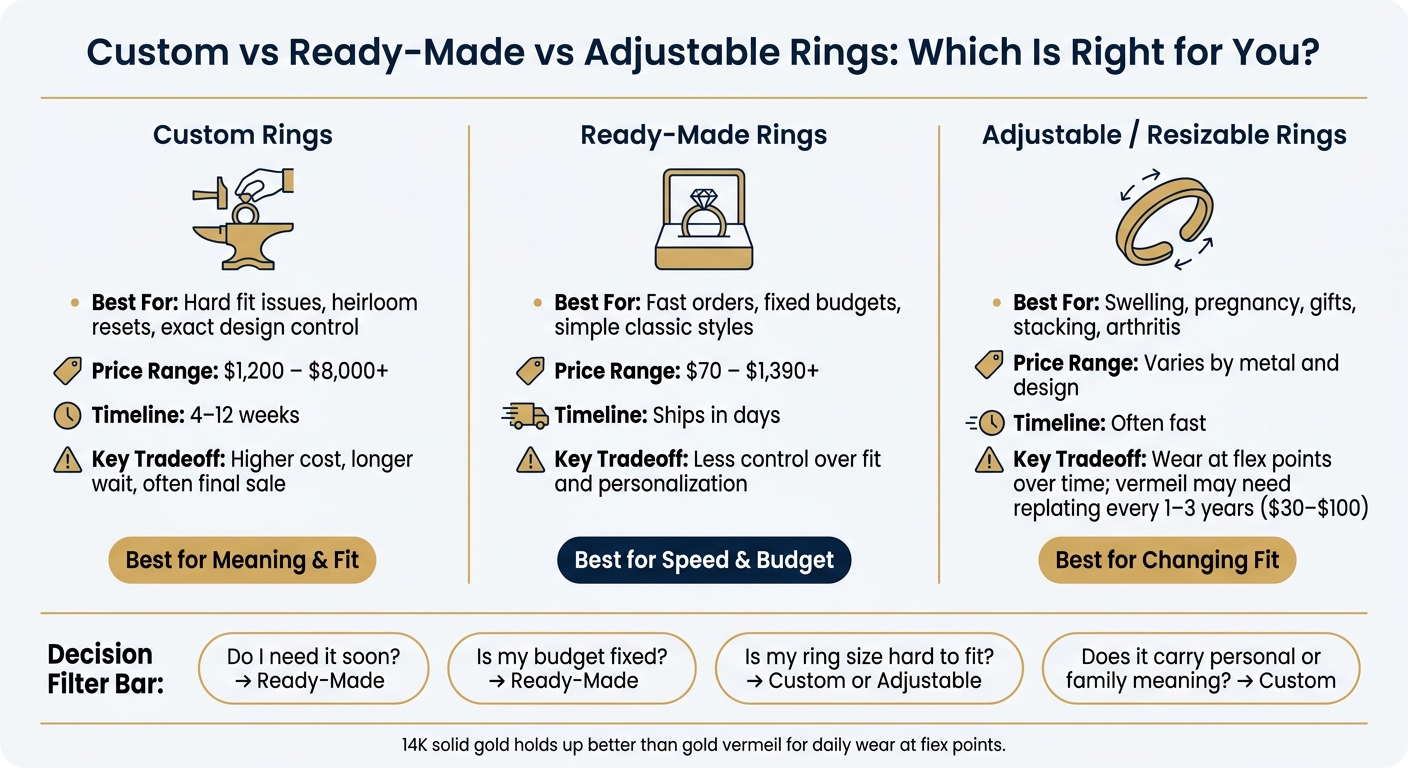
Custom vs Ready-Made vs Adjustable Rings: Quick Comparison Guide
Custom vs Ready-Made Engagement Rings: The Honest Pros & Cons
sbb-itb-9da40c1
Custom vs Ready-Made Rings: Key Differences Side by Side
The gap between custom and ready-made rings isn't just about price. Each option solves a different problem. One gives you control. The other gives you speed and simplicity.
Here’s how they compare on the points most buyers care about.
| Factor | Custom Rings | Ready-Made Rings |
|---|---|---|
| Timeline | Usually 4–8 weeks or longer for complex designs | Ships in days; often available immediately |
| Cost | Often starts around $1,200–$2,000+; typical range is $2,500–$8,000 | Everyday rings from about $70; basic engagement styles from about $90 |
| Personalization | High - stone, metal, setting, engravings, symbolic details | Low to moderate - choose from existing styles |
| Sizing flexibility | Excellent for unusual or complex fit needs | Standard sizes; resizing is possible but limited |
| Return risk | Often final sale; lower mismatch risk when designed correctly | Standard return policies; easier to exchange |
| Long-term satisfaction | Higher when fit, meaning, or uniqueness matter most | Higher when a classic look and fast purchase are the goal |
Where custom rings give you more for your money
Custom work makes sense when a stock ring can’t handle what you need. Fit is the most obvious case.
Most ready-made rings stick to standard size ranges: sizes 5–9 for women and 8–12 for men. If your finger falls outside that range, or if your knuckle is much larger than the base of your finger, things get tricky fast. A stock ring may not get over the knuckle at all. Or it may slide on, then spin around once it’s in place. One documented case involved a finger that measured about size 7.5–8 at the base but 12–13 at the knuckle, which called for a specialized hinged ring design.
Heirloom redesigns are another strong reason to go custom. If someone wants to combine diamonds from a mother’s ring and a grandmother’s ring into one new piece, the jeweler has to work with fixed stone sizes, shapes, and family meaning. You can’t just pull that off with an off-the-shelf setting. The same goes for engagement rings with less common stone cuts, mixed metals, or settings made to sit neatly with future stacking rings.
Where ready-made rings are the better call
Ready-made rings work best when you want something good-looking, easy to buy, and fast to your door. That’s the lane where they shine.
Classic solitaires, plain bands, and simple stacking rings are easy to find in stock collections. The styles are familiar, classic, and simple to compare, which takes a lot of stress out of the process. Sometimes that matters more than having every small detail tailored.
The price is easier to map out too. Everyday rings often start around $70, and basic engagement styles can begin near $90. From there, prices tend to move up in a fairly clear way based on metal type or stone size. There’s no design fee, no long revision process, and no waiting several weeks while the ring is made. If you want a timeless look without turning the purchase into a project, that’s a clear upside - not a compromise.
When Adjustable or Resizable Rings Work Better Than Either Option
Sometimes the main issue isn't style or price. It's fit.
In that case, adjustable rings can make more sense than both custom and ready-made options. If finger size doesn't stay the same, a fully custom ring and a standard off-the-shelf ring can both fall short.
Best use cases for adjustable ring designs
Here, flexibility matters more than locking in one fixed size.
Adjustable rings are a strong fit when finger size changes during the day, with weather, swelling, or activity. Heat, movement, fluid retention, and summer swelling can turn a ring from comfortable to tight faster than you'd expect.
Arthritis is one of the clearest examples. Enlarged knuckles can make fixed rings painful to take off, while an adjustable band can open for the knuckle and then close for a more secure fit. Satinski's adjustable rings are designed to fit approximately U.S. sizes 5–9.
They also make sense for surprise gifts and stacking, where exact sizing can be hard to pin down. The same goes for pregnancy and other periods when swelling is common, since ring size can shift from month to month.
When a custom adjustable ring is worth paying more for
A standard adjustable ring works for most fit changes. Going bespoke starts to make sense when the ring also needs to serve as a daily-wear piece with long-term design value.
For an engagement ring or wedding band, built-in adjustability can be smarter than resizing the ring again and again, especially if future size changes are likely. That same idea applies to heirloom stones or family metal when the goal is to keep the ring wearable for years.
One practical material note: if the ring will be opened and closed often, 14K solid gold is the better choice for daily wear. Gold vermeil can wear down faster at the flex points and may need replating every 1 to 3 years.
A Simple Framework for Choosing the Right Ring Type
Use timeline, budget, fit, style, and maintenance as your fast filter. The table below turns those five factors into a quick decision.
| Scenario | Best Option | Why |
|---|---|---|
| Short proposal timeline | Ready-made | Near-term deadline |
| Strict budget, price certainty | Ready-made | Predictable total cost |
| Non-standard size or knuckle fit | Custom or adjustable | Fit is the main constraint |
| Heirloom stones or sentimental redesign | Custom | Preserves heirloom materials |
| Specific metal, stone, or setting choice | Custom | Material or design control matters |
| Simple, timeless style | Ready-made | Low-decision purchase |
| Stacking rings or fluctuating finger size | Adjustable/resizable | Sizing needs to stay flexible |
Choose custom when fit, meaning, or design control matter most
Custom makes the most sense when the ring needs to do something a standard piece can't. That often means a non-standard ring size, a tricky knuckle fit, a ring built around a specific stone, or a piece made in 18K gold or platinum. It's also the better path when the ring is tied to family history or meant to carry personal meaning for decades.
There is a tradeoff: time and cost. Full custom work usually takes 4–12 weeks. Heirloom resets often run $1,200–$3,000, while full redesigns usually cost $2,500–$8,000.
Choose ready-made when speed, budget, or simple styling lead
Ready-made is the easiest pick when the design already works and the deadline is tight. You can see the ring before you buy it, the total price is easier to plan for, and you skip design revisions and shop delays.
For example, Satinski's silver and gold vermeil rings run about $80–$150, while 14K solid gold options fall between $990 and $1,390. If you want a simple, timeless look without a long back-and-forth, this route keeps things easy.
Choose adjustable or resizable when size is the main concern
When fit is the main issue, adjustable or resizable rings are often the smarter answer. They work well for gifts when you don't know the exact size, for stacking rings that change how a ring sits, and for day-to-day wear when finger size shifts.
They can also save you from paying for a full custom build just to solve sizing. That said, frequent adjustment puts more wear on the flex point over time. 14K solid gold tends to hold up better than gold vermeil, which may need replating every 1–3 years at a cost of $30–$100 per service.
Once you know the main problem - speed, price, fit, or meaning - the best ring type usually becomes pretty clear.
Conclusion: Match the Ring Type to the Problem You Need to Solve
The right ring isn’t the most expensive or the most elaborate. It’s the one that fixes the main issue you need to deal with. Start there, and the choice often gets a lot simpler.
Custom makes sense when a standard ring can’t do the job - hard-to-fit sizes, heirloom redesigns, or higher-end material picks like platinum or 18K gold. If the only upside is looks, ready-made is often the better buy.
Ready-made is the smart move when the design is simple and your budget or timeline is fixed. You get a clear price, no revision cycle, and a faster path to purchase.
Adjustable or resizable rings do one job better than fixed-size rings: handling fit changes. They’re a good match for swelling, pregnancy, or other size shifts, and they can cut down on repeat resizing. Choosing one means planning for day-to-day wear.
Start with the main limit - fit, meaning, budget, or timeline - and the right ring type will usually become clear.
FAQs
How much should I budget for custom?
For a custom ring, don’t just look at the materials. A big part of the price often comes from the work behind the scenes: consultations, design revisions, and skilled labor. In many cases, those services account for 30% to 40% of the total.
On a $3,000 budget, that works out to about $900 to $1,200 for professional services.
To avoid hidden fees, ask for a clear cost breakdown that covers:
- design time
- labor
- possible revisions
If money’s a little tight, it often makes sense to put your budget toward durable materials instead of a more complex design.
Can a ready-made ring be resized later?
Sometimes. It comes down to the ring’s design, how it was made, and what materials it uses.
Some ready-made rings are built so they can be resized. Others come in a fixed size and only allow small changes before the setting starts to be affected.
A jeweler can often resize a ring the usual way. But there’s a tradeoff. Cutting, stretching, or heating the band again and again can weaken it over time.
If you think your ring size may change often, an adjustable ring can be the better long-term pick.
Which metal is best for an adjustable ring?
The best metal comes down to how often you’ll wear the ring and how often you’ll adjust it.
For daily use, frequent resizing, or a wedding band you plan to keep for years, 14K solid gold is the best pick. Its makeup is consistent all the way through, so adjusting the ring over time won’t reveal a different base metal where the band slides against itself.
Sterling silver and 18K gold are also good fits for adjustable rings. They hold up well for this kind of design and make sense if you want something a bit different in look or feel.
Gold vermeil works better for short-term wear, occasional fashion use, or a tighter budget. The trade-off is simple: if you keep adjusting it, the outer gold layer can wear down and expose what’s underneath.


