

How to Brief a Jeweler: The Details That Change Your Custom Ring
A custom ring goes off track when the brief is vague. If I want a ring that fits well, feels good all day, and holds up over time, I need to give my jeweler clear details on fit, band width, stone shape, setting, metal, finish, budget, timeline, and personalization.
Here’s the short version:
- Start with fit first: exact U.S. ring size, finger swelling, knuckle size, stacking plans, and whether resizing may be needed later
- Then lock the design: band width in millimeters, profile, stone shape, stone size range, setting style, metal, and finish
- Match it to daily wear: work, gym use, gloves, hand-washing, and snag risk all change what makes sense
- Set the project limits: budget in USD, delivery date, and what happens if changes come late
- Confirm the final details in writing: engraving text, reused stones or metal, care needs, inspections, and resize limits
A few numbers matter more than most people think: prongs should often be checked every 6–12 months, pavé may need checks about every 6 months, many custom rings take 4–8 weeks, and some rings can usually be resized only about 1–2 U.S. sizes without extra work.
If I had to boil the whole process down, it would be this: fit first, design second, daily wear third, money and timing fourth, personal details last.
| What I need to brief | What to tell the jeweler |
|---|---|
| Fit | Exact U.S. size, finger changes, knuckle shape, comfort needs |
| Band | Width, profile, height, inside shape |
| Stone | Shape, size or carat range, top goal like sparkle or low height |
| Setting | Prong, bezel, pavé, or tension, plus snag and care concerns |
| Metal & finish | Platinum, 14K/18K gold, sterling silver, polish or matte |
| Daily use | Typing, lifting, gloves, tools, hand-washing, sports |
| Budget & date | Price range in $, hard cap or flexible, needed-by date |
| Personal details | Engraving, motifs, heirloom stones, reuse of old metal |
In other words: if I want the ring to come back looking and wearing the way I pictured it, I can’t rely on memory or broad phrases like “simple” or “not too big.” I need a short written brief with the details that change comfort, wear, cost, and delivery.
Specify Fit First: Size, Resizing, and Adjustable Requirements
Start with fit. Tell the jeweler your exact size, whether it changes, and whether the ring needs to be fixed, resizable, or adjustable. Once that part is clear, the jeweler can build the rest of the ring around it.
Give Your Exact US Ring Size and Explain Finger Changes
Give your jeweler a professionally measured US ring size, not a rough at-home guess. Jewelers use metal sizers that feel much closer to an actual ring band, and it helps to try sizes at different times of day. Fingers often swell later in the day and in warm weather. If you're between two sizes, the larger one is usually the safer pick.
The number alone doesn't tell the whole story. Explain how your finger is shaped. If your knuckle is much wider than the base of your finger, say that up front. A ring may need extra room to get over the knuckle, then feel loose once it sits at the base. In that case, the jeweler has to balance both measurements. You should also mention any patterns, like swelling during flights, in summer heat, with arthritis, during pregnancy, or after exercise.
Give your band width along with your ring size. Wider bands cover more of the finger, so they often feel tighter. Because of that, jewelers often suggest going up by ¼ to ½ a US size for wider styles.
Ask for Future Resizing or an Adjustable Design Up Front
If you expect your finger size to change because of weight loss, pregnancy, or a medical issue, say so before the design is locked in. Most gold and platinum rings can usually be resized by about 1–2 US sizes without trouble, but going past that can affect the shank or the stone settings.
Some styles are much harder to resize. Bands with stones set all the way around or tension settings need extra thought if future size changes are likely. This is one of those details that's easy to miss early on and expensive to deal with later.
If your size is likely to shift, ask about future resizing or a hidden adjustable feature. Also explain whether the ring needs to pass over a knuckle every day or change size often. That helps the jeweler choose a build that can handle regular wear.
Cover Stacking, Finger Changes, and Daily Comfort Needs
If you'll wear the ring with other bands, tell your jeweler which ones. Stacked rings can change the fit more than people expect. A few thin bands together can feel as snug as one wide ring, so each ring in the stack may need a small size tweak to keep the set from pinching.
A comfort-fit interior can also help. That means the inside of the band is slightly domed instead of flat, which can ease pressure during long wear. If you plan to stack rings or keep the ring on all day, it's worth asking for.
You should also share day-to-day details that affect comfort and fit, such as:
- needing the ring to come off fast before gloves
- wearing it during workouts
- typing for long hours each day
Those small habits shape the jeweler's call on how snug the ring should be, what profile makes sense, and whether an adjustable feature should be built in.
After fit, brief the jeweler on band, stone, setting, and metal.
sbb-itb-9da40c1
Define the Physical Design: Band, Stone, Setting, and Metal
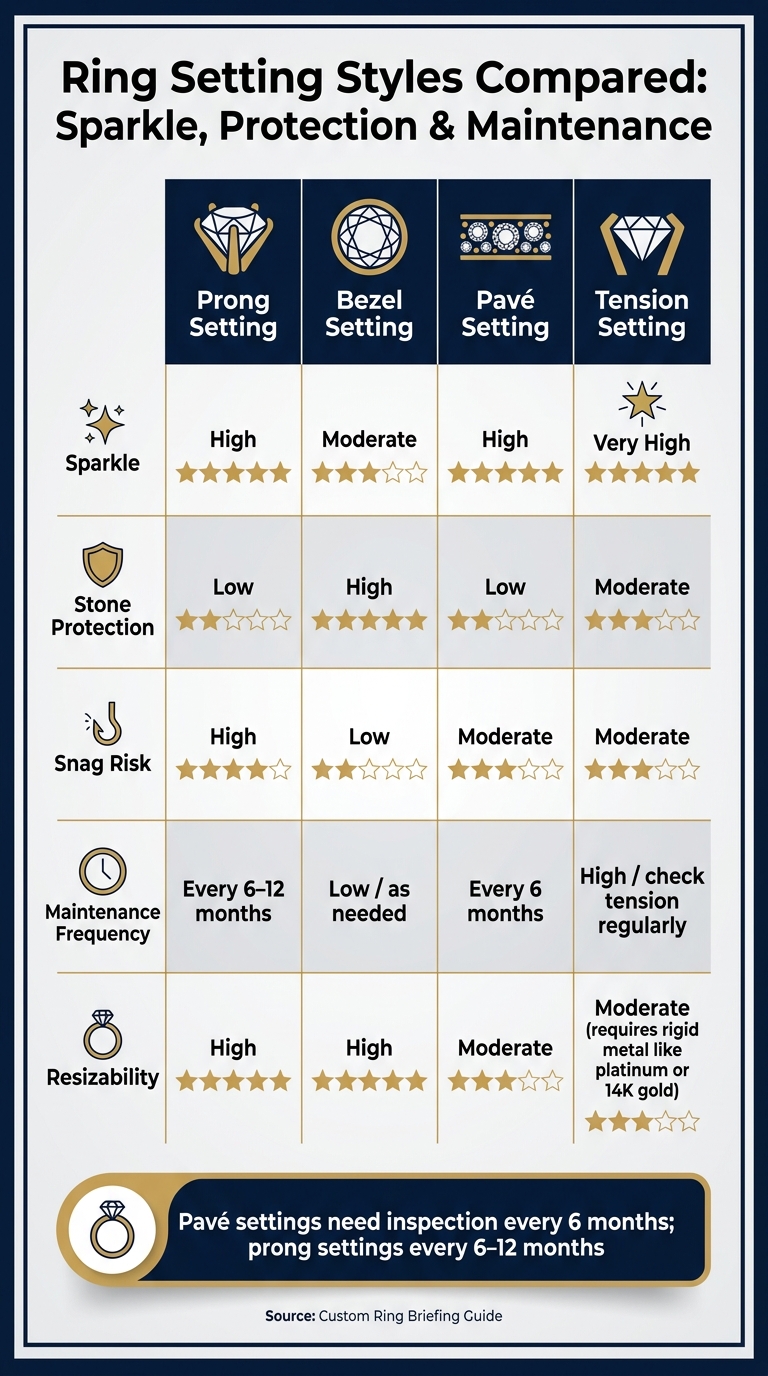
Ring Setting Styles Compared: Sparkle, Protection & Maintenance
Once the fit is locked in, it’s time to spell out the design: band, stone, setting, metal, and finish. Each one changes how the ring looks, feels, and holds up with daily wear.
Set Band Width, Profile, and Height Based on Comfort
Give the band width in millimeters and name the profile: flat, half-round, or knife-edge. If comfort matters during all-day wear, ask for a comfort-fit interior so the ring puts less pressure on your finger.
After that, move to the stone and setting. Those two choices shape sparkle, snag risk, and how much upkeep the ring will need.
Choose Stone Shape and Setting With Wearability in Mind
When you describe the stone, give the jeweler three things:
- The shape
- An approximate size or carat range
- Your top priority, like sparkle, a low profile, or stone protection
A round brilliant is known for maximum sparkle and even light return. An oval or other elongated cut can make the finger look longer and give more finger coverage for a similar weight. If you want a pointed shape like marquise or pear, say that early. Those tips need protective settings to help avoid chipping.
The setting changes more than the look. It also affects snag risk, upkeep, and long-term wear.
Prong settings let in the most light, which means the most sparkle, but prongs can catch on fabric and should be checked every 6–12 months. Bezel settings surround the stone with a metal rim, which gives strong chip resistance and the lowest snag risk. GIA says they provide excellent resistance to chips and everyday wear. Pavé settings look dazzling, but they need more upkeep. The tiny beads holding each stone can wear down in 3–5 years with daily use, so plan on inspections about every 6 months. Tension settings have a bold look, but they’re rigid by design. They’re harder to resize later and need a high-strength metal like platinum or 14K gold to keep the stone secure.
| Setting Style | Sparkle | Protection | Snag Risk | Maintenance | Suitability for Adjustable Rings |
|---|---|---|---|---|---|
| Prong | High | Low | High | Moderate (check every 6–12 months) | High |
| Bezel | Moderate | High | Low | Low | High |
| Pavé | High | Low | Moderate | High (inspect every 6 months) | Moderate |
| Tension | Very High | Moderate | Moderate | High (check tension) | Moderate (requires rigid metal) |
Next comes the metal and finish, which help the jeweler match the ring to your skin, habits, and budget.
Name the Metal and Finish, Including Skin Sensitivities
Be specific about the metal and karat: platinum 950, 18K gold, 14K gold, or 925 sterling silver.
Platinum 950 is dense, naturally white, and hypoallergenic. It doesn’t need rhodium plating and tends to hold prongs securely over time. 14K gold is harder than 18K gold, so it handles daily bumps better and is a smart pick for active wear. 18K gold has a richer color and is a standard fine-jewelry choice, though it’s a bit softer. 925 sterling silver is lighter and costs less, but it can tarnish and may need more polishing than gold or platinum.
If you have skin sensitivity, name the exact alloy and ask for platinum or higher-karat gold. If you want an adjustable design, ask which metals work with that build and how the metal choice changes both cost and upkeep.
Finish comes last. A high-polish finish is classic and mirror-bright, but it shows scratches more easily. Matte and brushed finishes soften reflected light and do a better job hiding minor wear. Tell the jeweler both how you want the ring to look and how much upkeep you’re okay with.
Once those specs are set, brief the jeweler on your routine, budget, and deadline.
Match the Ring to Real Life: Lifestyle, Budget, Timeline, and Personalization
Once fit and construction are set, tell the jeweler how the ring will actually be worn.
Describe Your Daily Activities So the Design Fits Your Routine
Walk the jeweler through how you use your hands day to day. A ring can look perfect in a sketch and still be a pain to wear.
Share the basics of your routine: typing, healthcare work with frequent hand-washing, wearing gloves, using tools, weightlifting, or spending time in chlorinated pools.
| Lifestyle | Suggested Band Width & Profile | Recommended Setting | Best Metal Choice |
|---|---|---|---|
| Office work / typing | Slim to medium; comfort-fit interior | Low-profile solitaire or bezel | Platinum or 14K gold |
| Healthcare / frequent hand-washing | Slim, smooth profile | Low-profile, secure setting | Platinum or 14K gold; avoid vermeil |
| Manual labor / tools / sports | Medium to wider band; rounded profile | Bezel or flush-set | Platinum or durable gold alloy |
| Gym / climbing / active hands | Comfort-fit; avoid sharp edges | Bezel or flush-set | Platinum or 14K gold |
| Gloves / seasonal outerwear | Slim band to reduce bulk | Low-height setting | Low-profile design throughout |
Once wearability is sorted out, move on to price and timing.
State a Clear Budget Range in USD and a Delivery Date
Give the jeweler a budget range in USD, and say whether it's a hard cap or if you have a little room. Something like "I'd like to stay between $1,500 and $3,000, but I can stretch slightly for the right design" helps them guide the project. If your cap is firm, say that up front. It saves time.
The main cost drivers are metal karat, stone quality, design complexity, and custom details. A simple solitaire in 14K gold will usually land near the lower end. Hand engraving, multi-stone halos, or custom adjustable parts can push the price up because they add labor and materials. Adjustable parts also tend to add time.
Ask for a written estimate that breaks out materials, labor, setting work, resizing limits, and the expected delivery date. Custom rings often take 4–8 weeks, while more detailed or highly personalized pieces can take 8–12 weeks or longer. Give your target date in U.S. format and confirm it before production begins.
Confirm Engraving, Motifs, and Maintenance Expectations
Write out engraving details before you approve the design. Give the jeweler the exact text, your font choice - script, block, or serif - and where you want it placed, usually inside the band. For dates, use U.S. format: 09-19-2026. That keeps the engraving clear and avoids any day/month mix-up.
If you want motifs, bring reference images and be clear about how bold or subtle you want them. Heavy design work near the bottom of the band can limit future resizing, so ask the jeweler to keep those details in spots less likely to be changed later. Thin bands and adjustable rings don't leave much room, so you may have to pick between a longer inscription and detailed surface patterning.
Before you leave the consultation, ask how the ring should be cleaned, inspected, and cared for. Get specific. Ask which cleaning methods are safe, how fast different finishes show wear, and whether an adjustable part needs routine care or should stay away from certain chemicals. Add those care notes to the brief before you approve the final design.
Conclusion: Details to Confirm Before You Approve the Design
Use your brief as the last check before production begins. Before you approve the design, line up the CAD or prototype with what you wrote in your brief.
Confirm these items before approving the design:
| Detail | What to Confirm |
|---|---|
| Ring size & adjustability | Exact US size, resizing range, included resizes |
| Band width & profile | Width, fit type, edge style, height |
| Stone & setting | Stone type, shape, carat weight, setting style, height |
| Metal & finish | Metal, karat, hallmark, finish, allergy fit |
| Lifestyle fit | Setting height and band sturdiness matched to your daily routine, work, and hobbies |
| Budget & timeline | Total price, deposit, production date, delivery date |
| Personalization | Engraving text, font, placement, motifs |
These details have the biggest impact on how the ring feels and wears day to day. If you change the stone size or setting after approval, you can expect extra cost and a later delivery date. Clear sign-off on each point helps you avoid expensive changes once production starts.
FAQs
What should I bring to a custom ring consultation?
Bring clear reference images, like photos or sketches, so the jeweler can see what you like. If you already have a dream design in mind, a reference image helps even more.
It also helps to come prepared to talk about your lifestyle, your budget, and any questions you have. That can include things like band thickness, stone security, and long-term maintenance, so the jeweler can steer the design in the right direction.
How do I know if my ring design will be comfortable every day?
For daily comfort, focus on fit, durability, and wearability. Pick a band with enough thickness for your day-to-day life, and skip sharp or raised edges that can catch on clothing or scratch other jewelry.
If changes in finger size are a concern, ask about an adjustable design. It also helps to share your daily routine, work, and hobbies with your jeweler so the piece strikes the right balance between comfort and long-term wear.
Which ring details are hardest to change later?
The hardest details to change later are the ones that don’t resize well at all, or barely resize without a lot of work. That includes:
- eternity bands with stones set all the way around
- tension settings
- closed settings
- highly textured bands
These styles can call for major structural changes during resizing. In some cases, the work can even damage the settings. That’s why it’s smart to talk through these limits with your jeweler before you lock in the design.


