

When Jewelry Not Fitting Is an Early Lymphedema Warning
If the same ring, watch, or bracelet keeps getting tight on one side, don’t brush it off. I’d treat that as a clue to track - especially if it lasts 1–2 weeks, comes with heaviness, tingling, stiffness, or skin tightness, or does not go away after rest or overnight.
Here’s the short version:
- A fit change alone does not diagnose lymphedema
- One-sided repeat swelling matters more than both hands swelling on a hot day
- Early lymphedema can start before you see swelling
- Redness, warmth, pain, fever, chest pain, or shortness of breath means get medical help fast
- If a ring is stuck or digging into skin, remove it or get help right away
I’d check three things at home before dismissing it:
- Compare both sides - same finger, wrist, or ankle
- Track the pattern - date, side, time, trigger, and whether it eases overnight
- Watch for other signs - heaviness, aching, tingling, less movement, or marks that linger
A few facts stand out from the article:
- The American Cancer Society lists a tight ring, watch, or bracelet as a possible sign
- The NHS says early swelling may come and go at first
- A fever of 100.4°F or higher with a red, hot, tender, or fast-swelling area needs urgent care
Signs of Lymphedema to Watch For
sbb-itb-9da40c1
Quick check
| What I notice | What I’d think | What I’d do |
|---|---|---|
| Both hands swell after heat, travel, or salty food | More likely short-term fluid shift | Rest, recheck later |
| One ring keeps getting tight on one hand | Pattern worth medical review | Log it, take photos, call a clinician |
| Tight jewelry plus heaviness or stiffness | More concern | Remove jewelry and get checked |
| Swelling with redness, warmth, pain, or fever | Possible infection or other urgent issue | Seek same-day care |
| Swelling with chest pain or shortness of breath | Medical emergency | Call 911 |
Bottom line: I’d use jewelry fit as an early clue, not an answer. If the same-side pattern keeps coming back or gets worse, I’d bring notes and photos to a doctor.
Signs that tight jewelry may point to early lymphedema
Not every snug ring is a warning sign. What matters more is a pattern that keeps showing up on one side, not one uncomfortable day.
Fit changes that go beyond normal day-to-day variation
Pay attention to new tightness that returns again and again on the same side. The American Cancer Society specifically lists a tight ring, watch, or bracelet - without meaningful weight gain - as a possible symptom of lymphedema. Cleveland Clinic also notes that clothes or jewelry can start fitting more tightly than usual before swelling is easy to see.
That can look like a ring leaving a deeper mark than it used to, a watchband staying tight, or a bracelet fitting differently from one side to the other. Tightness that gets worse later in the day or comes back after activity means more than a one-off change.
Here are the patterns most worth tracking:
| Fit change | What makes it more concerning |
|---|---|
| One ring tight without weight change | Persistent, one-sided, or paired with visible asymmetry |
| Watch or bracelet leaving deeper marks | Mark lingers, or swelling increases throughout the day |
| Jewelry tight with no visible swelling | Accompanied by heaviness, aching, or reduced movement |
| Tightness that builds later in the day | Recurs repeatedly in the same spot or limb |
Other early symptoms that can appear alongside jewelry tightness
Tight jewelry becomes more concerning when it shows up with other subtle body changes.
Early lymphedema can be easy to miss. Swelling may come and go, and someone might notice a ring or bracelet fitting differently long before clear puffiness appears. The CDC lists heaviness, tingling, tight skin, and thickened skin among possible symptoms. The NHS says swelling can come and go at first and may leave a temporary indent when pressed.
Along with jewelry tightness, early signs may include:
- A heavy or full feeling in the hand, wrist, or arm
- Aching or tingling
- Skin that feels stretched or warmer than usual
- Reduced flexibility or stiffness in the fingers or wrist
- Soft swelling that may briefly pit, meaning gentle pressure leaves a small indentation
Pitting may happen in some cases, but not seeing it doesn't rule anything out. These signs don't prove lymphedema. Still, when they cluster with repeated one-sided tightness, they merit medical review.
What to check at home before you dismiss the change
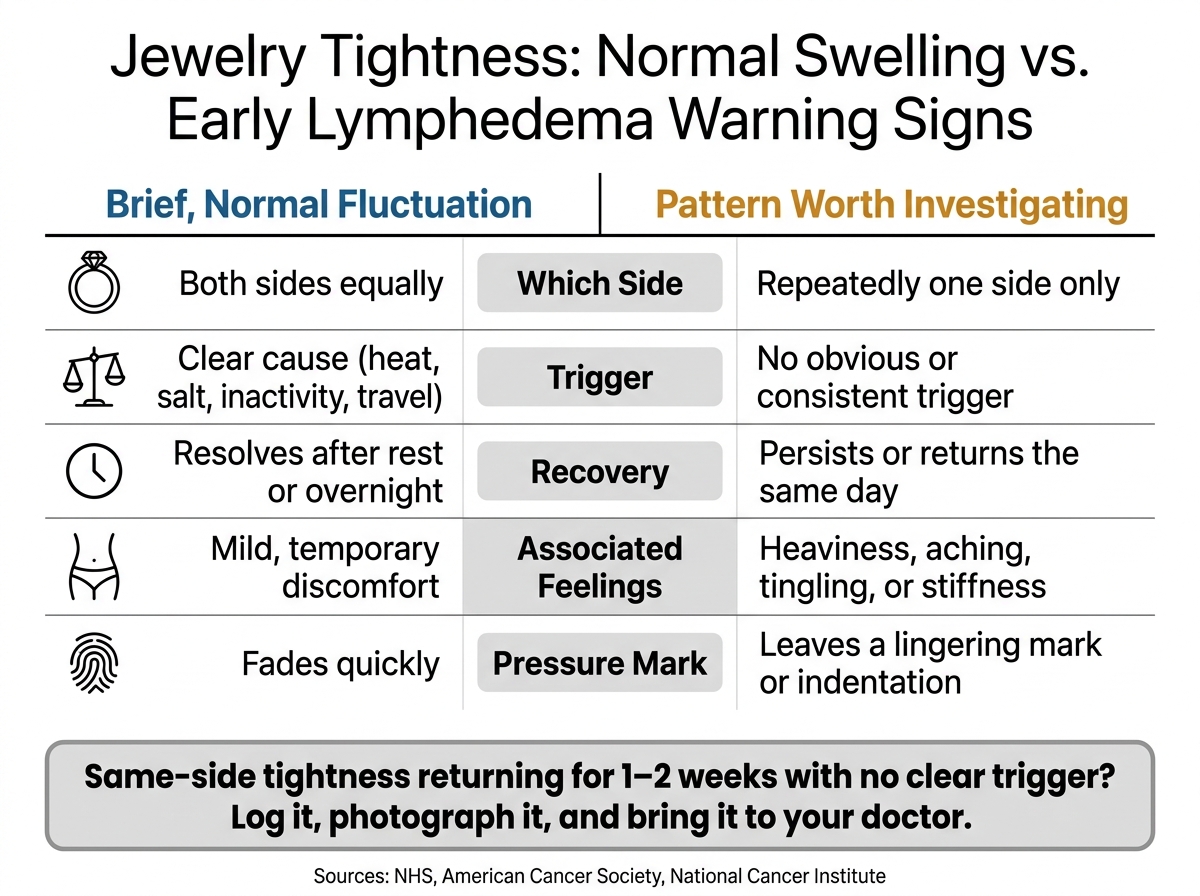
Jewelry Tightness: Normal Swelling vs. Early Lymphedema Warning Signs
Compare both sides and track what keeps coming back
If the same piece keeps feeling tight, do a quick side-by-side check before brushing it off. Compare the same spot on both sides of your body. That could mean the same finger on each hand, both wrists, or both ankles.
Pay attention to small differences, like:
- Puffiness
- Skin texture
- How deeply jewelry leaves a mark
- Whether one side feels heavier or less flexible
The American Cancer Society specifically recommends comparing the affected area with the unaffected side when possible.
Once you notice a change, keep a short log. Write down the date, which side it happened on, the piece involved, how long it lasted, and any possible trigger, like heat, exercise, or a salty meal. Also note whether the fit goes back to normal after rest or overnight. If the same side tightens again the next day or later that week, bring the log to a doctor.
Take same-angle photos of both hands or wrists at about the same time of day when the tightness comes back and after it eases.
If the pattern keeps returning, compare it with short-term swelling and track what changes.
How to tell brief swelling from a pattern that needs attention
Heat, exercise, long periods of inactivity, travel, or a salty meal can cause short-term swelling on both sides that goes away after rest.
What needs more attention is swelling that keeps coming back on the same side, doesn't fully go away overnight, or shows up without a clear trigger. The NHS notes that early lymphedema swelling can come and go at first, but tends to become more persistent over time if left unaddressed. The table below makes that distinction easier to spot:
| Feature | Brief, Normal Fluctuation | Pattern Worth Investigating |
|---|---|---|
| Which side | Both sides equally | Repeatedly one side only |
| Trigger | Clear cause (heat, salt, inactivity) | No obvious or consistent trigger |
| Recovery | Resolves after rest or overnight | Persists or returns the same day |
| Associated feelings | Mild, temporary discomfort | Heaviness, aching, tingling, or stiffness |
| Pressure mark | Fades quickly | Leaves a lingering mark or indentation |
If the same piece keeps tightening on one side for 1–2 weeks without a clear trigger, bring the log to your doctor.
When to see a doctor and what not to ignore
If your tracking shows that the same-side tightness keeps coming back, it’s time to move past watching and get it checked. A tight ring or bracelet can be a clue, but it’s not a diagnosis. Ongoing swelling, especially if it affects only one side, needs medical evaluation.
Signs that should prompt a medical appointment
Make an appointment if the tightness doesn’t have an obvious, short-term cause. Tightness or swelling that lasts 1–2 weeks, keeps coming back on one side, or slowly gets worse over time should be checked by a clinician. The same applies if the swelling comes with heaviness, fullness, tingling, numbness, stiffness, less movement, or visible asymmetry.
Don’t wait as long if the change started after cancer treatment, lymph-node removal, radiation therapy, trauma, or treatment or surgery that may have disrupted lymph flow. The National Cancer Institute advises contacting a doctor as soon as symptoms like heaviness or swelling appear after cancer treatment, because lymphedema is easier to control when treatment starts early.
Bring your dated log and photos. They can help the clinician spot whether the pattern is persistent, recurring, or getting worse.
Urgent symptoms that need faster care
Some changes in fit need care sooner than a routine visit. Get same-day medical advice if swelling happens with redness, warmth, tenderness, pain, or swelling that increases fast. These can point to cellulitis or another acute problem.
Call 911 or go to the ER if new limb swelling happens with shortness of breath or chest pain. A fever of 100.4°F or higher along with an area that is red, hot, tender, or swelling fast also needs urgent attention.
If a ring won’t come off or is digging into the skin, get prompt help and don’t force it. The ring may be affecting circulation. Jewelry fit should never replace a medical assessment when these symptoms are present.
How to stay comfortable in jewelry while the cause is being assessed
While the cause is being checked, focus on comfort and don’t force jewelry to fit. These steps are temporary comfort measures only. They do not treat lymphedema, and they do not replace getting checked.
Remove tight pieces early and avoid pressure on swollen areas
Take off any ring, bracelet, or watch as soon as it starts to feel snug. Don’t wait until it’s hard to remove. If jewelry leaves a deep mark, causes numbness or tingling, changes your skin color, or makes it harder to move your fingers or wrist, take it off and leave it off until the area has been assessed.
You can briefly elevate the limb above heart level for comfort. But that should not take the place of medical evaluation. Also, do not use tight wraps or non-prescribed compression.
Ring options that adjust to size changes
If you still want to wear a ring while your finger size is changing, an adjustable ring may help for a short period. But treat it as a temporary bridge. If it starts leaving an indentation or becomes hard to open, stop wearing it right away.
Satinski's adjustable ring collection is one example of fit-flexible jewelry made for changing finger sizes. If you look at this kind of ring, check the exact adjustment mechanism and size range for the style you pick. And when possible, adjust it off your finger so you’re not pressing on swollen skin.
Quick-reference table: jewelry fit changes, possible meaning, comfort steps, and when to get care
Use the guide below to match a fit change with the safest next step. This table cannot tell you what is causing the swelling. Share your notes with a clinician.
| Jewelry-fit observation | What it may suggest | Comfort-focused response | When medical evaluation is appropriate |
|---|---|---|---|
| Tight jewelry with heaviness, aching, numbness, or reduced movement | Needs assessment | Remove all constricting pieces and avoid pressure; do not use tight wraps or non-prescribed compression | Contact a clinician promptly; early evaluation is recommended for possible lymphedema |
| Rapid swelling with redness, warmth, severe pain, or fever | Possible infection | Remove jewelry, avoid pressure, and do not wait for jewelry changes alone to resolve | Seek same-day or urgent medical care; fever, redness, warmth, increasing pain, and swelling are infection warning signs |
Conclusion: Use the fit change as a clue, not a diagnosis
The main point here is simple: if a ring, bracelet, or watch suddenly feels tight, treat it as a clue, not a diagnosis. What matters most is whether the change is new, one-sided, sticking around, or getting worse over time.
One-sided tightness is the detail that matters most, especially if it keeps coming back.
If you keep noticing the same pattern, bring those details to a clinician. Write down the date, which side it affects, and how long the tightness lasts. That gives the clinician something clear to work with.
Adjustable or resizable jewelry can help with comfort for the moment, but only as a temporary step while the cause is being checked.
Pressure off. Pattern tracked. Evaluation next. A tight ring is a clue. Get it checked.
FAQs
Can lymphedema start before visible swelling?
Yes. Lymphedema can start with small changes before swelling is easy to spot. One early sign is jewelry that suddenly feels tight or uncomfortable, like rings, bracelets, or watches.
If that tightness sticks around or shows up more on one side than the other, keep track of it and get a medical evaluation.
Why is one-sided jewelry tightness more concerning?
One-sided jewelry tightness is more concerning because it can point to localized, persistent swelling instead of normal day-to-day size changes.
A ring can feel snug for a short time because of heat, exercise, or general fluid retention. But if the tightness is only on one side, it may point to a health issue, especially when it comes with swelling, tingling, or numbness. If it doesn’t ease up, seek medical care.
Who is most at risk for lymphedema?
People with health issues that affect how the body handles fluids - like heart disease or kidney disease - may face a higher risk. The same goes for people who deal with lasting swelling tied to circulation problems.
Arthritis, thyroid disorders, and pregnancy can also make fingers swell. That’s why persistent or worsening swelling - especially when it comes with joint pain, stiffness, or tightness on just one side - should be checked by a medical professional.


