

Wedding Ring Too Big After Weight Loss? Stop Using Ring Guards
If your wedding ring is loose after weight loss, I would not rely on a ring guard for long. It may help for a few days or weeks, but it can pinch, trap soap and moisture, scratch the band, and still let the ring spin or slip off.
Here’s the short answer:
- If my finger size has settled for 1 to 2 months: I’d choose professional resizing
- If my ring can’t be resized safely: I’d ask about sizing beads, a spring insert, or a sizing bar
- If my finger size still changes a lot: I’d wear an adjustable ring for daily use
- If my ring is top-heavy: I’d fix it soon, because spinning can stress the setting
- If the ring slides during hand washing, glove removal, or daily wear: I’d stop wearing it loose
One fact stands out: one study found 10x higher median bacteria levels under rings. That helps explain why guards and inserts that trap moisture can get uncomfortable fast.
A loose ring is not just annoying. It can mean:
- higher risk of loss
- more spinning
- more skin irritation
- more wear on the ring over time
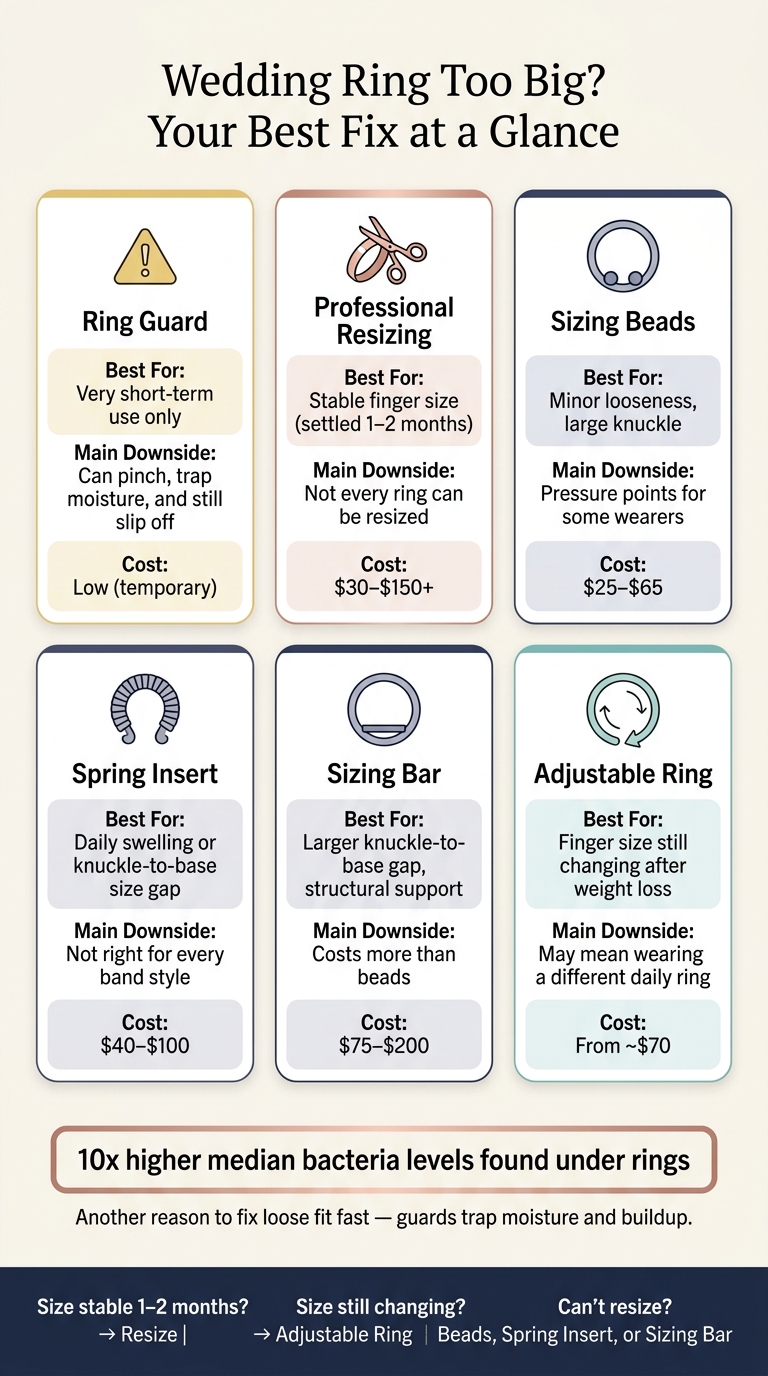
Wedding Ring Sizing Solutions: Cost, Comfort & Best Use Comparison
3 WAYS TO SIZE DOWN a RING | WITHOUT CUTTING in HALF
sbb-itb-9da40c1
Quick comparison
| Option | Best for | Main downside | Typical U.S. cost |
|---|---|---|---|
| Ring guard | Very short-term use | Can pinch, trap moisture, and still slip | Low |
| Professional resizing | Stable finger size | Not every ring can be resized | $30–$150+ |
| Sizing beads | Minor looseness, large knuckle | Pressure points for some people | $25–$65 |
| Spring insert | Swelling or knuckle gap | Not right for every band | $40–$100 |
| Sizing bar | More support inside the band | Costs more than beads | $75–$200 |
| Adjustable ring | Finger size still changing | May mean wearing a different daily ring | From about $70 |
My takeaway: once weight loss has changed the fit, the best move is usually to stop patching the problem and choose a fix that keeps the ring secure, comfortable, and safe to wear every day.
Why Ring Guards Are Usually a Short-Term Fix
What Ring Guards Are and Why People Use Them
Ring guards are usually a stopgap. People turn to them when their finger size is still changing and they’re not ready to resize the ring yet.
The most common options are plastic or silicone coil wraps that go around the back of the shank, tube-style inserts that sit inside the band, and metal clip-in guards, which are often a curved bar or hinged insert clipped or soldered inside the shank. In plain English, a ring guard is a bridge, not the last stop.
Common Problems With Ring Guards
At first, ring guards seem easy. Then daily wear starts to show the downside.
Plastic and silicone coil wraps can pinch the skin where the coil overlaps. After a full day, that can mean redness or soreness. Tube-style inserts may feel bulky or uneven, like there’s always something slightly off about the fit. Metal clip-in guards can be even harder on the skin because their edges may press into the finger, especially when your hands swell in hot weather or during exercise.
And here’s the bigger issue: a guard doesn’t always fix the loose-ring problem as well as people expect. A ring can still slip off, even with a guard in place. On top of that, gaps under the band can trap soap, lotion, and moisture. That can irritate the skin and make the ring harder to clean.
One medical study found that wearing rings was tied to a 10-fold higher median bacteria levels under the ring, which gives you a sense of how much buildup can collect in that small space.
There’s also the ring itself to think about. Metal clip-in guards can leave pressure dents or scratches on the inner shank, especially on softer metals like gold. Plastic guards can trap tiny bits of grit, and over time that grit may rub against the band like sandpaper. Jewelers warn that leaving a guard on for months or years, especially on a high-value ring, can lead to repair costs later.
Here’s how the main options stack up:
| Method | Comfort | Permanence | Risk to Ring | Best For |
|---|---|---|---|---|
| Plastic/Silicone Coil Wrap | Often pinches; can trap moisture | Temporary, removable | Low–moderate; possible abrasions | Very short-term fixes |
| Tube-Style Insert | Can feel bulky or uneven | Temporary, removable | Moderate; can rub the inner band | Short-term daily wear during size changes |
| Clip-In Metal Guard | Hard edges can press skin | Semi-temporary | Moderate–high; pressure points, scratches | Short-term use on sturdier bands |
| Professional Ring Resizing | Natural feel when correctly sized | Permanent | Low if done by a skilled jeweler | Stable sizes; everyday wear |
| Sizing Beads/Spring Insert | Targeted support; less bulk | Long-term but adjustable | Low–moderate; depends on workmanship | Fingers with large knuckles or minor fluctuations |
Once your finger size settles down, a jeweler’s permanent fix usually makes more sense for daily wear.
Professional Ring Resizing: The Best Permanent Fix for a Stable Size
Once your weight has stayed steady for at least one to two months, professional resizing is usually the most dependable fix. It changes the ring itself instead of working around the issue with a temporary add-on. This works best when the ring is made from a metal that can be resized and when there’s enough plain metal at the bottom of the band for the jeweler to cut. At that stage, a proper resize makes more sense than a temporary ring guard.
How a Jeweler Resizes a Ring Down
To size a ring down, a jeweler measures your finger, removes a small section from the shank, solders the band closed, reshapes it, and then polishes the seam. The goal is a fit that goes over the knuckle with mild resistance and then sits securely at the base of the finger.
When Resizing Works Best and What It Costs
Resizing makes the most sense when your size has settled, the ring is made from a resizable metal, and the band has enough plain metal at the bottom for cutting. Plain gold and sterling silver bands are usually the easiest jobs. Simple solitaire settings also tend to resize well.
Turnaround time depends on the ring. Simple jobs are often done the same day. More involved work can take around 2 to 7 days or more.
"Reducing the size of a ring is generally cheaper than enlarging it because it involves removing a portion of the metal, which is a simpler and faster process." - Satinski
Here’s a realistic look at what sizing down often costs in the U.S.
| Ring Type | Metal/Design | Typical Cost (USD) | Resizing Difficulty |
|---|---|---|---|
| Plain Band | Gold or Silver | $30–$80 | Low |
| Solitaire | Gold or Platinum | $50–$150 | Moderate |
| Intricate/Engraved | Patterned Shank | $75–$150+ | High |
| Eternity Band | Stones all around | High / Varies | Very High |
| Alternative Metals | Tungsten or Titanium | N/A | Impossible |
The final price depends on the metal, the design, and how much smaller the ring needs to be. Platinum usually costs more - often $80–$150 to size down - because it has a much higher melting point and needs special tools and handling to avoid visible seams or metal problems.
If the band can’t be cut safely, a jeweler-installed fix may be the better route.
When Resizing Is Not the Right Option
Some rings just aren’t good candidates for resizing. Full eternity bands, heavy pavé styles, thin shanks, and many vintage rings often need a different fix. If the ring needs to be reduced by a lot, or if the structure is too delicate, the safest move may be to remake the ring with the same stones.
When resizing isn’t safe, jewelers usually look at options like sizing beads, spring inserts, or an adjustable shank.
Jeweler-Installed Modifications for Fingers That Change Size
When a full resize doesn’t make sense, a jeweler can add a fix inside the ring. That’s the big advantage here: the ring still looks almost the same from the outside.
These options are helpful when the ring feels loose at the base of the finger but still needs enough room to get over a larger knuckle. That tends to happen after weight loss, when the lower part of the finger gets slimmer but the knuckle doesn’t change as much.
Sizing Beads, Spring Inserts, and Sizing Bars Explained
Sizing beads are two small metal balls soldered inside the bottom of the band. They create small contact points against the finger, which helps the ring grip better, spin less, and keep a top-heavy setting from tipping sideways. Since the beads mostly change the fit at the base of the finger, the ring can still slide over a larger knuckle.
Spring inserts are thin metal strips shaped like a horseshoe and soldered inside the lower part of the band. As the ring moves over the knuckle, the insert opens slightly. Once the ring is in place, it springs back and hugs the base of the finger. In many cases, this can tighten the fit by about one full US ring size.
Sizing bars are flat or slightly curved metal strips placed inside the lower band. Some stay fixed, while others are U-shaped and flex a bit to help the ring move over a swollen knuckle. Compared with beads, bars spread pressure more evenly across the finger. They can tighten the fit by about one to two US sizes.
Which Modification Fits Which Problem
The best pick depends on the size gap between your knuckle and finger base, plus how much your fingers swell during the day. If your ring size is still shifting, it’s smart to ask the jeweler whether a removable fix or a longer-term inside-band change is a better move than resizing the ring itself.
| Method | Best For | Comfort | Appearance Impact | Maintenance | Typical Cost (USD) |
|---|---|---|---|---|---|
| Sizing Beads | Top-heavy rings; large knuckle with slim finger base; minor looseness | Good; some wearers notice contact points | Minimal; hidden inside band | Low | $25–$65 |
| Spring Insert | Daily swelling; arthritis; knuckle-to-base mismatch of about one size | Often the smoothest feel; flexes with swelling | Minimal; hidden inside band | Low to moderate | $40–$100 |
| Sizing Bar | Hard-to-resize rings; larger knuckle-to-base gap; need for more structural support | Even pressure distribution; less noticeable than beads for some wearers | Minimal to moderate | Low | $75–$200 |
One small but useful detail: if you’re adding sizing beads, the jeweler may first size the ring up by about a quarter size. That leaves enough room for the beads so the ring still feels comfortable once they’re soldered in.
For rings that need more built-in flex, adjustable designs are the next option.
Adjustable and Resizable Rings for Daily Wear, Plus the Best Next Step
When an Adjustable Ring Is the Better Long-Term Choice
If resizing or inside-band changes still don't fix the fit, it may be time to switch to a ring made to move with your finger.
If your size is still changing after weight loss, an adjustable ring is often the better long-term pick than a ring guard or resizing the same ring again and again. This tends to make the most sense if your weight is still shifting, your fingers swell with the seasons, or arthritis makes a fixed-size ring harder to wear. In that case, a simple setup works well: keep the original ring for special occasions, and use an adjustable ring for daily wear.
Satinski Options for Resizable Wedding and Engagement Rings
For daily wear, it helps to choose a ring that adjusts neatly instead of relying on a guard. Satinski offers adjustable wedding rings and engagement rings in sterling silver and 18K gold, made to fit U.S. sizes 5–9. These rings use a hidden adjustment mechanism, which lets the fit change without adding extra bulk inside the band.
"A resizable band adjusts to your finger's unique shape and prevents sliding and spinning." - Satinski Product Guide
Pricing starts at about $70 for adjustable rings and about $90 for adjustable engagement rings. Higher-end options in solid 18K gold with moissanite can reach about $1,390.
Conclusion: Choose the Right Fit for Your Ring and Your Life
Choose the option that gives you the best mix of comfort, security, ring protection, and price.
| Situation | Best Option |
|---|---|
| Size has stabilized after weight loss | Professional resizing |
| Size changes often or with the seasons | Adjustable ring for daily wear |
| Original ring is sentimental; daily wear feels risky | Adjustable daily ring + save original for special occasions |
Ring guards usually work best as a short-term fix, not something you'd want to rely on for years. The right move depends on how often your size changes and which option keeps the ring secure, comfortable, and protected over time.
FAQs
How do I know if my ring size has truly stabilized?
Pay attention to how your ring fits over a few weeks, not just on one day. Finger size can shift on its own based on temperature, exercise, hormones, and how hydrated you are.
If the ring feels loose or tight most of the time, even with those ups and downs, your size is probably fairly steady. If the fit keeps changing, a professional jeweler can help you figure out whether you need a permanent resize or a more flexible long-term fix.
Can a loose ring damage the stone setting over time?
Yes. A loose ring can wear down the stone setting over time.
When a ring shifts or spins a lot, it’s more likely to catch on clothing, hair, or other objects. And that extra motion puts stress on the setting.
Over time, that can loosen the prongs or even knock stones out of place. If the ring has a larger center stone, the problem can get worse. The added weight can swing like a pendulum, putting more strain on both the setting and the band.
Which option is best if my knuckle is much larger than my finger base?
If your knuckle is larger than the base of your finger, you need a ring that can get over the joint and still sit snugly once it’s in place.
Adjustable rings are a smart pick here. They can slide over the knuckle with less trouble, then tighten for a better fit at the base of your finger. Flexible or stretch-style designs tend to work especially well.


