

Wedding Bands for Men With Arthritis: Comfort Without Compromise
If I have arthritis, I don’t have to settle for a ring that hurts, gets stuck, or feels loose all day. The best path is simple: measure the base and the knuckle, buy for the largest knuckle size, then choose a band style that matches the main problem - swelling, large knuckles, limited grip, or skin irritation.
Here’s the short version:
- If my knuckle is more than 1.5 U.S. sizes larger than the finger base, a fixed band often feels bad.
- If my size changes from morning to evening, I should look at adjustable or open-shank rings.
- If the ring is hard to get over the knuckle at all, a hinged band is often the best pick.
- If I want less rubbing, a comfort-fit interior can help the ring slide more easily.
- If skin is sensitive, platinum, titanium, and nickel-free gold are often safer picks.
- If future sizing may change, gold and platinum are often easier to resize than titanium.
- If emergency removal matters most, I should ask how the ring would be removed before I buy.
What matters most is not looks first. It’s fit, safe removal, easy on/off, and metal choice - in that order.
Adjustable Ring for Arthritis / Converting an Existing Ring for Arthritis
sbb-itb-9da40c1
Quick comparison
| Ring option | Best for | Main trade-off |
|---|---|---|
| Adjustable band | Day-to-day swelling changes | Parts may need care |
| Hinged band | Large knuckles and stiff fingers | Clasp and hinge add upkeep |
| Comfort-fit solid band | Smoother feel and classic look | Still has to pass over the knuckle |
| Open-shank band | Mild to moderate swelling | Less range than a hinged ring |
| Titanium | Low weight and skin comfort | Often hard to resize |
| Gold | Resizing and easier cutting | Alloy matters for skin comfort |
| Platinum | Skin comfort and long wear | Heavier on sore fingers |
| Sterling silver | Lower upfront cost | Scratches and tarnishes faster |
I’d sum it up like this: measure at more than one time of day, size for the biggest point, and pick the ring style before I worry about the metal. That cuts down on pain, spinning, and ring-removal problems later.
How Arthritis Changes the Way a Ring Fits
A standard ring size often stops working when arthritis makes the knuckle wider than the finger base. If you size the ring for the knuckle, it may spin once it’s past that point. If you size it for the base, it may get stuck when swelling kicks in.
And that gets harder when finger size changes during the day.
Swollen Knuckles, Finger Base Size, and Daily Size Changes
When the knuckle is much wider than the base, standard sizing starts to fall apart. Fit guides note that if the knuckle measures more than 1.5 U.S. sizes larger than the base, a standard ring is not likely to feel comfortable. In that case, it’s better to look at extra clearance, some form of adjustability, or a ring that can open instead.
Ring fit can also change a lot from morning to afternoon. A ring that slips on without trouble early in the day can feel snug by mid-afternoon after typing, walking, or being out in the heat. That’s why sizing from one single moment often doesn’t hold up in day-to-day wear.
Fit the ring to the knuckle first. Size for the widest point the ring has to pass over, not just the base.
How Osteoarthritis, Rheumatoid Arthritis, and General Swelling Affect Ring Wear Differently
Not every kind of arthritis changes ring fit in the same way. Osteoarthritis often leads to bony joint enlargement and stiffness. Rheumatoid arthritis more often brings soft swelling and long morning stiffness.
| Condition | Typical Hand Effect | Main Ring-Fit Challenge |
|---|---|---|
| Osteoarthritis | Bony, knobby joint enlargement; stiffness | The ring may need extra clearance over a knuckle that stays larger all the time. |
| Rheumatoid arthritis | Soft swelling; morning stiffness lasting more than 1 hour | Ring size may shift, and the ring can get harder to remove during flares. |
| General swelling | Fingers swell later in the day or after use | A ring sized at rest may feel uncomfortable or even unsafe by afternoon. |
The main issue matters. Some people need more room over the knuckle. Others need help with swelling. Some need both. Those fit differences shape how you should measure the finger before you buy.
How to Measure an Arthritic Finger Before You Shop
Start by measuring both your finger base and your knuckle, and do it more than once. You’re not chasing one “perfect” size. You’re trying to find a ring that goes on without a fight, feels wearable, and can still come off when swelling changes.
Measure Both the Base and the Widest Part of the Knuckle
You only need a few things:
- A 1/4-inch paper strip
- A pen
- A ruler
- A U.S. ring size chart
Wrap the strip snugly around the base of your finger. Mark the spot where the end meets the paper. Then lay it flat and measure the length in inches to the nearest 1/16 inch. Write that number down.
Next, do the same thing around the widest part of your knuckle. Keep your finger relaxed and slightly bent. That small detail matters. A stiff, straight finger can give you a less useful reading.
Then convert both measurements with a standard U.S. ring size chart. For a quick reference, a circumference of about 59.5 mm matches a U.S. size 9, while 64.6 mm matches a size 11. Write down both sizes with the date and time, like this: Base: size 9, Knuckle: size 11. The gap between those two numbers tells you a lot about how a ring will fit in day-to-day life.
If your knuckle is more than 1.5 U.S. sizes larger than the base, a fixed ring usually won’t feel good for long. In that case, size for the knuckle first. A ring that feels a bit loose at the base is much easier to live with than one that gets stuck during a flare-up. Use the larger size to help decide if you need an adjustable, hinged, or open style.
Measure at Different Times of Day and Know When to Get Help
Measure in the morning, then check again in the late afternoon or evening. Stick to room temperature when you do it. If you can, measure on a day when your joints feel stiff or swollen too. That “bad day” number is often the one that matters most.
When it’s time to choose a band, go by your largest recorded knuckle size, not your smallest. That’s the safer call.
Pay close attention to warning signs. If the skin around a ring turns red, purple, or bluish, or if you feel tingling, numbness, or can’t rotate the ring at all, don’t force it. A tight ring isn’t just annoying. It’s a medical issue. Mild tightness may mean the ring needs resizing. But discoloration, numbness, or bad pain means you need help right away. Urgent care clinics and emergency departments can remove a ring safely when needed. Losing a ring is painful. Losing nerve function or making joint damage worse is far worse.
These measurements help you figure out if a standard band can work or if you need a style that gets past swelling and a larger knuckle. The next step is matching those numbers to band styles that work better when finger movement is limited.
Which Band Design Works Best for Swelling, Grip Limits, and Daily Wear
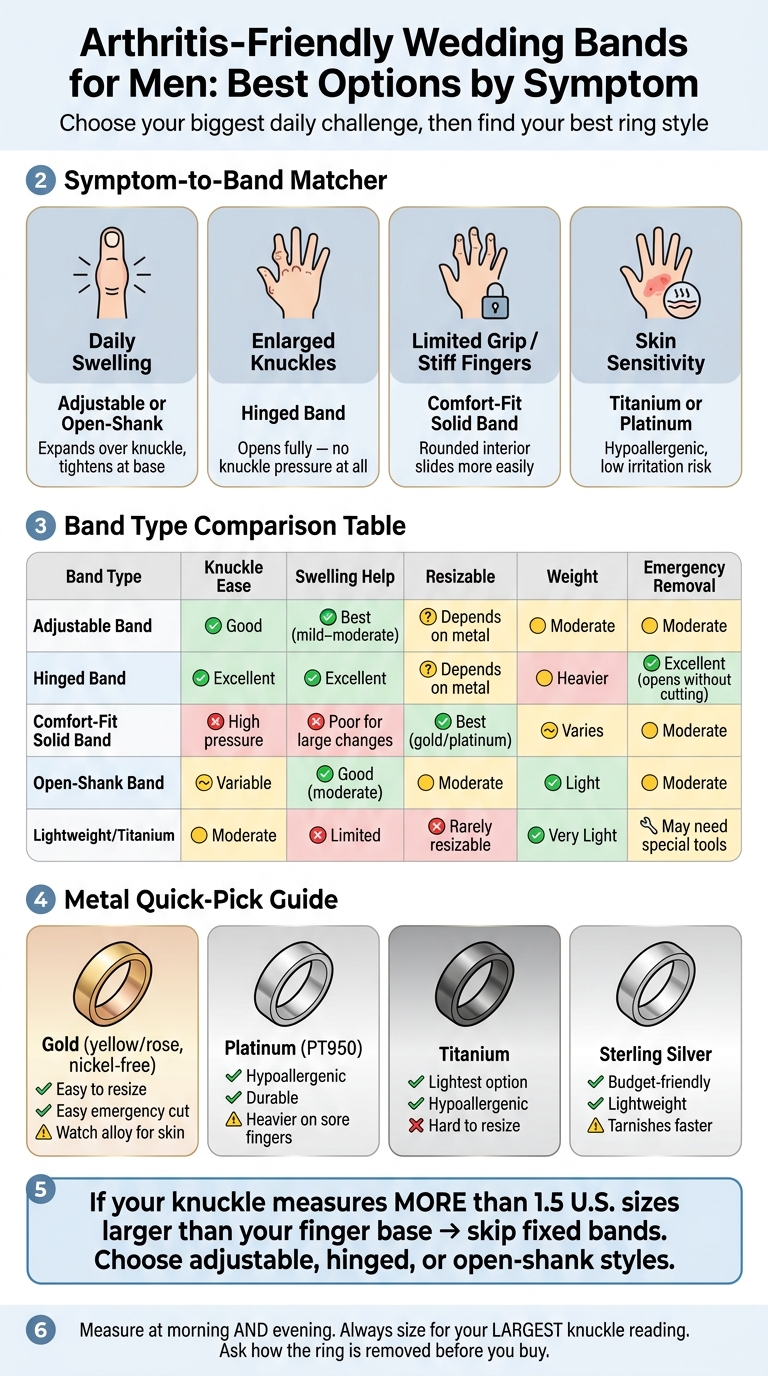
Arthritis-Friendly Wedding Bands for Men: Best Options by Symptom
Use your base and knuckle measurements to pick the band structure that puts the fewest limits on your hand. Size matters, but structure matters just as much. An arthritis-friendly ring that helps with swelling may do very little for grip issues, and a ring that clears a large knuckle may still be annoying to handle every day.
Adjustable, Resizable, and Open-Shank Bands for Fluctuating Finger Size
If your finger size changes during the day, a fixed ring is going to feel off sooner or later. Adjustable sliding bands use a hidden mechanism that lets one end of the band slide inside the other. That way, the ring can open enough to get over a larger knuckle, then tighten back down at the smaller finger base.
From the front, it still looks like a plain wedding band because the gap sits at the back of the finger. Open-shank bands work a bit differently. They use a small gap or overlap that can be widened or pressed in to handle moderate swelling. For people who deal with flare-ups, that can mean the difference between wearing a ring comfortably and not wearing one at all.
If you expect to change the fit often, a hinged band may make more sense.
Hinged and Openable Bands for Enlarged Knuckles and Limited Dexterity
A hinged band is often easier when the knuckle is much larger than the finger base. These rings act more like a small bracelet than a fixed band. A hinge on one side of the shank and a clasp on the other let the ring swing fully open, move past the knuckle, and then lock shut once it's sitting where it should - at the finger base, not stretched to fit the knuckle. Some hinged systems can open as much as 3 to 3.5 sizes beyond their closed size.
The catch, no pun intended, is the clasp itself. It needs to be simple enough to use with stiff fingers and secure enough to stay closed through daily wear. If the latch is tiny or awkward, it can turn into a bigger hassle than the knuckle issue it was meant to fix.
Before you buy, test the opening and closing motion several times. If possible, do it when your hands feel stiff. That gives you a much better sense of whether you can manage it on your own. Hinged bands also have moving parts, and moving parts need care. Debris can build up in the mechanism, so regular cleaning and jeweler checkups are part of owning one. It’s also smart to ask whether the hinge is covered by a warranty and whether local service is available.
What you want is pretty simple: a band that opens without a fight, locks shut with confidence, and still feels like a wedding band.
Comfort-Fit Interiors, Smooth Edges, and Lightweight Profiles
The mechanism gets most of the attention, but the inside shape of the band has a big effect on comfort. A comfort-fit interior has a rounded, domed inner surface instead of a flat inside wall. That shape cuts down on drag when the ring moves over a knuckle and spreads contact more evenly across the finger.
Comfort-fit bands can also feel a bit roomier than flat-interior rings with the same labeled size, especially once you get past about 6 mm in width. For many people, a 6 to 7 mm comfort-fit band gives a good middle ground between stability and easier gripping. Once you get to 8 mm or more, the band can feel heavier and add torque at the joint, which may make it less comfortable over a full day. Lighter bands tend to reduce hand fatigue, and rounded, deburred edges help limit pressure on swollen skin.
How to Compare Metals and Features Before You Buy
Once you've settled on the band shape, the metal becomes the next big decision. It affects comfort, whether the ring can be resized later, and how easy it is to remove in an emergency. A ring might technically fit, but that’s not the whole story. You also want to know how it feels on swollen skin and whether a jeweler can work on it down the road.
Skin-Friendly Metals: Titanium, Platinum, Gold, and Sterling Silver
Arthritis can make fingers more sensitive because of chronic inflammation, reduced blood flow, or medications that thin the skin. That’s why metal choice matters more than many people expect.
Titanium is often a good pick for sensitive or thinning skin. It’s also one of the lightest metals you can choose, which can make a difference when your fingers are already sore.
Platinum, including PT950, is naturally hypoallergenic and very durable. The tradeoff is weight. It has a denser, heavier feel, and some men notice that more when their fingers are swollen or tender.
If you want gold, go with 14K or 18K yellow or rose gold with a nickel-free alloy blend. That lowers the chance of skin irritation. White gold can contain nickel, and if the rhodium plating wears off, the metal underneath may touch your skin.
Sterling silver is light and budget-friendly, but it scratches and tarnishes faster. So while it may look good at first, it usually needs more care over time.
Resizing Limits, Upkeep, and Emergency Removal
Gold and platinum are the easiest metals to resize, usually by one to two sizes. That makes them a safer bet if your finger size may change.
Titanium is much less flexible in that sense. Its hardness makes standard resizing difficult or impossible for many jewelry shops, so a major size change often means replacing the ring instead. If you’re leaning toward titanium, check the seller’s exchange or replacement policy before you buy. That small detail can save a lot of hassle later.
White gold also comes with some upkeep. It may need rhodium replating every 12 to 18 months, and U.S. jewelry shops commonly charge about $55 to $125 per service. If that plating gets thin and the alloy contains nickel, skin irritation may become more likely.
Hinged bands need occasional checks too. The hinge should open smoothly and close securely. If it gets rough or slightly out of line, the ring can become much harder to handle, especially if grip strength is limited.
Emergency removal matters too, and not all metals behave the same way. Gold and sterling silver can usually be cut pretty fast. Platinum takes more effort, and titanium may need specialized tools. That’s one reason hinged bands stand out: if the hinge still works, the ring may open without being cut at all.
Comparison Table: Arthritis-Friendly Wedding Band Options Side by Side
Use the table below to match the band material and design to the issue you need to solve first.
| Band Type | Knuckle Pressure | Ease of On/Off | Works with Swelling | Easy to Resize | Weight | Skin-Friendliness | Classic Look |
|---|---|---|---|---|---|---|---|
| Adjustable Bands | Good; mechanism spreads load more evenly than a fixed band | Good to excellent; expands over the knuckle, then tightens at the base | Best for mild to moderate swelling | Depends on metal; gold/platinum versions are usually modifiable, titanium often is not | Moderate (varies by metal) | Good if the alloy is nickel-free | Classic when the mechanism is hidden |
| Hinged Bands | Excellent; ring opens fully, so there's no knuckle pressure during on/off | Excellent; best for enlarged knuckles and limited grip | Excellent; opens fully to handle significant size changes | Depends on the metal and hinge construction; gold/platinum versions are often modifiable | Heavier because of the hinge | Good if made from hypoallergenic alloys | Visible hinge; less seamless |
| Comfort-Fit Solid Bands | High; domed interior spreads contact evenly across the finger | Moderate; slides more easily than a flat-interior band, but still must pass over the knuckle | Poor for large fluctuations; usually needs bench resizing | Best long-term option in gold or platinum; typically up to 1–2 sizes | Varies by metal | High if the alloy is nickel-free or platinum | Most traditional appearance |
| Open-Shank Designs | Variable; the gap at the base reduces underside pressure | Moderate; the gap gives slight flex | Good for moderate swelling; limited range | Moderate; some adjustment is possible by a jeweler | Generally lightweight | High if a hypoallergenic alloy is used | Can look modern depending on how visible the opening is |
| Lightweight Options | Moderate; lower overall load on the finger | Moderate; still has to pass over the knuckle | Limited without an adjustable mechanism | Titanium is generally not resizable; narrow gold usually is | Very light | High; titanium is generally well tolerated, and gold depends on the alloy | Classic silhouette |
Conclusion: Match the Band to Your Symptoms and Daily Life
After looking at the options side by side, choose in this order: widest fit, safe removal, band design, then metal.
Start with your knuckle measurement, not your base size. Measure both the base of your finger and the widest part of your knuckle, then use the larger number as your guide.
Next, match the ring style to the symptom that gives you the most trouble. If swelling happens often, look at adjustable or open-shank bands. If your knuckles are enlarged, hinged designs usually make more sense. If grip is limited, smooth comfort-fit interiors tend to feel easier to wear.
Then pick the metal based on wear, resizing, and removal. Gold or sterling silver are usually easier to resize and cut off in an emergency. Platinum is a solid pick for long-term wear and is often a good choice for sensitive skin. Titanium is the lightest option and has a strong hypoallergenic profile. Before you buy, make sure you know exactly how the ring would be removed in an emergency.
The right design can help you keep that classic look without giving up comfort or safety.
FAQs
How do I know if I need a hinged ring instead of a standard band?
Consider a hinged ring if your knuckles are much larger than the base of your finger, or if sliding a ring over the joint hurts because of grip limits.
A standard resizable band opens up enough to get past the knuckle, then tightens at the base of the finger. A hinged ring works a bit differently: it opens all the way, so you can place it on your finger without having to slide it over the joint.
What ring metal is best for sensitive skin?
For sensitive skin, stick with hypoallergenic metals like platinum or titanium. Platinum is naturally hypoallergenic and holds up well to daily wear. Titanium is also a safe pick and is often less likely to irritate sensitive or inflamed skin.
If you want gold, go with higher-carat solid gold, such as 14K. It usually means less contact with alloy metals than plated vermeil, which matters in arthritis designs that open and close often.
Can an arthritis-friendly wedding band still look traditional?
Yes. An arthritis-friendly wedding band can still look classic. Many newer designs use hidden adjustable features that help with swelling or shifts in finger size, without changing how the band looks on the outside.
They also come in classic materials like gold and platinum, so you don’t have to trade a timeless style for comfort.


